
 Micro-oscillations in positive and negative affect during competitive laboratory cycle time trials - a preliminary study
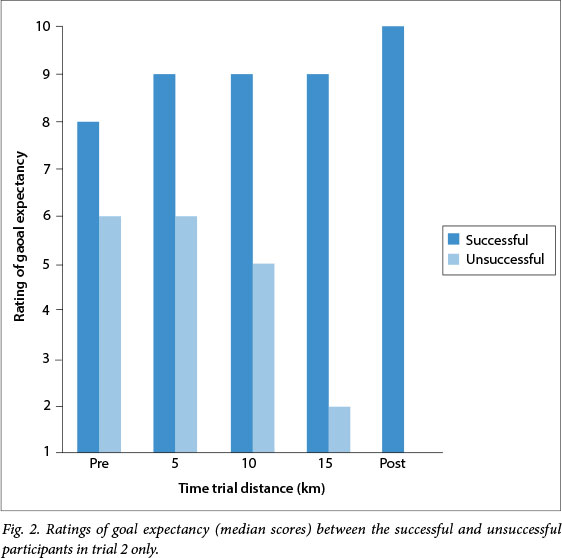
BACKGROUND: By incorporating pre-performance or retrospective recall measurement methods, research has shown positive (PA) and negative affect (NA) to operate as both a precursor to, and as a consequence of performance in line with goal achievement. The extent of this affective change within sport is unclear, as measurement of affect within acute settings has yet to be adopted fully. OBJECTIVE: To conduct exploratory research examining affect and goal achievement during self-paced cycling to understand further their role during performance. METHODS: The positive and negative affect schedule (PANAS), Worcester affect scale (WAS) and ratings of goal achievement were completed by seven trained cyclists prior to two separate 20 km laboratory time trials. The WAS and ratings of goal achievement were also rated during each trial. RESULTS: Micro-oscillations in affect occurred throughout time trials and to a greater degree where participants were unsuccessful in reaching their goals. Successful trials were characterised by higher PA (p=0.000) and lower NA (p=0.000), with higher goal expectations from the start (p=0.008). CONCLUSION: In unsuccessful trials, an overly aggressive start, perhaps due to inaccurate goal setting, led to an inability to maintain performance, with reductions in power output. Further clarification of the catalyst to the performance demise requires a parallel analysis of psychological and physiological parameters. In so doing, a greater understanding of the combined role of affect and goal expectation in pacing and performance will ensue; a benefit to both cyclist and coach alike.
 Thumbnail
The South African Sports Medicine Association
South African Sports Medicine Association, Research Unit for Exercise Science & Sports Medicine (ESSM), PO Box 115, Newlands, University of Cape Town, Cape Town, Western Cape, ZA, 7725, Tel: +27 21 650 4558 -
E-mail: mike.lambert@uct.ac.za