
 Effect of caffeine ingestion on fluid balance during exercise in the heat and during recovery
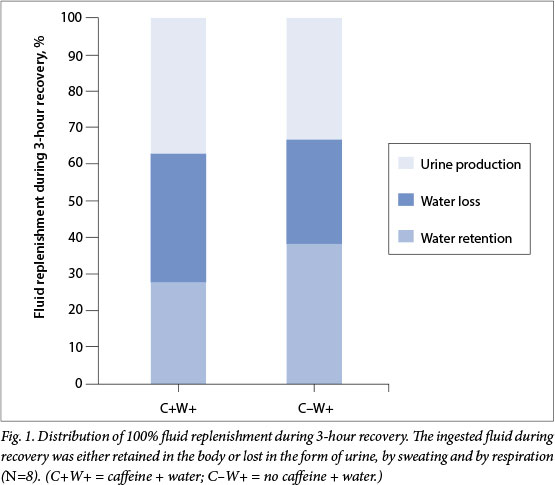
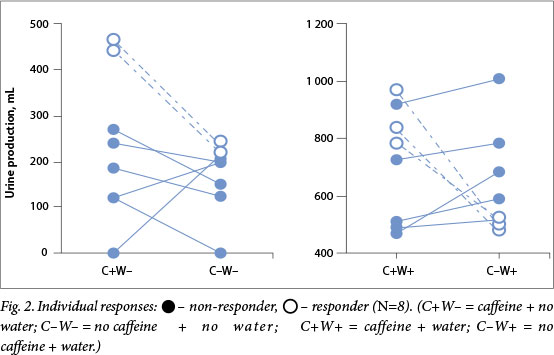
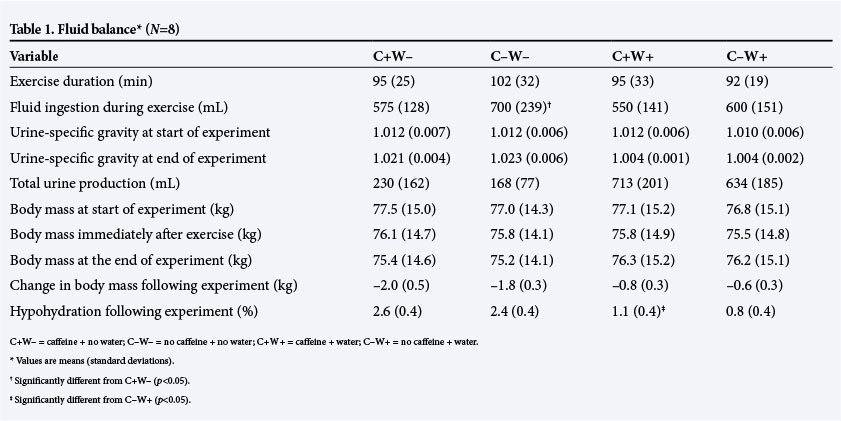
BACKGROUND: The effect of ingestion of a common stimulant, caffeine, on fluid balance during exercise and recovery is not fully known. OBJECTIVES: To determine the effect of caffeine on fluid balance during exercise in the heat and during a 3-hour recovery period thereafter. METHODS: In a randomised, controlled design, caffeine-naive participants (N=8) pedalled on a bike to achieve 2.5% baseline body mass loss in a hot environment in four separate conditions: with (C+) or without (C-) caffeine ingestion (6 mg/kg of body mass) prior to exercise, followed by (W+) or without (W-) 100% fluid replenishment (water) of the body mass loss during a 3-hour recovery period (yielding C+W+, C+W-, C-W+ and C-W-, respectively). RESULTS: Mean (standard deviation) urine production was not different (p>0.05) regardless of rehydration status: 230 (162) mL (C+W-) v. 168 (77) mL (C-W-); and 713 (201) mL (C+W+) v. 634 (185) mL (C-W+). For the 3-hour recovery, caffeine ingestion caused higher hypohydration during rehydration conditions (p=0.02), but practically the mean difference in the loss of body mass was only 0.2 kg. CONCLUSION: In practical terms, there was no evidence that caffeine ingestion in moderation would impair fluid balance during prolonged exercise in the heat or during 3 hours of recovery.
 Thumbnail
 Thumbnail
The South African Sports Medicine Association
South African Sports Medicine Association, Research Unit for Exercise Science & Sports Medicine (ESSM), PO Box 115, Newlands, University of Cape Town, Cape Town, Western Cape, ZA, 7725, Tel: +27 21 650 4558 -
E-mail: mike.lambert@uct.ac.za