The point prevalence of South African male soccer players' injuries in the Gauteng province
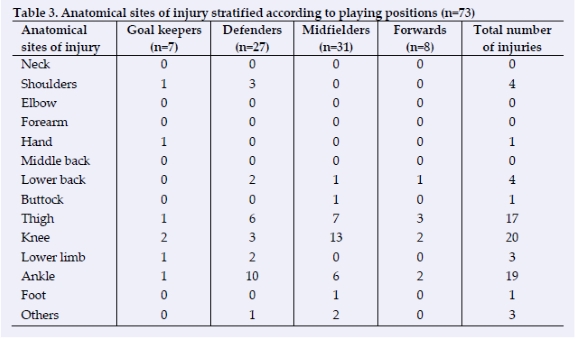
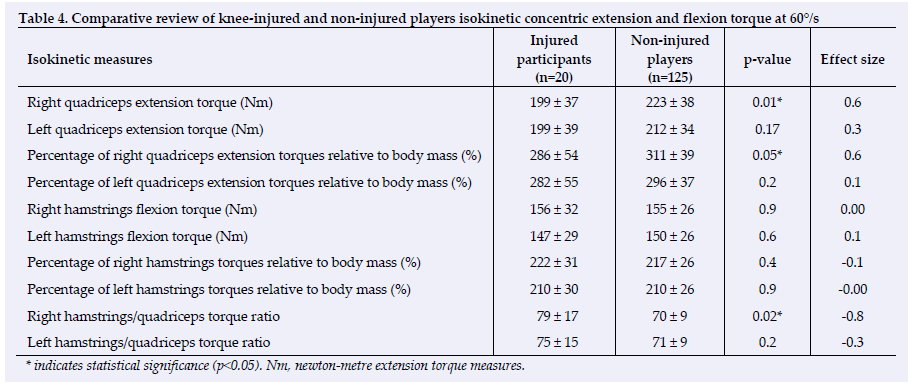
BACKGROUND: The ever-evolving game of soccer is a complex physical contact team sport, exposing its participants to injury. OBJECTIVES: To identify the point prevalence of soccer injuries among young amateur, semi-professional, and professional South African male soccer players. METHODS: The participation of male amateur (n=54), semi-professional (n=34), and professional (n=57) players provided a cross-sectional overview of the nature of the most predominant types and anatomical sites of injuries affecting soccer players (average age 23.9±4.7 years). All participants completed the Fuller soccer injury questionnaire, ISAK somatotype profiling and knee flexion/extension isokinetic concentric peak torque (Nm) evaluations at 60°/s. RESULTS: Fifty per cent of the players sustained soccer injuries (X2=0.9). Knee (20%) and ankle (19%) were the most vulnerable sites (X2=0.00001). Knee-injured players' right quadriceps torque (199±37 vs 223±38 Nm) and percentage right quadriceps torque relative to body mass (286±54 vs 311 ±39%) was significantly weaker than the non-injured players (p<0.01). The injured players' right hamstrings/quadriceps (H/Q) torque ratio further significantly differed from the non-injured players' H/Q torque ratios (79±17 vs 70±9%) (p<0.01). CONCLUSION: Male soccer players experience neuro-musculoskeletal injuries, with their knees and ankles being the most vulnerable. Knee-injured players had weaker quadriceps isokinetic strength than non-injured players.
knee; isokinetic; training history; body composition