The relationships between rugby ground pass accuracy and kinematic variables resulting from two different pelvic orientations
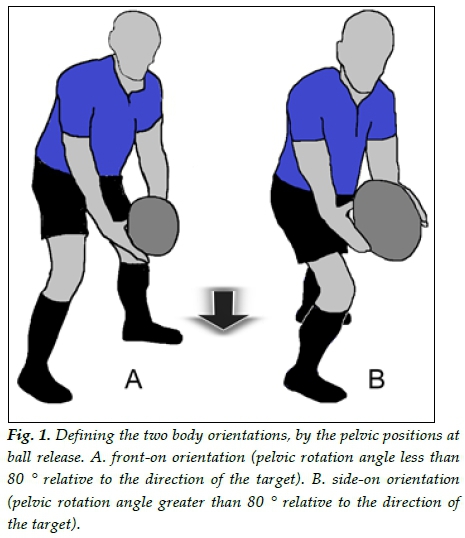
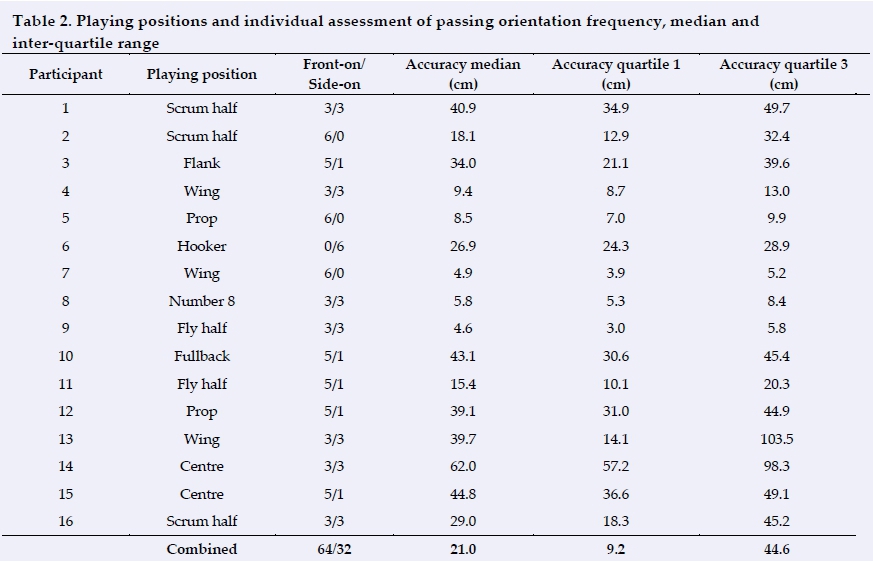
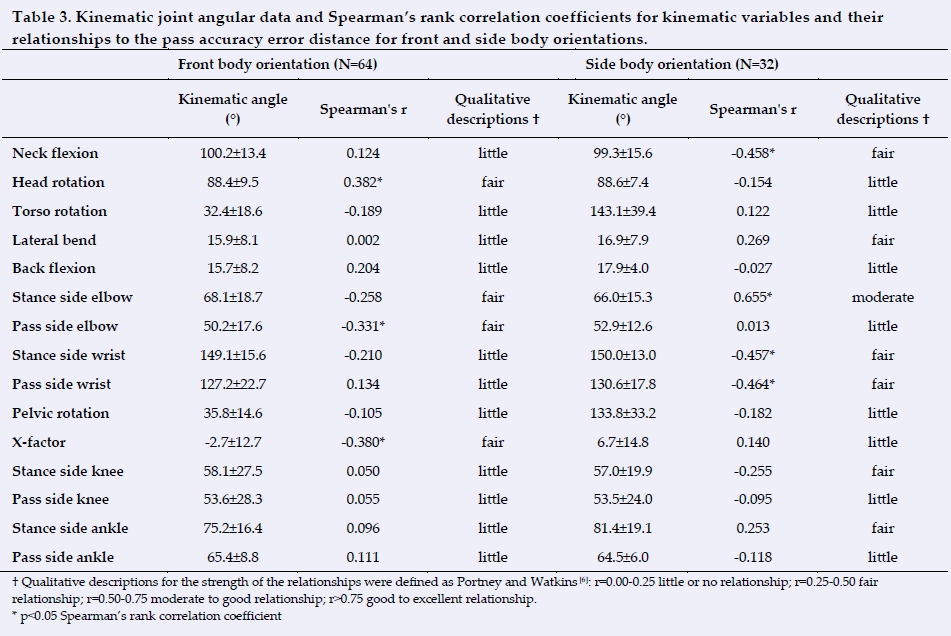
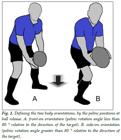
INTRODUCTION: Despite having been largely understudied, one of the crucial components of a team's success in rugby is accurate passing. This study identified biomechanical correlates of the rugby ground pass and accuracy performance. METHODS: Sixteen club players (height 1.77+0.04 m; mass 86.8+16.8 kg) undertook a combined total of 96 passes and their respective body kinematics were analysed concurrent with measurements of pass accuracy at 10 m. Two distinct types of body orientations were found to be utilised by the players: a side-on orientation (pelvic rotation >80 °) and a front-on orientation (pelvic rotation <80 °. RESULTS: Side-on body orientation passes were more accurate than front-on body orientation passes (p<0.0001). Fair relationships were present between the pass accuracy and upper body and hip kinematics for the two distinct body orientations individually. However, no common relationships were observed between the different orientations. CONCLUSION: Therefore different strategies exist within players to perform the ground pass with varying grades of accuracy.
biomechanics; direct measurement
 Thumbnail