A comparison of drought stress and heat stress in the leaves and tubers of 12 potato cultivars
Abstract
Potato yield is extremely sensitive to drought and heat stress, but there are variations in the degree to which cultivars are affected by these stresses. Strategies for the selection of stress-tolerant cultivars in a breeding programme can therefore be developed. The 2,3,5-triphenyltetrazolium chloride viability assay was evaluated to estimate drought and heat tolerance of leaves and tubers of 12 potato cultivars which differ in their response to drought. Floating leaf discs and tuber slices in 0.5 M mannitol (-1.24 MPa) simulated drought. After the drought acclimation treatment, the leaf discs were subjected to a lethal drought stress by exposure to an osmotic potential of -2.48 MPa. The viability of the leaf discs after the drought treatment was estimated spectrophotometrically by measuring the formazan concentration at 485 nm. Lower absorbance values in the control treatment, compared with the stress treatment, indicated a tolerant reaction. As drought simulation in the laboratory can differ from field conditions due to the effect of heat stress, the cultivars were also evaluated for heat tolerance. A stress index was established which can assist breeders to distinguish between plant responses to heat and drought.
Introduction
Potato yield is optimal under growing conditions with adequate light, water and cool temperatures. According to Vayda,1
Several physiological methods have been devised to measure abiotic stress tolerance in crop plants. These include: regrowth,2345678et al.29101112131415
The TTC assay is based on the ability of viable cells to reduce tetrazolium salts metabolically into soluble formazans.1615315Brassica napus, with the vigorous lines having a higher capacity to reduce TTC than less performing lines.17
Van der Mescht, De Ronde and Rossouw1815
Materials and methods
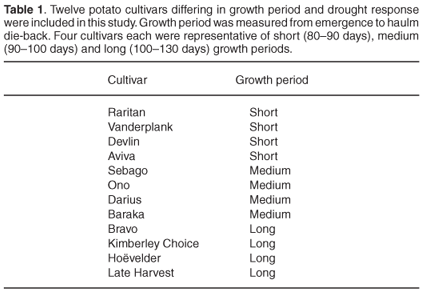
Plant material. Twelve potato cultivars (Table 1) were grown in a greenhouse under conditions as previously described by Van der Mescht et al.19
Induction of drought and heat stress. Leaf discs (7 mm in diameter) or tuber slices (4 mm in diameter and 2 mm wide) of the control treatments were incubated in a sodium hydrogen maleate buffer (pH 6.0) at 23°C for 3 hours.20159
TTC assay. The triphenyl formazan accumulation was measured spectrophotometrically at 485 nm as described by De Ronde et al.3
Results
Drought stress in leaves
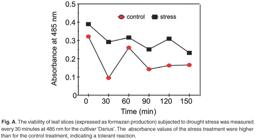
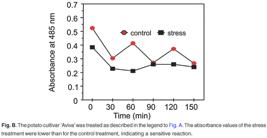
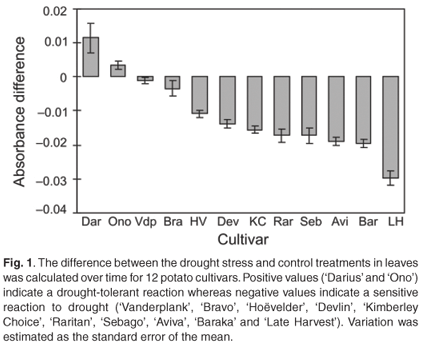
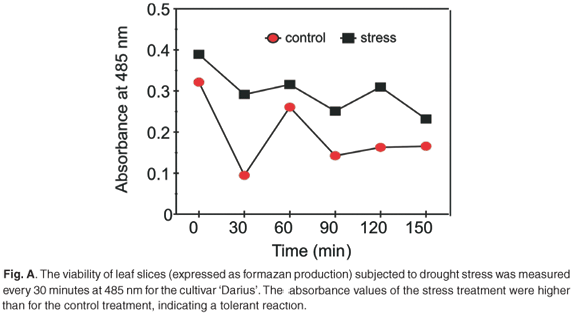
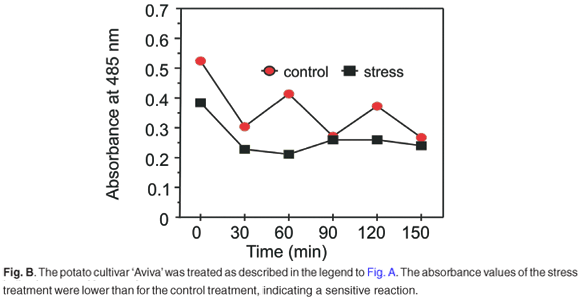
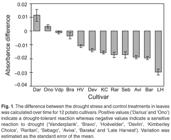
Viability was measured every 30 min over 150 min after the lethal stress was induced. The formazan concentrations were higher in the stress treatment than in the control treatment in the cultivars 'Darius' and 'Ono', indicating a tolerant reaction (see Fig. A in supplementary material online). In the sensitive reaction, the formazan concentrations over time were lower in the stress treatment compared to the control treatment. This was true for all the cultivars except 'Darius' and 'Ono' (see Fig. B in supplementary material online). The area between the graphs was estimated as the difference between the respective means of the stress and control treatments over time (Fig. 1).3Table 2).
Drought stress in tubers
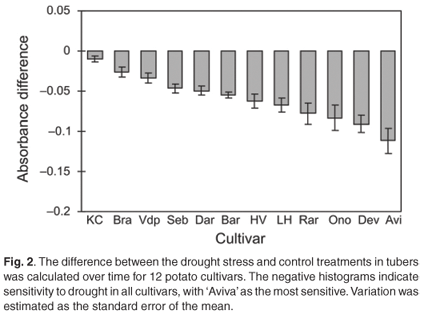
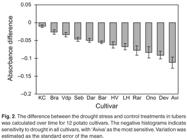
Tubers were subjected to osmotic stress as described for leaves. In contrast to the leaves, all the cultivars showed a sensitive reaction when tubers were used. The stress index was calculated (Fig. 2), ranking the cultivars from least sensitive to most sensitive. The cultivar 'Kimberley Choice' was least sensitive whereas 'Aviva' was most sensitive (Table 2). Additionally, the areas between the graphs were ten times larger than for leaves, an indication of tubers' hypersensitive reaction to drought.
Heat stress in leaves
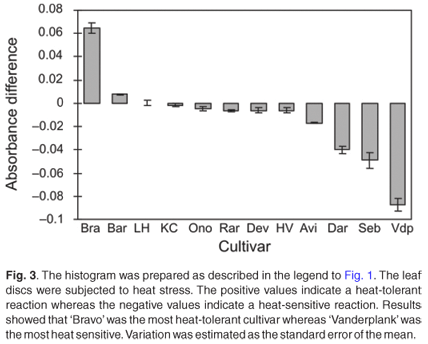
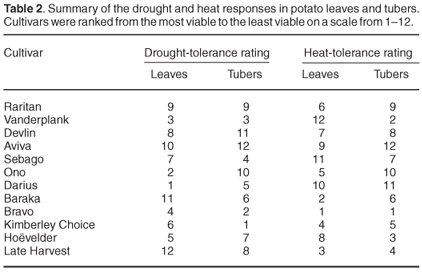
Leaf discs were subjected to a moderate stress of 37°C for 3 hours before a lethal stress of 45°C was induced. Viability was measured every 30 min for 3 hours after induction of the lethal stress. Heat-tolerant reactions were found in the cultivars 'Bravo', 'Baraka' and 'Late Harvest', whereas sensitive reactions were observed in the rest of the cultivars (Fig. 3). The stress index was calculated and indicated that 'Bravo' was most heat tolerant and 'Vanderplank' the most heat sensitive (Table 2).
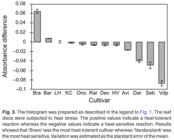
The cultivars were ranked according to the values of the difference between the mean of the stress treatments and the mean of the control treatments over time for each cultivar. The cultivar with the highest value was designated 1 and the cultivar with the lowest value 12.
Heat stress in tubers
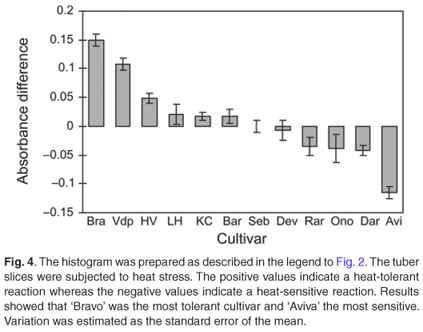
Potato tubers were subjected to heat stress as described for leaves. According to the histogram, the cultivars 'Bravo', 'Vanderplank', 'Hoëvelder', 'Late Harvest', 'Kimberley Choice', 'Baraka' and 'Sebago' showed tolerant reactions whereas cultivars 'Devlin', 'Raritan', 'Ono', 'Darius' and 'Aviva' showed sensitive reactions (Fig. 4). A stress index with 'Bravo' as most tolerant and 'Aviva' as most sensitive was calculated and presented in Table 2. As for tubers and leaves subjected to osmotic stress, the areas between the graphs of tubers subjected to heat stress were ten times higher than for leaves.
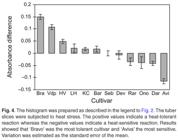
Discussion
The TTC assay measures the ability of plant tissue to carry out electron transport. Additionally, inhibition of TTC-reduction indicates dehydrogenase inactivation resulting in a decrease in formazan production.211722Table 2).
Potato leaves were more heat sensitive than tubers. According to Van der Mescht et al.,23Eucalyptus grandis clones2415Table 2), the relative rankings between leaves and tubers were similar in the cultivars 'Devlin', 'Darius', 'Bravo', 'Kimberley Choice' and 'Late Harvest'. Tubers were more sensitive to heat than leaves for the cultivars 'Raritan', 'Aviva', 'Ono' and 'Baraka', whereas leaves were more heat sensitive than tubers in the cultivars 'Vanderplank', 'Sebago' and 'Hoëvelder'.
Information about the correlation between heat and drought tolerance is of great economic value. It may be used to determine the best locality for a specific cultivar as well as for cultivar improvement in a breeding programme. The data in Table 2 are also an indication of the correlation between heat and drought tolerance. When leaves were evaluated, a negative correlation was found in the cultivars 'Vanderplank', 'Darius', 'Baraka' and 'Late Harvest'. The cultivars 'Vanderplank' and 'Darius' were relatively drought tolerant and heat sensitive whereas 'the cultivars 'Baraka' and 'Late Harvest' were relatively heat tolerant and drought sensitive. In the case of tubers, it was found that the cultivar 'Darius' was relatively drought tolerant and heat sensitive whereas 'Late Harvest' and 'Hoëvelder' were relatively heat tolerant and drought sensitive. Li et al.10
We conclude that heat and drought tolerance are organ and cultivar specific. In addition to our results on tubers that showed a hypersensitive reaction to drought, Shimshi and Susnoschi2612728
We are grateful to the Water Research Commission for financial support.
References
- 1. Vayda M.E. (1994). Environmental stress and its impact on potato yield. In Potato Genetics, eds J.E. Bradshaw and G.R. Mackay, pp. 239–261. CAB International and Cambridge University Press, Cambridge.
- 2. Ishikawa M., Robertson A.J. and Gusta L.V. (1995). Comparison of viability tests for assessing cross-adaptation to freezing, heat and salt stresses induced by abscisic acid in brome grass (Bromus inermis Legss) suspension cultured cells. Plant Sci. 107, 83–93.
- 3. De Ronde J.A., Van der Mescht A. and Cress W.A. (1995). The biochemical responses of six cotton cultivars to heat stress. S. Afr. J. Sci. 91, 363–366.
- 4. Chen P.M. and Gusta L.V. (1982). Cold acclimation of wheat and smooth bromegrass cell suspension. Can. J. Bot. 60, 1207–1211.
- 5. Larcher W. (1980). Physiological Plant Ecology, 2nd edn. Springer-Verlag, Berlin.
- 6. Palta J.P., Levitt J.L. and Stadelmann E.J. (1977). Freezing tolerance of onion bulbs and significance of freeze induced tissue infiltration. Cryobiology 14, 614–619.
- 7. Sukumaran V.P. and Weiser C.J. (1972). An excised leaflet test for evaluating potato frost tolerance. Hort. Sci. 7, 467–468.
- 8. Wiest S.C., Good G.L. and Steponkus P.L. (1976). Evaluation of root viability following freezing by the release of ninhydrin reactive compounds. Hort. Sci. 11, 197–199.
- 9. Zhang M.I.N., Willison J.H.M. and Hall S.A, (1993). Measurement of heat injury in plant tissue by using electrical impedance analysis. Can. J. Bot. 71, 1605–1611.
- 10. Li P.H., Huner N.P.A., Toivio-Kinnucan M., Chen H.H. and Palta J.P. (1981). Potato freezing injury and survival, and their relationships to other stress. Am. Potato J. 58, 15–29.
- 11. Vratsons D. and Rossouw F.T. (1991). Heat shock protein synthesis in Solanum tuberosum, an inter-cultivar comparison. S. Afr. J. Sci. 87, 442–446.
- 12. Jinn T-L., Chiu C-C., Song W-W., Chen Y-M. and Lin C-Y. (2004). Azetidine-induced accumulation of class i small heat shock proteins in the soluble fraction provides thermotolerance in soybean seedlings. Plant and Cell Physiol. 45(12), 1759–1767.
-
13. Hosseini R and Mulligan B.J. (2002). Application of rice (Oryza sativa L.) suspension culture in studying senescence in vitro (I). Single strand preferring nuclease activity. EJB Electronic Journal of Biotechnology 5(1), online at www.ejb. org/content/vol5/issue1/full/8
» www.ejb. org/content/vol5/issue1/full/8 - 14. Verleysen H., Samyn G., Van Bockstaele E. and Debergh P. (2004). Evaluation of analytical techniques to predict viability after cryopreservation. Plant Cell, Tissue and Organ Culture 77(1), 11–21.
- 15. De Ronde J.A. and Van der Mescht A. (1997). Utilization of 2,3,5-triphenyltetrazolium chloride reduction as a measure of the interaction between drought tolerance simulation and heat tolerance in cotton. S. Afr. J. Sci. 93, 431–433.
- 16. Berridge M.V., Tan A.S., McCoy K.D. and Wang R. (1967). The biochemical and cellular basis of cell proliferation assays that use tetrazolium salts. Plant Physiol. 42, 1423–1426.
- 17. De Block M. and De Brouwer D. (2002). A simple and robust in vitro assay to quantify the vigour of oilseed rape lines and hybrids Plant Physiol, Biochem. 40(10), 845–852.
- 18. Van der Mescht A., De Ronde J.A. and Rossouw F.T. (1993). Drought related protein synthesis is cultivar and organ specific in potato. J. S. Afr. Soc. Hort. Sci. 3(2), 97–101.
- 19. Van der Mescht A., Visser A.F., De Ronde J.A. and Vorster H.J. (1992). Protein profiles during drought stress in potato. J. S. Afr. Soc. Hort. Sci 2(1), 55–57.
- 20. McKenzie H.A., (1969). pH, buffers and physiological media. In Data for Biochemical Research, eds R.M.C. Dawson, D.C. Elliot, W.H. Elliot and K.M. Jones, 2nd edn. Clarendon Press, Oxford.
- 21. Chen H.H., Shen Z.Y. and Li P.H. (1982). Adaptability of crop plants to high temperature stress. Crop Sci. 22, 719–725.
- 22. Rich P.R., Mischis L.A., Purton S. and Wiskich J.T. (2001). The sites of interaction of triphenyltetrazolium chloride with mitochondrial respiratory chains. FEMS Microbiol. Lett. 202(2), 181–187.
- 23. Van der Mescht A., De Ronde J.A. and Rossouw F. T. (1998). Superoxide dismutase, glutathione reductase and ascorbate peroxidase levels during drought stress in potato. S. Afr. J. Sci. 94, 496–498.
- 24. Van der Merwe T., Van Staden L., Van der Mescht A. and Laurie R. (1997). Evaluation of 2,3,5-triphenyltetrazolium chloride reduction as a measure of heat- and drought tolerance in Eucalyptus grandis. IUFRO Conference on Silviculture and Improvement of Eucalypts 4, 112–116.
- 25. Steyn J.M., Du Plessis H.F., Fourie P. and Hammes P.S. (1998). Yield response of potato genotypes to different soil water regimes in contrasting seasons of a subtropical climate. Potato Res. 41, 239–254
- 26. Shimshi D. and Susnoschi M. (1985). Growth and yield studies of potato development in a semi-arid region. 3. Effect of water stress and amounts of nitrogen top dressing on physiological indices and on tuber yield and quality of several cultivars. Potato Res. 28, 177–191.
- 27. Ogren E. (1990). Evaluation of chlorophyll fluorescence as a probe for drought stress in willow leaves. Plant Physiol. 93, 1280–1285.
- 28. Walter M.H. (1989). The induction of phenylpropanoid biosynthetic enzymes by ultraviolet light or fungal elicitor in cultured parsley cells is overridden by a heat-shock treatment. Planta 177, 1–8.
* Author for correspondence. E-mail: