Indigenous knowledge systems and science education
Abstract
SIGNIFICANCE: The inclusion of indigenous knowledge into the curricula of natural science courses remains contentious. In this paper I use critical realism to show the relationship between these two forms of knowledge. An engagement with both knowledge structures could afford better pedagogy and assessment. In addition, the engagement with indigenous knowledge allows for the development of 'knower awareness' in the practice of science. Meaningful engagement with indigenous knowledge could therefore enhance science education, whilst making visible the socio-cultural relevance to students.
indigenous knowledge systems; science education; critical realism
Introduction
For nearly 20 years South Africa has had a formal indigenous knowledge policy.1,2
Most academics in the natural sciences presumed the call of decolonisation to be irrelevant to their disciplines until the #ScienceMustFall video went viral.34
I begin then with an exploration of knowledge and curricula, drawing on the work of Basil Bernstein. Bernstein's work on pedagogy and curricula has been used extensively in academic development work across South African universities.56
Approaches
In the intervening period, there have been multiple attempts to respond to the call for decolonisation by recognising South African knowledge in different ways. Some efforts are focused on widening what Bernstein terms the 'field of production'.67
A second approach is to facilitate communication and knowledge transfer between academic scientists and local communities. This approach falls under transdisciplinary research approaches. "Transdisciplinary research seeks to integrate diverse knowledge from academic and non-academic actors to co-produce knowledge or solution options while reconciling values and preferences, and creating ownership for problems as well as solutions."896
A third approach is to incorporate indigenous knowledge directly into the curriculum. This sits in Bernstein's 'field of reproduction'.610
What is the imperative?
The intention of the inclusion of IKS into science curricula is to valourise these traditional ways of knowing and thereby foreground the wisdom held in the indigenous peoples of South Africa.11121113
However, the inclusion of IKS into a science curriculum must be done with some care. One needs to recognise that the knowledge structures of IKS and Western science are not necessarily the same. Incorporating ethnobotany such as a module on wild edible plants in a botany course14 umqombothi, is a chemical process, but the molecular understanding is not a part of the indigenous knowledge and this needs to be actively connected to chemistry if it is to be incorporated into a science curriculum.15
In order to ensure that IKS is appropriately incorporated into a science curriculum, one must consider the different kinds of knowledge. Carefully thinking this through allows for two important points: (1) We see that IKS and Western science are interrelated but are not the same thing. Careful observation and clear communication are essential to both. (2) We see that Western science in its quest for objectivity and reproducibility has failed to give sufficient attention to the particularity of the person who first develops an experiment to investigate a particular phenomenon.
Critical realism offers a useful perspective
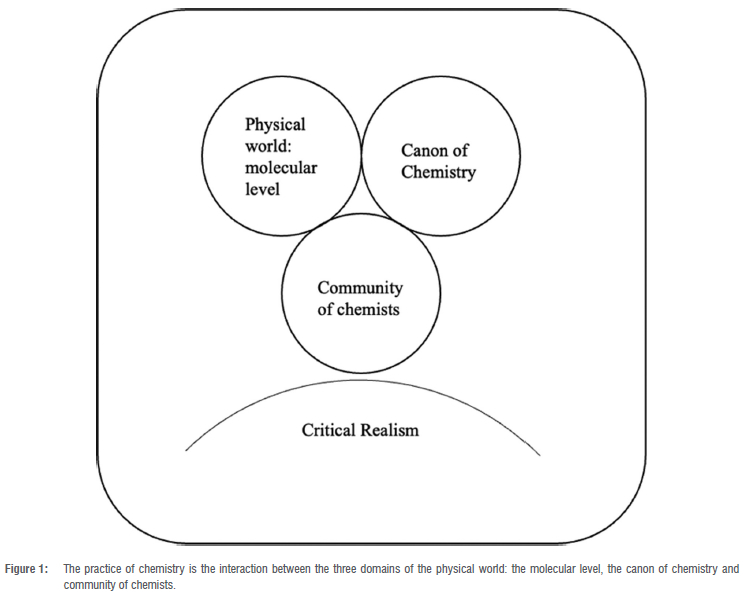
Critical realism offers a way to explore the relationship between Western science and traditional knowledge systems. Blackie1617Figure 1). The first domain is the physical world at the level of the molecular. The second is the 'canon of chemistry' - the knowledge field, that we know as the subject of chemistry, provides conceptual understanding to explain the real mechanisms and entities which give rise to changes at a molecular level. The third is the community of chemists. Because the science offers a conceptual explanation of real mechanisms which exist in the physical world, the fact that the concepts are socially constructed is frequently overlooked. In the physical sciences, the interrogation of the system to establish the causal mechanism takes place by closing the system. In chemistry, this closure is achieved through the use of specialist glassware. The scientist is not the passive observer of the system, rather they are an active agent in the design of the experiment, such that a single mechanism or sequence of mechanisms is isolated.16
However, Level 2 of 'chemistry as science'16how to do a particular reaction, one must have a conceptual explanation for why the reaction is happening. Level 2 is built from combining and probing various Level 1 activities. For example, across the globe we have evidence of indigenous cultures having the technology to isolate the metal we know as iron from iron ore using a process of applying heat in a clay furnace. That is a Level 1 activity. It is only with the development of the science of chemistry that we can say that what is happening at a molecular level is the reduction of iron oxide using carbon from burning wood. The heat combined with restricted supplies of oxygen means that the oxygen is removed from the iron oxide to form carbon dioxide and iron. The development of the periodic table and the discovery of oxygen as a component of air was required before the explanation was possible. The discovery of oxygen was only possible once the substantially more accurate spring balance was invented and the art of glass blowing was refined. These two technologies were necessary to make possible the kinds of experiments needed to discover the nature of what previously had been described as 'phlogiston'. The accuracy of measurement of mass and isolation of gases could have been achieved through the creation of other technologies. Nonetheless, to our knowledge, there is no evidence of any indigenous culture creating equivalent technologies and so there is no indigenous molecular explanation.
It is on this foundation that I argue that indigenous knowledge and Western science are related but not interchangeable. In some sciences there may be a Level 2 equivalent in the indigenous knowledge system; it depends on the nature of the science and the dependence of the science on accurate measurement. Thus, when one is trying to combine IKS and Western science, one must be clear about what the Level 2 part of the science is and determine whether there is an IKS equivalent. Similarly, in some sciences, there may be large parts of the science that are still at Level 1. In such instances, IKS can be used alongside Western science. If the call for decolonisation is to decentre Western science, then one might argue that foregrounding the IKS when the science is primarily at Level 1 is the correct approach. However, when one is teaching chemistry, which is primarily at Level 2, to foreground IKS as equivalent to chemistry is inaccurate and misleading.
Making the knower visible
As has been stated earlier, one of the arguments against considering decolonisation of tertiary science higher has been the notion that 'science is objective'.31810-1210
However, there is always a particular person bringing together a particular set of ideas to interrogate a particular phenomenon. Blackie and Adendorff18191819
Conclusion
There is a huge opportunity to develop resources which adequately honour indigenous ways of knowing and being. Nonetheless, bringing indigenous knowledge into a science course needs careful thought. The person teaching must pay careful attention to the knowledge structure of their field and of the particular section of work being taught and the knowledge structure of the indigenous knowledge they intend to incorporate. The indigenous knowledge must be connected at the appropriate level. Because of this requirement, the pedagogy of science could well be improved by engagement with IKS in two ways. Firstly, the need to focus on the knowledge structures could facilitate more meaningful assessment.20
It is also profoundly useful that an unexpected asset can be brought to science in the form of developing knower awareness. Knower awareness is an essential first step to the recognition that scientific knowledge can be used to different ends. Not all of these ends will be ethical and not all exploration of scientific questions is appropriate. Bringing to light the motivations of the person of the scientist is important. I believe that our practice of science can be enriched by intentional and careful incorporation of IKS into the knowledge project at all levels. This does not mean that IKS should be incorporated into every course.
Competing interests
I have no competing interests to declare.
References
-
1. Green L. Beyond South Africa's 'indigenous knowledge - science' wars. S Afr J Sci. 2012;108(7/8), Art. #631. https://doi.org/10.4102/sajs.v108i7/8.631
» https://doi.org/10.4102/sajs.v108i7/8.631 - 2. Masoga M. South African research in indigenous knowledge systems and challenges of change. Indilinga Afr J Indig Knowl Syst. 2005;4(1):15-30.
- 3. Adendorff H, Blackie MAL. Decolonizing the science curriculum. In: Winberg C, McKenna S, Wilmot K, editors. Building knowledge in higher education: Enhancing teaching and learning with Legitimation Code Theory. London: Routledge; 2020. p. 237-254.
-
4. Blackie MAL. Implications of a critical realism approach to chemistry research and education. Nat Chem. 2023;15(8):1047-1050. https://doi.org/10.1038/s41557-023-01274-2
» https://doi.org/10.1038/s41557-023-01274-2 -
5. Luckett K, Blackie MAL. Beyond epistemology: The challenge of reconceptualising knowledge in higher education. Teach High Educ. 2022; 27(8):1018-1026. https://doi.org/10.1080/13562517.2022.2111206
» https://doi.org/10.1080/13562517.2022.2111206 - 6. Bernstein B. Pedagogy, symbolic control and identity: Theory, research and critique. London & New York: Taylor & Francis; 1996.
- 7. Manyevere A, Mnkeni PNS, Laker MC, Muchaonyerwa F! The use of indigenous knowledge systems in soil classification, appraisal and soil productivity rating for maize cropping: A case of the Xhosa speaking people in Raymond Mhlaba Municipality, South Africa. Indilinga Afr J Indig Knowl Syst. 2020;19(1):96-109.
-
8. Sellberg MM, Cockburn J, Holden PB, Lam DPM. Towards a caring transdisciplinary research practice: Navigating science, society and self. Ecosyst People. 2021;17(1):292-305. https://doi.org/10.1080/26395916.2021.1931452
» https://doi.org/10.1080/26395916.2021.1931452 -
9. Cockburn JJ, Khumalo-Seegelken B, Villet MH. IziNambuzane: IsiZulu names for insects. S Afr J Sci. 2014;110(9/10), Art. #2013-0292. https://.doi.org/10.1590/sajs.2014/20130292
» https://.doi.org/10.1590/sajs.2014/20130292 - 10. Mateus V, Ngcoza KM. The making of clay pots and its relevance to school science: Reclaiming knowledge in the cultural practice of Ovawambo people in Namibia. Indilinga Afr J Indig Knowl Syst. 2019;18(1):64-77.
-
11. Naidoo PD, Vithal R. Teacher approaches to introducing indigenous knowledge in school science classrooms. Afr J Res Math Sci Technol Educ. 2014;18(3):253-263. https://doi.org/10.1080/10288457.2014.956407
» https://doi.org/10.1080/10288457.2014.956407 -
12. Onwu GOM, Mufundirwa C. A two-eyed seeing context-based approach for incorporating indigenous knowledge into school science teaching. Afr J Res Math Sci Technol Educ. 2020;24(2):229-240. https://doi.org/10.1080/18117295.2020.1816700
» https://doi.org/10.1080/18117295.2020.1816700 -
13. Blackie MAL. Diversity is an asset to science not a threat. Int J Crit Divers Stud. 2021;4(2):96-113. https://doi.org/10.13169/intecritdivestud.4.2.0096
» https://doi.org/10.13169/intecritdivestud.4.2.0096 - 14. Cimi PV Ngcoza K, Dold T. The role of ethnobotany in integrating indigenous knowledge in the discipline of science education: A study by the Herbarium of the Albany Museum in South Africa. S Afr Mus Assoc Bull. 2020;42(1):1-8.
- 15. Mutanho C. Exploring indiginising the university's science curriculum through bottom-up decolonisation: Affordances and hindrances [PhD thesis]. Makhanda: Rhodes University; 2021.
-
16. Blackie MAL. An examination of the practice of chemistry through the lens of critical realism. J Crit Realism. 2022;21(4):401-415. https://doi.org/10.1080.14767430.2022.2069333
» https://doi.org/10.1080.14767430.2022.2069333 - 17. Bhaskar R. A realist theory of science. London: Routledge; 1978.
-
18. Blackie MAL, Adendorff H. A decolonial science education: How do we move forward? In: Hlatshwayo MN, Adendorff H, Blackie MAL, Fataar A, Maluleka P, editors. Decolonising knowledge and knowers: Struggles for university transformation in South Africa. London: Routledge; 2022. p. 103-120. https://doi.org/10.4324/9781003106968
» https://doi.org/10.4324/9781003106968 - 19. McGilchrist I. The matter with things: Our brains, our delusions, and the unmaking of the world. London: Perspectiva Press; 2021.
-
20. Blackie MAL. Knowledge building in chemistry education. Found Chem. 2022; 24(1):97-111. https://doi.org/10.1007/s10698-022-09419-w
» https://doi.org/10.1007/s10698-022-09419-w