Is there evidence for a Congo peafowl (Afropavo congensis) in the Middle Stone Age of South Africa?: comments on Stidham (2008)
Recently, a fossil Congo peafowl (Afropavo congensis) was described from Middle Stone Age Plovers Lake Cave, South Africa.1 Because this species is now restricted to rainforests in the Congo Basin, it was concluded that the fossil indicates forested, or even rainforest, habitats in the vicinity of Plovers Lake Cave during the Pleistocene.1 The correct identification of the fossil specimen is, however, questionable, and the hypothesis of densely forested areas in this area 71 000 years ago is at odds with manifold evidence that grasslands and open woodlands predominated the palaeoenvironment in Pleistocene southern Africa.
Afropavo; Plovers Lake; Middle Stone Age; Pleistocene; rainforest; climate change
Is there evidence for a Congo peafowl (Afropavo congensis) in the Middle Stone Age of South Africa? – comments on Stidham (2008)
A. ManegoldandI, II, *; A. LouchartII, III
IForschungsinstitut Senckenberg, Sektion Ornithologie, Senckenberganlage 25, D-60325 Frankfurt am Main, Germany
IIIziko South African Museum, Natural History Department, Cenozoic Palaeontology Collections, P.O. Box 61, Cape Town 8000, South Africa
IIILa Font Mignot, 42410 Chuyer, France
Recently, a fossil Congo peafowl (Afropavo congensis) was described from Middle Stone Age Plovers Lake Cave, South Africa.1 1
Recently, Stidham1 Afropavo congensis). Today, this species is restricted to the Democratic Republic of Congo where it inhabits undisturbed equatorial primary rainforests with dense undergrowth.2 3 3 1 Afropavo congensis] known geographic range'.
Stidham's1 Afropavo humerus are also heavily coated with such a layer of calcium carbonate,3 3
It is indeed possible to distinguish Afropavo from other galliforms based on distinct features of the proximal humerus, such as the shapes of the fossa pneumotricipitalis and the crista deltopectoralis.4,5 In the fossil specimen from Plovers Lake, however, these features are entirely concealed by a calcite crust as mentioned above. Stidham's1 1 Afropavo congensis is considered, both characters turn out to be highly variable within species, and thus unsuitable for identifying the fossil. Hence, the Plovers Lake specimen cannot be distinguished from that of Numididae based on its few discernible morphological features.
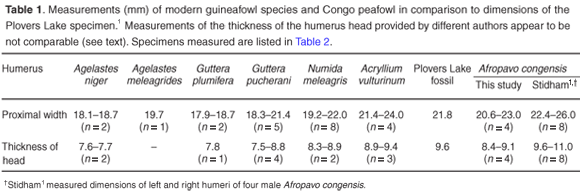
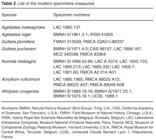
The assignment of the fossil to modern Congo peafowl would then rely on size, but not on discrete characters. We found that the proximal end of the humerus of helmeted guineafowl (Numida meleagris) and vulturine guineafowl (Acryllium vulturinum) is similar in size to that of the fossil specimen as well as of the Congo peafowl (Table 1). Stidham1 1 4
The identification of the fossil specimen with Afropavo is not convincing, and it is unwarranted to assume the existence of a 'more closed forest or even rain forest [sic]'1 3 Equus burchelli) and several alcelaphine antelope species, or of open woodlands, e.g. vervet monkey (Chlorocebus aethiops), baboon (Papio ursinus) and Cape buffalo (Syncerus caffer), but not a single species unequivocally indicates the presence of dense forest, let alone rainforest. These observations are in agreement with those at other southern African fossil sites from the Plio-Pleistocene, especially those in the Sterkfontein Valley, less than 10 km southwest of Plovers Lake. The faunal composition at these sites indicates the predominance of grasslands and open woodlands during the past two million years.6–8 During the same period subtropical to tropical woodlands, as well as forests, were evidently replaced by savanna and grasslands in the interior of southern Africa as well as other parts of the continent.9–11 These environmental changes were triggered by a decrease in both temperature and annual precipitation, a situation also reflected by the dramatically low levels of Lake Malawi, Lake Tanganyika and Lake Bosumtwi.12 13 13,14 If one accepts current estimates of the distribution of African rainforests during glacial maxima,14 15 Afropavo congensis.
Avery7,8 estimated that annual precipitation did not exceed 550 mm during the Plio-Pleistocene at the fossiliferous sites at Sterkfontein, Swartkrans and Kromdraai, just less than 10 km southwest of Plovers Lake. This is obviously far below the threshold for modern rainforests. Rainfall—100 000 years ago— might even have been as low as 330 mm at one particular Middle Stone Age site at Sterkfontein (post Member 6 infill).7,8 It seems unlikely that rainfall would have quintupled during the subsequent 30 000 years in this part of southern Africa, which would have been essential for the establishment of a connection to the Pleistocene equatorial rainforest refugia, several thousand kilometres to the north.
Finally, Stidham's speculations on the taphonomy of the fossil specimen are unfounded. Stidham1
In conclusion, Stidham's1 3,7–9
We wish to thank all curators and collection managers for allowing access to comparative material housed at the following institutions: California Academy of Sciences, Field Museum of Natural History, Institut Royal des Sciences Naturelles de Belgique, Muséum National d'Histoire Naturelle Paris, Natural History Museum at Tring, Peabody Museum, Royal Museum for Central Africa and Université Claude Bernard Lyon. We thank Deano Stynder (Iziko South African Museum), Lloyd Rossouw (National Museum Bloemfontein) and Greg Davies (Natal Museum Pietermaritzburg) for fruitful discussions regarding the reconstruction of South Africa's palaeoenvironment, as well as two anonymous reviewers whose comments greatly improved an earlier version of this manuscript. A.M. was supported by the German Academy of Sciences Leopoldina grant BMBF-LPD 9901/8-183.
References
- 1. Stidham T.A. (2008). The first fossil evidence of the Congo peafowl (Galliformes: Afropavo). S. Afr. J. Sci. 104, 511–512.
- 2. Urban E.K., Fry C.H. and Keith S. (eds) (1986). The Birds of Africa, vol. II. Academic Press, London.
- 3. De Ruiter D.J., Brophy J.K., Lewis P.J., Churchill S.E. and Berger L.R. (2008). Faunal assemblage composition and paleoenvironment of Plovers Lake, a Middle Stone Age locality in Gauteng Province, South Africa. J. Hum. Evol. 55, 1102–1117.
- 4. Louchart A. (2003). A true peafowl in Africa. S. Afr. J. Sci. 99, 368–371.
- 5. Ksepka D.T. (2009). Broken gears in the avian molecular clock: new phylogenetic analyses support stem galliform status for Gallinuloides wyomingensis and rallid affinities for Amitabha urbsinterdictensis. Cladistics 25, 173–197.
- 6. Vrba E.S. (1976). The fossil Bovidae of Sterkfontein, Swartkrans and Kromdraai. Transvaal Mus. Mem. 21, 1–166.
- 7. Avery D.M. (1995). Southern savannas and Pleistocene hominid adaptations: the micromammalian perspective. In Paleoclimate and Evolution with Emphasis on Human Origins, eds E. Vrba, G.H. Denton, T.C. Partridge and L.H. Burckle, pp. 459–478. Yale University Press, New Haven and London.
- 8. Avery D.M. (2001). The Plio-Pleistocene vegetation and climate of Sterkfontein and Swartkrans, South Africa, based on micromammals. J. Hum. Evol. 41, 113–132.
- 9. Scott L. (1995). Pollen evidence for vegetational and climatic change in southern Africa during the Neogene and Quaternary. In Paleoclimate and Evolution with Emphasis on Human Origins, eds E. Vrba, G.H. Denton, T.C. Partridge and L.H. Burckle, pp. 65–76. Yale University Press, New Haven and London.
- 10. Bobe R. and Behrensmeyer A.K. (2004). The expansion of grassland ecosystems in Africa in relation to mammalian evolution and the origin of the genus Homo. Paleogeogr. Paleoclimatol. Paleoecol. 207, 399–420.
- 11. McCarthy T. and Rubidge B. (2005). The Story of Earth and Life – A Southern African Perspective on a 4.6-Billion-Year Journey. Struik Publishers, Cape Town.
- 12. Cohen A.S., Stone J.R., Beuning K.R.M., Park L.E., Reinthal P.M., Dettman D., Scholz C.A., Johnson T.C., King J.W., Talbot M.R., Brown E.T. and Ivory S.J. (2007). Ecological consequences of early Late Pleistocene megadroughts in tropical Africa. Proc. Natl. Acad. Sci. USA 104, 16422–16427.
- 13. Tchouto M.G.P., de Wilde J.J.F.E., de Boer W.F., van der Maesen L.J.G. and Cleef A.M. (2008). Bio-indicator species and Central African rain forest refuges in the Campo-Ma'an area, Cameroon Syst. Biodivers. 7, 21–31.
- 14. Plana V. (2004). Mechanisms and tempo of evolution in the African Guineo-Congolian rainforest. Phil. Trans. Roy. Soc. Lond. B 359, 1585–1594.
- 15. Benefit B.R. (1999). Biogeography, dietary specialization, and the diversification of African Plio-Pleistocene monkeys. In African Biogeography, Climate Change, and Human Evolution, eds T.G. Bromage and F. Schrenk, pp. 172–188. Oxford University Press, New York and Oxford.