Antiplasmodial activities of some abietane diterpenes from the leaves of five Plectranthus species
Abstract
Seven known abietane diterpenes were isolated from five Plectranthus species, namely P. hadiensis, P. lucidus, P. ecklonii, P. purpuratus subsp. purpuratus and P. purpuratus subsp. tongaensis. The seven compounds were tested for their antiplasmodial activity and for their ability to inhibit β-haematin formation. Overall, they showed good activity (IC50 values ranging from 3.11 to 14.65 µM), with one compound being 62% as effective as chloroquine in inhibiting β-haematin formation. However, the cytotoxicity profile indicated a low degree of specificity towards the malaria parasite. When combined with quinine, three compounds interacted in an additive manner whereas one interacted synergistically.
Introduction
It is estimated from recent studies that at least 300 million cases of malaria occur worldwide,1,2 resulting in millions of deaths every year. Our motivation to investigate the genus Plectranthus (Lamiaceae) as a possible source of antiplasmodial compounds has been influenced by three interrelated observations published in recent literature:
(a) Of the known species in the genus (350 in Africa, of which 53 occur in South Africa and Namibia), many have been tested worldwide for a variety of purposes. For example, they are effective against many harmful bacteria,3 have an anti-proliferation effect on human lymphocytes,4 can control insect feeding habits,5 and are good insect repellents.6
(b) In African traditional medicine, 45 species of Plectranthus have received attention, amongst others, for treatment of gastro-intestinal disorders,7 as anti-microbial agents,8 for the treatment of wounds,9 the alleviation of respiratory conditions10 and for malaria.9,11-14
(c) In a recent review,15 the statement is made that several of the compounds from Plectranthus, that have high anti-microbial activities, also possessed good antiplasmodial properties.
These three observations, coupled with recent findings16 that certain species of Plectranthus, notably P. hadiensis, have extremely high anti-fungal and anti-bacterial activity, have been the driving force for the present investigation.
Experimental
See Appendix.
Results and discussion
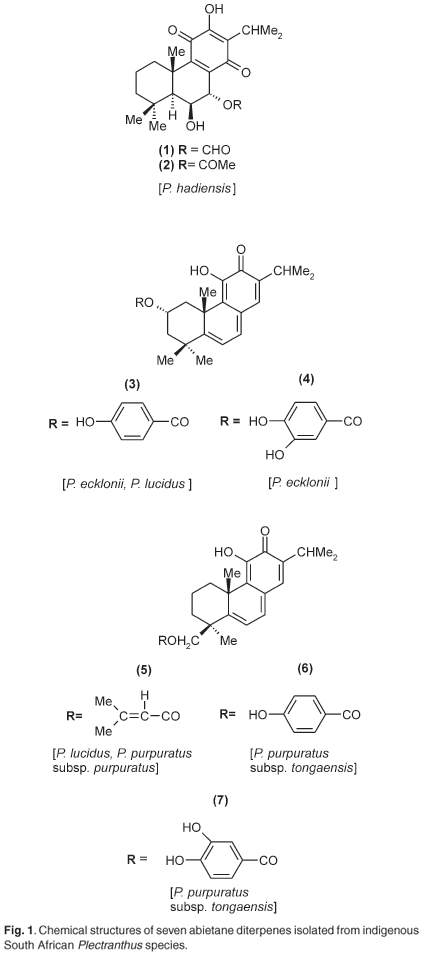
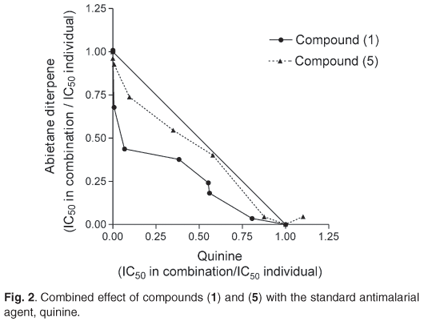
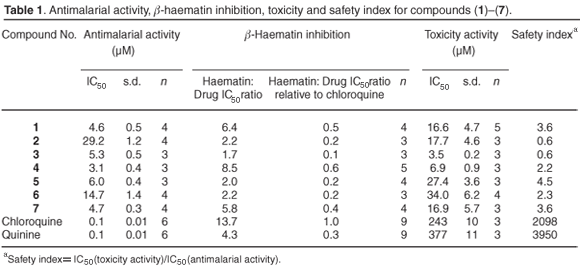
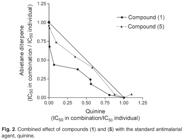
The antiplasmodial activities against a chloroquine-resistant strain of Plasmodium falciparum and the inhibitory effects of the seven abietane diterpenes (1)-(7) (Fig. 1) on β-haematin formation as well as their toxic effects are shown in Table 1. Relative to chloroquine and quinine, the seven compounds were less active, but showed significant activity in inhibiting the formation of β-haematin. These compounds (1), (4) and (7) were more active than quinine. As can be seen from the isobolograms (Fig. 2), when combined with quinine, compounds (4), (5) and (7) interacted in an additive manner, whereas compound (1) interacted synergistically. To ensure clarity in Fig. 2, the results obtained from (4) and (7) were not included as they overlapped the results obtained for (5).
While the activities of our abietane diterpenes (Table 1) may not be as high as previously reported plant metabolites, they display potential pharmacological activities worthy of further investigation. Until this study, the only reported anti-protozoal activity of abietane diterpenes is that of 7-hydroxy-12-methoxy-20-nor-abieta-1,5(10),7,9,12-pentaen-6,14-dione and abieta-8,12-dien-11,14-dione against the amastigote form of Leishmania donovani and L. major.17 The IC50 values for the latter two abietane diterpenes of 170- and 120-nM against L. donovani amastigotes are regarded as 'appreciable' by the authors. When compared to the control drug, sodium stibogluconate (IC50: 10.6 nM) there is a 15-fold decrease in activity with the abietane diterpenes. By comparison, our three best IC50 results [from (4), (1) and (7)] against Plasmodium falciparum were 3.11, 4.59, and 4.74 µM, respectively, and when compared to chloroquine were approximately 35-fold less active (Table 1). The weakest result was for (2) with an IC50 of 29.20 µM.
The lipophilic nature of our abietane diterpenes (1)-(7) enables easy transport across the erythrocytic and parasitic membranes to accumulate in the parasitic food vacuole. The inhibitory effect of our compounds appears to relate to their ability to prevent the formation of β-haematin. This is an important effect, because the malaria parasite degrades haemoglobin and the released haem, which is toxic to the parasite, is normally converted to the inert malaria pigment, β-haematin.18 As can be seen in Table 1, compounds (1), (4) and (7) are more effective than quinine, and compound (4) is 62% as active as chloroquine.
Most of the diterpenes are known to combine high antiprotozoal activity with high toxicity for mammalian cells (such as kidney epithelial cells) (Table 1), hepatoma cells, as well as colonic carcinoma cells.19 The unfavourable safety indices (Table 1) imply that our compounds are poor candidates for development as antimalarial agents. However, the selective antiprotozoal action that inhibits β-haematin formation differs enough from its toxic mode of action (r2 = 0.097) to an extent that appropriate formulations and analogues of compound (4) could retain or enhance antimalarial activity, while reducing toxicity. This particular approach has been successfully applied with the improved potency of the 2,7-dibromo analogue of crytolepine, along with decreased in vivo toxicity.20
Conclusions
These particular findings, coupled with the general statement by the Kew group15 that too little is known about the chemistry of other (excluding forskolin) species of Plectranthus to explain their traditional uses, emphasizes that the results presented here are only a start of a research direction. This involves the approach of using natural products as model compounds for chemical modification,20 ideally increasing anti-parasitic activity, while decreasing toxicity.
A concern is the possibility of interactions between traditional medicines and commonly used antimalarial agents, particularly because these interactions are thinly documented. It is possible that patients taking traditional medicines for the treatment or prevention of malaria could be hospitalized and also administered conventional antimalarial agents such as quinine. Therapeutic failure could be possible if the two treatments interact antagonistically, as has been observed between Aspilia africana and artemisinin.30 However, the interactions observed between quinine and the diterpenoids (4), (7) and (5) are found to be additive; whilst a synergistic interaction has been observed between quinine and compound (1). This latter interaction is of therapeutic importance due to the rapid development of drug resistance, and the necessity to administer two or more agents concurrently, in order to achieve a desired therapeutic goal.
Thanks are due to the University of KwaZulu-Natal Research Committee for the award of a postdoctoral bursary (F.K.) and the provision of financial assistance; to C.-T. Chen for technical assistance; and the University of the Witwatersrand Faculty Research Committee/NRF for financial support.
References
- 1. Snow R.W., Guerra C.A., Noor A.M., Myint H.J. and Hay S.I. (2005). The global distribution of clinical episodes of Plasmodium falciparum malaria. Nature 434, 214-217.
- 2. Willcox M.L. and Bodeker G. (2000). Plant-based malaria control: research initiative on traditional antimalarial methods. Parasitol. Today 16, 220-221.
- 3. Texeira A.P., Batista O., Simões M.F., Nasimento J., Duarte A., De la Torre M.C. and Rodrigue B. (1997). Phytochemistry 44, 325-327.
- 4. Cerqueira F., Cordeiro-Da-Silva A., Gaspar-Marques C., Simões F., Pinto M.M. and Nascimento M.S.J. (2004). Effect of abietane diterpenes from Plectranthus grandidentatus on T- and B-lymphocyte proliferation. Bioorg. Med. Chem. 12, 217-223.
- 5. Wellsow J., Grayer R.J., Veitch N.C., Kokuban T., Lelli R., Kite G.C. and Simmonds M.S.J. (2006). Insect-antifeedant and antibacterial activity of diterpenoids from species of Plectranthus. Phytochemistry 67, 1818-1825.
- 6. Omolo M.O., Okinyo D., Ndiege I.O., Lwande W. and Hassanali A. (2004). Repellency of essential oils of some Ken yan plants against Anopheles gambiae. Phytochemistry 65, 2797-2802.
- 7. Kokwaro J.O. (1993). Medicinal Plants of East Africa. Kenya Literature Bureau, Nairobi.
- 8. Matu E.M. and Van Staden J.H. (2003). Anti-bacterial and anti-inflammatory activities of some plants used for medicinal purposes in Kenya. J. Ethnopharmacol. 87, 35-41.
- 9. Githinji C.W. and Kokwaro J.O. (1993). Ethnomedicinal study of major species in the family Labiatae from Kenya. J. Ethnopharmacol. 39, 197-203.
- 10. Boily Y. and Van Puyvelde L.J. (1986). Screening of medicinal plants of Rwanda (Central Africa) for anti-microbial activity. J. Ethnopharmacol. 16, 1-13.
- 11. Hutchings A., Scott A.H., Lewis G. and Cunningham A. (1996). Zulu Medicinal Plants - An Inventory. University of Natal Press, Pietermaritzburg.
- 12. Neuwinger H.D. (2000). African Traditional Medicine. A Dictionary of Plant Use and Applications. Medpharma Scientific Publications, Stuttgart.
- 13. Rwangabo P.C. (1993). La médicine traditionnelle au Rwanda. Editions Karthala, ACCT.
- 14. Schlage C.H., Mabula C., Mahunnah R.L.A. and Heinrich M. (2000). Medicinal plants of Washamba (Tanzania): documentation and ethnopharmacological evaluation. Plant Biol. 2, 83-92.
- 15. Lukhoba C.W., Simmonds M.S.J. and Paton A.J. (2006). Plectranthus: a review of ethnobotanical uses. J. Ethnopharmacol. 103, 1-24.
- 16. Gurlal P. (2005). Isolation and characterization of biologically-active chemicals in selected indigenous plants. M.Sc. thesis, University of KwaZulu-Natal, Pietermaritzburg.
- 17. Tan N., Kaloga M., Radtke O.A., Kiderlen A.F., Öksüz S., Ulubelen A. and Kolodziej H. (2002). Abietane diterpenoids and triterpenoic acids from Salvia cilicica and their antileishmanial activities. Phytochemistry 61, 881-884.
- 19. Egan T.J., Ross D.C. and Adams P.A. (1994). Quinoline anti-malarial drugs inhibit spontaneous formation of β-haematin (malaria pigment). FEBS Lett. 352, 54-57.
- 19. Marques C.G., Pedro M., Simões M.F.A., Nascimento M.S.J., Pinto, M.M.M. and Rodríquez B. (2002). Effect of abietane diterpenes from Plectranthus grandidentatus on the growth of human cancer cell lines. Planta Med. 68, 839-840.
- 20. Wiesner J., Ortmann R., Jomaa H. and Schlitzer M. (2003). New antimalarial drugs. Angew. Chem. Int. Edit. 42, 5274-5293.
- 21. Miyase T., Rüedi P. and Eugster C.H. (1977). Diterpenoide Drüsenfarbstoffe aus Labiaten. Helv. Chim. Acta 60, 2770-2779.
- 22. Hensch M., Rüedi P. and Eugster C.H. (1975). Horminon, Taxochinon und weitere Royleanone aus zwei abessinischen Plectranthus-species. Helv. Chim. Acta 58, 1921-1934.
- 23. Rüedi P. and Eugster C.H. (1978). Diterpenoide Drüsenfarbstoffe aus Labiaten: Sechs neue p-Chinomethane aus Plectranthus parviflorus Willd. Helv. Chim. Acta 61, 709-715.
- 24. Katti S.B.and Eugster C.H. (1982). Diterpenoide Chinomethane, vinyloge Chinone und ein Phyllocladen-Derivat aus Plectranthus purpuratus. Helv. Helv. Chim. Acta 65, 2189-2197.
- 25. Jansen J.B. and Trager W. (1976). Human malaria parasites in continuous culture. Science 193, 674-675.
- 26. Desjardins R.E., Carfield C.J., Haynes D.J. and Chulay J.D. (1972). Quantitative assessment of antimalarial activity in a semi-automated microdilution technique. Antimicrob. Agents Ch. 16, 710-718.
- 27. Berenbaum M.C. (1989). A method for testing synergy with any number of agents. J. Infect. Dis. 137, 122-130.
- 28. Chemaly S.M., Chen C.-T. and Van Zyl R.L. (2007). Naturally occurring cobalamines have antimalarial activity. J. Inorg. Biochem. 101, 764-773.
- 29. Mosmann T. (1983). Rapid colorimetric assay for cellular growth and survival: application to proliferation and cytotoxic assays. J. Immunolog. Methods 65, 55-63.
- 30. Waako P.J., Smith P. and Folb P.I. (2005). In vitro interactions of Aspilia africana (Pers.) C.D. Adams, a traditional antimalarial medicinal plant, with artemisinin against Plasmodium falciparum. J. Ethnopharmacol. 102, 262-268.