A role for barcoding in the study of African fish diversity and conservation
Abstract
Africa has a rich diversity of marine and freshwater fishes, but very little taxonomic expertise or funding to describe it. New approaches to using modern technology, such as DNA barcoding, can facilitate collaboration between field biologists, reference collections and sequencing facilities to speed up the process of species identification and diversity assessments, provided specimen vouchers, tissues, photographs of the specimen and DNA sequences (barcodes) are clearly linked. The FISH-BOL project in Africa aims to establish a collaborative Pan-African regional working group to facilitate barcoding of fish across the continent and the surrounding FAO marine regions. This is being established through existing African biodiversity networks and global biodiversity programmes that are already in place. Barcoding is expected to inform African fisheries management and conservation through more accurate identification of species and their different life-history stages, by speeding up biodiversity assessments. Barcoding is an important development, contributing towards an evolutionary history perspective on which to base Africa's conservation strategies.
Introduction
Biodiversity assessments and implementation of conservation actions worldwide are hampered by slow progress in taxonomic research, termed the Taxonomic Impediment.1234–6 out of a possible total of approximately 7–15 million.67,8 Many species may be going extinct before they can be identified or described. This presents a problem for conservation planning and prioritization, obviously because species that have not been identified cannot be protected effectively.
This problem is especially evident in Africa, whose rich biodiversity is poorly known. Taxonomic expertise is lacking even for major and commercially important groups. The few taxonomists who are working in developing countries, home to more than 95% of globally described species, find it difficult to access basic taxonomic information such as species descriptions.91011,12
There have been strident calls on the taxonomy community to embrace new technologies and to form networks to speed up the description of biodiversity13,14 and to improve our ability to identify species.2,15–18 How this could be achieved without compromising rigorous taxonomic research principles is, however, questioned.19202122et al.19
Nucleotide sequence divergence in short, standardized gene regions (DNA barcodes) can be used to identify known species and facilitate the discovery of new ones.15,23 Mitochondrial DNA is a valuable marker in population genetic or phylogeographic studies because it is maternally inherited, evolves rapidly and recombination is rare or absent.24a priori reason for choosing COI among the 13 protein-coding mitochondrial genes,152526
The Consortium for the Barcode of Life (CBOL) was established as a growing coalition of biodiversity organizations interested in developing barcoding as a global standard for DNA-based species identification. CBOL promotes FISH-BOL as an international campaign to barcode all marine and freshwater fish. FISH-BOL consists of ten regional working groups representing Africa, Australia, Oceania/Antarctica, the Americas (North, Central and South America), Europe and Asia (India, North East Asia, and South East Asia). Each of these regional working groups is charged with the task of organizing support and participation to barcode the ichthyofauna within their region, based on expert-identified voucher specimens.
The main purpose of barcoding is to identify species reliably, increase the rate of species discovery and raise the profile of taxonomic research.27
In this review, we illustrate the role of FISH-BOL (www. fishbol.org) in taxonomic and diversity studies in Africa, with applications in conservation, fisheries management, identification of alien invasive fishes, law enforcement and resource management. We show that FISH-BOL will lead to greater access to African fish diversity information through a global alignment of resources and linkages to other global networks. We summarize the functioning and aims of the African FISH-BOL programme and draw conclusions about its potential role in African fish diversity assessments and conservation.
Why barcode fish in Africa?
Barcoding has an important role to play in phylogenetic and phylogeographic studies,2829–31 These studies are, however, not comparable for the purposes of species identification as different regions of the mitochondrial genome were used. The African projects proposed by FISH-BOL are also on a larger scale than previous molecular studies.
These projects are designed to identify species through a composite database based on the mitochondrial COI region of as many species as possible, to provide a hitherto unavailable 'horizontal genomics' perspective.28
The identification of species remains, however, the main objective of barcoding. Owing to maternal inheritance, mtDNA reflects only a portion of the ancestry of a species. Additional information is necessary to test whether divergent mtDNA lineages constitute separate species.32–34 We therefore view provisional species assignments (that is, not formal descriptions) based only on mtDNA as working hypotheses. As new collections are made, individuals suspected of being unique (especially of equivocal taxonomic status) can be barcoded. If they are divergent or form part of a unique lineage, they can then be flagged for further taxonomic investigation.
The identification process using COI sequence data for fish is looking promising, as supported by recent examples of its application. Hubert et al.35et al.36et al.3738Galaxias from New Zealand. Pseudogenes did not significantly affect the barcoding of birds.39et al.36404142432344
The potential contributions of barcoding in African fisheries management should not be underestimated. Global capture fisheries yielded 95 million tonnes in 2004 with an estimated first-sale value of US$84.9 billion.4546,47 Accurate identification is essential in assessing the distribution, utilization and spread of fish species, therefore, prioritizing fish biodiversity assessments using barcoding is not only a global but also an African necessity.
In 2006, a CBOL meeting in Cape Town (South Africa) identified barcoding in fish stock management in African countries as a priority. Barcoding has an application in forensics for African fisheries departments to prosecute illegal fishing, even after processing has already occurred, because only a small part of the fish is needed for DNA analysis. An example is the illegal shark-fin trade, which is a major problem in most coastal African countries. Barcoding can identify different shark species,4048
Barcoding may help link life-history stages, since little taxonomic information and few descriptions are available for fish larvae and eggs (e.g. refs 49–51). Incorrect identification of larvae will mislead understanding of speciation, diversity, niche partitioning and other ecosystem features.51525346
Molecular studies have improved our understanding of aquatic biodiversity; for example, 15 historically isolated lineages were identified within the seven described Pseudobarbus species that occur in Lesotho and in the Cape Floristic Region in South Africa.5431www.redlist.org), are those that rely on freshwater habitats.4755
One of the most important applications of a comprehensive, Pan-African barcoding study of fish will be more robust estimates of the phylogenetic diversity of different biogeographic regions. Phylogenetic diversity is a critical factor in conservation planning.56
As PCR and sequencing technology advances—such as nanolitre-scale sequencing technology developments57582,59
The FISH-BOL programme provides a platform for students trained in molecular systematics to collaborate with taxonomic experts to increase the transfer of knowledge and help train new taxonomists. Barcoding will not only provide a new avenue for researchers from different disciplines to collaborate more closely, but will also accelerate the process of species identification and discovery. These developments will be facilitated by a large online and publicly available reference database of DNA barcode information (Barcode of Life Data System, or BOLD2660
A global network linked to the African FISH-BOL project
The FISH-BOL campaign will build on the success of sister projects that focus on other taxa, namely the All Birds Barcoding Initiative (ABBI) and the All Leps (Lepidoptera) Barcode of Life campaign. The FISH-BOL project will be more challenging than the All Birds project, not only because fish are far more diverse, but also because there is much less taxonomic information and expertise available. FISH-BOL, under the auspices of the Consortium for the Barcode of Life, has already assisted in driving a coherent approach within the taxonomic community. CBOL has built up an impressive network of collaborating organizations (for more information on CBOL and barcoding in general, see Savolainen et al.61www.barcoding.si.edu). One of these, the Census of Marine Life (CoML), has joined forces with CBOL and FISH-BOL to speed up the description of marine biodiversity.62
FISHBASE, the California Academy of Sciences' Catalog of Fishes and the Integrated Taxonomic Information System (ITIS) are other major depositories for updated taxonomic and biological information on fish species globally. FISH-BOL is currently using FISHBASE as its global taxonomic authority, but is also collaborating with Catalog of Fishes, ITIS and FISHBASE to incorporate their information into a resolved checklist for all fishes. FISH-BOL also supports the efforts of the International Commission on Zoological Nomenclature (ICZN) to establish a common registry of animal names. Some authors are already including barcodes of the holotype in their species descriptions,63,64 and this is expected to help reconcile and resolve ambiguities in the application of taxonomic names going forward.
The Global Biodiversity Information Facility (GBIF) has given scientists, conservationists and policy-makers access to geo-referenced, species databases across the world. Information relating to the South African National Fish Collection at the South African Institute for Aquatic Biodiversity (SAIAB), for example, has been linked through the South African Biodiversity Information Facility (SABIF) node to GBIF. FISH-BOL, through CBOL, is an associate participant in GBIF. Together, these initiatives aim to develop standards and protocols that will link voucher specimen data with barcode data. The U.S. National Center for Biotechnology Information (NCBI) is also working with GBIF and CBOL to make this happen and is the final depository (GenBank) for barcode sequences mainly administered through BOLD.26
Several other global programmes and campaigns have attempted to inject new life into taxonomy over the years, and some have benefited African taxonomic research and inventories. For freshwater fish, the Cypriniformes Tree of Life (CToL) programme focused mainly on a phylogeny of cypriniform fishes, which includes the largest family of fishes, the Cyprinidae, with many species in Africa. In addition, the All Species Foundation, in partnership with the U.S. National Science Foundation (NSF), is attempting to describe all species on Earth in one human generation (25 years). They support the All Catfish Species Inventory programme that has been successful in increasing the number of species descriptions for fishes, in this case siluriform catfishes. These global initiatives, like many others, have been less successful in Africa, mainly because of a lack of taxonomic expertise in African countries to participate effectively. FISH-BOL will rely on its network of experts to identify fish and to train current African museum staff and field biologists in collecting data for barcoding.
The FISH-BOL programme will also explore other existing biodiversity networks in Africa to expand its operations. BioNET is attempting to promote taxonomy through the North African (NAFRINET), West African (WAFRINET), East African (EAFRINET) and the Southern African (SAFRINET) partnerships for taxonomy, the last becoming an official project of the Southern African Development Community (SADC). BioNET through EAFRINET has already held a regional meeting in Kenya and established the East African Barcoding Initiative (EABI). This group has recognized the need to barcode fish diversity and arranged a barcoding workshop to develop a proposal for a regional project on barcoding cyprinids. In South Africa, the South African Biosystematics Initiative (SABI) has stimulated research in taxonomy by providing dedicated government funding for taxonomic research. Nevertheless, there has been limited increase in the capacity of fish taxonomic research. The likely reasons for this deficiency include a lack of employment opportunities in museums or research institutions, and declining taxonomic expertise to train students. Only three fish taxonomic experts are formally employed in exclusively taxonomic positions in southern Africa, two at SAIAB in Grahamstown and one at the Iziko South African Museum in Cape Town. Although most new appointees in biodiversity-related posts have multidisciplinary skills (often including experience in molecular genetics and systematics), they lack the taxonomic expertise that is usually acquired only through years of research on a specific taxonomic group. This situation is a global problem, but especially exacerbates the Taxonomic Impediment in East, West and North Africa. It is therefore vital to increase collaboration by sharing the limited expertise and to encourage capacity building amongst African countries. If this is not addressed, Africa's fish diversity will not be managed in a sustainable manner.
SAIAB has signed a Memorandum of Understanding with the Canadian Centre for DNA Barcoding (CCDB) at the University of Guelph, and a Memorandum of Cooperation with CBOL to stimulate an African fish barcoding programme through the global FISH-BOL initiative. These developments act on the call by Klopper et al.65
Aims and challenges of the African FISH-BOL programme
The African FISH-BOL campaign will focus on all the fishes of the continent and the surrounding FAO marine regions 1, 34, 47 and 51 (see www.fishbol.org). The current FISH-BOL target for Africa of 8720 species that is based on FISHBASE is probably a major underestimate of the number of species that will eventually need to be investigated to make the campaign a success. The African Regional Working Group has been charged with editing the global checklist against African regional checklists. This review has already started with IUCN freshwater biodiversity projects in eastern and southern Africa, which suggest not only that many more fish species exist, but also that many of them remain undescribed.
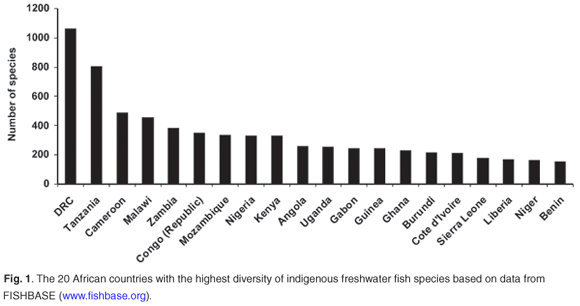
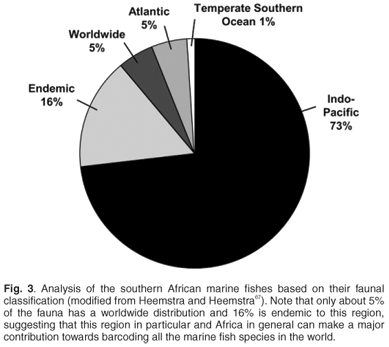
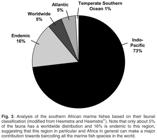
May66Figs 1 and 2) based on data from FISHBASE (www.fishbase.org), without which the FISH-BOL programme will not achieve its goal of barcoding most of Africa's fish species. A successful programme in Africa will also make a major contribution to the barcoding of all the marine fish species in the world. For example, only about 5% of the southern African marine fish fauna has a worldwide distribution, whereas 16% is endemic to this region67Fig. 3).
The biggest challenge for the FISH-BOL project in Africa will be to collect, curate and accurately capture information in databases and deliver vouchers and samples of the species that are not already represented in natural history collections, to sequencing facilities. Field biologists interested in biodiversity, taxonomy and/or species identification can make an important contribution to this programme. Taxonomists will have a critical role in preparing and identifying vouchers for museum collections. BOLD has been designed specifically to link barcoding information to museum-registered specimens, so that taxonomic experts can go back to specimens to re-check identifications if necessary.2611,68,69 and will, we hope, also encourage better biomaterial banking practices.70,71 In the absence of other preferred facilities, SAIAB is currently the depository for tissues or extractions thereof (biomaterial bank), voucher specimens (main collection), images and associated locality and collection information (information system) that can be referred to once samples have been barcoded. All this information will be freely available to through SAIAB's web pages.
Conclusion
Many fish species remain to be discovered across the African continent and in its surrounding marine margins. We argue that barcoding holds a central role in the discovery and characterization of this diversity, and will also help democratize access to quality biodiversity information. Only time will tell how widely barcoding information will be used in fish species identification and aquatic biodiversity assessments in Africa. Preliminary results from the North American birds and Lepidoptera, North Atlantic shark and Australian marine fish projects have been positive. Although there are funding concerns, we envisage that FISH-BOL will provide previously inaccessible avenues of funding for taxonomic research in Africa. 'Barcoding' as a term immediately interests the public and therefore potential funders. The key challenge is for fish taxonomists, and the taxonomic community in general, to find ways in which this interest can be translated into greater support for taxonomic research, which will underpin the more efficient description of biodiversity.
The Consortium for the Barcode of Life (CBOL) is thanked for support to attend meetings where many of the aspects of barcoding referred to in this paper were discussed. Denis Tweddle (SAIAB) and three anonymous reviewers are thanked for comments on the manuscript. Our research is supported through the Ontario Genomics Institute within the Canadian Barcode of Life Network by Genome Canada, NSERC and other sponsors listed at www.bolnet.ca
References
- 1. Hoagland K.E. (1996). The Taxonomic Impediment and the Convention on Biodiversity. ASC News 24, 61–62, 66–67.
- 2. Costa F.O. and Carvalho G.R. (2007). The Barcode of Life Initiative: synopsis and prospective societal impacts of DNA barcoding of fish. Genomics Soc. Policy 3, 29–40.
- 3. May R.M. and Beverton R.J.H. (1990). How many species? Philos. Trans.: Biol. Sci. 330, 293–304.
- 4. Stork N.E. (1988). Insect diversity: facts, fiction and speculation. Biol. J. Linn. Soc. 35, 321–337.
- 5. Southwood T.R.E. (1978). The components of diversity. In Diversity of Insect Faunas, eds L.A. Mound and N. Waloff, pp. 19–40. Blackwell, Oxford.
- 6. Mace G.M. (2004). The role of taxonomy in species conservation. Phil. Trans. R. Soc. Lond. B 359, 711–719.
- 7. Thomas C.D., Cameron A., Green R.E., Bakkenes M., Beaumont L.J. et al. (2004). Extinction risk from climate change. Nature 427, 145–148.
- 8. Hughes J.B., Daily G.C. and Ehrlich P.R. (1997). Population diversity: its extent and extinction. Science 278, 689–692.
- 9. Agosti D. (2006). Biodiversity data are out of local taxonomists' reach. Nature 439, 392–392.
- 10. Balakrishnan R. (2005). Species concepts, species boundaries and species identification: a view from the Tropics. Syst. Biol. 54, 689–693.
- 11. Herbert D.G. (2001). Museum natural science and the NRF: crisis times for practitioners of fundamental biodiversity science. S. Afr. J. Sci. 97, 168–172.
- 12. Wynberg R. (2002). A decade of biodiversity conservation and use in South Africa: tracking progress from the Rio Earth Summit to the Johannesburg World Summit on Sustainable Development. S. Afr. J. Sci. 98, 233–243.
- 13. Wheeler Q.D., Raven P.H. and Wilson E.O. (2004). Taxonomy: impediment or expedient? Science 303, 285.
- 14. Polaszek A. (2005). A universal register for animal names. Nature 437, 477.
- 15. Hebert P.D.N., Cywinska A., Ball S.L. and De Waard J.R. (2003). Biological identifications through DNA barcodes. Proc. R. Soc. Lond. B 270, 313 – 321.
- 16. Schander C. and Willassen E. (2005). What can biological barcoding do for marine biology? Mar. Biol. Res. 1, 79 – 83.
- 17. Schindel D.E. and Miller S.E. (2005). DNA barcoding a useful tool for taxonomists. Nature 435, 17–17.
- 18. Miller S.E. (2007). DNA barcoding and the renaissance of taxonomy. Proc. Natl Acad. Sci. USA 104, 4775–4776.
- 19. de Carvalho M.R., Bockmann F.A., Amorim D.S., de Vivo M., de Toledo-Piza M. et al. (2005). Revisiting the taxonomic impediment. Science 307, 353.
- 20. Ebach M.C. and Holdrege C. (2005). DNA barcoding is no substitute for taxonomy. Nature 434, 697–697.
- 21. Blaxter M.L. (2004). The promise of a DNA taxonomy. Phil. Trans. R. Soc. B 359, 669–679.
- 22. DeSalle R. (2007). Phenetic and DNA taxonomy; a comment on Waugh. Bioessays 29, 1289–1290.
- 23. Gómez A., Wright P.J., Lunt D.H., Cancino J.M., Carvalho G.R. et al. (2007). Mating trials validate the use of DNA barcoding to reveal cryptic speciation of a marine bryozoan taxon. Proc. R. Soc. Lond. B 274, 199–207.
- 24. Moritz C., Dowling T.E. and Brown W.M. (1987). Evolution of animal mitochondrial DNA: relevance for population biology and systematics. Annu. Rev. Ecol. Syst. 18, 269–292.
- 25. Collins F.S., Morgan M. and Patrinos A. (2003). The Human Genome Project: lessons from large-scale biology. Science 300, 286–290.
- 26. Ratnasingham S. and Hebert P.D.N. (2007). BOLD: the Barcode of Life data system (http://www.barcodinglife.org). Mol. Ecol. Notes 7, 355–364.
- 27. Hebert P. and Gregory T. (2005). The promise of DNA barcoding for taxonomy. Syst. Biol. 54, 852–859.
- 28. Hajibabaei M., Singer G.A.C., Hebert P.D.N. and Hickey D.A. (2007). DNA barcoding: how it complements taxonomy, molecular phylogenetics and population genetics. Trends Genet. 23, 167–172.
- 29. Waters J.M. and Cambray J.A. (1997). Intraspecific phylogeography of the Cape galaxias from South Africa: evidence from mitochondrial DNA sequences. J. Fish Biol. 50, 1329–1338.
- 30. Wishart M., Hughes J., Stewart B. and Impson, D. 2006. Extreme levels of intra-specific divergence among Cape Peninsula populations of the Cape galaxias, Galaxias zebratus Castelnau 1861, reveals a possible species complex. Afr. J. Aquat. Sci. 31, 99–106.
- 31. Swartz E.R., Skelton P.H. and Bloomer, P. (2007). Sea-level changes, river capture and the evolution of populations of the Eastern Cape and fiery redfins (Pseudobarbus afer and Pseudobarbus phlegethon, Cyprinidae) across multiple river systems in South Africa. J. Biogeog. 34, 2086–2099.
- 32. Nielsen R. and Matz M. (2006). Statistical approaches for DNA Barcoding. Syst. Biol. 55, 162–169.
- 33. DeSalle R., Egan M. and Siddall M. (2005). The unholy trinity: taxonomy, species delimitation and DNA barcoding. Phil. Trans. R. Soc. B 360, 1905–1916.
- 34. Rubinoff D. (2006). Utility of mitochondrial DNA barcodes in species conservation. Conserv. Biol. 20, 1026–1033.
- 35. Hubert N., Hanner R., Holm E., Mandrak N.E., Taylor E., Burridge M., Watkinson D., Dumont P., Curry A., Bentzen P., Zhang J., April J. and Bernatchez L. (2008). Identifying Canadian freshwater fishes through DNA barcodes. Plos ONE 3, e2490–2490.
- 36. Ward R.D., Zemlak T.S., Innes B.H., Last P.R. and Hebert P.D.N. (2005). DNA barcoding Australia's fish species. Phil. Trans. R. Soc. B 360, 1847–1857.
- 37. Venkatesh B., Dandona N. and Brenner S. (2006). Fugu genome does not contain mitochondrial pseudogenes. Genomics 87, 307–310.
- 38. Waters J.M. and Wallis G.P. (2001). Cladogenesis and loss of the marine life-history phase in freshwater galaxiid fishes (Osmeriformes: Galaxiidae). Evolution 55, 587–597.
- 39. Kerr K.C.R., Stoeckle M.Y., Dove C.J., Weigt L.A., Francis C.M. et al. (2007). Comprehensive DNA barcode coverage of North American birds. Mol. Ecol. Notes 7, 535–543.
- 40. Greig T.W., Moore M.K., Woodley C.M. and Quattro J.M. (2005). Mitochondrial gene sequences useful for species identification of western North Atlantic Ocean sharks. Fish. Bull. 103, 516–523.
- 41. Hebert P.D.N., Stoeckle M.Y., Zemlak T.S. and Francis C.M. (2004). Identification of birds through DNA barcodes. PLoS Biology 2, e312.
- 42. Hebert P.D.N., Penton E.H., Burns J.M., Janzen D.H. and Hallwachs W. (2004). Ten species in one: DNA barcoding reveals cryptic species in the neotropical skipper butterfly Astraptes fulgerator. Proc. Natl Acad. Sci. USA 101, 14812–14817.
- 43. Hogg I.D. and Hebert P.D.N. (2004). Biological identification of springtails (Collembola: Hexapoda) from the Canadian Arctic, using mitochondrial DNA barcodes. Can. J. Zool. 82, 749–754.
- 44. Barber P. and Boyce S.L. (2006). Estimating diversity of Indo-Pacific coral reef stomatopods through DNA barcoding of stomatopod larvae. Proc. R. Soc. Lond. B 273, 2053–2061.
- 45. Anon. (2007). Fisheries and Aquaculture Department: the state of world fisheries and aquaculture 2006. FAO, Rome.
- 46. Cowx I.G. (2002). Analysis of threat to freshwater fish conservation: past and present challenges. In Conservation of Freshwater Fishes: Options for the future, eds M.J. Collares-Pereira, I.G. Cowx and M.M. Coelho, pp. 201–220. Fishing News Books, London.
- 47. Mace G., Masundire H., Baillie J., Ricketts T., Brooks T. et al. (2005). Biodiversity. Millennium Ecosystem Assessment, 2005 Current state and trends: findings of the Condition and Trends Working Group Ecosystems and human well-being, vol. 1. Island Press, Washington, D.C.
- 48. Lleonart J., Taconet M. and Lamboeuf M. (2006). Integrating information on marine species identification for fishery purposes. Mar. Ecol. Prog. Ser. 316, 231–238.
- 49. Leis J.M., Trnski T. and Beckley L.E. (2002). Larval development of Pagellus natalensis and what larval morphology indicates about relationships in the perciform fish family Sparidae (Teleostei). Mar. Freshwat. Res. 53, 367–376.
- 50. Pegg G.G., Sinclair B., Briskey L. and Aspden W.J. (2006). MtDNA barcode identification of fish larvae in the southern Great Barrier Reef, Australia. Sci. Mar. 70S2, 7–12.
- 51. Webb K.E., Barnes D.K.A., Clark M.S. and Bowden D.A. (2006). DNA barcoding: a molecular tool to identify Antarctic marine larvae. Deep-Sea Res. II 53, 1053– 1060.
- 52. Smith P.J., McVeagh S.M., Allain V. and Sanchez C. (2005). DNA identification of gut contents of large pelagic fishes. J. Fish Biol. 67, 1178–1183.
- 53. Siddall M.E. and Budinoff R.B. (2005). DNA-barcoding evidence for widespread introductions of a leech from the South American Helobdella triserialis complex. Conserv. Genet. 6, 467–472.
- 54. Swartz E.R. (2005). Phylogeography, phylogenetics and evolution of the redfins (Teleostei, Cyprinidae, Pseudobarbus) in southern Africa. PhD thesis. University of Pretoria, South Africa.
- 55. Vitousek P.M., Mooney H.A., Lubchenco J. and Melillo J.M. (1997). Human domination of Earth's ecosystems. Science 277, 494–499.
- 56. Faith D.P. (1992). Conservation evaluation and phylogenetic diversity. Biol. Conserv. 61, 1–10.
- 57. Blazej R.G., Kumaresan P. and Mathies R.A. (2006). Microfabricated bioprocessor for integrated nanoliter-scale Sanger DNA sequencing. Proc. Natl Acad. Sci. USA 103, 7240–7245.
- 58. Hollingsworth P.M. (2007). DNA barcoding: potential users. Genomics Soc. Policy 3, 44–47.
- 59. Holm P. (2007). The book of life goes online. Genomics Soc. Policy 3, 48–51.
- 60. Chakraborty A., Sakai M. and Iwatsuki Y. (2006). Museum fish specimens and molecular taxonomy: a comparative study on DNA extraction protocols and preservation techniques. J. Appl. Ichthyol. 22, 160–166.
- 61. Savolainen V., Cowan R., Vogler A., Roderick G. and Lane R. (2005). Towards writing the encyclopaedia of life: an introduction to DNA barcoding. Phil. Trans. R. Soc. B 360, 1805–1811.
- 62. Mason B. (2003). Marine survey sees net gain in number of fish species. Nature 425, 889–889.
- 63. Victor B.C. (2007). Coryphopterus kuna, a new goby (Perciformes: Gobiidae: Gobiinae) from the western Caribbean, with the identification of the late larval stage and an estimate of the pelagic larval duration. Zootaxa 1526, 51–61.
- 64. Pyle R.L., Earle J.L. and Greene B.D. (2008). Five new species of the damselfish genus Chromis (Perciformes: Labroidei: Pomacentridae) from deep coral reefs in the tropical western Pacific. Zootaxa 1671, 3–31.
- 65. Klopper R.R., Smith G.F. and Chikuni A.C. (2002). The Global Taxonomy Initiative in Africa. Taxon 51, 159–165.
- 66. May R. (2004). Tomorrow's taxonomy: collecting new species in the field will remain the rate-limiting step. Phil. Trans. R. Soc. B 359, 733–734.
- 67. Heemstra P. and Heemstra E. (2004). Coastal Fishes of Southern Africa. National Inquiry Service Centre and South African Institute for Aquatic Biodiversity, Grahamstown, South Africa.
- 68. Cotterill F.P.D. (2002). The future of natural science collections into the 21st century. Conferencia de clausura. Actas del I simposio sobre el patrimonio natural en las colecciones públicas en España. Departamento de cultura, diputación foral de Alava, Vitoria, pp. 237–282.
- 69. Suarez A.V. and Tsutsui N.D. (2004). The value of museum collections for research and society. BioScience 54, 66–74.
- 70. Prendini L., Hanner R. and DeSalle R. (2002). Obtaining, storing and archiving specimens and tissue samples for use in molecular studies. In Techniques in Molecular Systematics and Evolution, eds R. DeSalle, G. Giribet and W. Wheeler. Birkhäuser Verlag, Basel.
- 71. Walters C. and Hanner R. (2006). Platforms for DNA banking. In DNA Banks – Providing novel options for genebanks? Topical Reviews in Agricultural Biodiversity, eds M.C. de Vicente and M.S. Andersson, pp. 25–35. International Plant Genetic Resources Institute, Rome.