Monitoring effects of anthropogenic climate change on ecosystems: a role for systematic ecological observation?
Introduction
At the heart of the UN Framework Convention on Climate Change, Article 2 describes its objective as 'stabilization of greenhouse gas concentrations in the atmosphere at a level that would prevent dangerous anthropogenic interference with the climate system', and goes further to define this as a level that would not compromise food production, would allow sustainable economic development, and should be 'achieved within a time-frame sufficient to allow ecosystems to adapt naturally to climate change' (see http://unfccc.int/resource/docs/convkp/ conveng.pdf). It is not surprising, therefore, that some of the most powerful data that have influenced policy debate in the climate change arena derive from longitudinal studies of wild organisms and ecosystems that reveal their responses to climate trends.1–3 Indeed, in the development of reports of the Intergovernmental Panel on Climate Change (IPCC, the premier policy-relevant compendium of climate change information), the first powerful compilation of such recorded responses was carried out for the Third Assessment Report.4 http://www.ipcc.ch/activity/ wg2outlines.pdf).
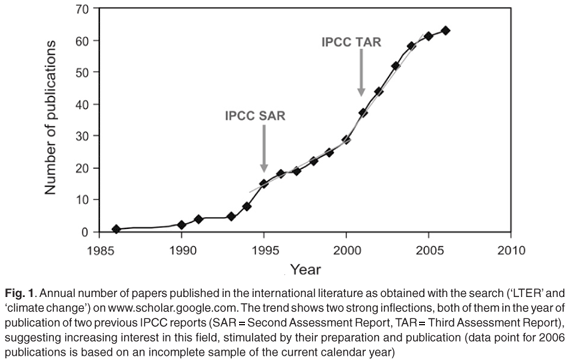
Systematic environmental monitoring has long been recognized as a key support for rational policy-making, and an important early-warning mechanism.5 Fig. 1), possibly indicating a growing appreciation of the policy value of such studies, and prompting further publication of data sets and conceptual designs for more efficient and policy-relevant monitoring systems.6 46
Studies using systematic site-based observation
The longest-running records of systematic observation most often are of phenological phenomena (the timing of growth and development events), generally of plants, e.g. ref. 7. Many such studies were summarized by Hughes8 9 10 11 12 13 14
Studies involving changes in low-temperature limitations have also identified consistent shifts in species' range, such as in altitude15 16 9,11 Significant range shifts have emerged generally in vagile organisms such as butterflies,1 17 Aloe dichotoma)18 19 20 21 22 23
Complex multi-species studies that provide insight into ecosystem characteristics and processes such as community composition and biomass production24 25
As the policy imperative for LTER has grown, e.g. ref. 26, a need for an integrated view of anthropogenic impacts on natural ecosystems and biogeochemical cycling has emerged. The first major studies to monitor the global biogeochemical cycles were those of the carbon cycle, established in the late 1950s on Mauna Loa, Hawaii,27 28
Significant concerns have been expressed, however, about blocks between monitoring efforts and policy making. For example, despite the annual investment of hundreds of millions of dollars in the United States in environmental monitoring, access to data and information for policy and decision makers has been lacking. This limits the extent to which policies may be updated in order to meet desired objectives, and suggests careful attention to the production of annual statistical reports and interpretational summaries from LTER efforts.32 http://www.ngo.grida.no/soesa/ nsoer/).
In the southern hemisphere, LTER research has a narrower scope and a shorter history than north of the equator. Indeed, recent reviews have highlighted the comparative dearth of long-term research in the southern hemisphere.3,9 In the south, LTER efforts to detect climate change impacts may be complicated by the hemispheric difference in environmental controls of ecosystem processes,33 34 35 36
Some terrestrial monitoring studies have also detected trends in the southern hemisphere, such as in forest trees of the South American tropics, where significant increases in individual plant turnover and biomass have been documented.30 37
Looking to the future – SAEON-based opportunities and potential limitations
Many modelling studies based on empirical correlations of species relationships with climate (the so-called bioclimatic niche approach) suggest that species ranges and abundance should be sensitive to climate change.8,38–41 Systematic observations could therefore provide a sensitive test of these projections by monitoring species turnover in time, with the added benefit of revealing the demographic processes that accompany range shifts. Recent developments in detecting climate change effects on ecosystems and wild species have begun to invoke the stringent requirement of 'joint attribution'42 Aloe dichotoma has achieved some success.18
The likelihood of future joint attribution in southern Africa remains slim, nonetheless, given the few studies in this area under way. A lack of credible evidence that climate change is affecting biodiversity and ecosystems, either positively or negatively, or that predicted effects are being realized, will ultimately undermine a key voice for climate policy and adaptation measures in South Africa. A pressing goal of SAEON should be the development of coupled modelling and empirical studies over a range of time scales that can further the achievement of joint attribution.
Given the wealth of biodiversity in southern Africa, and the wide array of plant and animal 'functional types', this region seems to offer excellent opportunities to use a national network of systematically observed sites for changes in abundance and/or species distributions that may confirm or refute expected responses to climate trends. The region has also developed a significant store of species distribution databases (though recognizing the considerable taxonomic bias thereof and the poor quality of invertebrate databases),43 38–41 This represents a powerful data set to guide focused monitoring efforts at the national scale, especially if combined with future modelling efforts that should develop projections for changes in ecosystem processes (such as fire and biological invasions), and range shifts for a broader range of vagile functional types such as birds and insects, under a broader set of climate change scenarios.
It is not only climate trends that may force ecosystem modifications—changes in atmospheric CO2 alone are believed to be able to alter the relative success of plant functional types by favouring, for example, woody plants coexisting with grasses in savanna-type ecosystems.44 45 2 fertilization effects suggest that even semi-desert regions may experience some increase in vegetation cover as CO2 continues to rise and possibly ameliorate or counteract the potentially adverse effects of warming and increasing soil water stress.46 47 48
While the potential role of LTER in detecting the effect of climate change is promising, significant barriers remain to establishing credible links between climate change trends and ecological responses in South Africa, and indeed in broader regions of the southern hemisphere. There are three main reasons for this:
• Species ranges and ecosystem function may be controlled by water availability and drought, rather than linear and/or threshold-type temperature effects.49,50 This implies that climates in South Africa are typical of parts of the world where few ecological changes have been attributed to climate change, and stochastic events may trigger changes in ecosystem states. Teasing apart water and temperature control on plant species composition is critical in projecting the effect of climate change on tree success in South African grasslands, for example, where frost has been proposed as a primary limiting factor.51 45
• Species occurrence and ecological success and ecosystem function are significantly affected by fire regime in many parts of the region,45,52 obscuring or complicating the attribution of climate change impacts.
• LTER sites are selected to represent 'typical' biomes or ecosystem types, a strategy that possibly limits the sensitivity of their component species to climate change, as sites may be positioned far from the 'edge' of biome and species ranges.
To counter these limitations, LTER efforts need careful strategizing to avoid obvious pitfalls.
Extreme events: It will be important to account carefully for inherently variable southern African rainfall,53 54 55 6
Many challenges are associated with long-term monitoring of extreme climatic events, and the maintenance of consistency of observational methods is key.56 57 56 52 58,59
Fire impacts: While fire is widely recognized as a driver of ecosystem structure, function and species composition, most work in this arena has focused on plant species, vegetation and ecosystem nutrient cycling. Rather little is known about the effects of fire on fauna, e.g. ref. 60. Unfortunately, fire frequency and intensity are functions of climatic factors, and may therefore be expected to change as climate alters,61 62
Site representivity: In LTER focused on the detection of climate change effects, placement of observation sites can be optimized to increase the probability of detecting trends. This may be carried out in one way by assessing where climate changes themselves may be more likely, or by positioning sites at points where change may be inherently more detectible. The importance of ecotonal vegetation types as areas that may be sensitive to changes in environmental conditions has long been recognized, and they may therefore be useful in change detection. For example, Stohlgren63 2
What is clear is that a strategy of selecting representative ecosystem types for long-term monitoring may result in site placement well within the geographical borders of target biomes or ecosystem types. Such a strategy reduces the chances of detecting species and ecosystem responses to climate changes, as these 'typical' sites may be far from ecotonal regions where component species are more likely to experience limiting climatic drivers. This shortcoming might be overcome by using experimental treatments that drive climatic conditions to more extreme levels,65,66 or simulate anticipated human impacts such as eutrophication, e.g. ref. 67. In addition, altitudinal transects, and transects which span the boundaries of one or more biomes, may be of particular significance for detecting the effects of change, especially where such change is predicted to be rapid, as is the case in some areas of the Grassland/Savanna, Succulent Karoo and Fynbos biomes.45,64,68
Taken together, the use of altitudinal transects and experimental treatments (such as drought, warming or CO2 fertilization) to 'force' responses or control disturbance regimes would be a useful addition to LTER and would help to address all three challenges identified above. Such treatments may also provide insights into anticipated responses in biota69
In summary, while the detection of the effects of climate change is only one of several primary objectives, SAEON provides a rare opportunity to coordinate this important objective countrywide, to maximize the chance for ecological work to guide policy. The cost of coordinating observations, as suggested above, is not likely to be much higher than that of programmes of independent observations. The cost of implementing experimental treatments replicated between SAEON sites will be high, however, but will provide useful opportunities to train and employ ecologists in a policy-relevant field that is urgently needed in this country. A focus on detecting climate change through SAEON would likely both sharpen the emphasis of monitoring protocols over time, and provide a rationale for maintaining funding inputs, science training and capacity building for the long haul, especially if the information generated were interpreted for the benefit of policy-making.
References
- 1. Parmesan, C., Ryrholm N., Stefanescu C., Hill J.K., Thomas C.D. et al. (1999). Poleward shifts in geographical ranges of butterfly species associated with regional warming. Nature 399, 579–583.
- 2. Parmesan C. and Yohe G. (2003). A globally coherent fingerprint of climate change impacts across natural systems. Nature 421, 37–42.
- 3. Root T.L., Price J.T., Hall K.R., Schneider S.H., Rosenzweig C. and Pounds J.A. (2003). Fingerprints of global warming on wild animals and plants. Nature 421, 57–60.
- 4. Gitay H., Brown S., Easterling W. and Jallow B. (2001). In Climate Change 2001 – Impacts, Adaptation, and Vulnerability. Contribution of Working Group II to the Third Assessment Report of the Intergovernmental Panel of Climate Change (IPCC), eds J.J. McCarthy, O.F. Canziani, N.A. Leary, D.J. Dokken and K.S. White, pp. 237–342. Cambridge University Press, Cambridge.
- 5. Vaughan H., Brydges T., Fenech A. and Lumb A. (2001). Monitoring long-term ecological changes through the ecological monitoring and assessment network: science-based and policy relevant. Environmental Monitoring and Assessment 67, 3–28.
- 6. Parr T.W., Ferretti M., Simpson I.C., Forsius M. and Kovács-Láng E. (2002). Towards a long-term integrated monitoring programme in Europe: network design in theory and practice. Environmental Monitoring and Assessment 78, 253–290.
- 7. Sparks T.H. and Carey P.D. (1995). The responses of species to climate over two centuries: an analysis of the Marsham Phenological Record, 1736– 1947. J. Ecol. 83, 321–329.
- 8. Hughes L. (2000). Biological consequences of global warming: is the signal already apparent? Trends Ecol. Evol. 15, 56–61.
- 9. Rosenzweig C., Casassa G., Karoly D.J., Imeson A., Liu C. et al. (2007). In Intergovernmental Panel on Climate Change. Working Group II: Climate Change Impacts, Adaptation and Vulnerability, eds O.F. Canziani and M. Parry. Cambridge University Press, Cambridge.
- 10. Schwartz M.D. (1994). Monitoring global change with phenology: the case of the spring green wave. Int. J. Biometeorol. 38, 18–22.
- 11. Walther G.R., Burga C.A. and Edwards P.J. (eds) (2001). 'Fingerprints' of Climate Change – Adaptative behavior and shifting species ranges. Kluwer, New York.
- 12. Nemani R.R., Keeling C.D., Hashimoto H., Jolly W.M., Piper S.C., Tucker C.J., Myneni R.B. and Running S.W. (2003). Climate-driven increases in global terrestrial net primary production from 1982 to 1999. Science 300, 1560–1563.
- 13. Southward A.J., Hawkins S.J. and Burrows M.T. (1995). Seventy years' observations of changes in distribution and abundance of zooplankton and intertidal organisms in the western English Channel in relation to rising sea temperature. J. Thermal Biol. 20, 127–155.
- 14. Visser M.E., Adriaensen F., van Balen J.H., Blondel J., Dhondt A.A. et al. (2003). Variable responses to large-scale climate change in European Parus populations. Proc. R. Soc. B 270, 367–372.
- 15. Pauli H., Gottfried M. and Grabherr G. (2001). In 'Fingerprints' of Climate Change – Adapted behaviour and shifting species ranges, eds G.R. Walther, C.A. Burga and P.J. Edwards, pp. 139–149. Kluwer, New York.
- 16. Millar C.I., Westfall R.D., Delany D.L., King J.C. and Graumlichc L.J. (2004). Response of subalpine conifers in the Sierra Nevada, California, U.S.A., to 20th-century warming and decadal climate variability. Arctic, Antarctic, and Alpine Research 36, 181–200.
- 17. Sturm M., Racine C. and Tape K. (2001). Climate change: increasing shrub abundance in the Arctic. Nature 411, 546–547.
- 18. Foden W., Midgley G.F., Hughes G., Bond W.J., Thuiller W., Hoffman M.T., Kaleme P., Rebelo A. and Hannah L. (2007). A changing climate is eroding the geographical range of the Namib Desert tree Aloe through population declines and dispersal lags. Divers. Distrib. 13, 645–653.
- 19. Mantgem P.J. v. and Stephenson N.L. (2007). Apparent climatically induced increase of tree mortality rates in a temperate forest. Ecol. Lett. 10, 909–916.
- 20. Thomas C.D., Bodsworth E.J., Wilson R.J., Simmons A.D., Davies Z.G., Musche M. and Conradt L. (2001). Ecological and evolutionary processes at expanding range margins. Nature 411, 577–581.
- 21. Hampe A., Petit R.J. and Cortufo F. (2005). Conserving biodiversity under climate change: the rear edge matters. Ecol. Lett. 8, 461–467.
- 22. Pounds J.A., Fogden M.P.L. and Campbell J.H. (1999). Biological response to climate change on a tropical mountain. Nature 398, 611–615.
- 23. Pounds J.A., Bustamante M.R., Coloma L.A., Consuegra J.A. et al. (2006). Widespread amphibian extinctions from epidemic disease driven by global warming. Nature 439, 161–167.
- 24. Silvertown J., Dodd M.E., McConway K., Potts J. and Crawley M. (1994). Rainfall, biomass variation, and community composition in the Park Grass Experiment. Ecology 75, 2430–2437.
- 25. Fleming R.A. and Candau J-N. (1998). Influences of climatic change on some ecological processes of an insect outbreak system in Canada's boreal forests and the implications for biodiversity. Environmental Monitoring and Assessment 49, 235–249.
- 26. Baer P., Harte J., Haya B., Herzog A.V., Holdren J., Hultman N.E., Kammen D.M., Norgaard R.B. and Raymond L. (2000). Equity and greenhouse gas responsibility. Science 289, 2287.
- 27. Keeling R.F., Chin J.F.S. and Whorf T. (1996). Increased activity of northern vegetation inferred from atmospheric CO2 measurements. Nature 382, 146–149.
- 28. Zeng N., Mariotti A. and Wetzel P. (2005). Terrestrial mechanisms of interannual CO2 variability. Global Biogeochemical Cycles 19, GB1016.
- 29. Ingram J.S.I., Canadell J., Elliott T., Hunt L.A., Linder S., Murdiyarso D., Stafford Smith M. and Valentin C. (1999). In The Terrestrial Biosphere and Global Change, eds B. Walker, W. Steffen, J. Canadell and J. Ingram, pp. 45–65. Cambridge University Press, Cambridge.
- 30. Lewis S.L., Phillips O.L., Baker T.R., Lloyd J. et al. (2004). Concerted changes in tropical forest structure and dynamics: evidence from 50 South American long term plots. Phil. Trans. R. Soc.: Biol. Sci. 359, 421–436.
- 31. Baldocchi D., Falge E., Gu L. and Olson R.A.E. (2001). FLUXNET: a new tool to study the temporal and spatial variability of ecosystem-scale carbon dioxide, water vapor, and energy flux densities. Bull. Am. Met. Soc. 82, 2415–2434.
- 32. Messer J.J., Linthurst R.A. and Overton W.S. (1991). An EPA program for monitoring ecological status and trends. Environmental Monitoring and Assessment 17, 67–78.
- 33. Chown S.L., Sinclair B.J., Leinaas H.P. and Gaston K.J. (2004). Hemispheric asymmetries in biodiversity – a serious matter for ecology. PLoS Biol. 2, 1701–1707.
- 34. Weimerskirch H., Inchausti P., Guinet C. and Barbraud C. (2003). Trends in bird and seal populations as indicators of a system shift in the Southern Ocean. Antarctic Sci. 15, 249–256.
- 35. Bergstrom D. and Chown S.L. (1999). Life at the front: history, ecology and change on southern ocean islands. Trends Ecol. Evol. 14, 472–477.
- 36. Forcada J., Trathan P.N., Reid K., Murphy E.J. and Croxall J.P. (2006). Contrasting population changes in sympatric penguin species in association with climate warming. Global Change Biology 12, 411–423.
- 37. Ogutu J.O. and Owen-Smith N. (2003). ENSO, rainfall and temperature influences on extreme population declines among African savanna ungulates. Ecol. Lett. 6, 412–419.
- 38. Erasmus B.F.N., Van Jaarsveld A.S., Chown S.L., Kshatriya M. and Wessels K.J. (2002). Vulnerability of South African animal taxa to climate change. Global Change Biology 8, 679–693.
- 39. Midgley G.F., Hannah L., Millar D., Thuiller W. and Booth A. (2003). Developing regional and species-level assessments of climate change impacts on biodiversity in the Cape Floristic Region. Biol. Cons. 112, 87–97.
- 40. Thuiller W., Broenniman O., Hughes G., Alkemades J.R.M., Midgley G.F. and Corsi F. (2006). Vulnerability of African mammals to anthropogenic climate change under conservative land transformation assumptions. Global Change Biology 12, 424–440.
- 41. Thuiller W., Midgley G.F., Hughes G.O., Bomhard B., Drew G., Rutherford M.C. and Woodward F.I. (2006). Endemic species and ecosystem sensitivity to climate change in Namibia. Global Change Biology 12, 759–776.
- 42. Root T.L., MacMynowski D.P., Mastrandrea M.D. and Schneider S.H. (2005). Human-modified temperatures induce species changes: joint attribution. Proc. Natl Acad. Sci. USA 102, 7465–7469.
- 43. Koch S.O., Chown S.L., Davis A.L.V., Endrödy-Younga S. and Van Jaarsveld A.S. (2000). Conservation strategies for poorly surveyed taxa: a dung beetle (Coleoptera, Scarabaeidae) case study form southern Africa. J. Insect Conserv. 4, 45–56.
- 44. Bond W.J. and Midgley G.F. (2000). A proposed CO2-controlled mechanism of woody plant invasion in grasslands and savannas. Global Change Biology 6, 865–869.
- 45. Bond W.J., Midgley G.F. and Woodward F.I. (2003). What controls South African vegetation – climate or fire? S. Afr. J. Bot. 69, 79–91.
- 46. Van Jaarsveld A.S., Pauw J.C., Mundree S., Mecenero S., Coetzee B.W.T. and Alard G.F. (2007). South African Environmental Observation Network: vision, design and status. S. Afr. J. Sci. 103, 289–294.
- 47. Ainsworth E. A. and Long S. P. (2005). What have we learned from 15 years of free-air CO2 enrichment (FACE)? A meta-analytic review of the responses of photosynthesis, canopy. New Phytologist 165, 351–371.
- 48. Stokes C., Ash A., Tibbett M. and Holtum J. (2005). OzFACE: the Australian savanna free air CO2 enrichment facility and its relevance to carbon-cycling issues in a tropical savanna. Aust. J. Bot. 53, 677–687.
- 49. Evans K.L., van Rensburg B.J., Gaston K.J. and Chown S.L. (2006). People, species richness and human population growth. Global Ecol. Biogeog. 15, 625–636.
- 50. van Rensburg B.J., Chown S.L. and Gaston K.J. (2002). Species richness, environmental correlates, and spatial scale: a test using South African birds. Am. Nat. 159, 566–577.
- 51. Ellery W.N., Scholes R.J. and Mentis M.T. (1991). Differentiation of the grassland biome of South Africa based on climatic indices. S. Afr. J. Sci. 87, 499–503.
- 52. Hastings A. (2004). Transients: the key to long-term ecological understanding? Trends Ecol. Evol. 19, 39–45.
- 53. Nicholson S.E. (2001). Climatic and environmental change in Africa during the last two centuries. Climate Res. 17, 123–144.
- 54. Tyson P.D. and Preston-Whyte R.A. (2000). The Weather and Climate of South Africa. Oxford University Press, Oxford.
- 55. Glantz M.H. (2001). Currents of Change: Impacts of El Niño and La Niña on climate and society. Cambridge University Press, Cambridge.
- 56. Nicholls N. (1995). Long-term climate monitoring and extreme events. Climatic Change 31, 231–245.
- 57. Gaines S.D. and Denny M.W. (1993). The largest, smallest, highest, lowest, longest, and shortest: extremes in ecology. Ecology 74, 1677–1692.
- 58. Carpenter S.R. and Brock W.A. (2006). Rising variance: a leading indicator of ecological transition. Ecol. Lett. 9, 308–315.
- 59. Vasseur D.A. and Yodzis P. (2004). The color of environmental noise. Ecology 85, 1146–1152.
- 60. Parr C.L. and Chown S.L. (2003). Burning issues for conservation: a critique of faunal fire research in southern Africa. Austral Ecol. 28, 384–395.
- 61. Midgley G.F., Chapman R.A., Hewitson B., Johnston P. et al. (2005). A status quo, vulnerability and adaptation assessment of the physical and socio-economic effects of climate change in the Western Cape. CSIR Environmentek, Stellenbosch.
- 62. Gillett N.P., Weaver A.J., Zwiers F.W. and Flannigan M.D. (2004). Detecting the effect of climate change on Canadian forest fires. Geophys. Res. Lett. 31, L18211.
- 63. Stohlgren T.J., Owen A.J. and Lee M. (2000). Monitoring shifts in plant diversity in response to climate change: a method for landscapes. Biodiversity and Conservation 9, 65–86.
- 64. Botes A., McGeoch M.A., Robertson H.G., van Niekerk A., Davids H.P. and Chown S.L. (2006). Ants, altitude and change in the northern Cape Floristic Region. J. Biogeog. 33, 71–90.
- 65. Musil C.F., Schmiedel U. and Midgley G.F. (2005). Lethal effects of experimental warming approximating a future climate scenario on southern African quartz-field succulents: a pilot study. New Phytologist 165, 539–547.
- 66. van Wijk M.T., Clemmensen K.E., Shaver G.R., Williams M. et al. (2004). Long-term ecosystem level experiments at Toolik Lake, Alaska, and at Abisko, Northern Sweden: generalizations and differences in ecosystem and plant type responses to global change. Global Change Biology 10, 105–123.
- 67. Willems J.H. and Nieuwstadt M.G.L. v. (1996). Long-term after effects of fertilization on above-ground phytomass and species diversity in calcareous grassland. J. Veg. Sci. 7, 177–184.
- 68. Hannah L., Midgley G.F., Hughes G. and Bomhard B. (2005). The view from the Cape: extinction risk, protected areas and climate change. BioScience 55, 231–242.
- 69. Lloret F., Penuelas J. and Estiarte M. (2004). Experimental evidence of reduced diversity of seedlings due to climate modification in a Mediterranean-type community. Global Change Biology 10, 248–258.