Robert Gordon, François Levaillant and early South African scientific collaboration
Abstract
This article explores an example of scientific collaboration in 18th-century South Africa when French explorer and ornithologist François Levaillant (born Vaillant, also written Le Vaillant and LeVaillant) (1752- 1824) collaborated with Dutch East India Company military official Robert Gordon (1743-1795). Levaillant drew heavily on Gordon's prior exploration of the Cape interior and used some of Gordon's botanical illustrations, but this article focuses on Levaillant's annotations of Gordon's bird illustrations. This article examines what Levaillant may have learnt from Gordon and Gordon's illustrator Schumacher and how this influenced his work and career, shedding light on how Levaillant moved from being a fieldworker, bird trader and collector to an author and ornithological authority. SIGNIFICANCE: Gordon and Levaillant were ambitious and wide-ranging explorers and naturalists. Gordon's never-realised ambition to publish his findings may have served both as inspiration for and as warning to the younger Frenchman. While there have been several studies of scientific discovery at the Cape, notably the work of Kees Rookmaaker and Siegfried Huigen, that include both, they do not analyse a surprising collaboration. Gordon's large map and illustrations to scale and the scope and range of his annotations to his bird illustrations influenced Levaillant and helped him produce the first guide to African birds. The collaboration sheds light on the history of ornithological discovery in southern Africa and suggests that collaboration between fieldworkers from different European traditions in South Africa was a major factor in the development of African ornithology.
Levaillant; Gordon; Schumacher; ornithological illustration; Grey Crowned Crane Balearica regulorum
Introduction
Colonel Robert Gordon was an important early South African explorer, scientific discoverer, social commentator and controversial political figure.1https://www.robertjacobgordon.nl/] While, as Rookmaaker pointed out, there are six different handwritings annotating the illustrations, on most of them there are two sets of annotations: Gordon's neat upright handwriting (usually in Dutch, giving a name for the bird, on several occasions with further information, often about the location where he saw it or about local names) and a much less tidy sloping French script, that of François Levaillant, French explorer and ornithologist. Rookmaaker, in section 7.6.3 of his seminal work, was the first to draw, tentatively, attention to this collaboration, as at that time there were very few samples of Levaillant's handwriting to establish conclusively that it was his hand.22(p.77).
In many other cases, there is a third hand, that of Johannes Schumacher (or Schoemaker), a German-born soldier and draughtsman, usually linked to technical details of the illustrations and often marked in Dutch with what Rookmaaker calls "a kind of mistake that would be expected from a German"2(p.77) in certain spellings or diacritic marks. Rookmaaker2(p.76-77), Cullinan1(p.48) and Huigen3(p.103-105) have discussed the respective roles of Gordon and Schumacher in the composition of various illustrations, but with very little emphasis on the bird illustrations. Cullinan quotes a 1797 letter to Sir Joseph Banks in which Philip Gidley King wrote that "The Charts and Natural History Mrs Gordon informs me were all designed by her own husband, who drew every outline, and had them finished under his own eye"1(p.48). This suggests that claims about life-size representations in the bird illustrations should be seen as Gordon's idea, particularly as most would have been from specimens he shot.
In most cases where both Gordon and Levaillant annotate, it seems that Gordon had written his annotation and Levaillant added his comments later; but, in some cases, the position of the annotations suggests that Levaillant may have written first with Gordon adding material later. In a few intriguing cases, evident particularly in an examination of the originals in the Rijksmuseum, it seems that Levaillant's writing has been erased.
What can we deduce from this dual, sometimes triple, perhaps duelling, set of annotations? Why did Gordon ask Levaillant for his comments, and what did Levaillant learn from what Gordon had done? Did Gordon help Levaillant become, in Erwin Stresemann's description (in his Chapter 5 on Levaillant), the first great modern ornithologist?4
While older international histories of ornithology by authors such as Stresemann and Farber omit Gordon, this is scarcely surprising given that his work remained unknown and unpublished for most of the 20th century.4,5 More recent accounts of South African or African ornithology, however, do not do justice to Levaillant and do not even mention Gordon. In their general overview of South African scientific development, Beinart and Dubow mention both figures but do not comment on the links between them or on ornithology as a discipline.6
Historical evidence of the link
Gordon was a major figure in facilitating early scientific work in South Africa. As Rookmaaker noted in his chapter on Gordon in his pioneering study: "We are beginning to perceive that Gordon was a pivotal pioneer in the scientific discovery of the South African fauna."27(p.xv-xvi)
Why did Gordon allow Levaillant to annotate his illustrations? It seems likely that Gordon did not have access to any major ornithological reference works and that most of his attempts at classification were linked to local names and knowledge, shown in Khoi or Dutch names he recorded. He no doubt saw the benefits of having a highly knowledgeable visitor, who had traversed much of the same territory he had, give scientific names and validation to his illustrations. It seems unlikely that Gordon had specimens to accompany his illustrations, probably because of the logistical difficulties of bringing back and preserving birds from his expeditions.
Levaillant commented warmly in both of his travel accounts on the help he received from Gordon and from Gordon's wife and on Gordon's strengths as a naturalist.1(p.134-137) The most important passage occurs in the first volume8
S'il lit cet écrit, il y trouvera le gage d'une estime sans bornes; puisse-t-il y puiser aussi le désir de se faire mieux connoître en publiant ses découvertes ! Il doit compte à l'Europe de ce complément de recherches sur les contrées si intéressantes de l'Afrique; elles sont une propriété de la science, qui ne peut pas rester plus longtemps ensevelie dans l'oubli.8(vol.1:p.10-11)
[If he reads this writing, he will find in it a pledge of boundless admiration. Would that he could also draw from it the desire to make himself better known by publishing his discoveries! He owes Europe an account of his complementary research findings on such interesting African countries - they belong to science and must not rest buried in oblivion any longer.] (My translation)
This is a remarkable passage. As a fieldworker who had succeeded in making the transition to published author, Levaillant offers his own work and his own success with the first volume of travels as spur and encouragement to Gordon. Gordon's discoveries should not only serve as material for European figures like Allamand but also, in Levaillant's view, belong to science as a collective enterprise and should not be buried and forgotten.
The publication date of Second Voyage was 1795 - the year in which Gordon's political and military roles left him so isolated and conflicted that he died by suicide. It seems very unlikely that he would have read this tribute. His work, in spite of Levaillant's hopes, was to remain buried in an archive until 1964.
Gordon and Levaillant may have influenced each other in other ways. Levaillant copied botanical illustrations held by Gordon.91,10 Both were interested in illustrating the richness of Indigenous cultures, but a consideration of their role as anthropological and cultural observers is outside the consideration of this article. Gordon's large map of southern Africa may have influenced the map based on Levaillant's travels produced by Jean-Benjamin de Laborde for King Louis XVI11https://gallica.bnf.fr/ark:/12148/btv1b55011014j/f1.item].
While Gordon and Levaillant may have been in competition on issues such as giraffe hunting, at the time of the annotations they shared a scientific position as subordinate fieldworkers, distant from the metropolitan centres to which they reported and to which they sent specimens. Farber and others have discussed the tensions between fieldworker and museum expert512(p.52)
Scientific influence
Paul Farber points out that in discussing the transformation of natural history, an approach may focus on "a history of conceptual and technical developments (the 'internal' history of science) or one that depicts only the social and cultural context (the 'external history of science')"56
Gordon and his birds
There are 72 different South African birds portrayed in the Gordon Atlas in the 110 illustrations, as some are not South African birds and there are species duplicated, for example, when showing juveniles. Did Levaillant benefit from having access to Gordon's illustrations and to what extent? Of the 72 species illustrated, 33 are described in Levaillant's bird books, 11 occur in the University of Leiden plates and 5 occur on the illustrated map produced by Jean-Benjamin de Laborde for Louis XVI (some occur more than once).
In 13 cases, Levaillant was the first to describe in print birds Gordon had already illustrated, including some of the most iconic species associated with him, such as the Bateleur Terathopius ecaudatus, African Fish-Eagle Icthyophaga vocifer, and Narina Trogon Apaloderma narina. In none of these cases, however, do Levaillant's illustrations look like Gordon's, suggesting he used his own shot specimens as models.
In 26 cases, Gordon illustrated birds that Levaillant never covered in his bird books or illustrations. In most of these cases, the birds were simply unknown to Levaillant. In ten of these cases, Gordon's illustration preceded the recognised description of the bird by 30 years or more: GA 239: Verreaux's Eagle Aquila verreauxii; GA 245: Lanner Falcon Falco biarmicus; GA 253 Orange River White-eye Zosterops pallidus; GA 257 Crimson-breasted Shrike Laniarius atrococcineus; GA 264: Black-winged Pratincole Glareola nordmanii; GA: 300 Double-banded Sandgrouse Pterocles bicinctus; GA 302: Fynbos Buttonquail Turnix hottentottus; GA 316: Grey Crowned Crane Balearica regulorum; GA 334: African Snipe Gallinago nigripennis; and GA 336: Black Crake Amaurornis flavirostris.
Levaillant portrayed at most one of those 26 birds in his bird books (the case of Verreaux's Eagle will be discussed below), suggesting that he did not, during his time in the Cape, see the point of copying birds with a view to producing a comprehensive list of southern African birds or did not see the point in taking information on birds he had not personally examined.
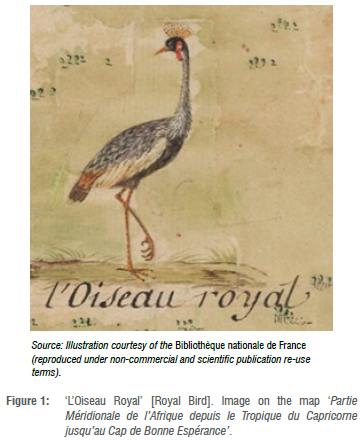
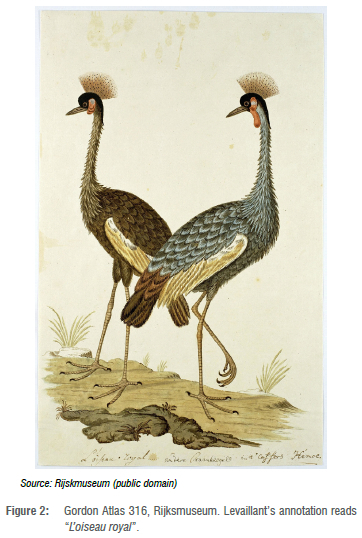
There is, however, one puzzling exception in the illustration of birds on the map Jean-Benjamin de Laborde produced for King Louis XVI based on Levaillant's travels. On this map, the painter of the birds on the map, J. Lebrecht Reinold, produced Figure 1 of a Grey Crowned Crane Balearica regulorum. This bird is not described in Levaillant's bird books, but the map clearly copied Gordon.
While there is much clearer evidence of how botanical illustrations were produced in the field and copied later9Figure 2), or part of it, was copied, miniaturised and used in a map in France a decade or so after its original production.
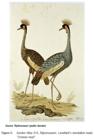
While Levaillant may not have benefitted from Gordon's collaboration in producing a comprehensive list of southern African birds, in examining Gordon's annotations he would have seen a range of observations and comments: on locations where the birds had been seen or shot; on song; on male and female plumages; on behaviour; on diet and prey items; on names given by colonists or Indigenous peoples; on phenomena such as mousebird torpor; on eggs and nests; and on countering myths about birds. In his later work, Levaillant drew on and expanded many of these observations and themes.
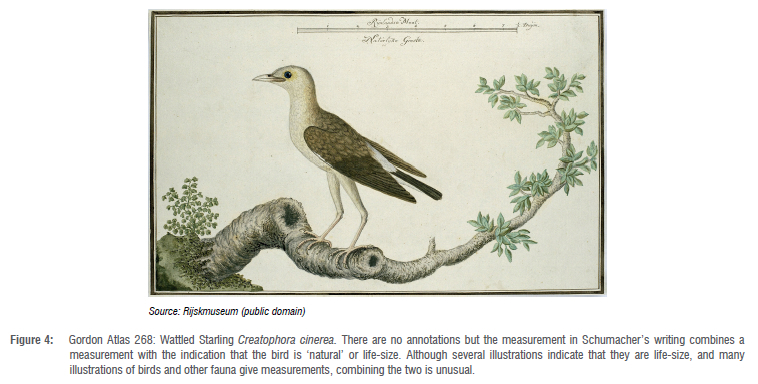
There is another way in which Gordon's birds were significant. They may not have been the first bird illustrations which add measurements and scales, but they were certainly one of the earliest. This seems to have been largely the work of Gordon's illustrator Schumacher, because the writing over many of the scales in the paintings is in his hand. In several cases, Schumacher and/or Gordon indicate that the birds have been painted life-size. If, as Mrs Gordon claimed, Gordon outlined the illustrations, it seems likely that he did this using a shot specimen with Schumacher completing the painting.
Here, again, this may not have been the very first time a bird artist claimed some aspect of their painting was life-size, as Mark Catesby had done this too.13
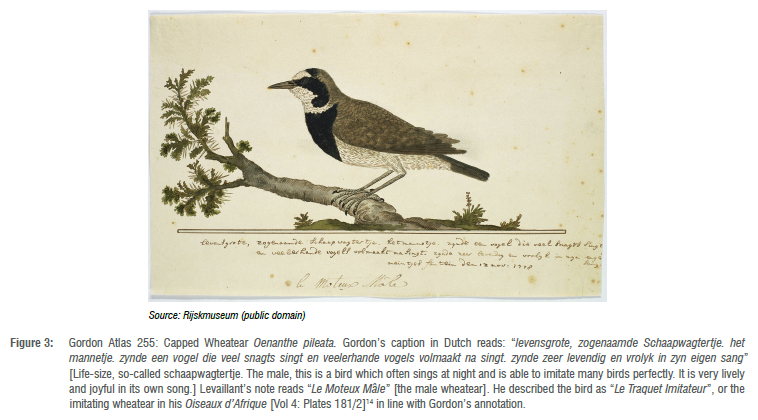
A few examples (Figures 3 and 4) show what and how Levaillant learnt from Gordon.
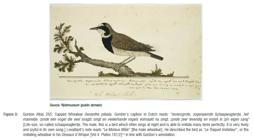
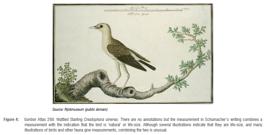
Levaillant too described the Capped Wheatear [Vol 4: 92-96] but with an interesting twist. Their sizes vary depending on the location, he argues. In most of the colony, they are "aussi grand que celui que j'ai fait dessiner, No. 181" [as big as the one that I had drawn in Plate 181], whereas, in more arid areas, they are smaller.14
In other respects, Schumacher's illustrations also innovated, perhaps at Gordon's suggestion. The birds are regularly portrayed with prey items such as grasshoppers or caterpillars. In other cases, their eggs are portrayed, also with the size indicated. There are several illustrations of nests.
Gordon's illustrations have their own interest besides the importance of Levaillant's collaboration. His description of the Black-winged Pratincole Glareola nordmanni shows that the bird was found far south of its current range during his time. There is another way in which he may have influenced early bird descriptions - in several cases, birds he described made it into their first official records via others like Sir Joseph Banks or William Paterson in the period between Levaillant's visit and the publication of his bird books. As Francis Masson took botanical specimens from Gordon to Banks, it seems quite plausible that Gordon also provided birds like the Ground Woodpecker. Levaillant himself recorded that Gordon sent several Wattled Starlings to Levaillant's friend Jacob Temminck when a large number flew as far south as Koeberg.15(p.179) This suggests that Gordon had a network of collectors in Europe.
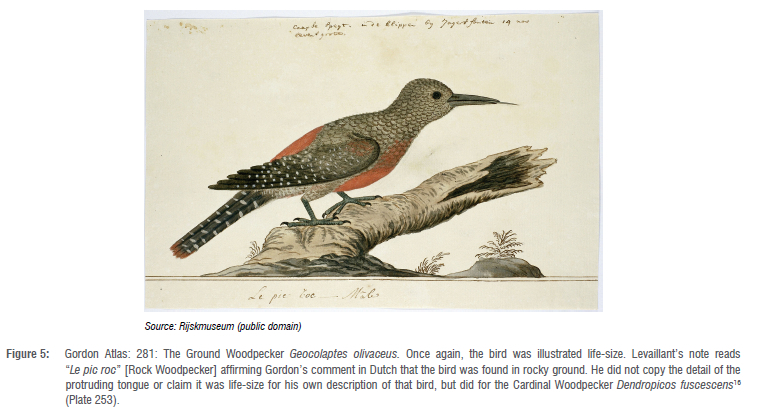
Two illustrations suggest that Schumacher was aware of complex details of avian physiognomy. In GA 240, his annotations to the Booted Eagle Hieraaetus pennatus noted that the bird had a "vlies dat he over sijn oog kan treken" [a membrane it can pull over its eye]. Although other observers had previously noted the phenomenon of the nictitating membrane, this suggests that Schumacher had dealt with a shot specimen and had examined it closely. As Figure 5 shows, he was also aware that woodpeckers have protruding tongues that they use to extract prey. This had been illustrated by Catesby almost contemporaneously in 1771.
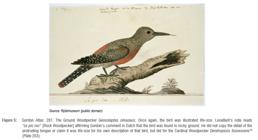
Had Levaillant not had the example of Gordon's illustrations, it is possible that he may have found some of these innovations in written texts when he returned to France, but it must surely have been a strong inspiration to see what illustrations of African birds could involve when looking at Gordon's illustrations.
The annotations and problem cases
Rookmaaker was the first to note that the French annotations were from Levaillant, but noted only that "there is very little agreement between the names given in the Gordon Atlas and those in Levaillant's published work"2
In the case of GA 239: Verreaux's Eagle Aquila verreauxii, Levaillant annotated this as "L'aigle noir" with Gordon's "Swarte arend van de Kaap". This is puzzling for several reasons. First, as it seems the bird was quite well known, why was no specimen reported for another 50 years? Second, in the University of Leiden Plate UBL 67, which is a reverse of Levaillant's mysterious 'Le Caffre'1217(p.201-202)
Gordon suggested in his annotation that the Bokmakierie Telophorus zeylonus (GA 259) was known as the "elandsvoel" or eland bird, apparently because the Khoi associated this bird with eland (Taurotragus oryx).18
The third puzzling case is in Levaillant's annotation to the Amethyst Sunbird Chalcomitra amethystina (GA 274) in which he wrote "Sucrie améthiste", although he himself called it the "Sucrier velours" or Velvet Sunbird in his own account (Vol 6: Plate 29416
From collector to writer and fieldworker to ornithologist
Why did Levaillant not copy the illustrations or the data of the other birds that Gordon had discovered and illustrated for his bird books as he copied illustrations of plants from Gordon?917,19
There are other reasons to suggest Levaillant did not come to Africa with the idea of writing bird books. His primary concern was to take back valuable and rare birds. This explains why he did not describe well-known and easy to find birds such as common doves or sparrows or even an ostrich. For Levaillant, with his unparalleled taxidermy skills at the time, it must have seemed logical to rely on his specimens when he later turned to writing bird books, as he could then give anatomical details whereas plant specimens were simply not available or a realistic option.
In the preface to the first volume12Oiseaux d'Afrique, Levaillant described his bitter disappointment that his collection - of birds, animals and material objects - had not yielded him the hoped-for sale to the state and a pension paid to those who had made a major contribution to learning in France. He complained about being betrayed, about injustices, and about the very reduced amount he was being offered for his collection, but, in crucial ways, this disappointment made him a major figure in ornithology rather than an important footnote in collecting history. Levaillant had exhorted Gordon to draw inspiration from his own writing to move from being a localised fieldworker and supplier of specimens to being an authority for all of Europe. A few years later, he applied this lesson to himself. As he put it in his introduction:
Un autre espoir m'occupe aujourd'hui entièrement, et me fera peut-être oublier d'aussi longues injustices. Livré tout entier aux soins que demande mon Ornithologie, je me console de ne pas voir au rang des richesses nationales l'humble mais rare tribut que je venois offrir à ma patrie; je donnerai mes oiseaux à l'Europe entière : j'en ai multiplié les portraits fidèlement peints, et aussi fidèlement décrits; ils seront pour les amateurs et pour les savans une propriété plus précieuse; ils pourront les consulter, les visiter à toute heure; les originaux sortiroient en vain de France, nul événement ne peut plus leur porter atteinte; tous les dessins de mon Ornithologie sont achevés.11
[Another hope occupies me entirely today and will perhaps make me forget injustices suffered for so long. Completely devoted to the care that my Ornithology demands, I console myself for not seeing among the ranks of national wealth the humble but rare tribute that I came to offer to my country. I will give my birds to all of Europe. I have multiplied the portraits faithfully painted, and as faithfully described; they will be a more precious property for lovers of science and for scholars. They will be able to consult them, to visit them at any time; the originals would leave France in vain, no event can now harm them; all the plans of my Ornithology have been achieved.] (My translation)
This passage echoes the address to Gordon in important ways. In both cases, the fieldworker's duty is to offer insights to a larger Europe-wide imagined community of lovers of science and of savants - an admirable sentiment in the middle of major European wars.
Levaillant's collection was in time sold, through his divorced wife's actions, to the Natural History Museum, for far less than he had hoped, but by then Levaillant was providing a substitute for museum exhibits in his books. For a fieldworker to become a major ornithological authority without scientific training or the resources of a major institution or collaborators in South Africa was enormously difficult and many of the errors in his work no doubt arose because of the challenges he faced.
Levaillant knew of the work of leading French ornithological authorities such as Buffon and Brisson and referred to them regularly; but in Gordon's work he had found an example of an African fieldworker not trying to build a valuable collection of objects or simply record anatomical details but to record birds and their behaviour - for all of Europe. Working with Gordon seems to have helped Levaillant move to claim the authority to write encyclopaedic compendia as an ornithological fieldworker, becoming one of the first to do so.
In the battle between fieldworker and metropolitan authority, Levaillant's wish that Gordon had published his findings also spurred himself on to publish his bird books. And, in urging Gordon to publish his complementary research, in the passage quoted earlier, Levaillant puts the fieldworkers in collaboration - working for the benefit of European science, but with their local knowledge. Science, in this view, does not belong to the professors of zoology in Paris but to the publishing fieldworkers working in complement.
Conclusion
This collaboration between fieldworkers with very different backgrounds, interests and aims may have benefitted Gordon marginally by consolidating his sense of his own findings. He may also have learnt some of Levaillant's taxidermy techniques, enabling him to send bird specimens to European collectors.
Gordon's influence on Levaillant cannot be separated neatly from other developments in ornithology that may have influenced him, but the evidence of the annotations suggests he helped shape Levaillant's subsequent development. In finding another highly knowledgeable fieldworker, Levaillant may have gained confidence in asserting his accounts against those of the metropolitan classifiers. Tensions between the fieldworker claiming the authority of his experience against the distant expertise of the metropolitan theorist recur repeatedly in Levaillant's travel accounts and bird books and his collaboration with Gordon strengthened his sense of the value of fieldwork. The topics Gordon covered in his annotations made their way into Levaillant's accounts of birds, helping him move from the description of specimens and taxonomy to behaviour and location. The illustrations also offered a form of disciplinary infrastructure in the scales and references to life-size portraits that helped Levaillant later.
Levaillant's comments on the illustrations also help explain some of his later lacunae and errors. His failure to record what Gordon had to offer, or to copy these illustrations, suggests that at the time he was focused on taking specimens for himself and Temminck and had no plans to write any bird books. Had European history been different, one could imagine that Levaillant might have continued to consult Gordon and benefit from his knowledge and observations, particularly given the mutual association with Temminck, but the French Revolution and events at the Cape leading to Gordon's suicide in 1795 made that impossible.
Funding
Funding was received from the South African National Research Foundation (grant no. 108838).
Data availability
There are no data pertaining to this article.
Declarations
I have no competing interests to declare. I have no AI or LLM use to declare.
References
- 1. Cullinan P. Robert Jacob Gordon 1743-1795: The man and his travels at the Cape. Cape Town: Struik Winchester; 1992.
- 2. Rookmaaker LC. The zoological exploration of southern Africa 1650-1790. Rotterdam: A.A. Balkema; 1989.
-
3. Huigen S. Knowledge and colonialism: Eighteenth-century travellers in South Africa. Leiden: Brill; 2009. https://doi.org/10.1163/ej.9789004177437.i-314
» https://doi.org/10.1163/ej.9789004177437.i-314 - 4. Stresemann E. Ornithology from Aristotle to the present. Cambridge, MA: Harvard University Press; 1975.
-
5. Farber PL. The emergence of ornithology as a scientific discipline: 1760-1850. Dordrecht: Reidel; 1982. https://doi.org/10.1007/978-94-009-7819-5
» https://doi.org/10.1007/978-94-009-7819-5 -
6. Beinart W, Dubow S. The scientific imagination in South Africa: 1700 to the present. Cambridge: Cambridge University Press; 2021. https://doi.org/10.1017/9781108938198
» https://doi.org/10.1017/9781108938198 - 7. Le Vaillant F, Glenn I, Farlam I, Lauga Du Plessis C, translators and editors. Travels into the Interior of Africa via the Cape of Good Hope. Cape Town: Van Riebeeck Society; 2007.
-
8. Le Vaillant F. Second voyage dans l'intérieur de l'Afrique, par le Cap de Bonne-Espérance: Dans les années 1783, 84 et 85 [Second voyage into the African interior, by way of the Cape of Good Hope, in the years 1783, 84 and 85]. Paris: H.J. Jansen; 1795. French. https://doi.org/10.5962/bhl.title.101758
» https://doi.org/10.5962/bhl.title.101758 - 9. Glenn I. François Le Vaillant: Resistant botanist? In: Batsaki Y, Cahalan SB, Tchikine A, editors. The botany of empire in the long eighteenth century. Washington DC: Dumbarton Oaks; 2016. p. 143-164.
-
10. Glenn I. Eighteenth-century natural history, travel writing and South African literary historiography. In: Attwell D, Attridge D, editors. The Cambridge history of South African literature. Cambridge: Cambridge University Press; 2012. p. 158-179. https://doi.org/10.1017/CHOL9780521199285.010
» https://doi.org/10.1017/CHOL9780521199285.010 - 11. Glenn I. Francois Levaillant and the mapping of southern Africa. Alternation. 2007;14(2):25-39.
-
12. Levaillant F. Histoire naturelle des oiseaux d'Afrique: Vol 1 [The natural history of African birds: Vol 1]. Paris: J.J. Fuchs; 1799. French. https://doi.org/10.5962/bhl.title.63636
» https://doi.org/10.5962/bhl.title.63636 -
13. Catesby M, Edwards G, White B. The natural history of Carolina, Florida, and the Bahama Islands: Containing the figures of birds, beasts, fishes, serpents, insects, and plants; particularly, those not hitherto described, or incorrectly figured by former authors, with their descriptions in English and French; to which is prefixed, a new and correct map of the countries; with observations on their natural state, inhabitants, and productions. London: Printed for Benjamin White; 1771. https://doi.org/10.5962/bhl.title.58835
» https://doi.org/10.5962/bhl.title.58835 - 14. Levaillant F. Histoire naturelle des oiseaux d'Afrique: Vol 4 [The natural history of African birds: Vol 4]. Paris: Delauchaussée; 1805. French.
-
15. Levaillant F. Histoire naturelle des oiseaux d'Afrique: Vol 2 [The natural history of African birds: Vol 2]. Paris: J.J. Fuchs; 1799. French. https://doi.org/10.5962/bhl.title.63636
» https://doi.org/10.5962/bhl.title.63636 - 16. Levaillant F. Histoire naturelle des oiseaux d'Afrique; Vol 6 [The natural history of African birds: Vol 6]. Paris: Delachaussée; 1808. French.
- 17. Rookmaaker LC, Mundy P, Glenn I, Spary E. François Levaillant and the birds of Africa. Johannesburg: Brenthurst Press; 2004.
- 18. du P Scholtz J. Uit die geskiedenis van die naamgewing aan plante en diere in Afrikaans [From the history of naming plants and animals in Afrikaans]. Cape Town: Nasionale Pers; 1941. Afrikaans.
-
19. Rookmaaker LC, Morris PA, Glenn IE, Mundy PJ. The ornithological cabinet of Jean-Baptiste Bécoeur and the secret of the arsenical soap. Arch Nat Hist. 2006;33(1):146-158. https://doi.org/10.3366/anh.2006.33.1.146
» https://doi.org/10.3366/anh.2006.33.1.146

Revised: 22 Jan. 2026
Revised: 31 May 2026
Accepted: 24 July 2026
Published: 29 Sep. 2026
Funding: South African National Research Foundation (108838)