An assessment of the likely impact of strain-related phenotypic plasticity on hominin fossil species identification
Abstract
It has been proposed that strain-related phenotypic plasticity may be a major confounding factor in attributing hominin fossils to species. The study reported here tested this hypothesis with craniometric data from the great apes and Colobus guereza. We divided the measurements into three groups: measurements of features subject to high masticatory strain, measurements of features subject to low-to-moderate masticatory strain, and measurements of features that do not remodel and therefore are not prone to strain-related phenotypic plasticity. Next, we used the coefficient of variation and ANOVA to investigate whether masticatory strain is a cause of variability. These analyses partially supported the hypothesis. The predicted differences between the high-strain measurements and the other measurements were found in the majority of the species. However, the coefficient of variation values for the low-to-moderate strain and non-phenotypically plastic measurements were indistinguishable. Thereafter, we used discriminant function analysis to compare the ability of the three groups of measurements to assign specimens to species. This analysis did not support the hypothesis. The high-strain measurements were less effective than the other measurements, but the low-to-moderate strain measurements were more effective than the non-phenotypically plastic measurements. In addition, better discrimination was achieved when all the measurements were employed than when just the non-phenotypically plastic measurements were utilised. We conclude from this that strain-related phenotypic plasticity is unlikely to impede hominin alpha taxonomic research.
phenotypic plasticity; hominin; taxonomy; species identification; strain; mastication; hominoid
Introduction
Phenotypic plasticity is the expression by a genotype of different phenotypes in response to different environmental conditions.1223–7 For example, mechanical loading experienced during development has been found to affect both the growth of cortical bone in diaphyses and the growth of trabecular bone in epiphyses.892
Wood and Lieberman2Gorilla gorilla, Homo sapiens, Pan troglodytes and Pongo pygmaeus, and one cercopithecoid species, Colobus guereza. They divided the measurements into three groups based on their likelihood of exhibiting phenotypic plasticity, and then computed the coefficient of variation of each measurement for each species. Subsequently, they compared the mean coefficient of variations for the three groups of measurements on a species-by-species basis. Wood and Lieberman's22
Recently, Collard and Lycett1021021010102
Here, we describe a second study that explicitly tests Wood and Lieberman's2210210
Materials and methods
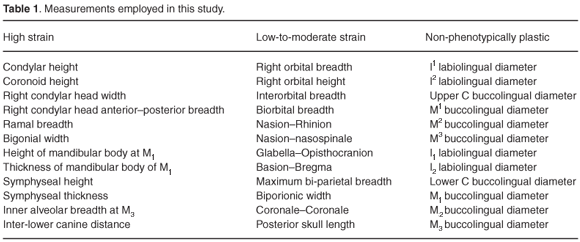
The dataset comprised values for 36 measurements recorded on 37 Gorilla gorilla (20 males, 17 females), 75 Homo sapiens (40 males, 35 females), 35 Pan troglodytes (13 males, 22 females), 41 Pongo pygmaeus (20 males, 21 females) and 24 Colobus guereza (12 males, 12 females). The measurements were selected on the basis of current knowledge of their likely propensity to exhibit phenotypic plasticity as a result of mastication-related strain. Twelve were dental measurements. Since dental enamel does not remodel, these were designated non-phenotypically plastic characters. Labiolingual and buccolingual tooth crown dimensions were used in order to avoid the confounding effect of interstitial wear.11µε during mastication12–15. These measurements were designated high-strain measurements, because strain in the order of 1 000 µε is known to be capable of inducing bone growth.9µε during mastication. These measurements were designated low-to-moderate strain measurements. Further details of the measurements are given in Table 1. The data were taken from Wood et al.162
We employed the dataset in two sets of analyses. These were similar to the ones carried out by Collard and Lycett.102α < 0.05). Since ANOVA assumes data are normally distributed,1722 18222
Results
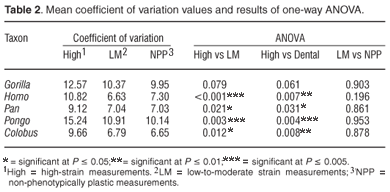
Table 2 shows the mean coefficient of variation of each variable group for each taxon as well as the results of the least significant difference pairwise comparisons following a one-way ANOVA. The mean coefficient of variation for the high-strain measurements was consistently higher than the mean coefficient of variation for the low-to-moderate strain measurements and for the non-phenotypically plastic measurements. However, the differences were only significant in H. sapiens, P. troglodytes, P. pygmaeus and C. guereza. In G. gorilla the high-strain measurements were more variable than the low-to-moderate strain measurements and the non-phenotypically plastic measurements, but the differences were not statistically significant at the 0.05 level. The low-to-moderate strain measurements were not significantly more variable than the non-phenotypically plastic measurements in any of the species. They were more variable than the non-phenotypically plastic measurements in G. gorilla, P. troglodytes, P. pygmaeus and C. guereza, but none of the differences were statistically significant. In the case of H. sapiens the non-phenotypically plastic measurements were more variable than the low-to-moderate strain measurements although the difference was not significant. Thus, the results of the coefficient of variation analysis were only partially consistent with the prediction that the high strain measurements should exhibit greater phenotypic plasticity than the low-to-moderate strain measurements, and that the latter should exhibit greater phenotypic plasticity than the non-phenotypically plastic measurements.
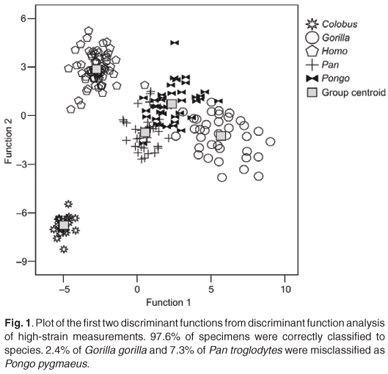
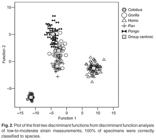
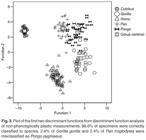
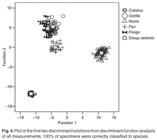
The first four discriminant functions were used in the discriminant function analyses. Plots of the first two discriminant functions from each analysis are presented in Figs 1–4. The high-strain measurements correctly classified 97.6% of specimens, the low-to-moderate strain measurements 100% and the non-phenotypically plastic measurements 98.6%. When all the measurements were analysed together, 100% of the specimens were correctly classified. Thus, the results of the discriminant function analysis did not support Wood and Lieberman's2
Discussion and conclusions
The results of the coefficient of variation analysis reported here were comparable to the results of the coefficient of variation analysis carried out by Collard and Lycett.1022G. gorilla, the predicted differences were present but did not reach statistical significance. In addition, the coefficient of variation values for the low-to-moderate strain measurements and the non-phenotypically plastic measurements were statistically indistinguishable.
The results of the discriminant function analysis reported here were also comparable to the discriminant function analysis results obtained by Collard and Lycett.1022
Taken together, the results of this study and those obtained by Collard and Lycett10222
With regard to alternative strategies for improving understanding of the species-level diversity of the fossil hominins, it is noteworthy that in both this study and Collard and Lycett's10
M.C. is supported by the Social Sciences and Humanities Research Council, the Canada Research Chairs Program, the Canada Foundation for Innovation, the British Columbia Knowledge Development Fund, and Simon Fraser University. S.J.L. is supported by the British Academy Centenary Research Project, Lucy to Language.
References
- 1. Reidl R.J. (1978). Order in Living Organisms. Wiley, New York.
- 2. Wood B.A. and Lieberman D.E. (2001). Craniodental variation in Paranthropus boisei: a developmental and functional perspective. Am. J. Phys. Anthropol. 116, 13–25.
- 3. Lanyon L.E. and Rubin C.T. (1985). Functional adaptation in skeletal structures. In Functional Vertebrate Morphology, eds M. Hildebrand, D.M. Bramble, K.F. Liem and D.B. Wake, pp. 1–25. Harvard University Press, Cambridge, MA.
- 4. Frost H.M. (1998). From Wolff's law to the mechanostat: a new 'face' of physiology. J. Ortho. Sci. 3, 282–286.
- 5. Herring S.W. (1993). Epigenetic and functional influences on skull growth. In The Skull, vol. 1, eds J. Hanken and B.K. Hall, pp. 153–206. Chicago University Press, Chicago.
- 6. Lieberman D.E. (1997). Making behavioral and phylogenetic inferences from hominid fossils: considering the developmental influence of mechanical forces. Ann. Rev. Anthropol. 26, 185–210.
- 7. Skerry T. (2000). Biomechanical influences on skeletal growth and development. In Development, Growth and Evolution: Implications for the Study of the Hominid Skeleton, eds P. O'Higgins and M.J. Cohn, pp. 29–39. Academic Press, London.
- 8. Lieberman D.E. and Crompton A.W. (1998). Responses of bone to stress. In Principles of Biological Design: the Optimization and Symmorphosis Debate, eds E. Wiebel, C. Taylor and L. Bolis, pp. 78–86. Cambridge University Press, Cambridge.
- 9. Martin R.B., Burr D.B. and Sharkey N.A. (1998). Skeletal Tissue Mechanics. Springer, New York.
- 10. Collard M. and Lycett S.J. (2008). Does phenotypic plasticity confound attempts to identify hominin fossil species? An assessment using extant Old World monkey craniodental data. Fol. Primatol. 79, 111–122.
- 11. Hinton R.J. (1982). Differences in interproximal and occlusal tooth-wear among prehistoric Tennessee Indians: implications for masticatory function. Am. J. Phys. Anthropol. 57, 103–115.
- 12. Hylander W.L., Picq P.G. and Johnson K.R. (1991). Masticatory stress hypotheses and the supraorbital region of primates. Am. J. Phys. Anthropol. 86, 1–36.
- 13. Hylander W.L. and Johnson K.R. (1994). Jaw muscle function and wishboning of the mandible during mastication in macaques and baboons. Am. J. Phys. Anthropol. 94, 523–547.
- 14. Hylander W.L. and Johnson K.R. (1997). In vivo bone strain patterns in the zygomatic arch of Macaques and the significance of these patterns for functional interpretations of craniofacial form. Am. J. Phys. Anthropol. 102, 203–232.
- 15. Ross C.F. (2001). In vivo function of the craniofacial haft: the interorbital 'pillar'. Am. J. Phys. Anthropol. 116, 108–139.
- 16. Wood B.A., Li Y. and Willoughby C. (1991). Intraspecific variation and sexual dimorphism in cranial and dental variables among higher primates and their bearing on the hominid fossil record. J. Anat. 174, 185–205.
- 17. Sokal R.R. and Rohlf F.J. (1995). Biometry. Freeman, New York.
- 18. Huberty C. (1994). Applied Discriminant Analysis. Wiley, New York.