Stakeholder insights and policy recommendations from the InnoFoodAfrica Project on traditional African foods
SIGNIFICANCE: Supporting systems that provide healthy and safe food ingredients and products and environmentally sustainable nutrition and food security solutions are key local priorities. To achieve these priorities in South Africa, multilevel and multiagency support is needed by smallholder farmers to expand the cultivation, growing, distribution, marketing, and production of indigenous and traditional African food crops (ITFC) and ingredients, as well as the sale, acceptance, and consumption of ITFCs. Public education is required to transform local perspectives on protein intake and the benefits of ITFCs. The government must exempt ITFCs from VAT to promote their mainstream commercial viability.
indigenous and traditional African food crops; stakeholder engagement; sustainable nutrition; food security; food innovations
Stakeholder insights and policy recommendations from the InnoFoodAfrica Project on traditional African foods
Katherine A. SmithI; Mohammad N. EmmambuxII; Shakila DadaI
ICentre for Augmentative and Alternative Communication, Faculty of Humanities, University of Pretoria, Pretoria, South Africa
IIDepartment of Consumer and Food Sciences, Faculty of Natural and Agricultural Sciences, University of Pretoria, Pretoria, South Africa
SIGNIFICANCE:
Supporting systems that provide healthy and safe food ingredients and products and environmentally sustainable nutrition and food security solutions are key local priorities. To achieve these priorities in South Africa, multilevel and multiagency support is needed by smallholder farmers to expand the cultivation, growing, distribution, marketing, and production of indigenous and traditional African food crops (ITFC) and ingredients, as well as the sale, acceptance, and consumption of ITFCs. Public education is required to transform local perspectives on protein intake and the benefits of ITFCs. The government must exempt ITFCs from VAT to promote their mainstream commercial viability.
Keywords: indigenous and traditional African food crops, stakeholder engagement, sustainable nutrition, food security, food innovations
Malnutrition is considered Africa's most pressing health and social challenge.123345(p.20).
The sub-Saharan African diet commonly includes an inadequate intake of animal products and vegetables.67
Local shifts toward urbanisation and changing agricultural production have affected the security of a healthy, acceptable, diverse and affordable food supply.8983,10
Indigenous and traditional food crops (ITFCs), such as sorghum, Bambara groundnut and cowpea, have marked potential to diversify diets and offer viable alternatives to enhance food and nutrition security.11121314
The InnoFoodAfrica (IFA) project, funded by the European Union, aims to create new value chains of ITFCs to produce and distribute healthy foods and bio-based materials for packaging from farms to local and export markets. IFA demonstrates the potential of African ITFCs as healthy food ingredients to combat malnutrition in children and pregnant women and the undernutrition risk in adults. The project has developed technologies and methods combined with capacity-building, communication, and business models to improve farming practices and nutrition, and to produce healthy ingredients and foodstuffs as well as packaging materials to reduce loss. The project involves 13 African and 5 European partners, comprising 5 research and technology organisations, 6 universities, 3 non-governmental organisations, and 4 private enterprises.
Coordinated policy, programmatic and research efforts are required to address malnutrition, food insecurity and environmental sustainability to address complex nutrition and food security challenges in South Africa. Stakeholder engagement is one way to facilitate the impact of research and promote the practical consideration and implementation of research findings and recommendations and put forward meaningful policy recommendations from research.1415(p.5). Stakeholder engagement assists researchers to draw meaningful insights from research findings and identify policy and implementation gaps. Given the central role that research plays in promoting sustainability16
A hybrid stakeholder workshop was hosted at the University of Pretoria's Future Africa Campus during their biennial 'Africa Week' science leadership event. Invitations were extended broadly to higher education institutions, the agricultural and farming industry, non-profit organisations, governmental agencies, and organisations, and shared through the Africa Week advertisements and webpage. A total of 42 stakeholders attended in person and 2 stakeholders attended virtually. Stakeholders represented academic and higher education institutions (9), food and beverage manufacturing, processing, and/or safety organisations (20), local research organisations (6), agricultural and farming industries (4), a national non-profit organisation (1), and governmental agencies or organisations (2). The workshop was also attended virtually by three of the funding partners and in person by nine IFA associates. Seven students from the University of Pretoria who were directly involved in the project contributed to the presentations and/or discussions.
Stakeholder engagement was bidirectional and collaborative as the stakeholders were included to improve the uptake of the research and facilitate policy recommendations.14
The stakeholder workshop was facilitated by a researcher (S.D.) with experience in stakeholder engagement. The facilitator started the workshop by detailing the primary aim of the workshop, explaining that stakeholder engagement was essential to ensure that the project had extensions beyond the research value to emphasise the impact of IFA research. Firstly, a brief overview of the IFA project aims, planned outputs and overarching objectives were shared. The workshop was divided into four sessions with different but complimentary foci, namely (1) consumer and nutrition studies, (2) farmers' participatory research, (3) food ingredients, food products and bio-packaging innovation, and (4) a summary and final comments. Each session started with a summary presentation on the primary aims and outputs of the research and an interactive question-and-answer session. Thereafter, there was an individual reflection session in which stakeholders made notes and, lastly, a facilitated reflection and discussion session.
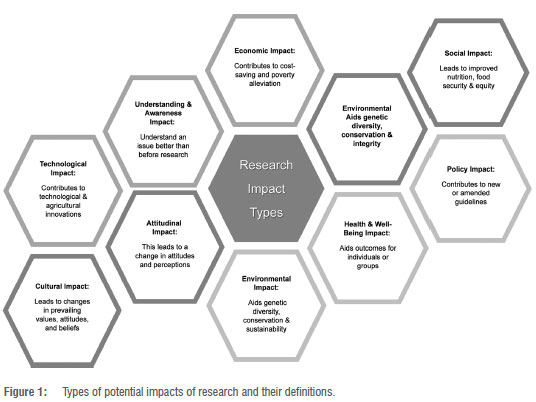
Stakeholders were provided with a summary graphic detailing the different types of potential impacts of research and their definitions (Figure 1). The impact summary graphic was developed based on literature in the field.17
Stakeholders were provided with sticky notes and requested to make notes focused on the different impact points during the presentations, reflection and discussion sessions. The sticky notes were collected after each session. Furthermore, summary notes were displayed on a board at the front of the venue and additional summary notes were compiled by a scribe during each reflection and discussion session. During the fourth and final session of the day, the workshop facilitator provided feedback to the stakeholders on the summary points drawn from their reflection; the main takeaway points and the identified roles of the responsible partners were also reintroduced and discussed. Following the workshop, one author (K.S.) compiled summaries of the notes, sticky notes and discussions. These summaries were sent to the IFA project partners and discussed between the authors (K.S., S.D., M.N.E.).
Stakeholder reflections acknowledged the commercial potential of the IFA innovations in terms of addressing food systems and nutrition challenges in a sustainable and comprehensive way. However, they further identified that scaling up the production of food ingredients and food products, to the commercial level required for them to make notable changes, would be hampered by the insufficient and inconsistent supply.
The impact of value-added tax (VAT) on commercial food and beverage producers and consumers was a key challenge to this endeavour. The potential for sidestream income from the bio-packaging innovation was highlighted as a positive financial contributor to an alternative income source for farmers, as existing machinery can be used in a novel way to produce bio-packaging.
Discussions during the sessions centred largely around the need to develop food systems that supply healthy, affordable and nutrient-dense foods to the South African population. The potential benefits of ITFCs to meet this agenda were acknowledged by the stakeholders. Stakeholders identified two main barriers related to the mainstreaming of ITFCs. Firstly, the cost of food and food ingredients from ITFCs could be more competitive compared to that of maize meal if they were VAT exempted. Secondly, there is a need for awareness of the Paediatric Food Based Dietary Guidelines of South Africa.18
Market potential needs to be developed and mainstream consumer demand needs to be increased to develop and sustain ITFC farming and food systems.19202121
The literature identifies that the dearth of reliable data about smallholder farmers in South Africa is a major contributing factor to the lack of support offered to them.20,2120,2121
There is a concurrent need for governmental policies to be developed and implemented that address food distribution and marketing, which historically have been left mainly to private entities.33 193,19
Caregivers at schools, among others, must be made aware of the importance of feeding the children affordable protein-rich foods such as legumes, eggs and fish. Caregivers also need to be educated on appropriate complementary feeding and education should focus on the first 1000 days of life. An updated school curriculum is required to include a renewed focus on nutrition and the Paediatric Food Based Dietary Guidelines of South Africa. Education should encourage plant-based diets to promote a transformation of local perspectives on protein intake. Despite their multiple benefits, negative perceptions and attitudinal barriers affect the acceptance of many ITFCs, and there needs to be more awareness about the benefits of ITFCs.11311
Another critical limiting factor to the mainstreaming of ITFCs identified by the stakeholders was the cost of including ITFCs as wide-scale commercialised food ingredients. While there are multiple factors that culminate to influence food insecurity and malnutrition, the affordability of food purchases is central for both urban and rural consumers.922
Multifaceted support is required in a circular fashion to boost the cultivation, growth, distribution, marketing and production of food ingredients as well as the selling, acceptance and consumption of ITFCs. To realise the aim of mainstreaming ITFCs, consistent support is required from the government in terms of policy and implementation, with further support from private entities.
Declarations
We have no competing interests to declare. We have no AI or LLM use to declare. All authors read and approved the final manuscript.
Acknowledgements
We acknowledge Dr Marinel Rothman, Prof. Riette de Kock, Prof. Quenton Kritzinger, Dr Danie Jordaan, Dr Diana Marais, the students from the various work packages of the University of Pretoria, and the various stakeholders who participated for their contributions to the stakeholder engagement workshop. This project was funded by the European Union's Horizon 2020 Research and Innovation Programme under grant agreement no. 862170. The views and opinions expressed are those of the authors and do not necessarily reflect those of the funders.
References
-
1. African Union. Africa regional nutrition strategy 2015-2025. Addis Ababa: African Union; 2022. Available from: https://au.int/sites/default/files/pages/32895-file-arns_english.pdf
» https://au.int/sites/default/files/pages/32895-file-arns_english.pdf -
2. Mkhize M, Sibanda M. A review of selected studies on the factors associated with the nutrition status of children under the age of five years in South Africa. Int J Environ Res Public Health. 2020;17(21), Art. #7973. https://doi.org/10.3390/ijerph17217973
» https://doi.org/10.3390/ijerph17217973 -
3. Mabhaudhi T, Chibarabada T, Chimonyo V, Murugani V Pereira L, Sobratee N, et al. Mainstreaming underutilized indigenous and traditional crops into food systems: A South African perspective. Sustainability. 2018;11(1), Art. #172. https://doi.org/10.3390/su11010172
» https://doi.org/10.3390/su11010172 -
4. Statistics South Africa. Demographic and health survey 2016. Key indicators report. Pretoria: Statistics South Africa; 2017. Available from: http://www.statssa.gov.za/publications/Report%2003-00-09/Report%2003-00-092016.pdf
» http://www.statssa.gov.za/publications/Report%2003-00-09/Report%2003-00-092016.pdf -
5. Nannan N, Laubscher R, Nel JH, Neethling I, Dhansay MA, Turawa EB, et al. Estimating the changing burden of disease attributable to childhood stunting, wasting and underweight in South Africa for 2000, 2006 and 2012. S Afr Med J. 2022;112(8):676-683. https://doi.org/10.7196/SAMJ.2022.v112i8b.16497
» https://doi.org/10.7196/SAMJ.2022.v112i8b.16497 -
6. Mudogo CM. Vulnerability of urban poor women and children to the triple burden of malnutrition: A scoping review of the sub-Saharan Africa environment. J Med Res. 2017;17(4):9-16. Available from: https://api.semanticscholar.org/CorpusID:80789091
» https://api.semanticscholar.org/CorpusID:80789091 -
7. Oladiran DA, Emmambux NM. Locally available African complementary foods: Nutritional limitations and processing technologies to improve nutritional quality -A review. Food Rev Int. 2022;38(5):1033-1063. https://doi.org/10.1080/87559129.2020.1762640
» https://doi.org/10.1080/87559129.2020.1762640 -
8. Thow AM, Schönfeldt H, deKock R, Viljoen A, duRand G, Gericke G, et al. Policy for the complex burden of malnutrition in Africa: A research agenda to bring consumers and supply chains together. Public Health Nutr. 2017;20(6):1135-1139. https://doi.org/10.1017/S1368980016003050
» https://doi.org/10.1017/S1368980016003050 -
9. Misselhorn A, Hendriks SL. A systematic review of sub-national food insecurity research in South Africa: Missed opportunities for policy insights. PLoS ONE. 2017;12(8), Art. #0182399. https://doi.org/10.1371/journal.pone.0182399
» https://doi.org/10.1371/journal.pone.0182399 -
10. Bain LE, Awah PK, Geraldine N, Kindong NP, Sigal Bernard N, et al. Malnutrition in sub-Saharan Africa: Burden, causes and prospects. Pan Afr Med J. 2013;15(1), Art. #120. https://doi.org/10.11604/pamj.2013.15.120.2535
» https://doi.org/10.11604/pamj.2013.15.120.2535 -
11. Akinola R, Pereira LM, Mabhaudhi T, De Bruin FM, Rusch L. A review of indigenous food crops in Africa and the implications for more sustainable and healthy food systems. Sustainability. 2020;12(8), Art. #3493. https://doi.org/10.3390/su12083493
» https://doi.org/10.3390/su12083493 -
12. Republic of South Africa. National policy on food and nutrition security. Pretoria: Government Printers; 2014. https://www.gov.za/sites/default/files/gcis_document/201409/37915gon637.pdf
» https://www.gov.za/sites/default/files/gcis_document/201409/37915gon637.pdf -
13. Mushaphi L, Dannhauser A, Walsh C, Mbhenyane X, Van Rooyen F. The impact of a nutrition education programme on feeding practices of caregivers with children aged 3 to 5 years in rural Limpopo Province, South Africa. S Afr J Clin Nutr. 2017;30(4):101-108. https://doi.org/10.1080/16070658.2017.1322823
» https://doi.org/10.1080/16070658.2017.1322823 -
14. Warren AM, Constantinides SV, Blake CE, Frongillo EA. Advancing knowledge about stakeholder engagement in multisectoral nutrition research. Glob Food Sec. 2021;29, Art. #100521. https://doi.org/10.1016/j.gfs.2021.100521
» https://doi.org/10.1016/j.gfs.2021.100521 -
15. Deverka PA, Lavallee DC, Desai PJ, Esmail LC, Ramsey SD, Veenstra DL, et al. Stakeholder participation in comparative effectiveness research: Defining a framework for effective engagement. J Comp Eff Res. 2012;1(2):181-194. https://doi.org/10.2217/cer.12.7
» https://doi.org/10.2217/cer.12.7 -
16. Weiβhuhn P Helming K, Ferretti J. Research impact assessment in agriculture -A review of approaches and impact areas. Res Eval. 2018;27(1):36-42. https://doi.org/10.1093/reseval/rvx034
» https://doi.org/10.1093/reseval/rvx034 -
17. Reed MS, Ferré M, Martin-Ortega J, Blanche R, Lawford-Rolfe R, Dallimer M, et al. Evaluating impact from research: A methodological framework. Res Policy. 2020;50(4), Art. #104147. https://doi.org/10.1016/j.respol.2020.104147
» https://doi.org/10.1016/j.respol.2020.104147 -
18. Vorster HH, Badham JB, VenterCS. An introduction to the revised food-based dietary guidelines for South Africa. S Afr J Clin Nutr. 2013;26(3suppl):S5-S12. Available from: https://www.sajcn.co.za/index.php/SAJCN/article/view/2244
» https://www.sajcn.co.za/index.php/SAJCN/article/view/2244 -
19. Mbhenyane XG. Indigenous foods and their contribution to nutrient requirements. S Afr J Clin Nutr. 2017;30(4):5-7. https://doi.org/10.10520/EJC-c6be5ce48
» https://doi.org/10.10520/EJC-c6be5ce48 -
20. Okunlola A, Ngubane M, Cousins B, du Toit A. Challenging the stereotypes: Small-scale black farmers and private sector support programmes in South Africa: A national scan. Cape Town: Institute for Poverty, Land and Agrarian Studies, School of Government, Faculty of Economic and Management Sciences, University of the Western Cape; 2014. Available from: https://africaportal.org/publication/challenging-the-stereotypes-small-scale-black-farmers-and-private-sector-support-programmes-in-south-africa-a-national-scan/
» https://africaportal.org/publication/challenging-the-stereotypes-small-scale-black-farmers-and-private-sector-support-programmes-in-south-africa-a-national-scan/ -
21. Aliber M, Hall R. Support for smallholder farmers in South Africa: Challenges of scale and strategy. Dev South Afr. 2012;29(4):548-562. https://doi.org/10.1080/0376835X.2012.715441
» https://doi.org/10.1080/0376835X.2012.715441 -
22. South African Government. Value-Added Tax Act 89 of 1991. Pretoria: Government Printers; 1991. Available from: https://www.gov.za/documents/value-added-tax-act-12-may-2015-0846
» https://www.gov.za/documents/value-added-tax-act-12-may-2015-0846