
 What can museum and herbarium collections tell us about climate change?
NEWS & VIEWS
What can museum and herbarium collections tell us about climate change?
Michael I. Cherry
Department of Botany and Zoology at Stellenbosch University, Private Bag X1, Matieland 7602, South Africa. E-mail:
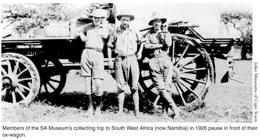
In 1926—the year of my late mother's birth—the South African Museum conducted a collecting trip to South West Africa (now Namibia). The participants went by train to Windhoek, where they hired ox wagons, in which they spent three months travelling to the Kunene River and back. The staff walked beside the wagon train each day, collecting specimens as they walked to supplement the museum's collection. Over eighty years later, is there much that biological collections such as these can tell us about climate change?
This was the question discussed at the annual meeting of the South African Biosystematics Initiative (SABI) in Bloemfontein in November 2008. The answer, at least in Africa, appears to be: not much yet—in climate change research we are lagging even further behind the northern hemisphere than in most other realms of science. Michelle Hamer of the South African National Biodiversity Institute (SANBI), presented the results of a review of the literature that found only two published studies reporting the impact of climate change on South African biota, compared to more than 28 000 from Europe.
At temperate latitudes, studies suggest that global warming is driving species ranges poleward and towards higher elevations, but evidence for range shifts is scarce for the tropics, where the upslope shifts are predicted to be more likely than poleward shifts. Colwell et al.,1
One of the two local examples was a field study by Wendy Foden et al.,2Aloe dichotoma) in South Africa and Namibia. This species appears to conform to these trends: it is disappearing in the north of its range in northern Namibia; and at lower altitudes. So far, it has been unable to establish itself in the cooler south, seemingly because rains are not heavy enough. Reduced rainfall is expected to accompany rises in temperature in Africa, and is likely to have severe effects on biodiversity. South Africa's dry west will be worst affected, and it includes two biomes with particularly diverse plant species, the Fynbos and the Succulent Karoo, in which species numbers are predicted to fall.
But why are collections of old dead biological specimens potentially interesting? The answer is that they offer us a temporal perspective which experiments or contemporary observations often cannot do. Foden was fortunate in that she was able to use photographs of quiver tree 'forests' taken last century, in which individual trees could be identified, to document their decline. Good museum and herbarium collections—often combined with contemporary surveys—can inform us not only of temporal shifts in distribution, but changes in morphology, size or colour; and even life-history variables such as changes in breeding season, or the emergence of adult stages.
Hamer found over 70 studies in the northern hemisphere which have used natural history collections to monitor climate change. She could find none, by contrast, in South Africa. In an interesting recent example from the northern hemisphere, Moritz et al.3
Moritz and his colleagues deliberately chose to replicate a study which had been particularly thorough and well-documented in terms of specimens and exactly where they had been collected. Are there similar collections from a bygone age lurking in the dusty corners of South African museums and herbaria waiting to be revisited? Unlike their predecessors in the early part of the 20th century, nowadays museum curators often whiz up and down national roads (when their collection budgets permit), so it is unsurprising that collections of many taxa reflect localities along these routes.
One solution to the problem of variable sampling effort is atlas projects, where observers are sent out to every quarter-degree grid square of the area being surveyed to record the presence/absence of a species. Provided that the sampling effort is carefully quantified, it can be replicated at a later date, as pointed out at the workshop by Barend Erasmus of the University of the Witwatersrand. In South Africa, atlas projects on proteas and birds were both completed in the mid-1990s, and could soon be replicated to see how distributions have changed. More recently, a frog atlas was completed, and atlas projects for reptiles, arachnids and butterflies are currently in progress.
Good taxonomy, together with well-maintained biological collections, are two essential prerequisites for predicting and understanding the impacts of climate change on biodiversity, so we should be building capacity in this area. In terms of plant diversity, we aren't doing too badly, largely due to the efforts of Brian Huntley, director of the National Botanical Institute from 1989 to 2004, and then of SANBI until 2007. Plant biodiversity is probably of primary importance in South Africa, which comprises less than 1% of the world's land surface, but contains 8% (over 20 000) of all species. But less well known is that the country also contains 7% of all bird, mammal and reptile species, and 15% of known coastal marine species. And in terms of animal taxonomy, by contrast, capacity appears to be declining, largely due to the demise of South Africa's museum sector.
In two of the country's four natural history museums: the Iziko South African Musem in Cape Town and the Northern Flagship Transvaal Museum in Pretoria, research staff numbers are down to between a third and half of their complement 20 years ago. Generally when curatorial posts are vacated they aren't filled, but frozen. In the main, it appears that the saved resources are being re-directed not towards new exhibitions, but towards new management posts. The result is that these institutions now have too many chiefs, and too few Indians.
The problem is often laid at the door of the Ministry of Arts and Culture, under whose aegis the national museums fall. But this explanation doesn't really wash, as both the Natal Museum in Pietermaritzburg and the National Museum in Bloemfontein, have managed to retain their full complements of curators. SABI— set up seven years ago in an attempt to develop and maintain capacity in biodiversity science—has been valiantly trying to make interventions by creating internships for students and postdoctoral positions at museums. But as long as posts are frozen rather than advertised, the perception will remain that taxonomy is a dead-end career.
References
- 1. Robert K., Colwell R.K., Gunnar Brehm G., Cardelús C.L., Gilman A.C. and Longino J.T. (2008). Global warming, elevational range shifts, and lowland biotic attrition in the wet tropics. Science 322, 258–261.
- 2. Foden W., Midgley G.F., Hughes G., Bond W.J., Thuiller W., Hoffman M.T., Kaleme P., Underhill L.G., Rebelo A. and Hannah L. (2007). A changing climate is eroding the geographical range of the Namib Desert tree Aloe through population declines and dispersal lags. Diversity Distrib. 13, 645–665.
- 3. Moritz C., Patton J.L., Conroy C.J., Parra J.L., White G.C. and Beissinger S.R. (2008). Impact of a century of climate change on small-mammal communities in Yosemite National Park, USA. Science 322, 261–264.