Key findings from the 'Free-Roaming Cheetah Census - South Africa 2022 to 2025'
Abstract
SIGNIFICANCE: This Commentary presents key findings from the first coordinated census of South Africa's free-roaming cheetah population, which revealed a substantially smaller and more fragmented population than previously assumed, with major implications for status assessments, landscape connectivity, conflict mitigation and enforcement of legal protections. Genetic results suggest that connectivity between subpopulations has not yet been fully lost, but maintaining or restoring connectivity at this stage could be decisive in preventing future inbreeding and population isolation. The Census calls for updated range mapping, repeat monitoring and coordinated conservation action across managed and free-roaming populations.
Acinonyx jubatus; South Africa; farmland; conflict; coexistence
Introduction
In this Commentary, I present the first empirically grounded census of South Africa's free-roaming cheetah population reported by Smit and Wemer1
In South Africa, cheetahs (Acinonyx jubatus) are managed across four distinct population contexts: a captive population, a managed metapopulation within private fenced reserves and national parks, semi-protected populations in Kruger National Park and Kgalagadi Transfrontier Park, and a free-roaming population persisting primarily on private and commercial farmlands along the northern border connecting to Namibia, Botswana and Zimbabwe.23,4 This represents a substantial contribution within a comparatively limited geographical area relative to neighbouring countries, underscoring the national and regional conservation significance of this population. However, these early estimates relied heavily on extrapolations from spatially restricted studies with limited empirical data.54
While such modelling approaches are understandable given the extensive, heterogeneous and often inaccessible nature of the landscape, they are inherently limited when applied to wide-ranging and elusive species such as the cheetah. Given that cheetahs have lost approximately 91% of their historical range6
Acquiring accurate cheetah population data in such a vast, fragmented human-populated landscape requires large-scale, coordinated survey efforts. These efforts need to be conducted within a sufficiently constrained timeframe to approximate population closure and minimise bias arising from demographic changes. To address this critical knowledge gap, Ashia Cheetah Conservation initiated, majority funded and led the Free-Roaming Cheetah Census (FRCC) in 2021, in collaboration with the Cheetah Outreach Trust and the University of Groningen. Fieldwork commenced in October 2022 as part of a multi-year effort (2021-2026) to generate the first coordinated, large-scale empirical assessment of South Africa's free-roaming cheetah population under the necessary ethical permits.
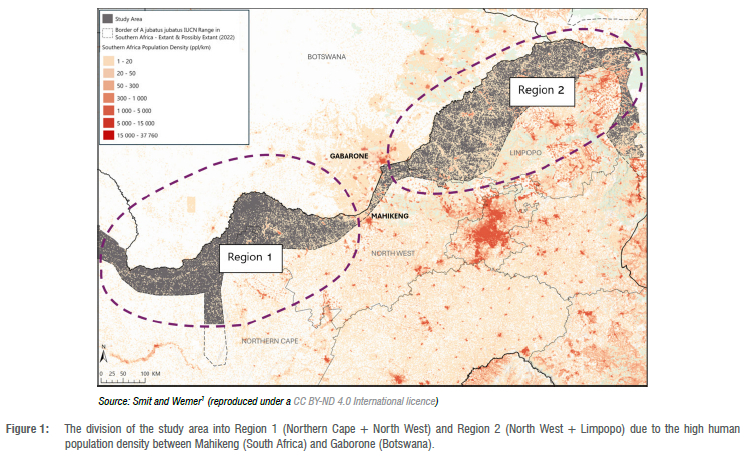
The FRCC focused on approximately 99 800 km2782Figure 1).
The strength of the FRCC lies in its multi-faceted, rigorously designed data collection, which integrates multiple complementary approaches into a single, coordinated census effort. The study combined structured landowner interviews (N = 299), large-scale systematic camera trapping (>5.2 million images), genetic sampling from scat (N = 164) and blood (N = 33) and Global Positioning System (GPS)-enabled collaring (N = 20). These methods enabled both detection and individual identification, as well as insights into movement ecology, habitat use and potential barriers to connectivity.
The first reliable census of South Africa's free-roaming cheetahs
Population estimates were conservatively based on adult individuals (>24 months). Across the entire study area, 119 unique cheetahs were identified through a combination of camera trapping, direct sightings and GPS collaring, of which 83 were classified as adults. The identified adults were unevenly distributed between the two regions, with 33 individuals in Region 1 and 50 in Region 2.
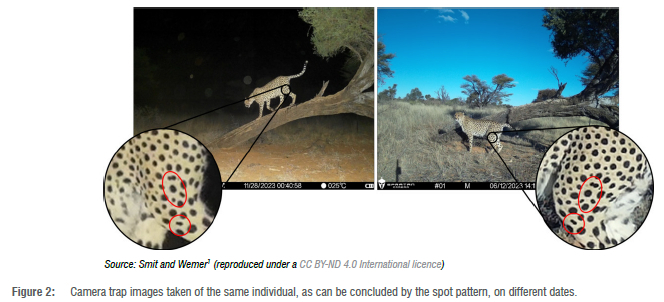
Individual identification relied on the species' unique spot patterns, with particular emphasis placed on the legs, shoulders and hindquarters, as these regions are least affected by variation associated with feeding, pregnancy or movement and therefore provide the most consistent markers for reliable matching (Figure 2). Identification certainty varied among individuals due to factors such as vegetation obstruction, incomplete flank visibility, limited photographic captures and temporary alterations to coat appearance (e.g. dirt or image quality). To account for this variability, each identified individual was assigned a confidence score ranging from 1 (high uncertainty) to 5 (high certainty). Based on this framework, overall identification confidence for adult individuals was high, estimated at 93% in Region 1 and 86% in Region 2.
Importantly, mortality data collected during the Census revealed that 17 of the 83 identified adults (~20%) died within the Census' timeframe. More than half of these deaths were directly attributable to anthropogenic causes, including snaring and vehicle collisions. The observed mean age at death for this free-roaming population was 3.72 years, substantially lower than the reported average lifespan of 5.94 years in the managed metapopulation.9Panthera leo), within the study area. These patterns of elevated mortality and reduced survival of free-roamers compared to metapopulation cheetahs are intrinsically linked to the broader socio-ecological context in which this population persists. In largely human-dominated landscapes, interactions between cheetahs and people, as well as the increasing fragmentation of suitable habitat, are likely to play a central role in shaping both individual survival and population-level dynamics.
Conflict, connectivity and collapse
The Census noted a widespread perception among landowners that cheetahs are significant livestock predators. Structured interviews conducted with 299 farmers indicated that 189 respondents reported cheetah presence on their land. To evaluate actual diet composition, DNA sequencing was performed on 106 scat samples confirmed to originate from cheetahs. Prey DNA was successfully detected in 54 samples; however, no livestock species (i.e. cattle, sheep and goats) were identified. Instead, at least 52% of detected prey consisted of small game species. Moreover, over half of the samples contained prey DNA corresponding to the dominant game species recorded by camera traps within a buffered area around the same locations, indicating that cheetah predominantly exploit locally abundant prey. These findings demonstrate a clear mismatch between perceived and actual predation impacts, suggesting that cheetahs may be disproportionately implicated in livestock losses. This discrepancy has important implications for human-wildlife conflict mitigation.
Furthermore, movement data derived from 20 GPS-collared individuals revealed marked differences between regions. Median daily distances travelled were highly similar between regions, with both exhibiting values of approximately 3.6 km per individual per day. This suggests that, at a fine temporal scale, cheetahs in both regions displayed comparable day-to-day movement behaviour. However, similar movement distances do not necessarily translate into equivalent space use over longer timeframes.
In Region 1, the spatial extent of individual ranges varied considerably, from relatively small areas of approximately 100 km22210
Genetic analyses, however, indicate that substantial differentiation between regions has not yet occurred, suggesting recent or ongoing gene flow. Given the generation time of cheetahs (approximately 4-6 years), detectable genetic structuring may lag behind landscape fragmentation by several decades.11,12 The current situation therefore represents a critical window where there is intensification of ecological barriers, but the genetic connectivity has not yet been fully eroded. Maintaining or restoring connectivity at this stage is decisive in preventing future inbreeding and population isolation.
Enforcement gap
Although cheetahs are legally protected in South Africa as a threatened or protected species1314
This enforcement gap was illustrated in mid-2024, when a collared male cheetah died after being shot by a local farmer. The fitted collar made it possible to determine the cause of death and the farmer acknowledged the shooting. Nevertheless, no penalties were imposed, reportedly because intent could not be sufficiently demonstrated. This case highlights a critical disconnect between legal protection and conservation reality, when even an admitted killing of a protected species does not result in prosecution. Such failures undermine deterrence, weaken conservation outcomes and expose cheetahs to continued illegal killing without accountability.
Conclusion
The FRCC provides the first empirically grounded estimate of South Africa's free-roaming cheetah population and has clear implications for national and regional conservation policy. The detection of only 83 adult individuals, approximately 72% lower than earlier estimates, reflects both the improved accuracy of a large-scale census and the likelihood of ongoing declines driven by habitat loss, landscape fragmentation and anthropogenic mortality. Given the scale, duration and methodological rigour of the FRCC, it is unlikely that a large proportion of the population remained undetected. These findings support reconsideration of the national conservation status of free-roaming cheetahs, potentially warranting classification as 'Endangered' under South African Red List criteria, even if global status remains unchanged. The findings underscore the need to revise the species' range in South Africa using confirmed occurrence, habitat suitability, fragmentation and socio-ecological constraints rather than broad extrapolation alone.
These results should inform the South African Biodiversity Management Plan for cheetahs and strengthen future monitoring and reporting. Given the scale and complexity of the landscape, repeated census efforts will be necessary to track population change over time, ideally using standardised methods that allow direct comparison across survey cycles. Such work will again require sustained funding, careful planning and close coordination among research and conservation partners.
More broadly, the FRCC highlights the need for integrated management across South Africa's different cheetah populations, including free-roaming, semi-protected, fenced metapopulation and captive individuals. Long-term persistence of the species will depend on a coordinated national approach, embedded within a wider southern African conservation framework that maintains connectivity, supports effective management and addresses the pressures driving decline.
Declarations
I have no competing interests to declare. I have no AI or LLM use to declare.
Acknowledgements
I acknowledge Ashia Cheetah Conservation for largely funding and coordinating the Census centrally, making sure the surveyed area was covered as thoroughly as possible; Cheetah Outreach Trust for assisting with coordination, surveys and field work; and the farmers, landowners and local communities who participated.
References
-
1. Smit M, Wemer N. Free-roaming cheetah census - South Africa 2022 to 2025. Paarl: Ashia Cheetah Conservation NPC; 2026. Available from: https://ashia.co.za/free-roaming-cheetah-census/
» https://ashia.co.za/free-roaming-cheetah-census/ -
2. Marnewick K, Page-Nicholson S, Roxburgh L, Somers MJ. Tracking data from nine free-roaming cheetahs (Acinonyx jubatus) collared in the Thabazimbi area, Limpopo Province, South Africa. Biodivers Data J. 2017;5, e11323. https://doi.org/10.3897/BDJ.5.e11323
» https://doi.org/10.3897/BDJ.5.e11323 - 3. Bartels P, Bouwer V, Crosier A, Cilliers D, Durant SM, Grisham J, et al., editors. Global cheetah action plan review final workshop report. In: Proceedings of the Global Cheetah Conservation Action Plan workshop; 2001 August 27-30; Johannesburg, South Africa. Apple Valley, MN: IUCN / SSC Conservation Breeding Specialist Group; 2002. p. 78.
-
4. Weise FJ, Vijay V, Jacobson AP, Schoonover RF, Groom RJ, Horgan J, et al. The distribution and numbers of cheetah (Acinonyx jubatus) in southern Africa. PeerJ. 2017;5, e4096. https://doi.org/10.7717/peerj.4096
» https://doi.org/10.7717/peerj.4096 -
5. Shams A, Farhadinia MS, O'Riain MJ, Gaylard A, Smit M, Fraticelli C, et al. Perilous state of critically endangered Northwest African cheetah (Acinonyx jubatus hecki) across the Sudano-Sahel. Anim Conserv. 2024;28:208-223. https://doi.org/10.1111/acv.12974
» https://doi.org/10.1111/acv.12974 -
6. Durant SM, Mitchell N, Groom R, Pettorelli N, Ipavec A, Jacobson AP, et al. The global decline of cheetah Acinonyx jubatus and what it means for conservation. Proc Natl Acad Sci USA. 2017;114(3):528-533. https://doi.org/10.1073/pnas.1611122114
» https://doi.org/10.1073/pnas.1611122114 -
7. Loarie SR, Duffy PB, Hamilton H, Asner GP, Field CB, Ackerly DD. The velocity of climate change. Nature. 2009;462:1052-1055. https://doi.org/10.1038/nature08649
» https://doi.org/10.1038/nature08649 -
8. Miller JRB. Mapping attack hotspots to mitigate human-carnivore conflict: Approaches and applications of spatial predation risk modeling. Biodivers Conserv. 2015;24:2887-2911. https://doi.org/10.1007/s10531-015-0993-6
» https://doi.org/10.1007/s10531-015-0993-6 - 9. Smit KL, Sievert O, Smit M, Ramcharan A. South African metapopulation: Population viability analysis (PVA) & annual harvest model (2026/2027). Unpublished report.
-
10. Pérez-Pereira N, Wang J, Quesada H. Prediction of the minimum effective size of a population viable in the long term. Biodivers Conserv. 2023;31(3):2763-2780. https://doi.org/10.1007/s10531-022-02456-z
» https://doi.org/10.1007/s10531-022-02456-z - 11. Allendorf F, Luikart G. Conservation and genetics of populations. Maldon, MA: Blackwell Publishing Ltd; 2006.
- 12. Frankham R, Ballou JD, Briscoe DA. Introduction to conservation genetics. 2nd ed. Cambridge: Cambridge University Press; 2010.
- 13. Kerley GIH, Behrens KG, Gerruthers J, Diemont M, du Plessis JJ, Minnie L, et al. Summary for policymakers. In: Kerley GIH, Wilson SL, Balfour D, editors. Livestock predation and its management in South Africa: A scientific assessment. Gqeberha: Centre for African Conservation Ecology; 2018. p. 7-14.
- 14. Adjustment of Fines Act of 1991, Republic of South Africa.