What constitutes adequate legal protection for the collection, use and sharing of mobility and location data in health care in South Africa?
Abstract
Mobile phone technology has been a catalyst that has added an innovative dimension in health care and created new opportunities for digital health services. These digital devices can be viewed as an extension of the person using them due to the deluge of personal information that can be collected and stored on them. Data collected on mobile phones are used extensively in health services and research. Personal, mobility and location data are constantly collected. The unique mobile phone architecture provides for an easy flow of data between various role players such as application developers and phone manufacturers. The collection, storage and sharing of personal information on mobile phones elicit various legal questions relating to the protection of privacy, consent, liability and the accountability of stakeholders such as health insurance providers, hospital groups and national departments of health. SIGNIFICANCE: We analyse the major legal concerns of mobility and location data collection and processing through mobile phones in the context of health care and provide recommendations to develop data protection guidelines that are built on the principles of lawfulness, fairness and transparency. The issues explored are of relevance in an African context and to a broader international audience.
data legislation; data sharing; mobility data; location data
Introduction
Mobile phones have become an integral part of daily life and can be viewed as an extension of their owners given the extent of personal information collected and stored.123
Data protection legislation largely is designed to safeguard against the exploitation of personal information through governing data collection, processing, and sharing. This protection includes data collected and processed through mobile phone use.4
Often data are generated and processed as an essential part of providing healthcare.222
Yet the way in which data protection legislation translates into practice, raises concerns. Are data subjects aware and adequately informed about the digital collection and processing of their personal information? How should privacy rights be managed to better protect them and legally allow for such data to be used in healthcare services?
In this article, we aim to offer guidance on the protection of privacy in the use of mobile phone data in healthcare services by addressing the above and other related questions. We include a comparative perspective about recent developments in this area in the United Kingdom (UK).
Data collection via mobile phones
The replacement of conventional paper-based methods with digital devices has significantly improved the efficiency of data collection, storage, and sharing.55
Cloud service providers, developers, manufacturers and proprietors of apps, operating systems, and devices are industriously involved in the complex mobile phone landscape that includes various software layers and they serve as role players in the mobility and location data ecosystem.56
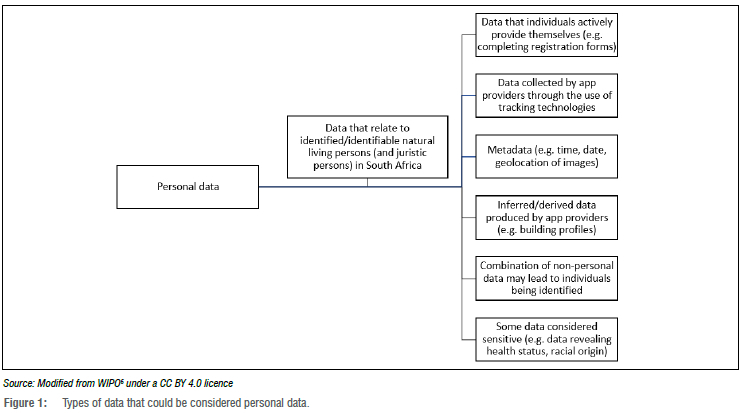
Section 1 of South Africa's Protection of Personal Information Act 4 of 2013 (POPIA)78,9 According to the European Union Agency for Cybersecurity, personal data further includes information related to the device itself, such as metadata, device identifiers and location data.8 Figure 1, developed by the World Intellectual Property Organization, illustrates various types of personal data that potentially could be collected by mobile devices.6
Although users actively collect and store such data on their mobile phones, data collection also occurs in large volumes in the background unbeknownst to the user; for example, activated device location services allow for the detection of geographical location.66
Hence, responsible parties must ensure that users are aware of and unequivocally consent to the processing of their personal information.9 7
App developers have access to the personal and non-personal data of their users and often are responsible for granting access to or selling their users' data to third parties - data which can be used in behavioural advertising by retailer and marketing agencies.1010510
The key responsibility of operating systems and mobile device manufacturers is to ensure the protection of the personal information of their users.111111 12
Although transparency is an underlying principle of lawful data processing613,14
The context in which personal data are collected and the nature of the data collected are important in determining and assessing the potential risks, as sensitive information could be inappropriately integrated or contained.13
Moreover, artificial intelligence (AI) is an important component at such interfaces due to its ability to use algorithms for data analysis to further link data from different apps.14,15 An example could be a fitness app that collects data on a user's physical activity and connects other data from the user's food diary app to provide an overall model of the user's health. Thus, the integration of AI creates another layer of personal data use and risk.1415
Use of mobile phone data and AI in health care
Health data are regarded as more sensitive than other forms of personal data, which place them higher in the level of interest for cyber criminals. Thus, this type of data receives special attention in data protection legislation such as the European Union (EU)'s General Data Protection Regulation (GDPR) and POPIA.7,16 Health information qualifies as "special personal information" in terms of section 26(1)(a) of POPIA, and therefore it qualifies for special protection. However, if the personal data are anonymised and cannot be re-identified, they fall outside the scope of POPIA and/or the GDPR.
In South Africa, the National Health Act 61 of 2003 stipulates that all patient (user) information is confidential and HCPs may share or disclose that information only upon consent obtained from the patient.17 National Health Act is not focused on data protection as such.
As personal information collected through health- or fitness-related apps can be used by HCPs to provide healthcare services to individuals, so can digitally collected health data and even medical insurance data be used in medical research.14,15 According to Ventola18
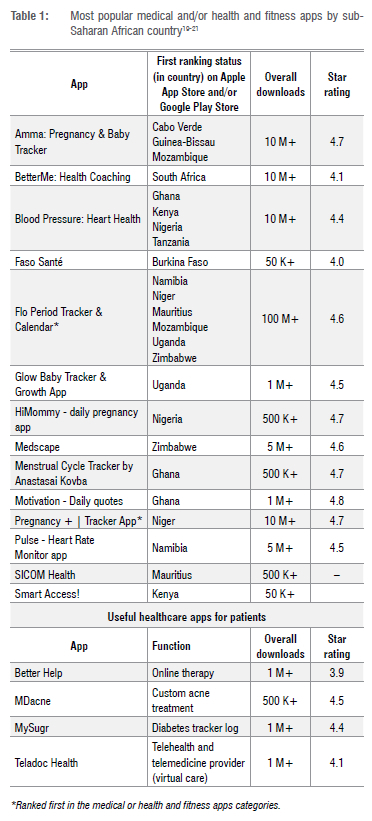
In the provision of healthcare services, mobile phone data can provide up-to-date information about an individual's state of health, which allows for remote health monitoring to better foster a HCPs clinical assessments and decision-making regarding a patient's treatment.1518Table 1.19-21
If the personal data on a fitness or health app are sent to medical insurers or HCPs, the recipients are allowed to process that health data in terms of the exception under section 32(1) of POPIA.716,22
Similarly, in low- and middle-income countries where patients experience challenges in accessing health care, the use of mobile phone data enables HCPs instant access to patients' up-to-date information.2324
AI systems, consisting of one or more algorithms, can be used to complement the decision-making of HCPs in the diagnosis and treatment of patients.252525
In addition to pertinent questions on how personal data are protected in the development and use of AI models, other important questions around the interpretability, transparency and traceability should not be ignored.15,25 Such questions include how AI models produce their specific output, how they are governed and what other data are required for auditing purposes? The use of AI models in the diagnosis and the treatment of patients brings into question if informed consent was obtained, or could be obtained, and, thus, impacts the doctor-patient relationship.25,26
Protection of personal data concerns
When consent is requested for the processing of personal information in an app, care should be taken to ensure clarity about the purpose and scope of such processing. It is common that apps are interlinked, e.g. a fitness app that provides the possibility of sharing data on various social media apps, which increases the risk of a data breach or the unauthorised use of the personal data. In the sharing of personal data between apps, how can privacy and protection still be ensured to prevent the risk of misuse or theft by unauthorised third parties?
Added to the complex challenge of obtaining consent for mobile phone app use in South Africa is the low literacy levels in certain populations in the country. A study by the Department of Higher Education and Training indicates that 3.7 million adults in South Africa are illiterate.28
Other data protection risks in mobile phone use include the constant power-up and Internet connection which facilitate data access by unauthorised third parties. Smartphones have various sensors that collect a variety of personal data and identifiers such as the device ID, metadata, and geolocation which, together, increase the risk of tracking and user profiling without consent.6,8 Such collated data from different trackers installed on apps feed behavioural advertising, with users often having only limited or no control.5,8,29
Processing of children's personal information receives special attention in data protection legislation such as the GDPR and POPIA, because children are regarded as a vulnerable group in society and they may be less aware of the risks involved (Recital 38, GDPR).167
Users of mobile phones often do not have a clear understanding of the permission required to use an app, and some apps may require more permission than is needed to function properly. This circumstance raises concerns about the legal compliance of the app providers. It is the responsibility of operating systems and app providers on mobile phones to ensure the lawful processing of personal information and, in accordance with the applicable data protection legislation, they should take extra care when the personal information of children is processed.
According to the World Intellectual Property Organization6
• there must always be a legal basis for processing personal data on a mobile phone, which could be consent provided by a data subject or another legal basis specified in the relevant legislation6
• processing may not lead to unfair discrimination and should avoid importing any bias6
• appropriate information about the processing must be provided in an understandable and clear way, and this could include publishing an appropriate privacy policy before installation of the app or before processing the data, and the provision of icons or privacy notifications during use of the app5,6.
Currently, there is no set of guidelines on mobile phone applications in South Africa. However, given the similitude between POPIA and the GDPR, the 'Guidelines on the Protection of Personal Data Processed by Mobile Applications Provided by European Union Institutions' may serve as guidance in our jurisdiction.7,16 These guidelines state that apps should collect only data that are strictly necessary for its functioning and that users must be provided with clear and accurate information to make an informed decision, with the option to withdraw their consent at any time.30 3131
A comparative perspective from the UK
The UK's data protection framework predates that of South Africa, making it instructive to look at how the UK handles issues related to data privacy and the use of mobile devices to discover learning opportunities from the UK experience.
The oldest instrument in the UK's data protection framework is an international data protection treaty to which the UK is a party, namely, the Convention for the Protection of Individuals regarding Automatic Processing of Personal Data323232
The Automatic Data Processing Convention provides the data subject with rights of access to, and correction of data held by third parties (Article 8).323232
In 1998, the UK enacted the Data Protection Act (DPA 1998).3334
In 2016, the EU enacted the GDPR 61 of 2016 (Regulation 2016 679 EU).1634161616
The GDPR's stated aim is to harmonise data privacy laws across Europe (Article 1, GDPR).16161616
Article 9(2) provides for circumstances under which the prohibition on the processing of data mentioned in sub-article 9(1) does not apply.1616
In addition, according to sub-article 9(4), member states may "maintain or introduce further conditions, including limitations", in respect of the "processing of genetic data, biometric data or data concerning health" (Article 9(4)).16
However, after 31 December 2020, at the end of the Brexit transition period, the GDPR ceased to apply directly in the UK but was incorporated into UK domestic law under section 3 of the European Union (Withdrawal) Act 2018 as well as the Data Protection Act 2018 (DPA 2018), successor to the DPA 1998.3316353616
The UK-GDPR broadly is the same as the GDPR in terms of its substantive requirements; however, as the UK no longer is a member of the EU, it provides for an alternative enforcement mechanism.163535
Data privacy in the context of mobile phones in the UK is regulated further by the Privacy and Electronic Communications (EC Directive) Regulations 2003 (PECR)37373416,35,37
In keeping with regulations in the EU and other parts of the world, the UK-GDPR contains provisions to ensure the protection of personal data. These include the requirement that personal data be "processed lawfully and fairly"; that such processing should be based on the data subject's consent or, if consent is absent, that it be based on another specified legal basis; it grants the data subject the right to obtain information about the processing of personal data and to demand that inaccurate personal data be rectified; it confers appropriate functions on the Information Commissioner's Office (see above), endowing that Office with the responsibility to monitor and enforce the provisions of the UK-GDPR.16
Importantly, the DPA 2018 adopts the definitions of the (EU's) GDPR, such as "personal data" meaning "any information relating to an identified or identifiable living individual"; "processing" meaning "an operation or set of operations which is performed on information, such as collection, recording, storage, disclosure, combination etc"; "data subject" as a "living individual to whom personal data relates", and so on.16
On 28 June 2021 the EU adopted an adequacy decision for the UK.38 38
On the face of it, the UK-GDPR framework constitutes a solid mechanism that protects individual privacy, including in relation to personal data being processed on mobile phones.1639 39 16,39
A 2021 literature review by Steven Furnell, commissioned by the UK government, revealed that although, on the face of it, the UK has a watertight data privacy framework, the reality is not as clearcut as it seems.404040
In the light of an Australian study which found that there are significant shortcomings in relation to privacy, and inconsistent privacy practices in health-related mobile phone apps41
Conclusions and recommendations
In exploring the use of mobile phones in health care, this article provides an overview of the complex mobile phone landscape and identifies various legal concerns relating to the processing of personal information on mobile phones. Despite the existence of data protection legislation in most countries, the shortcomings in relation to the protection of personal information in health-related mobile phone apps identified in Australia probably are relevant everywhere.
The increased availability and use of health and fitness apps on mobile phones provide various benefits to users and HCPs. However, the risk of unlawful data processing on mobile phones still exists despite the presence of general data protection legislation. The protection of privacy on mobile phones is a challenge given a complex landscape with various role players. The most common legal basis for the processing of personal data remains the consent of the data subject. Yet operating systems and app developers often use longwinded and opaque language upon seeking consent or providing information about the purpose of data processing. This practice is of particular concern in South Africa given the low literacy level in certain population groups.
A multi-disciplinary approach - in combination with the development of clear guidance for HCPs, healthcare institutions, patients, and the manufacturers of digital devices - will address the various ethical and legal issues in digital health care. Furthermore, it is recommended that guidelines for the protection of personal data on mobile phone apps are developed based on the principles of lawfulness, fairness, and transparency. A reliance on these principles is important, not only in South Africa but everywhere. The development of legislation for the use of AI in healthcare services is recommended to further strengthen the protection of privacy and personal data in healthcare services in South Africa.
The collection, use and sharing of mobility and location data in health care in South Africa presents a scenario with significant benefits and risks. Adequate legal protection is essential to ensure that the data are collected, used and shared in a responsible and ethical manner that respects individual rights and privacy. A comprehensive legal framework that includes data protection regulations, ethical guidelines and oversight mechanisms is a necessary requirement to address the complex issues surrounding mobility and location data in health care. Such a framework should account for the unique cultural and societal contexts in South Africa. It is an imperative that policymakers, healthcare providers, and other stakeholders work together to develop and to implement an effective legal framework that protects the rights of individuals while promoting the responsible use of mobility and location data to improve healthcare outcomes. Only in doing so, can South Africa fully leverage the potential in these technologies to improve the delivery of health care and ensure that individual privacy and rights are safeguarded.
Competing interests
We have no competing interests to declare.
Authors' contributions
D.B.: Substantial contributions to the conception or design of the work, or the acquisition, analysis, or interpretation of data for the work; drafted/revised the work critically for important intellectual content. A.G.N.M.: Substantial contributions to the conception or design of the work, or the acquisition, analysis, or interpretation of data for the work; drafted/revised the work critically for important intellectual content. N.C.: Drafted/revised the work critically for important intellectual content. All authors approved the final version and agreed to be accountable for all aspects of the work in ensuring that questions related to the accuracy or integrity of any part of the work are appropriately investigated and resolved.
Acknowledgements
Research reported in this publication was supported by the US National Institute of Mental Health of the US National Institutes of Health under award number U01MH127704. The content is solely the responsibility of the authors and does not necessarily represent the official views of the US National Institutes of Health.
References
-
1. Jiang Y Mosquera L, Jiang B, Kong L, El Emam K. Measuring re-identification risk using a synthetic estimator to enable data sharing. PLoS ONE. 2022;17, e0269097. https://doi.org/10.1371/journal.pone.0269097
» https://doi.org/10.1371/journal.pone.0269097 -
2. Jiang D, Shi G. Research on data security and privacy protection of wearable equipment in healthcare. J Healthc Eng. 2021;2021, Art. # 6656204. https://doi.org/10.1155/2021/6656204
» https://doi.org/10.1155/2021/6656204 -
3. Alnajrani HM, Norman AA, Ahmed BH. Privacy and data protection in mobile cloud computing: A systematic mapping study. PLoS ONE. 2020;15, e0234312. https://doi.org/10.1371/journal.pone.0234312
» https://doi.org/10.1371/journal.pone.0234312 -
4. Carrillo MA, Kroeger A, Cardenas Sanchez R, Diaz Monsalve S, RungeRanzinger S. The use of mobile phones for the prevention and control of arboviral diseases: A scoping review. BMC Public Health. 2021;21(1):110. https://doi.org/10.1186/s12889-020-10126-4
» https://doi.org/10.1186/s12889-020-10126-4 - 5. Working Party. Working document 02/2013 providing guidance on obtaining consent for cookies. European Union; 2013.
-
6. World Intellectual Property Organization (WIPO). A guide to data protection in mobile applications Geneva: WIPO; 2021. Available from: https://www.wipo.int/export/sites/www/ip-development/en/agenda/docs/wipo-guide-data-protection-mobile-apps.pdf
» https://www.wipo.int/export/sites/www/ip-development/en/agenda/docs/wipo-guide-data-protection-mobile-apps.pdf - 7. Republic of South Africa. Protection of Personal Information Act 4 of 2013. Republic of South Africa; 2013.
-
8. European Union Agency for Cybersecurity (ENISA). Privacy and data protection in mobile applications: A study on the app development ecosystem and the technical implementation of GDPR [document on the Internet]. c2017 [cited 2022 Sep 16]. Available from: https://www.enisa.europa.eu/publications/privacy-and-data-protection-in-mobile-applications/at_download/fullReport
» https://www.enisa.europa.eu/publications/privacy-and-data-protection-in-mobile-applications/at_download/fullReport -
9. Kamarinou D, Millard C, Turton F. Responsibilities of controllers and processors of personal data in clouds. In: Millard C, editor. Cloud computing law. 2nd ed. Oxford: Oxford University Press; 2021. p. 294-339. https://doi.org/10.1093/oso/9780198716662.003.0009
» https://doi.org/10.1093/oso/9780198716662.003.0009 -
10. Johnson G, Runge J, Seufert E. Privacy-centric digital advertising: Implications for research. Customer Needs and Solutions 2022;9:49-54. https://doi.org/10.1007/s40547-022-00125-4
» https://doi.org/10.1007/s40547-022-00125-4 -
11. Fowler GA. I tried to read all my app privacy policies. It was 1 million words. Washington Post. 2022 May 31. Available from: https://www.washingtonpost.com/technology/2022/05/31/abolish-privacy-policies/
» https://www.washingtonpost.com/technology/2022/05/31/abolish-privacy-policies/ -
12. Republic of South Africa. Consumer Protection Act 68 of 2008. Government Gazette. Volume 526 Number 32186. South African Government; 2009 [cited 2022 Sep 16]. Available from: https://www.gov.za/sites/default/files/32186_467.pdf
» https://www.gov.za/sites/default/files/32186_467.pdf -
13. Rath DK, Kumar A. Information privacy concern at individual, group, organization and societal level - a literature review. Vilakshan - XIMB Journal of Management. 2021;18:171-186. https://doi.org/10.1108/XJM-08-2020-0096
» https://doi.org/10.1108/XJM-08-2020-0096 -
14. Seifert A, Hofer M, Allemand M. Mobile data collection: Smart, but not (yet) smart enough. Front Neurosci. 2018; 12, Art. #971. https://doi.org/10.3389/fnins.2018.00971
» https://doi.org/10.3389/fnins.2018.00971 -
15. Gerke S, Minssen T, Cohen G. Ethical and legal challenges of artificial intelligence-driven healthcare. In: Bohr A, Memarzadeh K, editors. Artificial intelligence in healthcare. Cambridge, MA: Academic Press; 2020. p. 295336. https://doi.org/10.1016/B978-0-12-818438-7.00012-5
» https://doi.org/10.1016/B978-0-12-818438-7.00012-5 - 16. The European Parliament and of the Council of 27 April 2016 on the Protection of Natural Persons. The General Data Protection Regulation (GDPR). European Union; 2016.
- 17. South African Government. National Health Act 61 of 2003. Republic of South Africa; 2004.
- 18. Ventola CL. Mobile devices and apps for health care professionals: Uses and benefits. P T. 2014;39:356-364.
-
19. SimilarWeb. Top Apps Ranking [webpage on the Internet]. No date [updated 2023 Mar 12; cited 2023 Mar 14]. Available from: https://www.similarweb.com/apps/top/apple/store-rank/za/health-fitness/top-free/iphone/
» https://www.similarweb.com/apps/top/apple/store-rank/za/health-fitness/top-free/iphone/ -
20. Apple App Store. App Store Preview: Health & fitness [webpage on the Internet]. No date [cited 2023 Mar 14]. Available from: https://apps.apple.com/us/charts/iphone/health-fitness-apps/6013
» https://apps.apple.com/us/charts/iphone/health-fitness-apps/6013 -
21. Google Play. Top charts [webpage on the Internet]. No date [cited 2023 Mar 14]. Available from: https://play.google.com/store/apps
» https://play.google.com/store/apps - 22. Mulder T. Health apps, their privacy policies and the GDPR. Eur J Law Technol. 2019;10(1):1-21.
-
23. Feroz A, Jabeen R, Saleem S. Using mobile phones to improve community health workers performance in low-and-middle-income countries. BMC Public Health. 2020;20, Art. #49. https://doi.org/10.1186/s12889-020-8173-3
» https://doi.org/10.1186/s12889-020-8173-3 -
24. Kwon H, An S, Lee H-Y Cha WC, Kim S, Cho M, et al. Review of smart hospital services in real healthcare environments. Healthc Inform Res. 2022;28:3-15. https://doi.org/10.4258/hir.2022.28.1.3
» https://doi.org/10.4258/hir.2022.28.1.3 -
25. Mittelstadt B. The impact of artificial intelligence on the doctor-patient relationship. Strasbourg: Council of Europe; 2021. https://rm.coe.int/inf-2022-5-report-impact-of-ai-on-doctor-patient-relations-e/1680a68859
» https://rm.coe.int/inf-2022-5-report-impact-of-ai-on-doctor-patient-relations-e/1680a68859 -
26. Silven AV Van Peet PG, Boers SN, Tabak M, De Groot A, Hendriks D, et al. Clarifying responsibility: Professional digital health in the doctor-patient relationship, recommendations for physicians based on a multi-stakeholder dialogue in the Netherlands. BMC Health Serv Res. 2022;22, Art. #129. https://doi.org/10.1186/s12913-021-07316-0
» https://doi.org/10.1186/s12913-021-07316-0 -
27. The Data Protection Commission. Data Protection Commission announces decision in WhatsApp inquiry [media release]. 2021 September 02 [cited 2022 Sep 16]. Available from: https://www.dataprotection.ie/en/news-media/press-releases/data-protection-commission-announces-decision-whatsapp-inquiry
» https://www.dataprotection.ie/en/news-media/press-releases/data-protection-commission-announces-decision-whatsapp-inquiry -
28. Khuluvhe M. Adult illiteracy in South Africa. Pretoria: Department of Higher Education and Training; 2022. Available from: https://www.dhet.gov.za/Planning%20Monitoring%20and%20Evaluation%20Coordination/Fact%20Sheet%20-%20Adult%20illiteracy%20in%20South%20Africa_March%202022.pdf
» https://www.dhet.gov.za/Planning%20Monitoring%20and%20Evaluation%20Coordination/Fact%20Sheet%20-%20Adult%20illiteracy%20in%20South%20Africa_March%202022.pdf -
29. Melicher W, Kurilova D, Segreti SM, Kalvani P Shay R, Ur B, et al. Usability and security of text passwords on mobile devices. In: Proceedings of the 2016 CHI Conference on Human Factors in Computing Systems; 2016 May 7-12; San Jose, CA, USA. New York: Association for Computing Machinery; 2016. p. 527-539. https://doi.org/10.1145/2858036.2858384
» https://doi.org/10.1145/2858036.2858384 -
30. European Data Protection Supervisor. Guidelines on the protection of personal data processed by mobile applications provided by European Union institutions [document on the Internet]. c2016 [cited 2022 Sep 16]. Available from: https://edps.europa.eu/sites/default/files/publication/16-11-07_guidelines_mobile_apps_en.pdf
» https://edps.europa.eu/sites/default/files/publication/16-11-07_guidelines_mobile_apps_en.pdf -
31. Council of Europe. Convention for the Protection of Human Rights and Dignity of the Human Being with regard to the Application of Biology and Medicine: Convention on Human Rights and Biomedicine (ETS No. 164). Strasbourg: Council of Europe; 1997. Available from: www.coe.int/en/web/bioethics/oviedo-convention
» www.coe.int/en/web/bioethics/oviedo-convention -
32. Council of Europe. Convention for the Protection of Individuals with regard to Automatic Processing of Personal Data. Strasbourg: Council of Europe; 1981. Available from: https://rm.coe.int/1680078b37
» https://rm.coe.int/1680078b37 -
33. European Parliament and of the Council of 27 April 2016 on the Protection of Natural Persons. Data Protection Act 1998. United Kingdom, 1998 [cited 2022 Sep 16]. Available from: https://www.legislation.gov.uk/ukpga/2018/12/contents/enacted
» https://www.legislation.gov.uk/ukpga/2018/12/contents/enacted -
34. European Parliament and of the Council of 24 October 1995. Data Protection Directive95/46/EC. European Union; 1995 [cited 2022 Sep 16]. Available from: https://eur-lex.europa.eu/legal-content/EN/TXT/?uri=celex%3A31995L0046
» https://eur-lex.europa.eu/legal-content/EN/TXT/?uri=celex%3A31995L0046 -
35. European Parliament and of the Council of 27 April 2016 on the Protection of Natural Persons. The Data Protection Act 2018. United Kingdom; 2018 [cited 2022 Sep 16]. Available from: https://www.legislation.gov.uk/ukpga/2018/12/pdfs/ukpga_20180012_en.pdf
» https://www.legislation.gov.uk/ukpga/2018/12/pdfs/ukpga_20180012_en.pdf -
36. European Parliament and of the Council of the Council of 27 April 2016 on the Protection of Natural Persons. The Data Protection, Privacy and Electronic Communications (Amendment etc) (EU Exit) Regulations 2019. United Kingdom; 2019 [cited 2022 Sep 16]. Available from: https://www.legislation.gov.uk/ukdsi/2019/9780111177594/contents
» https://www.legislation.gov.uk/ukdsi/2019/9780111177594/contents -
37. European Parliament and of the Council of 11 December 2003. The Privacy and Electronic Communications (EC Directive) Regulations 2003. United Kingdom; 2003 No. 2426 [cited 2022 Sep 16]. Available from: https://www.legislation.gov.uk/uksi/2003/2426/contents/made
» https://www.legislation.gov.uk/uksi/2003/2426/contents/made -
38. Information Commissioner's Office. Data protection and the EU in detail. Data protection at the end of the transition period [document on the Internet]. c2019 [cited 2022 Sep 16]. Available from: https://ico.org.uk/media/for-organisations/dp-at-the-end-of-the-transition-period/data-protection-and-the-eu-in-detail-1-0.pdf
» https://ico.org.uk/media/for-organisations/dp-at-the-end-of-the-transition-period/data-protection-and-the-eu-in-detail-1-0.pdf -
39. Kollnig K, Binns R, Van Kleek M, Lyngs U, Zhao J, Tinsman C, et al. Before and after GDPR: Tracking in mobile apps. Internet Policy Rev. 2021;10. https://doi.org/10.14763/2021.4.1611
» https://doi.org/10.14763/2021.4.1611 -
40. Furnell S. Closed consultation: Literature review on security and privacy policies in apps and app stores [webpage on the Internet]. c2022 [cited 2022 Sep 16]. Available from: https://www.gov.uk/government/consultations/app-security-and-privacy-interventions/literature-review-on-security-and-privacy-policies-in-apps-and-app-stores
» https://www.gov.uk/government/consultations/app-security-and-privacy-interventions/literature-review-on-security-and-privacy-policies-in-apps-and-app-stores -
41. Tangari G, Ikram M, Ijaz K, Kaafar MA, Berkovsky S. Mobile health and privacy: Cross sectional study. BMJ. 2021;373, Art. #1248. https://doi.org/10.1136/bmj.n1248
» https://doi.org/10.1136/bmj.n1248

Revised: 16 Mar. 2023
Accepted: 20 Mar. 2023
Published: 30 May 2023
Funding: US National Institutes of Health (1U01MH127704-01)