Life-history evolution as an explanation for the absence of the tree life-form in Cape fynbos
Invasive exotic tress are able to grow tall (more than 15 m) in the fynbos environment of the southwestern Cape of South Africa, whereas the tallest fynbos plants, generally from the Proteaceae, have much shorter maximum stature (less than 5 m). Analysis of the Protea Atlas Database for the Cape shows a positive correlation between age at maturity and maximum plant size. Monographs of the Proteaceae indicate a shorter period to maturity for reseeders than resprouters. We propose an evolutionary hypothesis for the absence of trees in the fynbos; predictable, frequent fires have favoured early maturity and this has discriminated against any strategies with delays to maturity (such as experienced by resprouters and trees).
Life-history evolution as an explanation for the absence of the tree life-form in Cape fynbos
J.J MidgleyI, *; A.G. RebeloII
IBotany Department, University of Cape Town, Private Bag, Rondebosch 7701, South Africa
IISouth African National Biodiversity Institute, Kirstenbosch, Private Bag X7, Claremont 7735, South Africa
Invasive exotic tress are able to grow tall (more than 15 m) in the fynbos environment of the southwestern Cape of South Africa, whereas the tallest fynbos plants, generally from the Proteaceae, have much shorter maximum stature (less than 5 m). Analysis of the Protea Atlas Database for the Cape shows a positive correlation between age at maturity and maximum plant size. Monographs of the Proteaceae indicate a shorter period to maturity for reseeders than resprouters. We propose an evolutionary hypothesis for the absence of trees in the fynbos; predictable, frequent fires have favoured early maturity and this has discriminated against any strategies with delays to maturity (such as experienced by resprouters and trees).
There is much current interest in modelling and understanding the determinants of plant biomass and plant traits, especially in relation to the potential impacts of global climate change on vegetation. For this modelling, the most basic and important trait is maximum plant height in a given environment. Models use eco-physiological principles such as plant hydraulics to predict maximum plant height depending on local water supply.123,4
Mesic fynbos areas (rainfall more than 1000 mm/yr) lack single-stemmed plants more than 5 m tall. Their absence cannot be due to eco-physiological constraints imposed by the environment, because taller trees such as indigenous Cape forest species5, 6 as well as exotic species such as Pinus radiata7Pinus pinaster8
The dominant fynbos canopy family, the Proteaceae, has only a few species that can grow taller than 5 m and only the rare Leucadendron argenteum reaches 10 m.9Faurea macnaughtonii, a Cape member of the Proteaceae, is a large single-stemmed tree over 20 m tall, as is Calodendrum capense (Rutaceae). It was argued previously5,6 that the lack of trees is because fires, especially of anthropomorphic origin,510
We argue that frequent and predictable disturbance by fire has placed a premium on early reproduction. Maximum organism size, in both plants and animals, is linked to other life-history attributes and in particular age to maturity. Among pines, for instance, there is a positive correlation between age at first reproduction and mean longevity and maximum height.11
Our aims here are to demonstrate precocious age to maturity of the Proteaceae, to report that there is a correlation between age to maturity and maximum plant size, and therefore that evolutionary constraints may be able to explain the eco-physiological lack of trees in fynbos.
Methods
To obtain age to first flowering from seed, we used the Protea Atlas Database (http://protea.worldonline.co.za). It is based on a massive widespread sampling exercise in which at least some populations of all extant Cape Proteaceae species were sampled across their distribution range. Among other measurements, populations were aged since the last fire and percentage flowering was estimated in three classes (some flowering, 50% flowering, and more than 50% flowering). From these data (more than 1000 observations from across the biome) we determined the mean post-fire age per species, as the mean of all sample populations, that had some individuals flowering, as well as for more than 50% of individuals per population that were flowering. We ignored resprouting species as they rarely produce seedlings; the data on the post-fire period to flowering for resprouters derived from the atlas is therefore from fire survivors. Resprouter survivors typically mature rapidly after fire whereas seedlings of resprouters have a longer period to first flowering (see below). Rebelo9Protea12Banksia,13
Results
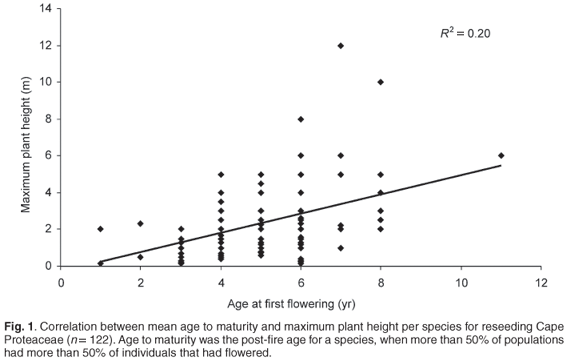
Mean time for the 111 reseeder species, which had at least some populations that had some individuals that were flowering, was 2.8 years according to the protea atlas. The mean age to more than 50% flowering was 5.0 years (n = 122 species). There is a significant correlation between age at first maturity (with 50% of individuals in more than 50% populations per species) and maximum size (Fig. 1, P < 0.01). Quantile regression of the top 10% values was also strongly significant (P < 0.003). Mean age to maturity from seed for Protea seeders was 4.5 years (n = 40), whereas for Protea sprouters it was 6.6 years (n = 18). For Banksia, seeders took 4.0 years (n = 31) to first maturity, whereas resprouters took 7.0 years (n = 26).
Discussion
Given the woody nature of the Cape Proteaceae and the relative nutrient poverty and summer water stress of the Cape environment,10
We suspect that the explanatory power of the regression in Fig. 1 is rather low because the influence of site factors and growth on age to maturity was not taken into account. The unexpectedly prolonged time to maturity of a short proteoid, for example, may be because of local environmental constraints on growth rates (such as their being from a cold mountain top or from arid fynbos).
The exotic trees which most often invade the mountain fynbos landscape are Pinus pinaster and Pinus radiata. There are no data on age to maturity for these species within the fynbos environment; age to maturity was mostly derived from monographs of these species in their country of origin.148P. pinaster plantation, and a similar age to reproductive maturity has been proposed for P. radiata.7
Why should early maturity lead to small maximum plant size and early senescence? In the Cape Proteaceae maximum size correlates negatively with the degree of branching.15
We thank I. Woodward, P. Grubb and M. Westoby for useful comments.
References
- 1. Beerling D.J. and Woodward F.I (2001). Vegetation and the Terrestrial Carbon Cycle. Modelling the first 400 million years. Cambridge University Press. Cambridge.
- 2. Westoby M. and Wright I.J. (2006). Land-plant ecology on the basis of functional traits. Trends Ecol. Evol. 21, 261–268.
- 3. Falster D.S. and Westoby M. (2003). Plant height and evolutionary games. Trends Ecol. Evol. 18, 337–343.
- 4. Petit R.J. and Hampe A. (2006). Some evolutionary consequences of being a tree. Ann. Rev. Ecol. Evol. Syst. 37, 187–214.
- 5. Moll E.J., McKenzie B. and McLachlan D. (1980). A possible explanation for the lack of trees in the fynbos, Cape Province, South Africa. Biol. Cons. 17, 221–228.
- 6. Manders P.T., Richardson D.M. and Masson P.H. (1992). Is fynbos a stage in succession to forest? Analysis of perceived ecological distinction between two communities. In Fire in South African Mountain Fynbos, eds B.W. van Wilgen, D.M. Richardson, F.J Kruger and H.J. van Hensbergen, pp. 81–107. Springer-Verlag, Berlin.
- 7. Richardson D.M. and Brown P.J (1986). Invasion of mesic mountain fynbos by Pinus radiata. S. Afr. J. Bot. 52, 529–536.
- 8. Kruger F.J. (1977). Invasive woody plants in the Cape fynbos with special reference to the biology and control of Pinus pinaster. In Proc. 2nd National Weeds Conference South Africa, pp. 57–74. Balkema, Cape Town.
- 9. Rebelo A.G (1995). Sasol Proteas. A field guide to the proteas of southern Africa. Fernwood Press, Vlaeberg.
- 10. Cowling R.M, Richardson D.M and Mustart P.J. (1997). Fynbos. In Vegetation of Southern Africa, eds R.M. Cowling, D.M. Richardson and S.M. Pierce, pp. 99–130. Cambridge University Press, Cambridge.
- 11. Strauss S.H and Ledig F.T. (1985). Seedling architecture and life-history evolution in pines. Am. Nat. 125, 702–715.
- 12. Rourke J.P. (1980) The Proteas of Southern Africa. Purnell, Cape Town.
- 13. George A.S. (1987). The Banksia Book. Kangaroo Press, Kenthurst, New South Wales.
- 14. Richardson D.M., Cowling R.M and Le Maitre D.C. (1990). Assessing the risk of invasive success in Pinus and Banksia in South African mountain fynbos. J. Veg. Sci. 1, 629–642.
- 15. Midgley J.J. and Kruger L.M. (2000). Senescence in fire-adapted Cape Proteaceae. J. Medit. Ecol. 1, 181–185.