Vertebrate distributions indicate a greater Maputaland-Pondoland-Albany region of endemism
Abstract
The Maputaland-Pondoland-Albany (MPA) biodiversity hotspot (~274 316 km2) was primarily recognised based on its high plant endemism. Here we present the results of a qualitative biogeographical study of the endemic vertebrate fauna of south-eastern Africa, in an exercise that (1) refines the delimitation of the MPA hotspot, (2) defines zoogeographical units and (3) identifies areas of vertebrate endemism. Initially we listed 62 vertebrate species endemic and 60 near endemic to the MPA hotspot, updating previous checklists. Then the distributions of 495 vertebrate taxa endemic to south-eastern Africa were reviewed and 23 endemic vertebrate distributions (EVDs: distribution ranges congruent across several endemic vertebrate taxa) were recognised, amongst which the most frequently encountered were located in the Eastern Escarpment, central KwaZulu-Natal, Drakensberg and Maputaland. The geographical patterns illustrated by the EVDs suggest that an expansion of the hotspot to incorporate sections of the Great Escarpment from the Amatola-Winterberg-Sneeuberg Mountains through the Drakensberg to the Soutpansberg would be justified. This redefinition gives rise to a Greater Maputaland-Pondoland-Albany (GMPA) region of vertebrate endemism adding 135% more endemics with an increase of only 73% in surface area to the MPA hotspot. The GMPA region has a more natural boundary in terms of EVDs as well as vegetation units. An accurate delimitation of this hotspot, as well as a better understanding of biogeography in the region, would greatly benefit conservation planning and implementation. Towards these aims, we used EVDs to delimit non-overlapping zoogeographical units (including 14 areas of vertebrate endemism), facilitating numerical biogeographical analyses. More importantly, this study opens up possibilities of refining hotspot delimitation and identifying local conservation priorities in regions of the world where data do not allow numerical analyses.
Introduction
Despite criticism over their selection and delimitation, biodiversity hotspots1,2 have undeniably become a popular approach for prioritising conservation efforts globally,34511,2 This means that animal endemism per se is not critical for hotspot selection, although vertebrates are most likely to become hotspot flagship species.6
The MPA biodiversity hotspot stretches along the eastern coast of southern Africa from Maputo in the north-east to Port Elizabeth in the south-west, extending inland towards the Great Escarpment.75,7 The delimitation of floristic regions by White855252910
Even though the vertebrate fauna of southern Africa is relatively well studied, greater emphasis on vascular plants (with 60% species endemism)51112131
Early phytogeographical studies of Africa have used intuitive chorological approaches to delimit floristic regions (phytochoria) and centres of floristic endemism,5,8 and recent studies have tested their validity using multivariate cluster analyses.14,15,16 In turn, vertebrate biogeography has addressed patterns in different vertebrate classes across Africa, initially by grouping species ranges qualitatively through visual sorting and matching,17,18 and later by numerical cluster analyses on distribution data.19,20,21,22,23,24,25 However, the databases used for most of the numerical analyses were incomplete and/or biased because various subjective factors were involved as a result of the lack of uniform sampling throughout the study areas. All these analyses were based on distribution patterns of taxa in single vertebrate classes (frogs,17,18,23,25 large mammals2219,20,21,24). Crowe26
Therefore, this paper documents vertebrate diversity and endemism in the MPA hotspot as currently defined, using the latest available literature. Subsequently, distribution ranges that are congruent across several endemic vertebrate taxa in south-eastern Africa are identified and used (1) to discuss the adequacy of the current boundary of the MPA hotspot, and (2) to propose a set of non-overlapping geographical units for a rigorous numerical analysis of south-east African zoo- (bio-) geography. The results we present here are not based on any numerical analysis, and as such our methods can be replicated in regions of the world where data are scarce.
Methods
Study area
This paper focuses on south-eastern Africa, delimited in the west by the Nelspoort interval in the southern Great Escarpment27,28 (about 24º E), and in the north by the northernmost loop of the Limpopo valley (about 22º S). The study area fully encompassed the MPA hotspot752929
Assessment of vertebrate endemism
Vertebrate species richness and endemism within the MPA hotspot, and endemism only for south-eastern Africa, were assessed based on distribution data available in the literature. We used the latest available atlases as the primary sources of data for amphibians, reptiles and birds (with data at quarter degree square3031,32 and further validated using FishBase (Froese and Pauly333435363738394033353641394042,43,44 were used in updating familial-level taxonomy.
Vertebrate species richness and endemism in the MPA hotspot
We compiled checklists of vertebrate species for the MPA hotspot as currently defined, updated those available in the terrestrial vertebrate species database of Conservation International,931Lioptilus nigricapillus and Natal red rock rabbit, Pronolagus crassicaudatus) and/or with small distant satellite populations outside it (e.g. Natal mountain catfish, Amphilius natalensis; Phongolo suckermouth, Chiloglanis emarginatus; and laminate vlei rat, Otomys laminatus). In order to minimise subjectivity in including or excluding marginal species, those that occurred along the boundary of the hotspot were included only if they showed a prominent association with habitat types that occur within the hotspot.
Vertebrate taxa endemic to south-eastern Africa
In order to correct for possible errors induced by having a latitude-longitude boundary for the study area when dealing with natural distribution ranges, we defined south-east African endemics as taxa with more than 50% of their extent of occurrence (at the QDS scale when data were available and approximately elsewhere) south of 22ºS and east of 24ºE. Therefore, even the taxa that cross 22ºS and 24ºE latitude-longitude boundaries were included in the analysis, as long as they were endemic to south-eastern Africa in a broader sense, and met the above criterion. Taxa endemic to the Cape Floristic Region and the Coastal Forests of Eastern Africa hotspots were excluded.
A database was compiled comprising all taxa endemic to south-eastern Africa. Taxa referred to here are species, whilst infraspecific taxa (subspecies, subspecies complexes and populations) were also taken into account wherever there was a considerable geographical disjunction. More specifically, a disjunct subspecies or subspecies complex isolated by a gap of more than one degree (~100 km) or a disjunct population (not recognised as a subspecies) isolated by a gap of more than 2 degrees (~200 km) or (in the case of freshwater fish) when found occurring in different major river systems that were not in contact under current drainage patterns, were included as a separate taxa. An exception was made for subspecies of range-restricted species endemic to south-eastern Africa, where subspecies were accepted as disjunct with a gap of more than 50 km.
The extent of occurrence of a given taxon was determined using records of naturally occurring breeding populations, excluding migrant and vagrant records as well as introduced (deliberately or unintentionally) and relocated populations extralimital to their natural range. Marine taxa were excluded from the analysis. The separation of terrestrial and freshwater taxa from marine taxa was self-explanatory in the case of marine mammals, pelagic sea birds and marine reptiles. In the case of fish, all taxa listed by Skelton313635
Precautions were taken when plotting bird distributions to minimise the bias caused by their higher dispersal ability compared to other vertebrates. Therefore, single outlying occupied QDSs were considered to be part of a taxon's extent of occurrence only if the reporting rate was more than 2% (see methods in Harrison et al.38Porzana pusilla and lesser jacana, Microparra capensis) were not regarded as disjunct. Bats (Order Chiroptera) were treated only at the species level, considering isolated records as parts of a single scattered population because they are long-distance flyers that are not easily detected and hence may have been overlooked. Disjunct populations of small mammals were also disregarded when disjunctions were likely to be the result of insufficient observations.
Identification of endemic vertebrate distributions
Distribution ranges that are congruent across several endemic vertebrate taxa are defined as endemic vertebrate distributions (EVDs). They often overlap each other, and hence cannot be used as exclusive biogeographical units, or considered for a hierarchical geographical analysis, but serve here as a first step in the qualitative grouping of distribution ranges. The EVDs were used in (1) identifying spatial relationships amongst endemic vertebrate assemblages, in an effort to refine the delimitation of the MPA hotspot and (2) delimiting non-overlapping geographical units for a hierarchical biogeographical analysis.
EVDs were detected through an extensive review of the distribution data followed by plotting, visual sorting and matching of distribution ranges. This qualitative method was developed based on the classical biogeographical methods of White8517,18 for amphibians. The subjectivity of the results obtained through this method can be reduced with wider experience, a critical outlook and possession of a good eye and memory.4545141584647481825493425251825
Once the EVDs were delimited, every taxon selected for the study was then assigned to the narrowest of the EVDs encompassing all of its accepted breeding records, to assess the frequency of occupation of each EVD. The EVDs were then used in refining the delimitation of the MPA hotspot.
Delimitation of zoogeographical units
A set of non-overlapping zoogeographical units was designed based on (1) the core regions of EVDs (delimited adopting Linder and Mann's502951
Results
Vertebrate species richness and endemism in the Maputaland-Pondoland-Albany biodiversity hotspot as currently defined
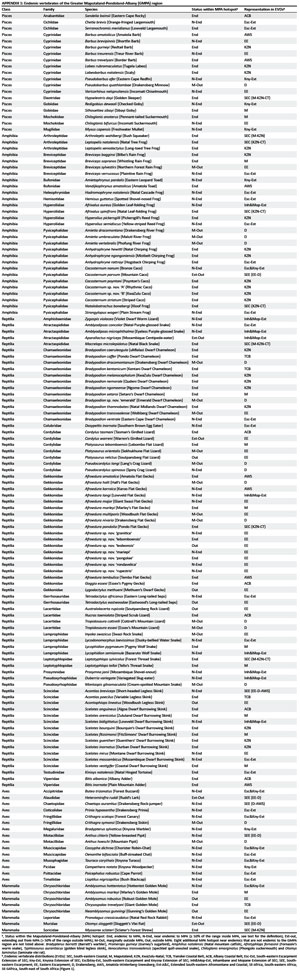
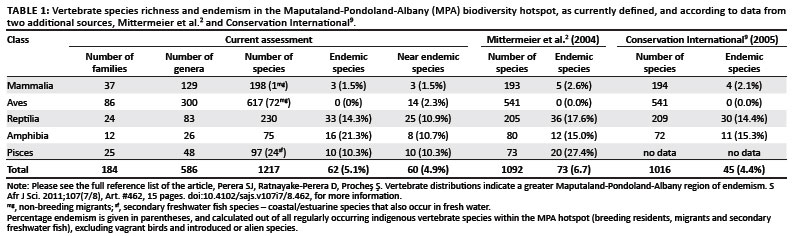
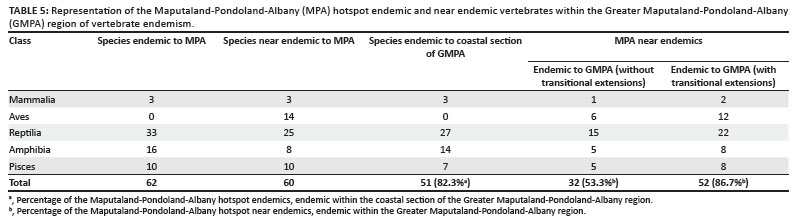
A list of 1217 regularly occurring indigenous species of vertebrates (representing 586 genera in 184 families), including 62 (5.1%) endemic and 60 (4.9%) near-endemic species is provided for the MPA hotspot (Table 1). In addition, at least 51 bird species were recorded from the hotspot as vagrants, and at least 25 alien species were introduced to the hotspot and have well-established populations. Birds show the highest species richness within the MPA hotspot (668 naturally occurring species including vagrants), whilst the herpetofauna show the highest endemism (21.3% in amphibians and 14.3% in reptiles). Endemic and near-endemic vertebrates of the MPA hotspot are listed in Appendix 1, whilst a complete checklist of all vertebrates occurring in the hotspot is available as online supplementary material to this paper (vagrants and alien species excluded).
Appendix 1
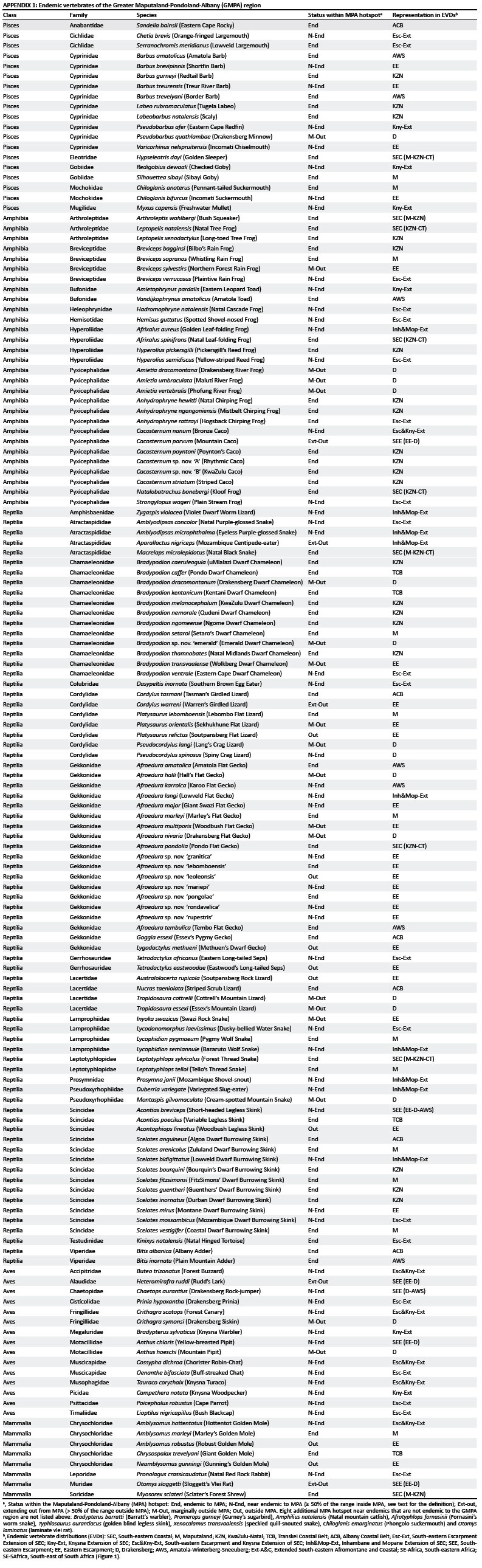
The ichthyofauna of the MPA hotspot includes narrow-range endemics such as the Amatola barb, Barbus amatolicus and the Border barb, B. trevelyani of the Amatola Mountains, the Eastern Cape rocky, Sandelia bainsii of Albany, the redtail barb, Barbus gurneyi and Tugela labeo, Labeo rubromaculatus of KwaZulu-Natal and the pennant-tailed suckermouth, Chiloglanis anoterus of Maputaland, together with the secondary freshwater endemics Sibayi goby, Silhouettea sibayi in Maputaland and the golden sleeper, Hypseleotris dayi along the coast of Maputaland and KwaZulu-Natal. The barbs in genus Barbus show the highest diversity and endemicity amongst fishes in the MPA hotspot with 18 indigenous species, 3 of which (mentioned above) are endemic and 2 are near endemic to the hotspot. The amphibian fauna of the MPA hotspot includes two endemic genera: the monotypic genus Natalobatrachus represented by the kloof frog, N. bonebergi (restricted to the KwaZulu-Natal coastal belt and Pondoland), and the genus Anhydrophryne, represented by the Natal chirping frog, A. hewitti and the mistbelt chirping frog, A. ngongoniensis, narrow-range endemics in KwaZulu-Natal and the KwaZulu-Natal Midlands, respectively, together with the Hogsback chirping frog, A. rattrayi, largely restricted to the Amatola Mountains. Amongst the reptiles, the monotypic endemic genus Macrelaps is represented by the Natal black snake, M. microlepidotus, restricted to Maputaland, KwaZulu-Natal and Podoland. Prominent reptile genera showing a great deal of diversification and narrow endemism within the hotspot are flat geckos in the genus Afroedura (15 species: 6 endemic and 7 near endemic), dwarf burrowing skinks in the genus Scelotes (11 species: 7 endemic and 3 near endemic) and dwarf chameleons in the genus Bradypodion (9 species: 8 endemic and 1 near endemic). Even though the avifauna shows the highest species richness in the MPA hotpsot, there are no endemic birds in the hotspot. However, 14 bird species are listed in Appendix 1 as near endemic to the MPA hotspot, with ranges extending towards the south-eastern escarpment and/or Knysna. The hotspot also forms a part of BirdLife International's 'South-east African Coast' endemic bird area52Chrysospalax trevelyani and Marley's golden mole, Amblysomus marleyi, narrowly endemic to the Transkei coastal belt and Maputaland, respectively), and one shrew (Sclater's forest shrew, Myosorex sclateri in KwaZulu-Natal). However, the numerous non-endemic species make the hotspot an important area for small mammals, especially for golden moles (with seven species representing five genera, two of which are endemic and one is near endemic in the MPA hotspot).
Vertebrate taxa endemic to south-eastern Africa
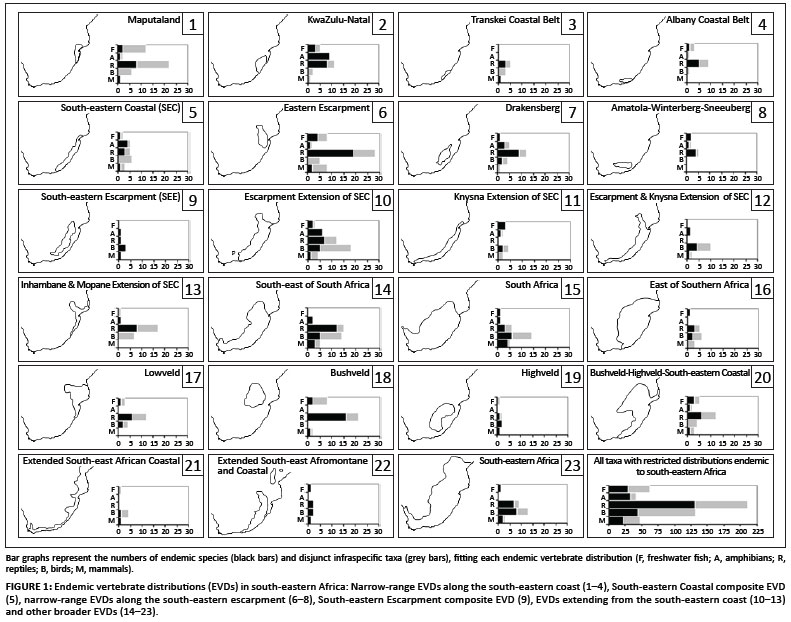
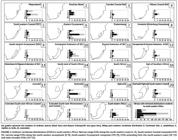
A total of 495 vertebrate taxa (259 species and 236 infraspecific taxa) were found to have restricted ranges endemic to south-eastern Africa (see last panel in Figure 1), making the area an important region of vertebrate endemism, especially for reptiles (211 endemic taxa). Birds, as expected, showed higher endemism in infraspecific taxa (88) than in species (44), as their mobility retards isolation-driven speciation, whilst greater numbers of endemic species compared to infraspecific taxa were recorded for the herpetofauna (with endemic species: endemic infraspecific taxa ratios of 131:80 in reptiles and 33:09 in amphibians), although it can be argued that many more taxa await description.
Endemic vertebrate distributions
A total of 23 EVDs were identified within the study area based on the distribution ranges of 495 endemic taxa. Figure 1 presents maps for all EVDs, together with the numbers of endemic species and infraspecific taxa they harbour for each vertebrate class. Different EVDs were found to possess exceptionally high endemism for different vertebrate classes. For example, from north to south, the Eastern Escarpment EVD had the highest number of endemic reptile taxa (28 taxa: 19 species and 9 infraspecific taxa) and endemic mammal taxa (8 taxa: 2 species and 6 infraspecific taxa); the Maputaland EVD had the highest number of endemic freshwater fish taxa (12 endemic taxa: 2 species and 10 infraspecific taxa); the KwaZulu-Natal EVD had the highest number of endemic amphibian taxa (9 endemic species); and the Escarpment Extension of the South-eastern Coast EVD had the highest number of endemic bird taxa (18 taxa: 5 species and 13 infraspecific taxa). In general, the Eastern Escarpment, KwaZulu-Natal, Drakensberg, and Maputaland are the most outstanding amongst the narrow-range EVDs in south-eastern Africa (with 26, 20, 15 and 12 endemic species, respectively), and hence can be regarded as priority areas for vertebrate conservation.
The greater Maputaland-Pondoland-Albany region of vertebrate endemism
There are seven narrow-range EVDs in south-eastern Africa: Maputaland, KwaZulu-Natal, Transkei Coastal Belt and Albany Coastal Belt along the south-eastern coast, and the Eastern Escarpment, Drakensberg and Amatola-Winterberg-Sneeuberg along the south-eastern Great Escarpment (Figure 2a). These narrow-range EVDs together with two EVDs showing endemic range extensions from the coastal belt towards the escarpment (the Escarpment Extension EVD and the Escarpment and Knysna Extension EVD of the south-eastern coast; Figure 2b), and two transitional extensions (the Inhambane and Mopane Extension in the north-east and the Knysna Extension in the south-west; Figure 2b), were used to demarcate a Greater Maputaland-Pondoland-Albany (GMPA) region of vertebrate endemism (Figure 2b and 2c). Some species, such as the bronze caco, Cacosternum nanum; chorister robin-chat, Cossypha dichroa; Knysna turaco, Tauraco corythaix and Hottentot golden mole, Amblysomus hottentotus have distributions almost identical to the extent of the GMPA region. The Maputaland, KwaZulu-Natal, Transkei Coastal Belt and Albany Coastal Belt EVDs form the coastal section of the GMPA region, largely matching the borders of the MPA hotspot, whilst the Eastern Escarpment, Drakensberg and Amatola-Winterberg-Sneeuberg EVDs are situated inland, forming the Great Escarpment section of the GMPA region.
The total vertebrate endemism of the GMPA region is thus as high as 146 species (19 freshwater fishes, 29 amphibians, 75 reptiles, 15 birds and 8 mammals - see Appendix 1), 135% higher than for the MPA hotspot (62 species), within an area only 73% larger than the hotspot (~274 316 km27
It is particularly remarkable that the GMPA region harbours 15 endemic bird species in contrast to the MPA hotspot, which has no endemic bird species. Three reptile genera extralimital to the MPA hotspot (genera of the Woodbush legless skink, Acontophiops; the Swazi rock snake, Inyoka and the cream-spotted mountain snake, Montaspis), together with the amphibian genus of the Natal cascade frog Hadromophryne and the bird genus of the bush blackcap Lioptilus, all monotypic and extending towards the escarpment from the MPA hotspot, are endemic within the GMPA region. This results in a total of eight genera (three amphibian genera - Anhydrophryne, Hadromophryne and Natalobatrachus, four reptile genera - Acontophiops, Inyoka, Macrelaps and Montaspis and the bird genus Lioptilus) endemic to the GMPA region, in contrast to the only three vertebrate genera (Anhydrophryne, Natalobatrachus and Macrelaps) endemic to the MPA hotspot. Furthermore, two golden mole genera, namely Chrysospalax and Neamblysomus, are near endemic to the GMPA region (each genus having two species, one of each endemic to the GMPA region and the others extending to the Northern Mesic Highveld and Central Bushveld bioregions, respectively29Appendix 1 lists all the vertebrate species endemic to the GMPA region, their status within the MPA hotspot and the EVDs they are characteristic to.
Zoogeographical units and areas of vertebrate endemism
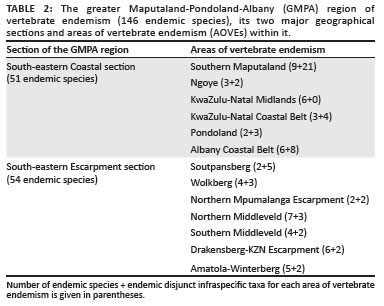
Using the core regions of EVDs, their overlapping margins and the patterns of narrower endemism within them, we demarcated 24 non-overlapping zoogeographical units within the GMPA region (Figure 2c), including 13 AOVEs (Table 2).
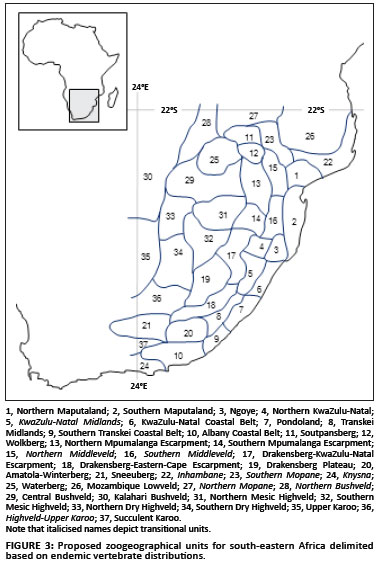
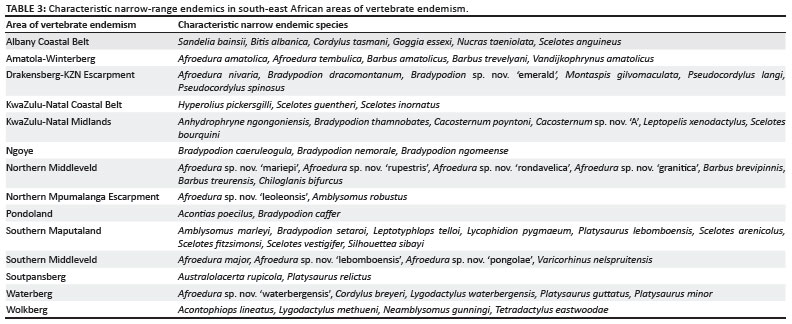
Overall, 37 zoogeographical units (Figure 3) can be recognised for south-eastern Africa (south of 22ºS and east of 24ºE) based on the EVDs illustrated in Figure 1. Of these, 14 represent AOVEs (13 are within the GMPA region and listed in Table 2 and 1 AOVE represents the Waterberg), whilst 7 are transitional units because taxa occupying them show considerable links with units on either side of them: the Northern Mopane, Southern Mopane, Inhambane, Northern Middleveld, Southern Middleveld, KwaZulu-Natal Midlands and Knysna (the Northern Middleveld, Southern Middleveld and KwaZulu-Natal Midlands transitional units are also AOVEs). The characteristic narrow endemics of each AOVE are listed in Table 3.
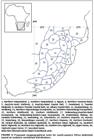
Within the GMPA region, six units are relatively endemic poor: the Southern Mpumalanga Escarpment, Northern Maputaland, Northern KwaZulu-Natal, Drakensberg Plateau, Transkei Midlands and Southern Transkei Coastal Belt; amongst which the last two, taken together, provide evidence for the existence of a 'Transkei gap'.53
Discussion
Methods revisited
We used the distribution ranges of endemic vertebrate taxa to qualitatively identify a region of conservation priority as well as zoogeographical units for south-eastern Africa, given that the distribution databases for some taxa are far from complete and not particularly accurate. The available distribution data for different vertebrate classes in south-eastern Africa vary considerably in their completeness and resolution, as a result of varied intensities of collection and different scales of mapping. Some of the available atlas data sets do not completely cover our study region (most being limited to South Africa, Lesotho and Swaziland), and other references from which these data can be supplemented give distribution maps at different resolutions. Therefore, we used a qualitative approach to delimit EVDs congruent amongst vertebrate classes. From these, a set of zoogeographical units were developed in order to incorporate the available data into a subsequent rigorous numerical analysis, reducing both data incompleteness (as compared to QDSs), and the arbitrary nature of boundaries (compared to half- or full-degree squares if QDS data were to be pooled). However, data are far scarcer in most of the world's biodiversity hotspots (e.g. the Guinean Forests of West Africa,54555657
Vertebrate endemism in the Maputaland-Pondoland-Albany biodiversity hotspot as currently defined
Although the MPA hotspot is identified as a biodiversity hotspot primarily based on its floristic endemism, it is evident that vertebrates also show an increased endemism in and towards the hotspot, albeit with comparatively lower degrees of endemism (5.1%) and near-endemism (4.9%) than is the case for plants, which have a degree of endemism of 23.5%.22Table 1), although many details have changed since, because of the discovery of new species (e.g. cacos, Cacosternum spp., flat geckos, Afroedura spp. and dwarf chameleons, Bradypodion spp.) and taxonomic revisions. The number of MPA-endemic fish species in Mittermeier et al.2210
South-east African vertebrate endemism and its congruence with vegetation types
As one would expect, the EVDs described here showed a considerable degree of congruence with vegetation patterns (biomes and bioregions).29
Several narrow endemics of forest affinities fall within the south-eastern coastal belt, represented in patches of sand, scarp and coastal forest.292929Lygodactylus methueni and Gunning's golden mole, Neamblysomus gunningi), the coastal (dune) forests of Southern Maputaland (e.g. Setaro's dwarf chameleon, Bradypodion setaroi; Zululand dwarf burrowing skink, Scelotes arenicolus and FitzSimons' dwarf burrowing skink, S. fitzsimonsi), the scarp and mistbelt forests of southern Zululand (our Ngoye 'area of endemism'; uMlalazi dwarf chameleon, Bradypodion caeruleogula; Qudeni dwarf chameleon, B. nemorale and Ngome dwarf chameleon, B. ngomeense), the mistbelt forest patches of the KwaZulu-Natal Midlands (Natal Midlands dwarf chameleon, Bradypodion thamnobates), the Afromontane forests along the Drakensberg-KwaZulu-Natal Escarpment (Drakensberg dwarf chameleon, Bradypodion dracomontanum and an undescribed dwarf chameleon species, B. sp. nov. 'emerald'), and the scarp forests of KwaZulu-Natal Coastal Belt and Pondoland (kloof frog, Natalobatrachus bonebergi), coastal forests of Pondoland (variable legless skink, Acontias poecilus and Pondo dwarf chameleon, Bradypodion caffer) and Southern Transkei Coastal Belt (giant golden mole, Chrysospalax trevelyani). In addition to the narrow endemics, a few avian forest endemics are found in most of the GMPA region (e.g. forest buzzard, Buteo trizonatus; chorister robin-chat, Cossypha dichroa and Knysna turaco, Tauraco corythaix).
Similarly, a few grassland endemics are fairly widespread in the GMPA region (e.g. Sloggett's vlei rat, Otomys sloggetti and the Natal red rock rabbit, Pronolagus crassicaudatus), whilst some sections of the grassland biome support narrow endemic vertebrates, namely, from north to south, the montane grasslands of the Wolkberg (Woodbush legless skink, Acontophiops lineatus) and Mpumalanga Escarpment (robust golden mole, Amblysomus robustus), the coastal grasslands of Southern Maputaland (pygmy wolf snake, Lycophidion pygmaeum), the mistbelt grasslands of the KwaZulu-Natal Midlands (mistbelt chirping frog, Anhydrophryne ngongoniensis; long-toed tree frog, Leptopelis xenodactylus and Bourquin's dwarf burrowing skink Scelotes bourquini), KwaZulu-Natal Midlands and Coastal Belt grasslands (striped caco, Cacosternum striatum), marshy areas within KwaZulu-Natal Coastal Belt grasslands (Pickersgill's reed frog, Hyperolius pickersgilli), montane grasslands along the Drakensberg-KwaZulu-Natal and Drakensberg-Eastern-Cape Escarpments (Drakensberg flat gecko, Afroedura nivaria; Lang's crag lizard, Pseudocordylus langi; Cottrell's mountain lizard, Tropidosaura cottrelli and Essex's mountain lizard, T. essexi), alpine grasslands on the Drakensberg Plateau and Escarpments (Drakensberg river frog, Amietia dracomontana; Maluti river frog, A. umbraculata; Hall's flat gecko, Afroedura halli; mountain pipit, Anthus hoeschi and Drakensberg Siskin, Crithagra symonsi) and the montane grasslands of the Amatolas (Amatola flat gecko, Afroedura amatolica; Tembo flat gecko, A. tembulica and Amatola toad, Vandijkophrynus amatolicus), as well as the Sneeuberg (plain mountain adder, Bitis inornata).
Few narrow endemics inhabit thicket in the Albany Coastal Belt (Albany adder, Bitis albanica; Tasman's girdled lizard, Cordylus tasmani and the striped scrub lizard, Nucras taeniolata), and fire-free habitat patches elsewhere (e.g. Kentani dwarf chameleon, Bradypodion kentanicum, in the Transkei Coastal Belt). Similarly, few narrow-endemic vertebrates exist within the savanna biome: in the Waterberg - the Waterberg girdled lizard, Cordylus breyeri; dwarf flat lizard, Platysaurus guttatus and Waterberg flat lizard, P. minor; the Soutpansberg - the Soutpansberg rock lizard, Australolacerta rupicola and Soutpansberg flat lizard, Platysaurus relictus; and the Northern Mpumalanga Escarpment - the Sekhukhune flat lizard, Platysaurus orientalis), whilst relatively widespread savanna endemics are found in the Bushveld EVD (e.g. Van Dam's girdled lizard, Cordylus vandami; black-spotted dwarf gecko, Lygodactylus nigropunctatus and Juliana's golden mole, Neamblysomus julianae).
The Northern Middleveld, Southern Maputaland, KwaZulu-Natal Midlands, Drakensberg-KwaZulu-Natal Escarpment, Albany Coastal Belt and the Amatola-Winterberg stand out as the AOVEs with the highest numbers of characteristic narrow endemics within the GMPA region (that is, more than five; see Table 2). Interestingly, the narrow endemics within these richest AOVEs show major habitat affinities to forests, grasslands and thicket vegetation, emphasising the importance of these habitats for vertebrate endemism in the region.
The structural features of the flora determine the faunal assemblages in a region,55558Aloe thraskii; woolly calpurnia, Calpurnia woodii; sticky star-apple, Diospyros glandulifera; parrot tree erica, Erica psittacina; Tugela spikethorn, Gymnosporia macrocarpa; Wood's spikethorn, G. woodii; Rudatis' dwarf currant, Searsia rudatisii and Tugela bush-milkwood, Vitellariopsis dispar), albeit some have only recently been described.
Congruence of endemic vertebrate distributions and the greater Maputaland-Pondoland-Albany region with published zoogeographical regions
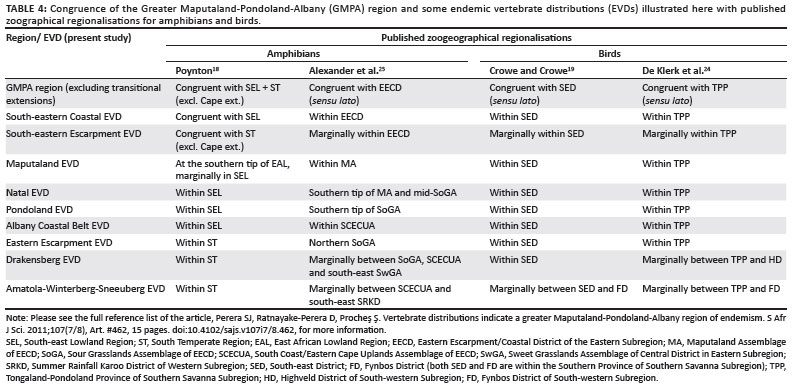
The GMPA region, as well as the narrow-range EVDs presented here, shows congruent patterns with published zoogeographical regionalisation schemes developed with numerical analyses for single vertebrate classes (Table 4). The faunal zones identified by Crowe26
The greater Maputaland-Pondoland-Albany region of vertebrate endemism and its conservation significance
The importance of the zoogeographically delimited GMPA region as a more comprehensive area for conservation prioritisation needs to be understood by comparing it with the MPA hotspot as currently defined. The coastal section of the GMPA region is largely congruent - if narrower - with the MPA hotspot. Inland, even though the hotspot encompasses most of the Amatola-Winterberg-Sneeuberg EVD and the southern parts of the Eastern Escarpment EVD, these extend well beyond the current boundary of the hotspot. Furthermore, some taxa occupying these EVDs continue their ranges along the Drakensberg Escarpment, which lies almost completely outside the hotspot. This incongruence explains the inconsistency between the current boundary of the MPA hotspot and the patterns of vertebrate endemism (Figure 2a). Only 82.3% of the MPA hotspot's endemism is captured within the coastal section of the GMPA region (Table 5), the remainder of the endemic species have ranges that extend towards the south-eastern Great Escarpment (mostly towards the Eastern Escarpment and a few towards the Amatola-Winterberg-Sneeuberg and Drakensberg EVDs: see Appendix 1). Hence, we propose that a GMPA region that merges coastal and escarpment EVDs represents a more natural region of vertebrate endemism.
The GMPA region can be further validated by vertebrate species near endemic to the MPA hotspot. Amongst the near endemics of the MPA hotspot, 53.3% were found extending from the coastal section towards the south-eastern Great Escarpment and hence are endemic to the GMPA region. Moreover, when the GMPA region is considered to include the Inhambane and Mopane and the Knysna transitional extensions, it encompasses 86.7% of the MPA hotspot's near endemics (Table 5 and Appendix 1). The eight MPA near endemics that are not endemic to the GMPA region nevertheless have their core populations restricted to the GMPA region, with disjunct satellite populations (namely. Barratt's warbler, Bradypterus barratti and Gurney's sugarbird, Promerops gurneyi with satellite populations in the Chimanimani-Nyanga Mountains of eastern Zimbabwe; the Natal mountain catfish, Amphilius natalensis in the Chimanimani-Nyanga Mountains and southern Malawi; Fornasini's worm snake, Afrotyphlops fornasinii, the golden blind legless skink, Typhlosaurus aurantiacus and the speckled quill-snouted snake, Xenocalamus transvaalensis in the Lowveld region; Phongolo suckermouth, Chiloglanis emarginatus in the Bushveld region; and the laminate vlei rat, Otomys laminatus in the Western Cape).
The mismatches between EVDs and boundaries of the MPA hotspot, in the south-west and especially in the north-west (Figure 2a), also validate the recognition of the GMPA region as a more natural region of conservation significance. The north-western boundary of the hotspot is currently delimited along the 1800 m a.s.l. contour, making several species with restricted ranges along this boundary near endemic to the MPA hotspot (six species of reptiles: the montane dwarf burrowing skink, Scelotes mirus; giant Swazi flat gecko, Afroedura major and four undescribed flat gecko species, A. sp. nov. 'mariepi', A. sp. nov. 'rupestris', A. sp. nov. 'rondavelica' and A. sp. nov. 'granitica', together with four freshwater fish species: the shortfin barb, Barbus brevipinnis; Treur River barb, B. treurensis; Incomati suckermouth, Chiloglanis bifurcus and Incomati chiselmouth, Varicorhinus nelspruitensis). These species are indeed restricted to a Middleveld strip along the slopes of the Eastern Escarpment, which we identify as a transition zone between the Bushveld and Lowveld bioregions. This transition zone descends to an elevation of about 1000 m a.s.l. and extends south through western Swaziland to north-western KwaZulu-Natal (west of the Lebombo Mountains). Whilst the aforesaid species occurring in the northern parts of the transition zone are near endemic to the MPA hotspot, species occupying its southern parts, like the undescribed flat geckos, Afroedura sp. nov. 'lebomboensis' and Afroedura sp. nov. 'pongolae', are endemic to the hotspot, providing further evidence for the inconsistency of the hotspot boundary. In contrast, the GMPA region, with a more natural boundary, encompasses all of them as endemics. Along the south-western corner, the boundary of the MPA hotspot follows the Albany centre of plant endemism. In the demarcation of the Albany centre, van Wyk and Smith5
The existence of the GMPA region is also supported by plants, as shown by the distribution patterns of some species in the thicket genera: Encephalartos (Zamiaceae), Rhoicissus (Vitaceae) and Cussonia (Araliaceae),59606162
Conclusions
This study emphasises south-eastern Africa as an important region for endemic vertebrates, especially with respect to herpetofauna. It also provides evidence for congruent endemic distributions amongst different vertebrate taxa, deriving patterns largely congruent with recognised centres of floristic endemism. The importance of the MPA hotspot is assessed for vertebrate endemism, providing less convincing evidence when compared to its flora. But the fact that vertebrate endemism in south-eastern Africa is concentrated towards the coastal belt and adjacent sections of the Great Escarpment provides an option to expand the boundaries of the MPA hotspot to include relevant Afromontane AOVEs. Supported by the zoogeographical links between the coastal and escarpment EVDs, the GMPA region of vertebrate endemism is proposed to serve as a better and more natural region of conservation significance. Simultaneously, the use of EVDs is proposed as a qualitative approach to identify conservation priorities, especially in situations where distributional data do not facilitate a numerical biogeographical analysis.
Acknowledgements
We are indebted to Syd Ramdhani for discussion. This work was supported by the National Research Foundation of South Africa (African Origins Platform grant to ŞP) and the University of KwaZulu-Natal (doctoral research grant and Gay Langmuir bursary in Wildlife and Conservation Biology to SJP). The authors would also like to thank three anonymous reviewers for their valuable comments and suggestions to improve the quality of the manuscript.
References
- 1. Myers N, Mittermeier RA, Mittermeier CG, Da Fonseca GAB, Kent J. Biodiversity hotspots for conservation priorities. Nature. 2000;403:853-858. doi:10.1038/35002501, PMid:10706275
- 2. Mittermeier RA, Robles-Gil P, Hoffmann M, et al., editors. Hotspots revisited: Earth's biologically richest and most endangered terrestrial ecoregions. Mexico City: CEMEX; 2004.
- 3. Wilson KA, McBride MF, Bode M, Possingham HP. Prioritising global conservation efforts. Nature. 2006;440:337-340. doi:10.1038/nature04366, PMid:16541073
- 4. Driver A, Maze K, Lombard AT, et al. South African national spatial biodiversity assessment 2004: Summary report. Pretoria: South African National Biodiversity Institute; 2004.
- 5. Van Wyk AE, Smith GF. Regions of floristic endemism in southern Africa. Pretoria: Umdaus Press; 2001.
- 6. Leader-Williams N, Dublin HT. Charismatic megafauna as 'flagship species'. In: Entwistle A, Dunstone N, editors. Priorities for the conservation of mammalian diversity: Has the panda had its day? Cambridge: Cambridge University Press, 2000; p. 53-81.
- 7. Steenkamp Y, van Wyk AE, Victor JE, et al. Maputaland-Pondoland-Albany. In: Mittermeier RA, Robles-Gil P, Hoffmann M, et al., editors. Hotspots revisited: Earth's biologically richest and most endangered terrestrial ecoregions. Mexico City: CEMEX, 2004; p. 218-229.
- 8. White F. The vegetation of Africa: A descriptive memoir to accompany the UNESCO/AETFAT/UNSO vegetation map of Africa (Natural Resources Research 20). Paris: UNESCO; 1983.
-
9. Conservation International. Biodiversity hotspots: Terrestrial vertebrate species database [homepage on the Internet]. c2005 [updated 2005 Feb 02; cited 2010 Aug 17]. Available from: http://www.biodiversityhotspots.org/xp/Hotspots/search/Pages/search.aspx
» http://www.biodiversityhotspots.org/xp/Hotspots/search/Pages/search.aspx -
10. Critical Ecosystem Partnership Fund. Ecosystem profile: Maputaland-Pondoland-Albany biodiversity hotspot [document on the Internet]. c2010 [updated 2010 Feb 26; cited 2010 Apr 16]. Available from: http://www.cepf.net/Documents/DC_Finaldraft_MPAHprofile_Feb262010.pdf
» http://www.cepf.net/Documents/DC_Finaldraft_MPAHprofile_Feb262010.pdf - 11. Kier G, Kreft H, Lee TM, et al. A global assessment of endemism and species richness across island and mainland regions. Proc Natl Acad Sci USA. 2009;106:9322-9327. doi:10.1073/pnas.0810306106, PMid:19470638, PMCid:2685248
- 12. Raxworthy CJ, Nussbaum RA. Patterns of endemism for terrestrial vertebrates in eastern Madagascar. In: Lourenço WR, editor. Biogéographie de Madagascar. Paris: ORSTOM, 1996; p. 369-383.
- 13. Cowling RM, Pressey RL. Introduction to systematic conservation planning in the Cape Floristic Region. Biol Conserv. 2003;112:1-13. doi:10.1016/ S0006-3207(02)00418-4
- 14. Linder P. Numerical analyses of African plant distribution patterns. In: Huxley CR, Lock JM, Cutler DF, editors. Chorology, taxonomy and ecology of the floras of Africa and Madagascar. Kew: Royal Botanic Gardens, 1998; p. 67-86.
- 15. Linder HP, Lovett J, Mutke JM, et al. A numerical re-evaluation of the sub-Saharan phytochoria of mainland Africa. Biol Skrift. 2005;55:229-252.
- 16. Ramdhani S, Barker NP, Baijnath H. Exploring the Afromontane centre of endemism: Kniphofia Moench (Asphodelaceae) as a floristic indicator. J Biogeogr. 2008;35:2258-2273. doi:10.1111/j.1365-2699.2008.01982.x
- 17. Poynton JC. The Amphibia of southern Africa: A faunal study. Ann Natal Mus. 1964;17:1-334.
- 18. Poynton JC. Distribution of amphibians in sub-saharan Africa, Madagascar, and Seychelles. In: Duellmann WE, editor. Patterns of distribution of amphibians, a global perspective. Baltimore: John Hopkins University Press, 1999; p. 483-539.
- 19. Crowe TM, Crowe AA. Patterns of distribution, diversity and endemism in Afrotropical birds. J Zool (Lond). 1982;198:417-442.
- 20. Guillet A, Crowe TM. Patterns of distribution, species richness, endemism and guild composition of water-birds in Africa. Afr J Ecol. 1985;23:89-120. doi:10.1111/j.1365-2028.1985.tb00719.x
- 21. Guillet A, Crowe TM. A preliminary investigation of patterns of distribution and species richness of southern African waterbirds. S Afr J Wildl Res. 1986;16:65-81.
- 22. Turpie JK, Crowe TM. Patterns of distribution, diversity and endemism of larger African mammals. S Afr J Zool. 1994;29:19-32.
- 23. Seymour CL, de Klerk HM, Channing A, Crowe TM. The biogeography of the Anura of sub-equatorial Africa and the prioritisation of areas for their conservation. Biodiversity Conserv. 2001;10:2045-2076. doi:10.1023/A:1013137409896
- 24. De Klerk HM, Crowe TM, Fjeldså J, Burgess ND. Biogeographical patterns of endemic terrestrial Afrotropical birds. Divers Distrib. 2002;8:147-162. doi:10.1046/j.1472-4642.2002.00142.x
- 25. Alexander GJ, Harrison JA, Fairbanks DH, Navarro RA. Biogeography of the frogs of South Africa, Lesotho and Swaziland. In: Minter LR, Burger M, Harrison JA, Braack HH, Bishop PJ, Kloepfer D, editors. Atlas and red data book of the frogs of South Africa, Lesotho and Swaziland. SI/MAB Series no. 9. Washington DC: Smithsonian Institution, 2004; p. 31-47.
- 26. Crowe TM. A quantitative analysis of patterns of distribution, species richness and endemism in southern African vertebrates. In: Peters G, Hutterer R, editors. Vertebrates in the tropics: Proceedings of the International Symposium on Vertebrate Biogeography and Systematics in the Tropics; 1989 June 5-8; Bonn, Germany. Bonn: Museum Alexander Koenig; 1990. p. 145-160.
- 27. Nordenstam B. Phytogeography of the genus Euryops (Compositae). A contribution to the phytogeography of southern Africa. Opera Botanica. 1969:23:7-77.
- 28. Clark VR, Barker NP, Mucina L. The Sneeuberg: A new centre of floristic endemism on the Great Escarpment, South Africa. S Afr J Bot. 2009;75:196-238. doi:10.1016/j.sajb.2008.10.010
- 29. Mucina L, Rutherford MC. The vegetation of South Africa, Lesotho and Swaziland. Strelitzia 19. Pretoria: South African National Biodiversity Institute; 2006.
- 30. Larsen R, Holmern T, Prager SD, Maliti H, Røskaft E. Using the extended quarter degree grid cell system to unify mapping and sharing of biodiversity data. Afr J Ecol. 2009;47:382-392. doi:10.1111/j.1365-2028.2008.00997.x
- 31. Skelton PH. A complete guide to the freshwater fishes of southern Africa. Johannesburg: Southern Book Publishers; 1993.
- 32. Skelton PH. Changes to the scientific and common names of southern African freshwater fishes. Afr J Aquat Sci. 2002;27:171-174. doi:10.2989/16085914.2002.9626588
-
33. Froese R, Pauly D, editors. FishBase [homepage on the Internet]. c2009 [updated 2009 Aug; cited 2010 Feb 28]. Available from: http://www.fishbase.org
» http://www.fishbase.org - 34. Minter LR, Burger M, Harrison JA, Braack HH, Bishop PJ, Kloepfer D, editors. Atlas and red data book of the frogs of South Africa, Lesotho and Swaziland. SI/MAB Series no. 9. Washington DC: Smithsonian Institution; 2004.
- 35. Du Preez L, Carruthers V. A complete guide to the frogs of southern Africa. Cape Town: Struik Nature; 2009.
-
36. Animal Demography Unit. The virtual museum: Southern African reptile conservation assessment [homepage on the Internet]. c2010 [updated 2010 Jan 29; cited 2010 Jan 31]. Available from: http://sarca.adu.org.za
» http://sarca.adu.org.za - 37. Branch B. Field guide to snakes and other reptiles of southern Africa. Cape Town: Struik; 1998.
- 38. Harrison JA, Allan DG, Underhill LG, et al. editors. The atlas of southern African birds. Johannesburg: BirdLife South Africa; 1997.
- 39. Hockey PAR, Dean WRJ, Ryan PG, editors. Robert's birds of southern Africa. 7th ed. Cape Town: The Trustees of the John Voelcker Bird Book Fund; 2009.
- 40. Skinner DS, Chimimba CT. The mammals of the southern African subregion. 3rd ed. Cambridge: Cambridge University Press; 2005.
- 41. Kelly CMR, Branch WR, Broadley DG, Barker NP, Villet MH. Molecular systematics of the African snake family Lamprophiidae Fitzinger, 1843 (Serpentes: Elapoidea), with particular focus on the genera Lamprophis Fitzinger 1843 and Mehelya Csiki 1903. Mol Phylogenet Evol. 2011;58:415-426. doi:10.1016/j.ympev.2010.11.010, PMid:21095234
- 42. Alström P, Ericson PGP, Olsson U, Sundberg P. Phylogeny and classification of the avian superfamily Sylvioidea. Mol Phylogenet Evol. 2006;38:381-397. doi:10.1016/j.ympev.2005.05.015, PMid:16054402
- 43. Johansson US, Fjeldså J, Bowie RCK. Phylogenetic relationships within Passerida (Aves: Passeriformes): A review and a new molecular phylogeny based on three nuclear intron markers. Mol Phylogenet Evol. 2008;48:858-876. doi:10.1016/j.ympev.2008.05.029, PMid:18619860
- 44. Kelly CMR, Barker NP, Villet MH, Broadley DG. Phylogeny, biogeography and classification of the snake superfamily Elapoidea: A rapid radiation in the late Eocence. Cladistics. 2009;25:38-63. doi:10.1111/j.1096-0031.2008.00237.x
- 45. White F. The AETFAT chorological classification of Africa: History, methods and applications. Bull Jard Bot Nat Belg. 1993;62:225-281. doi:10.2307/3668279
- 46. Procheş Ş. The world's biogeographical regions: Cluster analyses based on bat distributions. J Biogeogr. 2005;32:607-614. doi:10.1111/j.1365- 2699.2004.01186.x
- 47. Kreft H, Jetz W. A framework for delineating biogeographical regions based on species distributions. J Biogeogr. 2010;37:2029-2053. doi:10.1111/j.1365-2699.2010.02375.x
- 48. Wallace AR. The geographic distribution of animals. New York: Harper; 1876.
- 49. Botts EA, Erasmus BFN, Alexander GJ. Geographic sampling bias in the South African Frog Atlas Project: Implications for conservation planning. Biodivers Conserv. 2011:20:119-139. doi:10.1007/s10531-010-9950-6
- 50. Linder HP, Mann DM. The phylogeny and biogeography of Thamnochortus (Restionaceae). Bot J Linn Soc. 1998;128:319-357. doi:10.1111/j.1095-8339.1998.tb02125.x
- 51. Nelson G, Platnick N. Systematics and biogeography: Cladistics and vicariance. New York: Columbia University Press; 1981.
- 52. Stattersfield AJ, Crosby MJ, Long AJ, Wege DC. Endemic bird areas of the world: Priorities for conservation. Series no. 7. Cambridge: BirdLife International, BirdLife Conservation; 1998.
- 53. Vernon CJ. Biogeography, endemism and diversity of animals in the Karoo. In: Dean WRJ, Milton SJ, editors. The Karoo: Ecological patterns and processes. Cambridge: Cambridge University Press, 1999; p.57-78. doi:10.1017/CBO9780511541988.008
-
54. Critical Ecosystem Partnership Fund. Ecosystem profile: Upper Guinean forest ecosystem of the Guinean forests of west Africa biodiversity hotspot [document on the Internet]. c2000 [updated 2000 Dec 14; cited 2010 Aug 12]. Available from: http://www.cepf.net/Documents/final.guineanforests.upperguineanforest.ep.pdf
» http://www.cepf.net/Documents/final.guineanforests.upperguineanforest.ep.pdf -
55. Critical Ecosystem Partnership Fund. Ecosystem profile: Eastern Himalayas region [document on the Internet]. c2005 [updated 2005 Feb; cited 2010 Aug 12]. Available from: http://www.cepf.net/Documents/final.ehimalayas.ep.pdf
» http://www.cepf.net/Documents/final.ehimalayas.ep.pdf -
56. Critical Ecosystem Partnership Fund. Ecosystem profile: Indo-Burma biodiversity hotspot - Indochina region [document on the Internet]. c2007 [updated 2007 May; cited 2010 Aug 12]. Aavailable from: http://www.cepf.net/Documents/final.indoburma_indochina.ep.pdf
» http://www.cepf.net/Documents/final.indoburma_indochina.ep.pdf - 57. Gunawardene NR, Daniels AED, Gunatilleke IAUN, et al. A brief overview of the Western Ghats-Sri Lanka biodiversity hotspot. Curr Sci. 2007;93:1567-1572.
- 58. Boon R. Pooley's trees of eastern South Africa: A complete guide. Durban: Flora and Fauna Publication Trust; 2010.
- 59. Cowling RM, Procheş Ş, Vlok JHJ. On the origin of southern African subtropical thicket vegetation. S Afr J Bot. 2005;71:1-23.
- 60. Van Wyk AE. Biodiversity of the Maputaland centre. In: Van der Maesen LJG, van der Burgt XM, van Medenbach de Rooy JM, editors. The biodiversity in African savannahs. Dordrecht: Kluwer Academic Publishers, 1996; p. 198-207.
- 61. Küper W, Sommer JH, Lovett JC, et al. Africa's hotspots of biodiversity redefined. Ann Missouri Bot Gard. 2004;91:525-535.
- 62. Olson DM, Dinerstein E. The Global 200: A representation approach to conserving the Earth's most biologically valuable ecoregions. Conserv Biol. 1998;12:502-515. doi:10.1046/j.1523-1739.1998.012003502.x
- 63. Born J, Linder HP, Desmet P. The greater Cape Floristic Region. J Biogeogr. 2006;34:147-162. doi:10.1111/j.1365-2699.2006.01595.x
Sandun Perera
School of Environmental Sciences, University of KwaZulu-Natal, Westville campus
Private Bag X 54001
Durban 4001, South Africa
Email: sandun.perera@gmail.com

Accepted: 14 Mar. 2011
Published: 15 July 2011