Success in first-year mathematics: school-leaving examinations and first-year performance
Success in first-year mathematics: School-leaving examinations and first-year performance
C. Robert DennisI; Daniël M. MurrayII
IChemistry Department, University of the Free State, Bloemfontein, South Africa
IIDepartment of Mathematics and Applied Mathematics, University of the Free State, Bloemfontein, South Africa
Correspondence to
Studying towards a BSc degree at universities in South Africa requires at least one course in mathematics. A course in mathematics also is a prerequisite if a candidate wants to register as a professional scientist with the South African Council for Natural Scientific Professions.1
Entrance to study a BSc at South African universities is based on a prospective student's level of performance in the final school leaving - Senior Certificate (SC) or National Senior Certificate (NSC) - examination. At the University of the Free State (UFS), the mathematics entrance requirement for the BSc in Actuarial Science and the pure mathematics and applied mathematics programmes is a higher-grade B (HG B) symbol in SC school mathematics or a level 6 for mathematics in the final NSC examination. Other BSc programmes require a minimum of a standard-grade C (SG C) in SC school mathematics or a level 4 for mathematics in the final NSC examination.
In 2008, the first cohort of matriculants completed the new NSC curriculum. An analysis of the mathematics examination results indicates that the number of learners that obtained a mark of 80% and higher in school mathematics increased significantly.233,4
During February 2009, the 2009 cohort entering the UFS undertook a battery of Alternative Admissions Research Project (AARP) tests.5
The National Benchmark Test Project (NBT), piloted in February 2009 with the 2009 cohort of higher education entrants at selected institutions, was implemented in August 2009 for the 2010 entrants. The results of the tests are divided into four proficiency levels67,8 The 2010 NBT report66
Several media reports have expressed the view that learners had been poorly prepared at school level. Serrau910
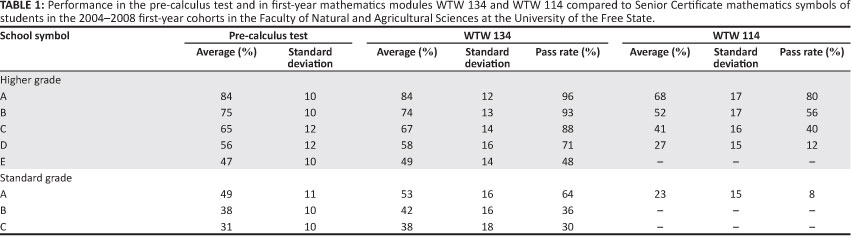
At the UFS we use a pre-calculus test for first-time entrants into first-year mathematics to establish their competency in mathematics, primarily to offer curriculum advice. The pre-calculus test has been taken by all students entering the Faculty of Natural and Agricultural Sciences since 2004. Table 1 shows a comparison of the symbols of first-time entrants from the old SC final examinations (between 2004 and 2008), their performance in the pre-calculus test, and their final results in the mathematics modules WTW 114 (major module) or WTW 134 (service module). When universities calculate an M-score for entrance purposes to universities, it is generally accepted that a SG A symbol is equivalent to a HG C symbol. However, our observations in terms of the pre-calculus test clearly show a significantly larger difference in student proficiency between these two symbols, namely that the SG A symbol instead corresponds to a HG E symbol.
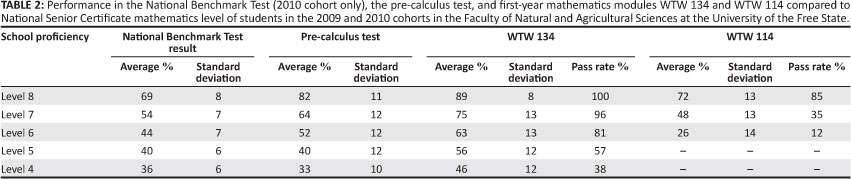
The main aim in applying the pre-calculus test since 2004 has been the benchmarking of the SC mathematics symbol against the NSC performance level. Table 1 shows that SC learners with a HG A symbol obtained an average of 84% in the pre-calculus test. According to Table 2, NSC learners with a performance level 8 (90% - 100%) obtained an average of 82% in the pre-calculus test. From this we conclude that a level 8 symbol corresponds well to a HG A for school mathematics. Similarly, we can argue that performance level 7 (80% - 89%) and level 6 (70% - 79%) correspond to HG C (60% - 69%) and HG D (50% - 59%) symbols, respectively. Table 2 also shows that performance level 5 (60% - 69%) and level 4 (50% - 59%) correspond to SG B and SG C symbols, respectively, which indicates a difference of approximately 20%. Our results confirm the finding that NSC mathematics may be inflated by 20% in the lower ranges.11
The only NBT results available are those of the 2010 cohort. Table 2 shows the NBT results and their corresponding pre-calculus results. Students in the proficient level (>62%) in the NBT, obtained a higher mark in the pre-calculus test, while students in the intermediate and basic levels of the NBT, obtained a similar mark in the pre-calculus test.
An important factor to consider is, however, the entrance requirement with respect to mathematics for study at a higher education institution and, with that, the success rate in mathematics in the first year of study. At the UFS, two mathematics modules are presented in the first semester of the first year: WTW 114 and WTW 134. WTW 114 is the module which leads to majoring in mathematics and actuarial science and in some programmes in physics and chemistry. This module is also the one which other universities recognise for engineering study. WTW 134 is a 'service' module, which is mainly for biological, earth and agricultural science programmes where mathematics is required only in the first year of the programme.
At the UFS, until 2008, the entrance requirement for WTW 114, the higher level mathematics, was a HG D symbol in the SC mathematics final examination. Since 2009, the requirement has been set as a level 6 in NSC mathematics. The data in Tables 1 and 2 clearly indicate that a HG D and a level 6 school mathematics proficiency is not sufficient to achieve success in the WTW 114 mathematics module. The entrance requirement for WTW 134, the 'service' module, was a SG C and a level 4 school mathematics proficiency. This entrance requirement leads to a success rate in this module considerably below 50%. We therefore conclude that standard-grade mathematics in the SC and a level 4 performance in NSC mathematics are not sufficient for success in our WTW 134 mathematics module.
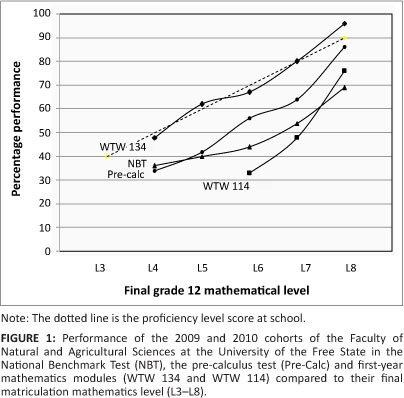
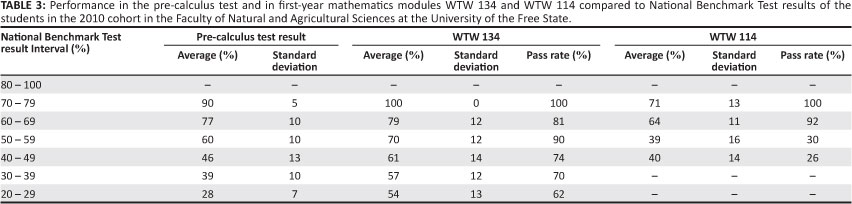
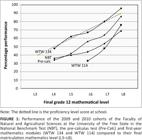
One of the objectives of the NBT project is to assess the relationship between higher-education entry-level requirements and school-level exit outcomes.776Table 3 and Figure 1 indicate the success rates in the two first-semester mathematics modules, WTW 114 and WTW 134, at the UFS compared to the NBT scores. Our data reveal a more positive picture than the NBT reports for success infirst-year mathematics. Thatis, to be successful in WTW Π4, a siudent shoulS sc0reat the proficient levd in mathematics in the NBT, but a basic level for mathematics in 4ss sufficiCTit: to he succe^fiilin meWTW s34
The claim of the 2010 NBT rport6
A new school curriculum dictated by the 'Curriculum and Assessment Policy Statements (CAPS)'12
References
-
1. SACNASP Information Brochure [document on the Internet]. No date [cited2010 Nov 16]. Available from: http://www.Sacnasp.org.za/documents/information_brochure_2010_2011.pdf
» http://www.Sacnasp.org.za/documents/information_brochure_2010_2011.pdf -
2. Department of Education. Abridged Report: 2008 National Senior Certificate Examination Results [document on the Internet]. c2008 [cited 2010 Oct 03]. Available from: http://edulibpretoria.files.wordpress.com/2009/01/abridgedreport2008nscexams.pdf
» http://edulibpretoria.files.wordpress.com/2009/01/abridgedreport2008nscexams.pdf - 3. Wolmarans N, Smit R, Collier-Reed B, Leather H. Addressing concerns with the NSC: An analysis of first-year student performance in mathematics and physics. Paper presented at: 18th Annual Conference of the Southern African Association for Research in Mathematics, Science and Technology Education; 2010 January 18-21; Durban, South Africa.
-
4. Collier-Reed BI, Wolmarans N, Smit R. The impact of NSC mathematics on student performance in mathematics in first-year engineering programmes: Where does the gap lie? Paper presented at: Academy of Science of South Africa's Mind the Gap forum; 2010 Oct 21-22; Cape Town, South Africa. Available from: http://www.uct.academia.edu/brandoncollier-íeed/papers/362566/The_impact_of_nsc_mathematics_on_student_performance_in_mathematics_in_first-year_engineering_programmes
» http://www.uct.academia.edu/brandoncollier-íeed/papers/362566/The_impact_of_nsc_mathematics_on_student_performance_in_mathematics_in_first-year_engineering_programmes - 5. Wilson-Strydom M. Results of the Alternative Admissions Research Project (AARP) tests written February 2009. Report for the Centre for Higher Education Studies and Development, University of the Free State, May 2010.
- 6. Prince R. The National Benchmark Test Project: 2010 intake report. Pretoria: HESA consultative Forum, Higher Education South Africa; 2010.
- 7. The National Benchmark Tests Project. Report on the February 2009 pilot tests, University of Cape Town. Pretoria: Higher Education South Africa; 2009.
-
8. MacGregor K. South Africa: Shocking results from university tests [homepage on the Internet]. c2009 [cited 2010 Oct 24]. Available from:http://www.universityworldnews.com/article.php?story=20090816082047397&mode=print
» http://www.universityworldnews.com/article.php?story=20090816082047397&mode=print - 9. Serrao A. Last year's matric maths results a big headache. The Star 2009 June 26.
-
10. Blaine S. New maths curriculum does not add up. Business Day 2009 Nov 19. Available from: http://www.businessday.co.za/articles/content.aspx?id=87514
» http://www.businessday.co.za/articles/content.aspx?id=87514 -
11. Hunt K. Comparability of NSC mathematics scores and former SC HG scores: How consistent is the signal across time? [document on the Internet]. No date [cited 2010 Nov 09]. Available from: http://www.assaf.org.za/wp-content/uploads/2010/11/Karin-Hunt.ppt
» http://www.assaf.org.za/wp-content/uploads/2010/11/Karin-Hunt.ppt - 12. Department of Basic Education. Curriculum and Assessment Policy Statement (CAPS). Pretoria: Department of Basic Education; 2011.
 Correspondence to:
C. Robert Dennis
PO Box 339,
Bloemfontein 9300, South Africa
Email: