
 Catching lightning in a bottle
Kim Gurney
Centre for Humanities Research, University of the Western Cape, Cape Town, South Africa Email:
Book Title: Restless Infections - Public Art and a Transforming City
Editor: Jay Pather
ISBN: 9781776149452 (paperback, 268 pp)
Publisher: Wits University Press, Johannesburg; USD35
Published: 2025
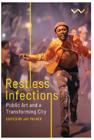
There is a double bind to writing about performance art, or live art as it is also called. Generally speaking, live art involves combinations of the body, time and space. It is an ephemeral artistic mode, in which site-specificity and duration are part of its meaning. What, then, does distilling live art into words and images do?
That is the unvoiced dilemma of a book like Restless Infections - a collection of essays reflecting upon art in public space. Specifically, drawing upon 15 years of programming at the University of Cape Town's Institute for Creative Arts, best known for an annual festival 'Infecting the City'. Free to the public, the festival's ambulatory format through central Cape Town follows loosely themed routes. For Jay Pather, the book's editor, this publication is also a goodbye salute as he hands the reins of the Institute for Creative Arts to a colleague, Nomusa Makhubu. At the book's Cape Town launch on 5 June 2025, Pather remarked upon "the veracity and pervasiveness of the colonial project", which the temporary nature of a live art festival cannot undo, but it can "illustrate, connect and communicate with publics".
Restless Infections "builds an archive that is otherwise invisible", as Sarah Nuttall proffered at the same launch event. It is indeed an index of cutting-edge contemporary art practice and theoretical framings. Inevitably, many worthy festival artworks are uncited. That inescapable bracketing underscores the rich seam from which emblematic examples are drawn. The book slices into the subject matter from three different angles: site (the city), audience (multiple publics) and thematics (land, home and belonging). Nuttall's own contribution, framing the first, is a chapter about public art and intimacy - or "the interior that exteriorises itself" (p. 21). Nuttall juxtaposes two filmic works - Ore Phelele (2019) by Mamello Makhetha and Shadow Shame Again (2021) by Penny Siopis. In different ways, they deal with the conflation of public and private space. This in the larger context of pandemic, which Nuttall frames alongside Zadie Smith's notion of viral contempt and Achille Mbembe's invocation of "the universal right to breathe".
That underlying tension echoes in subsequent contributions, along with the everyday nature of performativity, not only in South Africa but possibly any fast-changing city of the Global South. "You do politics where you are", Nuttall offers. Take for instance Mbongeni Mtshali's text about open-air temples of the Shembe (Nazareth Baptist Church) whose appropriation tactics institute a different experience of space-time, reflected in the place-making installations of Xolile Mazibuko that involve colonial-era memorial objects. Or Amogelang Maledu who posits "after tears" rituals, which often follow funeral formalities in townships, as part of an archive or site of thinking with black urbanisms.
The second section, angled upon multiple publics, helpfully brings in the perspective of a curator or organiser of public art interventions. In her chapter, Rike Sitas asks what happens when art gets risky and unruly, its inherent messiness invoking larger questions around what benefits the public realm. Sharing this spirit of public encounter, Khanyisile Mbongwa thinks with the transitional and liminal space of township alleyways - or iRhanga - as "a space of unspaciousness, the one we make ourselves", as she describes it at the book launch. Mbongwa plays in her chapter with narrative form, including diary extracts, in order to echo alleys as unscripted space. Black life, she writes, is "not only an index of suffering and pain, but also of joy and love" (p. 165). I recall well Mbongwa's 2017 installation at 'Infecting the City', kuDanger!, that repurposed the furniture supply basement of the Drama Department at the University of Cape Town's Hiddingh campus with a maze-like navigation of 'unspaciousness'.
Cue the very first time I encountered, in Johannesburg, the work of Sello Pesa and his Ntsoana Contemporary Dance Theatre team, who are regular 'Infecting the City' participants. Their signature approach of reading the specific dynamics of an everyday urban environment, and then slowing things down or speeding things up, plays with the 'real' versus 'invented' city to blur art and everyday life. Ntsoana's In House Project (2013) temporarily turned private space public - from homes in Soweto to alleyways in Alexandra. The latter profoundly shaped the development of my own understanding of public space as common space, in which competing claims are constantly enacted, performed and negotiated.
The third and final section kicks off with a powerful essay by Nicole Sarmiento on the durational artwork of Haroon Gunn-Salie, Crying for Justice, installed adjacent to the Castle of Good Hope. Its 188 graves commemorate those who died in detention during apartheid, and highlight unfinished reckoning. It concludes with an epilogue consisting of a conversation between Pather and three artists.
So - how then to catch lightning in a bottle? Archiving performance art is not only the preserve of books and anecdote. Sometimes, just sometimes, it has a real-world afterlife that not even its creator anticipates. As Pesa told me back in 2013, it is the unknown element that is crucial with art in public space. "You are learning to really get lost in the things that you do. You have to accept that you don't know [...] Every time we do it, there is so much we didn't plan to do. The questions are a starting point for us to get lost. And sometimes, getting lost, you find really interesting things that you were not thinking about. And sometimes they are not digestible." The seismic protest performance in March 2015, by Chumani Maxwele at the foot of the statue of Cecil Rhodes at University of Cape Town campus, refers. It led to the statue's toppling one month later, a national social movement, and global reverberations that continue today. What is often missed in this sequence of events is how Maxwele timed his intervention to coincide with 'Infecting the City', which gave him artistic cover. The rest, as we know, is history.
