Tiarajudens: a significant mammal-like reptile
Anusuya Chinsamy-Turan
Department of Zoology, University of Cape Town, Cape Town, South Africa
Popularly known as the 'mammal-like reptiles', the therapsids are well documented in the fossil record. Their abundance in the Karoo basin has made South Africa world renowned for the diversity of Permian and Triassic therapsids. The earliest known therapsid is Raranimus from China's Middle Permian Dashankou Formation,12,3: the heavily built, large-bodied Dinocephalia; the Biarmosuchia, which retain many similarities to the sphenacodontian pelycosaurs (better known as the sail-backed reptiles); the carnivorous Therocephalia and Gorgonopsia; the herbivorous Anomodontia; and the Cynodontia (to which mammals and their ancestors belong). Tiarajudens sheds light on the evolution of the Anomodontia.
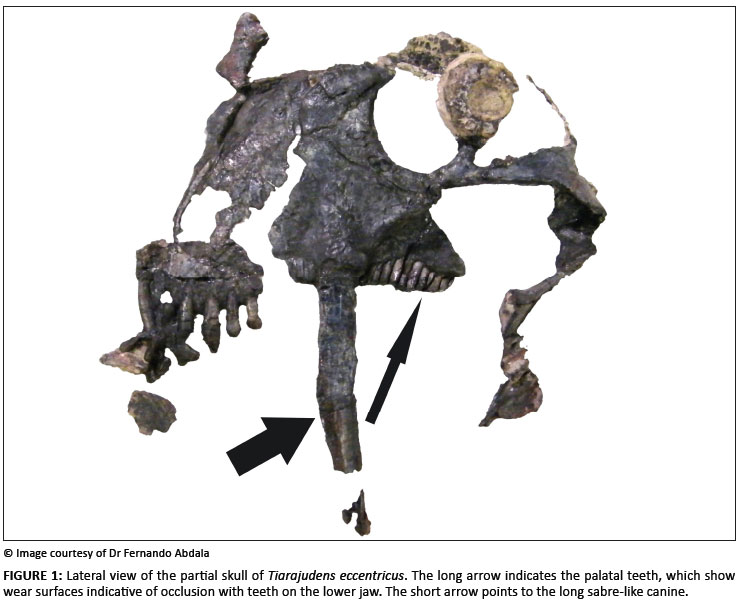
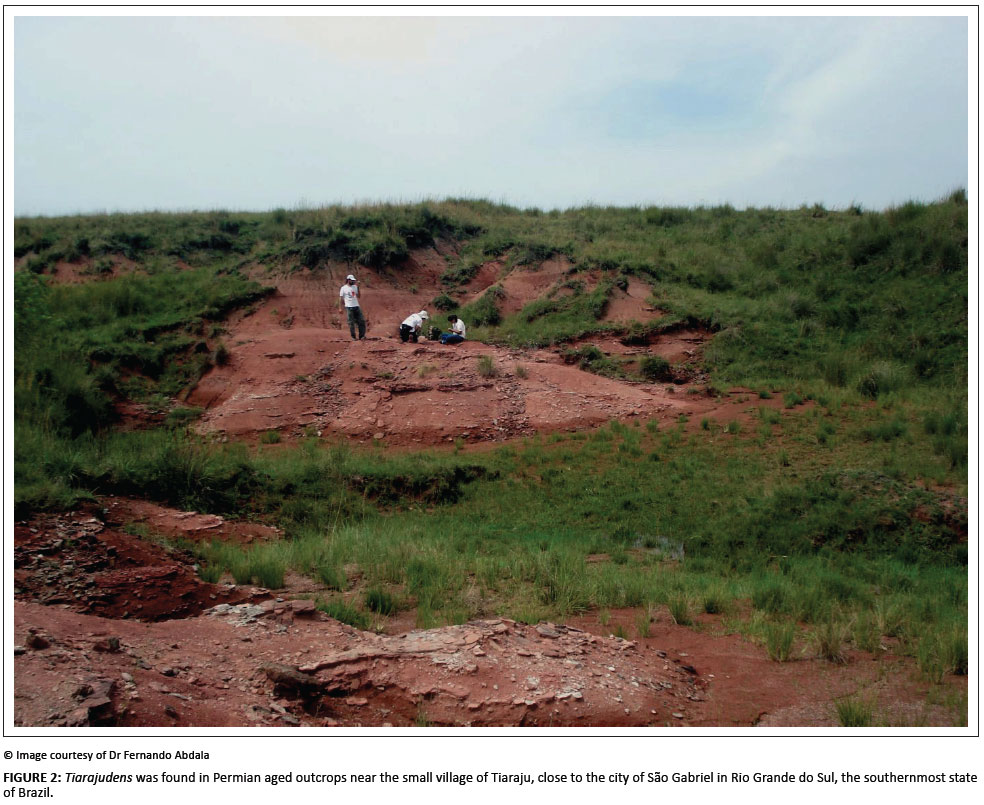
In March 2011, the 260-million-year-old Tiarajudens eccentricus from Brazil was announced to the world in the journal Science by a team consisting of Brazilian and South African scientists4Figures 1 and 2). Tiarajudens consists of a partial skull with an ~120 mm long, laterally compressed canine, 5 leaf-shaped incisors and 13 expanded palatal teeth that formed a grinding surface. Although the skull is rather fragmentary, Juan Cisneros and his colleagues4Anomocephalus, a basal anomodont recovered in 1999 from the Tapinocephalus assemblage zone of the Beaufort Group of the South African Karoo beds, near Williston in the Northern Cape.5
The large transversely expanded palatal teeth in Tiarajudens can be explained as having formed a grinding or occlusal surface with that of the lower jaw (which regrettably, was not found) to process high-fibre plant matter. However, the function of the canines in this herbivore poses an enigma. Considering the presence of canines in extant animals such as the antlerless water deer and the Asian musk deer, Cisneros et al.4
Although Tiarajudens has similar cranial proportions to the oldest known anomodont, China's Biseridens,1Anomocephalus54Tiarajudens and Anomocephalus suggests that in the Permian period similar basal anomodonts roamed South America and South Africa. There are many extinct animals that are known from both these continents, but, until now, Brazil and South Africa have had only dinocephalians6,7 and a small filter-feeding, aquatic reptile called Mesosaurus, in common. Although basal anomodonts are known from China, Russia and South Africa, Tiarajudens represents the first basal anomodont from South America and its discovery increases our understanding of the biogeographical distribution of the Anomodontia and the early radiation of the Therapsida.
References
- 1. Liu J, Rubidge BS, Li J. A new specimen of Biseridens qilianicus indicates its phylogenetic position as the most basal anomodont. Proc R Soc B. 2010;277:285-292.
- 2. Kemp TS. The origin and evolution of mammals. Oxford: Oxford University Press; 2005.
- 3. Kemp TS. The origin and radiation of Therapsids. In: Chinsamy-Turan A, editor. Forerunners of mammals: Radiation, histology, biology. Bloomington: Indiana University Press, in press.
- 4. Cisneros JC, Abdala F, Rubidge BS, Dentzien-Dias PC, Oliveira Bueno de A. Dental occlusion in a 260-million-year-old therapsid with saber canines from the Permian of Brazil. Science. 2011;331:1603-1605.
- 5. Modesto SP, Rubidge BS, Welman J. The most basal anomodont therapsid and the primacy of Gondwana in the evolution of the anomodonts. Proc R Soc London Ser B. 1999;266:331-337.
- 6. Langer MC. The first record of dinocephalians in South America: Late Permian (Rio do Rasto Formation) of the Parana Basin. Neues Jahrbuch für Geologie und Paläontologie Abhandlungen. 2000;215:69-95.
- 7. Smith RS, Rubidge BS, Van der Walt M. Therapsid biodiversity patterns and paleoenvironments of the Karoo Basin, South Africa. In: Chinsamy-Turan A, editor. Forerunners of mammals: Radiation, histology, biology. Bloomington: Indiana University Press, in press.