A note on equity returns for South African investors
Eben Maré
Department of Mathematics and Applied Mathematics, University of Pretoria, Pretoria, South Africa
Keywords: equities; earnings; volatility; risk; real return; risk adjusted returns
October: This is one of the particularly dangerous months to invest in stocks. Other dangerous months are July, January, September, April, November, May, March, June, December, August and February.
Mark Twain
Equity risk and returns
On a historical basis, South African equity markets have outperformed inflation significantly. Using returns from the 2016 version of the Credit Suisse Global Investment Sourcebook11
Investors buy equities to participate in the growth prospects of a company and the economy, but are exposed to significant short-term noise, namely so-called volatility. Shiller2
My data set comprises monthly closing levels of the FTSE/JSE All Share Index dating from January 1960 to December 2017. I also captured the dividend yield and price/earnings ratio. The source of my data is I-Net.
The analysis ensued by calculating the monthly price returns as well as the total returns (i.e. the price returns plus returns of dividends accrued). The same process was applied to earnings, i.e. I calculated the monthly change in earnings. I also calculated the change in the price/earnings ratio on a month-to-month basis. This gave me an effective decomposition of the monthly total return of the index into dividends received, change in earnings, as well as change in the price/earnings ratio. The monthly numbers are very volatile and obviously reflect the full ambit of noise in the turbulent equity market as a whole - my main aim was to demonstrate longer-term investment trends, hence I calculated the returns described earlier over a 20-year horizon. The rolling returns are depicted in Figure 1.
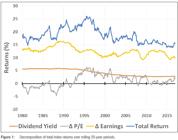
Note 1 - The main driver of total equity returns, apart from the fairly stable dividend yield, is growth in earnings, which contributes about two-thirds of the total return over time. The price/earnings ratio, which drives shorter-term valuation issues, is a lot more volatile, but, over longer-term periods, contributes marginally towards total returns.
Note 2 - Dividend yield. The dividend yield reflects a very healthy and attractive yield above 5% until the early 1990s. In 1993, a so-called Secondary Tax on Companies was introduced, which meant that companies were required to pay tax on a portion of all dividends declared to shareholders.3
Note 3 - My analysis was done on the basis of the FTSE/JSE All Share Index, which consists of multiple equities. However, the analysis is equally valid for single securities or a well-balanced diversified portfolio of equities.
It is important to note that company earnings reflect the sum total of risks and efforts experienced by a company to achieve and sustain financial profitability; understanding this fact makes us look at risks to achieve earnings growth. Understanding risks to earnings growth over time allows us to build an investment case for specific securities.
Conclusion
We are often reminded that our investments should be considered on a long-term basis. In this note I illustrate the importance of considering earnings growth as a driver of equity returns over the long term. It is important to realise that the stock market will have many short-term gyrations and exhibit significant volatility, but considering earnings growth provides us with a firm basis to look through short-term noise and assess long-term potential investment returns.
References
- 1. Dimson E, Marsh P, Staunton M. Credit Suisse global investment returns sourcebook. Zurich: Credit Suisse; 2016.
- 2. Shiller RJ. Market volatility. Cambridge, MA: MIT Press; 1989.
-
3. South African Revenue Services. Who must pay Secondary Tax on Companies (STC)? [webpage on the Internet]. No date [updated 2013 Feb 14; cited 2018 Apr 01]. Available from: www.sars.gov.za/FAQs/Pages/210.aspx.
» www.sars.gov.za/FAQs/Pages/210.aspx