Anti-inflammatory and antimicrobial profiles of Scilla nervosa (Burch.) Jessop (Hyacinthaceae)
Abstract
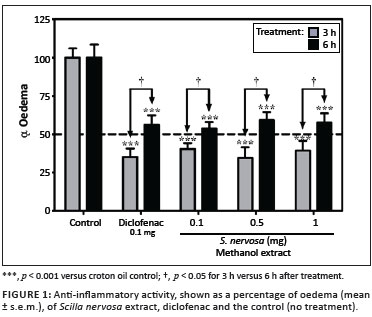
Scilla nervosa (Burch.) Jessop (Hyacinthaceae) [=Schizocarphus nervosus (Burch.) Van der Merwe] is a well-known plant in traditional medicine in South Africa, used for conditions associated with pain and inflammation, such as rheumatic fever. However, the topical anti-inflammatory and antimicrobial activities of the plant have not been investigated. A bioassay-guided fractionation approach was implemented to determine the biological activities of different extracts. A crude methanol extract was prepared from the bulbs to investigate the anti-inflammatory properties in a mouse model of acute croton oil-induced auricular contact dermatitis. The non-polar and polar components present in the methanol extract were separated by extraction with dichloromethane and ethanol, respectively; and their antimicrobial activity against the invasive pathogenic microorganisms Staphylococcus aureus, Klebsiellla pneumoniae and Candida albicans was investigated using a microplate method. Oedema induced by application of croton oil was significantly reduced 3 h (~66%) and 6 h (~40%) after treatment with the extracts. Anti-inflammatory activity was ~1.8-fold lower at 6 h, suggesting a potent, short-acting effect. The non-polar extract exhibited greater efficacy and potency against the microorganisms than the polar extract. The non-polar extract was equipotent against S. aureus and K. pneumoniae, but twice as potent against C. albicans as against the bacteria, suggesting little discrimination between Gram-positive and Gram-negative bacteria but specificity for the fungal yeast. The polar extract was the least potent against K. pneumoniae, but 10-fold more potent against C. albicans, suggesting specificity for Gram-positive bacteria and the fungal yeast. S. nervosa contains compounds that are individually, or in combination, potent anti-inflammatory and antimicrobial agents. The anti-inflammatory activity demonstrated here may rationalise the use of the plant in traditional medicine.
 Thumbnail