Overweight and obesity in children and adolescents: the South African problem
Abstract
Overweight and obesity in children and adolescents are on the increase worldwide. Overweight and obesity increase the risk for the development of non-communicable diseases during childhood and adolescence, and predispose the individual to the development of overweight, obesity, cardiovascular disease, and metabolic and other disorders in adulthood. In Africa the number of overweight or obese children has doubled since 1990. In South Africa, overweight and obesity in children and adolescents are on the increase, but the prevalence varies with age, gender and population group. These differences are important when intervention programmes and policies are considered. South Africa faces a double burden of disease where undernutrition and overweight or obesity are found in the same populations, in the same households and even in the same children. Malnutrition is a major contributor to the double burden of disease in South African children and adolescents.
Introduction
The terms overweight and obesity refer to abnormal or excessive fat accumulation to the extent that it may have adverse effects on the health and well-being of the individual.12223,4 However, these charts have thus far been compiled without adequate normative values for the African and Asian continents.
Once considered predicaments mainly of the affluent, overweight and obesity are now markedly on the increase in low-income and middle-income populations, particularly in urban areas. In 2010, it was estimated that, globally, about 43 million children under the age of 5 years were overweight, and 35 million of these were living in developing countries.5,6 The fastest overweight and obesity growth rates are found in Africa - the number of overweight or obese children in 2010 was more than double that in 1990.5,6 The two overriding causes of the increased prevalence of overweight and obesity in developing countries are said to be a decline in physical activity and diets rich in refined fats, oils and carbohydrates.7,8 Whereas undernutrition and communicable diseases were once the overriding health threat in developing countries, it is now estimated that non-communicable diseases, such as obesity-associated disorders, could be the cause of 7 out of every 10 deaths by 2020.7
The impact of overweight and obesity in childhood and adolescence
Overweight and obesity during childhood and adolescence have negative impacts, on both physical and psychological well-being. From a physical point of view, obesity is associated with a higher risk for the development of insulin resistance, type 2 diabetes mellitus, and a number of cardiovascular abnormalities during childhood and adolescence.99,10,11,12,13 While most cases of childhood diabetes mellitus were once type 1, there has, over the last couple of decades, been a rapid increase in the development of obesity-associated type 2 diabetes mellitus.12911,13,14
Overweight and obesity during childhood and adolescence not only influence well-being during this period, but can persist into adulthood. Excess body fat in children and adolescents increases the risk for the development of several medical conditions during adulthood, including insulin resistance, adult-onset type 2 diabetes mellitus and cardiovascular problems such as hypertension, ischaemic heart disease and stroke.9,14 Overweight and obesity are also said to increase the risk for different cancers, skeletal problems, non-alcoholic fatty liver disease, polycystic ovarian syndrome, and a variety of inflammatory conditions.11,14,15,16 A recent systematic review of the literature showed that overweight and obesity in childhood and adolescence increase adulthood risk for disability pension, premature mortality and morbidity.14
From a psychological point of view, low self-esteem seems to be the overriding concern of overweight and obesity during childhood and adolescence.1718,19,20 From a psychosocial perspective, stereotyping, discrimination and social rejection may occur.1917
The South African problem
The occurrence of overweight and obesity in South African children at present is said to be at least comparable to that found in developed countries more than a decade ago.20,21 It has even been said to be on par with that of many industrialised nations and amongst the highest in Africa.22623
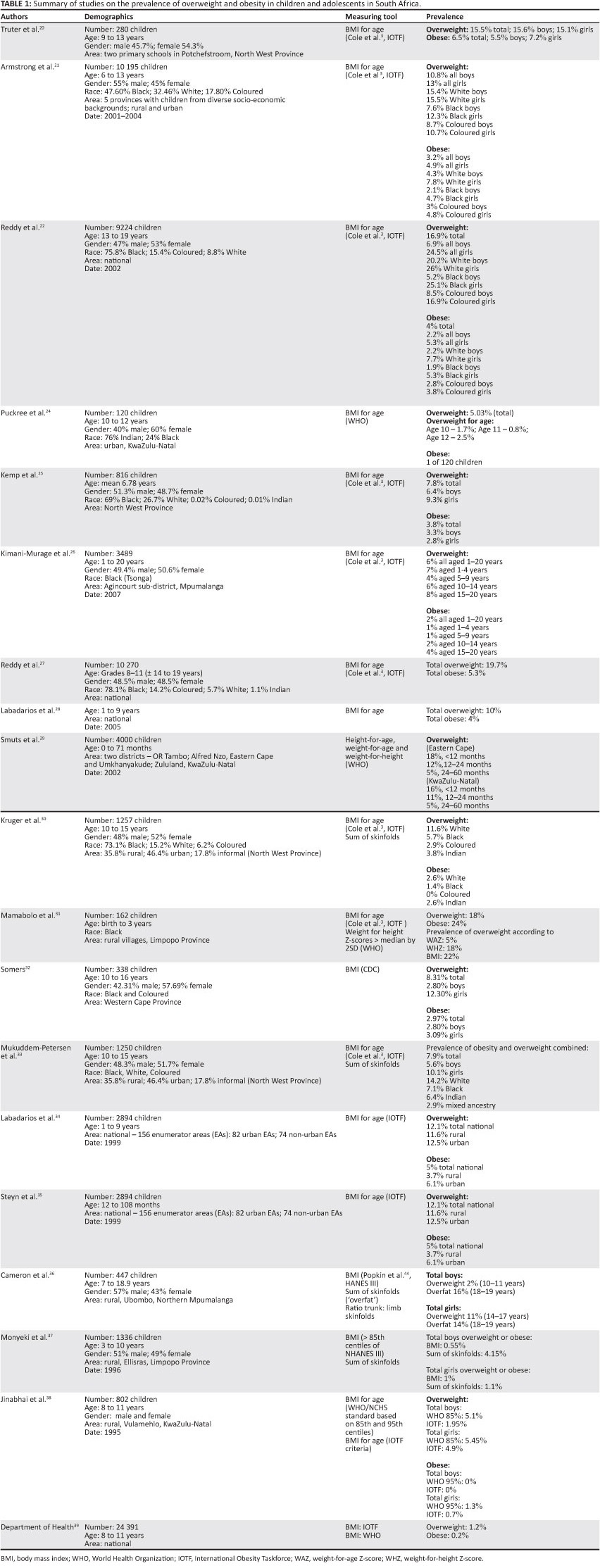
Primary Schools' Anthropometric Survey and The Health of the Nation Study, estimated an increase in overweight from 1.2% to 13% and in obesity from 0.2% to 3.3% over the period from 1994 to 2004. The results of major studies on the prevalence of overweight and obesity in South African children and adolescents are summarised in Table 1. Results from studies before 1999 showed low overweight and obesity rates, whilst more recent studies showed a mean prevalence of just over 15% for overweight and obesity combined. However, this prevalence does not give a true reflection of the problem as overweight and obesity differ markedly between age groups, between boys and girls, between ethnic groups and between geographical areas.
There appear to be strong age-dependent trends from early childhood to late adolescence in the prevalence of obesity and overweight, especially in previously disadvantaged populations. Some of the highest rates for overweight and obesity have been reported for early childhood. In rural communities from the Limpopo, Eastern Cape and KwaZulu-Natal Provinces, high overweight and obesity rates were observed with up to 50% of the under-one-year-olds being either overweight or obese.29,31 Mamabolo et al.312629,31 From cross-survey comparisons, the prevalence of overweight and obesity seems to decrease from early to late childhood, after which it once again increases to reach values of over 20% in girls in late adolescence.23,29 This increase from late childhood to adolescence appears to be gender, and perhaps ethnicity, dependent.
In the majority of studies on children and adolescents in South Africa (Table 1), a higher prevalence of overweight or obesity was found in girls than in boys.20,21,22,32,33,36,38 In most of these studies, there was an increase in the prevalence of overweight or obesity with age, where development of overweight or obesity in girls was linked to the time of menarche.30,33,36 These findings are supported by the results of a recent study (2010) on 3511 children and adolescents from rural villages in a former Gazankulu homeland in Mpumalanga.26262613402141,42
South Africa is in a rural-to-urban transition phase and it is known that populations in a transition towards urbanisation may experience an increase in overweight and obesity.4334,35 more studies are needed to confirm these indications. To say that urbanisation leads to the development of overweight and obesity is a simplification, as it is known that poor families facing urban industrialisation may be at a risk for the development of nutritional disorders.2330
South Africa, like many other middle-income and low-income countries,35,44 faces the so-called double burden of disease, where overweight contributes to the burden of disease caused by undernutrition and communicable diseases. Whereas childhood undernutrition leads to stunted growth and underdevelopment, overweight increases the risk for metabolic, cardiovascular and other non-communicable diseases. This coexistence of undernutrition and overweight in child populations from nations in nutritional transition has been known for decades.4445
Several local studies investigated the coexistence of stunting, as a measure of undernutrition, and overweight.26,31,35,38 In a comparison between the incidence of overweight or obesity and stunting found in 1994 with that found in a survey from 2001 to 2004, stunting decreased, but overweight and obesity increased significantly from 1994 to 2004.232326263310,46 Several studies abroad have shown an association between stunting and the risk of developing overweight at a later stage.47,48 This association was also reported in a paper by Steyn et al.354950
The home environment has, in more than one way, a significant role to play in the prevalence of overweight and obesity. International research showed the probability of overweight or obesity in childhood and adolescence to be dramatically increased when both parents are overweight or obese.5152352953,54 The fact that the mean age-standardised BMI for women in southern Africa increased from about 25.8 kg/m2255
Evidence exists that childhood overweight and obesity are, in fact, contributing to the non-communicable burden of disease in South Africa. In a recent study, the risk of developing metabolic disease, as estimated from the prevalence of central obesity (waist circumference), was seen to be 16% for girls and only 1% for boys.2656,57,58 Although hypertension rates as high as 22% were found in overweight children, and as high as 35% in obese children, hypertension was found in up to 25% of normal weight children58
In summary, high levels of overweight and obesity are present in South African children and adolescents. The prevalence appears to be strongly dependent on age, gender and population. These differences are important when intervention programmes and policies are considered. The coexistence of overweight or obesity and undernutrition in the same population, the same household or the same individual, confirms malnutrition as a major contributor to the double burden of disease in South African children and adolescents. Whilst a switch to energy-dense diets is considered the major cause of overweight and obesity, several other factors contribute; these factors include physical inactivity, intra-uterine and early life experience, level of education, cultural factors, stress levels and genetics.59
It is obvious that there is a need for an increase in research on overweight and obesity in South African children and adolescents. Although large-scale, preferably longitudinal, epidemiological studies on anthropometric aspects, such as height, weight, fat distribution and blood pressure, are essential, further studies into the causes and effects of overweight and obesity are also necessary. Whereas immunological, neural, hormonal, metabolic and other mechanisms are known to influence the weight regulating systems, it is said that genetic factors and genetic-environmental interactions may be amongst the more important.59
Competing interests
We declare that we have no financial or personal relationships which may have inappropriately influenced us in writing this article.
Authors' contributions
H.R. was responsible for the compilation of the table and made conceptual contributions. C.C.G. was involved in the initiation of the project and made conceptual contributions. M.V. wrote the manuscript.
Acknowledgements
References
-
1. World Health Organization. Global strategy on diet, physical activity and health. What is overweight and obesity? [homepage on the Internet]. No date [cited 2011 Dec 11]. Available from: http://www.who.int/dietphysicalactivity/childhoodwhat/en/index.html
» http://www.who.int/dietphysicalactivity/childhoodwhat/en/index.html -
2. De Onis M, Lobstein T. Defining obesity risk status in the general childhood population: Which cut-offs should we use? Int J Pediatr Obes. 2010;5:458-460. http://dx.doi.org/10.3109/17477161003615583, PMid:20233144
» http://dx.doi.org/10.3109/17477161003615583 -
3. Cole TJ, Bellizzi MC, Flegal KM, Dietz WH. Establishing a standard definition for child overweight and obesity worldwide: International survey. BMJ.2000;320;1240-1243.http://dx.doi.org/10.1136/bmj.320.7244.1240, PMid:10797032, PMCid:27365
» http://dx.doi.org/10.1136/bmj.320.7244.1240 - 4. De Onis M, Garza C, Onyango AW, Borghi E. Comparison of the WHO child growth standards and the CDC 2000 growth charts. J Nutr. 2007;137:144-148. PMid:17182816
- 5. De Onis M, Blössner M, Borghi E. Global prevalence and trends of overweight and obesity among preschool children. Am J Clin Nutr.2010;92:1257-1264.
- 6. De Onis M, Blössner M. Prevalence and trends of overweight among preschool children in developing countries. Am J Clin Nutr. 2000;72:1032-1039.
-
7. Boutayeb A, Boutayeb S. The burden of non-communicable diseases in developing countries. Int J Equity Health. 2005;4:2. http://dx.doi.org/10.1186/1475-9276-4-2, PMid:15651987, PMCid:546417
» http://dx.doi.org/10.1186/1475-9276-4-2 - 8. Prentice AM. The emerging epidemic of obesity in developing countries. J Infect Dis. 2005;35(1):93-99.
-
9. Steinberger J, Daniels SR. Obesity, insulin resistance, diabetes and cardiovascular risk in children. Circulation. 2003;107:1448-1453. http://dx.doi.org/10.1161/01.CIR.0000060923.07573.F2, PMid:12642369
» http://dx.doi. org/10.1542/peds.103.6.1175 -
11. Lee WWR. An overview of pediatric obesity. Pediatr Diab. 2007;8(Suppl.9):76-87. http://dx.doi.org/10.1111/j.1399-5448.2007.00337.x, PMid:17991136
» http://dx.doi.org/10.1111/j.1399-5448.2007.00337.x -
12. Hannon TS, Rao G, Arslanian SA. Childhood obesity and type 2 diabetes mellitus. Pediatrics. 2005;116(2):473-480. http://dx.doi.org/10.1542/peds.2004-2536, PMid:16061606
» http://dx.doi.org/10.1542/peds.2004-2536 -
13. He Q, Karlsberg J. BMI in childhood and its association with height gain, timing of puberty, and final height. Pediatr Res. 2001;49(2):244-251. http://dx.doi.org/10.1203/00006450-200102000-00019
» http://dx.doi.org/10.1203/00006450-200102000-00019 -
14. Reilly JJ, Kelly J. Long-term impact of overweight and obesity in childhood and adolescence on morbidity and premature mortality in adulthood:Systematic review. Int J Obes. 2010;35:891-898. http://dx.doi.org/10.1038/ijo.2010.222
» http://dx.doi.org/10.1038/ijo.2010.222 -
15. Jeffreys M, Smith G, Martin R, Frankel S, Gunnell D. Childhood body mass index and later cancer risk: A 50-year follow-up of the Boyd Orr study. Int J Cancer. 2004;112:348-351. http://dx.doi.org/10.1002/ijc.20423, PMid:15352051
» http://dx.doi.org/10.1002/ijc.20423 -
16. Mathur P, Das MK, Arora NK. Non-alcoholic fatty liver disease and childhood obesity. Indian J Pediatr. 2007;74(4):401-407. http://dx.doi.org/10.1007/s12098-007-0068-0
» http://dx.doi.org/10.1007/s12098-007-0068-0 - 17. Monyeki MA, Pienaar AE, Mamabolo RL, Temane M. Effect of obesity on physical self-concept of urban school children living in Potchefstroom, South Africa: Health. AJPHERD. 2009;15(1):1-14.
-
18. Israel AC, Ivanova MY. Global and dimensional self-esteem in preadolescent and early adolescent children who are overweight: Age and gender differences. Int J Eat Disord. 2002;31(4):424-429. http://dx.doi.org/10.1002/eat.10048, PMid:11948647
» http://dx.doi.org/10.1002/eat.10048 -
19. Doak CM, Visscher TLS, Renders CM, Seidel JC. The prevention of overweight and obesity in children and adolescents: A review of interventions and programmes. Obes Rev. 2006;7:111-136. http://dx.doi.org/10.1111/j.1467-789X.2006.00234.x, PMid:16436107
» http://dx.doi.org/10.1111/j.1467-789X.2006.00234.x - 20. Truter L, Pienaar AE, Du Toit D. Relationships between overweight, obesity and physical fitness of nine-to-twelve-year-old South African children. SA Fam Pract. 2010;52(3):227-233.
- 21. Armstrong MEG, Lambert MI, Sharwood KA, Lambert EV. Obesity and overweight in South African primary school children. The Health of the Nation Study. S Afr Med J. 2006;96(5):439-444. PMid:16751921
-
22. Reddy SP, Resnicow K, James S, Kambaran N, Omardien R, Mbewu AD. Underweight, overweight and obesity among South African adolescents: Results of the 2002 National Youth Risk Behaviour Survey. Public Health Nutr. 2008;12(2):203-207. http://dx.doi.org/10.1017/S1368980008002656, PMid:18547451
» http://dx.doi.org/10.1017/S1368980008002656 - 23. Armstrong MEG, Lambert MI, Lambert EV. Secular trends in the prevalence of stunting, overweight and obesity among South African children (1994-2004). Eur J Clin Nutr. 2011;65:835-840. http://dx.doi.org/10.1038/ejcn.2011.46, PMid:21505505
-
24. Puckree T, Naidoo P, Pillay P, Naidoo T. Underweight and overweight in primary school children in eThekwini district in KwaZulu-Natal, South Africa. Afr J Prm Health Care Fam Med. 2011;3(1), Art. #203, 6 pages. http://dx.doi.org/10.4102.phcfm.v3i1.203
» http://dx.doi.org/10.4102.phcfm.v3i1.203 - 25. Kemp C, Pienaar AE, Schutte AE. The prevalence of hypertension and the relationship with body composition in Grade 1 learners in the North West Province of South Africa. S Afr J Sports Med. 2011;23(4):117-122.
-
26. Kimani-Murage EW, Kahn K, Pettifor JM, et al. The prevalence of stunting, overweight and obesity, and metabolic disease risk in rural South African children. BMC Public Health. 2010;10:158. http://dx.doi.org/10.1186/1471-2458-10-158, PMid:20338024, PMCid:2853509
» http://dx.doi.org/10.1186/1471-2458-10-158 - 27. Reddy SP, James S, Sewpaul R, et al. Umthente Uhlaba Usamila - The South African Youth Risk Behaviour Survey 2008. Cape Town: South African Medical Research Council; 2010.
- 28. Labadarios D, Swart R, Maunder EMW, et al. National Food Consumption Survey Fortification Baseline (NFCS-FB-I) South Africa, 2005. S Afr J Clin Nutr. 2008;21(2):245-300.
- 29. Smuts CM, Faber M, Schoeman SE, et al. Socio-demographic profiles and anthropometric status of 0- to 71-month-old children and their caregivers in rural districts of the Eastern Cape and KwaZulu-Natal Provinces of South Africa. S Afr J Clin Nutr. 2008;21(3):117-124.
-
30. Kruger R, Kruger HS, MacIntyre UE. The determinants of overweight and obesity among 10- to 15-year-old schoolchildren in the North West Province, South Africa - the THUSA BANA study. Public Health Nutr. 2006;9(3):351-358. http://dx.doi.org/10.1079/PHN2006849, PMid:16684387
» http://dx.doi.org/10.1079/PHN2006849 -
31. Mamabolo RL, Alberts M, Steyn NP, et al. Prevalence and determinants of stunting and overweight in 3-year-old Black South African children residing in the Central Region of Limpopo Province, South Africa. Public Health Nutr. 2005;8(5):501-508. http://dx.doi.org/10.1079/PHN2005786, PMid:17381956
» http://dx.doi.org/10.1079/PHN2005786 - 32. Somers A. The prevalence of obesity amongst learners attending the schools in Belhar, Delft and Mfuleni in Cape Town, South Africa. Master's dissertation in Biomedical Technology, Cape Town, Peninsula Technikon, 2004.
-
33. Mukuddem-Petersen J, Kruger HS. Association between stunting and overweight among 10TM 15-y-old children in the North West Province of South Africa: The THUSA BANA Study. Int J Obes. 2004;28:842-851. http://dx.doi.org/10.1038/sj.ijo.0802586, PMid:14758345
» http://dx.doi.org/10.1038/sj.ijo.0802586 -
34. Labadarios D, Steyn NP, Maunder EMW, et al. The National Food Consumption Survey (NFCS): South Africa, 1999. Public Health Nutr. 2005;8(5):533-543. http://dx.doi.org/10.1079/PHN2005816
» http://dx.doi.org/10.1079/PHN2005816 -
35. Steyn NP, Labadarios D, Maunder E, Nel J, Lombard C. Secondary anthropometric data analysis of the national food consumption survey in South Africa: The double burden. Nutrition. 2005;21:4-13. http://dx.doi.org/10.1016/j.nut.2004.09.003, PMid:15661473
» http://dx.doi.org/10.1016/j.nut.2004.09.003 -
36. Cameron N, Getz B. Sex differences in the prevalence of obesity in rural African adolescents. Int J Obes.1997;21:775-782. http://dx.doi.org/10.1038/sj.ijo.0800472, PMid:9376890
» http://dx.doi.org/10.1038/sj.ijo.0800472 -
37. Monyeki KD, Van Lenthe FJ, Steyn NP. Obesity: Does it occur in African children in a rural community in South Africa? Int J Epidemiol. 1999;28:287-292. http://dx.doi.org/10.1093/ije/28.2.287, PMid:10342693
» http://dx.doi.org/10.1093/ije/28.2.287 -
38. Jinabhai CC, Taylor M, Sullivan KR. Implications of the prevalence of stunting, overweight and obesity amongst South African primary school children: A possible nutritional transition? Eur J Clin Nutr. 2003;57:358-365. http://dx.doi.org/10.1038/sj.ejcn.1601534, PMid:12571672
» http://dx.doi.org/10.1038/sj.ejcn.1601534 - 39. Department of Health (DOH). Anthropometric survey in primary schools in the RSA. Pretoria: DOH; 1994
-
40. Elrick HD, Samaras TT, Demas A. Missing link in the obesity epidemic. Nutr Res. 2002;22:1101-1123. http://dx.doi.org/10.1016/S02715317(02)00422-0
» http://dx.doi.org/10.1016/S02715317(02)00422-0 - 41. Mvo Z, Dick J, Steyn K. Perceptions of overweight African women about acceptable body size of women and children. Curationis. 1999;22(2):27-31. PMid:11040616
-
42. Clark RA, Niccolai L, Kissinger PJ, Peterson Y, Bouvier V. Ethnic differences in body image attitudes and perceptions among women infected with human immunodeficiency virus. J Am Diet Assoc. 1999;99:735-737. http:// dx.doi.org/10.1016/S0002-8223(99)00398-3
» http:// dx.doi.org/10.1016/S0002-8223(99)00398-3 -
43. Wang Y, Popkin BM, Zhai F. The nutritional status and dietary pattern of Chinese adolescents 1991 and 1993. Eur J Clin Nutr. 1998;52(12):908-916. http://dx.doi.org/10.1038/sj.ejcn.1600664, PMid:9881886
» http://dx.doi.org/10.1038/sj.ejcn.1600664 - 44. Popkin BM, Richards MK, Monteiro C. Stunting is associated with overweight in children of four nations that are undergoing the nutrition transition. J Nutr. 1996;126:3009-3016. PMid:9001368
-
45. World Health Organization. Obesity and overweight [homepage on the Internet]. No date [updated 2011 Mar; cited 2012 Feb 15]. Available from: http://www.who.int/mediacentre/factsheets/fs311/en/
» http://www.who.int/mediacentre/factsheets/fs311/en/ -
46. Asayama K, Oguni T, Hayashi K, et al. Critical values for the index of body fat distribution based on waist and hip circumference and stature in obese girls. Int J Obes Relat Metab Disord. 2000;24:1026-1031. http://dx.doi.org/10.1038/sj.ijo.0801355, PMid:10951542
» http://dx.doi.org/10.1038/sj.ijo.0801355 -
47. Walker SP, Gaskin PS, Powell CA, Bennet FI. The effects of birth weight and postnatal linear growth retardation on body max index, fatness and fat distribution in mid and late childhood. Public Health Nutr. 2002;5:391-396. http://dx.doi.org/10.1079/PHN2002275, PMid:12003649
» http://dx.doi.org/10.1079/PHN2002275 -
48. Florencio TM, Ferreira HS, Da Franca AP, Cavalcante JC, Sawaya AL. Obesity and undernutrition in a very-low-income population in the city of Maceio in north-eastern Brazil. Br J Nutr. 2001;86:277-284. http://dx.doi.org/10.1079/BJN2001396
» http://dx.doi.org/10.1079/BJN2001396 - 49. Hoffman DJ, Sawaya AL, Verreschi I, Tucker KL, Roberts SB. Why are nutritionally stunted children at increased risk for obesity? Studies of metabolic rate and fat oxidation in shantytown children from Sao Palao, Brazil. Am J Clin Nutr. 2000;72:702-707. PMid:10966887
- 50. Sawaya AL, Grillo LLP, Verreschi I, Da Silva AC, Roberts SB. Mild stunting is associated with higher susceptibility to the effects of high fat diets: Studies in a shantytown population of Sao Paolo, Brazil. J Nutr. 1998;128(Suppl.2):415S-420S. PMid:9478039.
-
51. Li Y, Zhai F, Yang X, et al. Determinants of childhood overweight and obesity in China. Br J Nutr. 2007;97(1):210-215. http://dx.doi.org/10.1017/S0007114507280559, PMid:17217578
» http://dx.doi.org/10.1017/S0007114507280559 -
52. Manios Y, Moschonis D, Grammatikaki E, Anastasiadou A, Liangkovinos T. Determinants of childhood obesity and associations with maternal perceptions of their children's weight status: The GENESIS study. J Am Diet Assoc. 2010;110(10):1527-1531. http://dx.doi.org/10.1016/j.jada.2010.07.004, PMid:20869492
» http://dx.doi.org/10.1016/j.jada.2010.07.004 - 53. Steyn NP, Nel PH, Tichelaar HY, et al. Malnutrition in Pedi preschool children, their siblings and caretakers. S Afr J Clin Nutr. 1994;7:12-18.
- 54. Tladinyane P. The difference in factors affecting childcare between mothers/caregivers of undernourished and nourished children in Oukasie (Brits), North West Province. Master's dissertation, Pretoria, Medical University of South Africa, 2003.
-
55. Finucane MM, Stevens GA, Cowan MJ, et al. National, regional, and global trends in body-mass index since 1980: Systematic analyses of health examination surveys and epidemiological studies with 960 country-years and 9.1 million participants. Lancet. 2011;377:557-567. http://dx.doi.org/10.1016/S0140-6736(10)62037-5
» http://dx.doi.org/10.1016/S0140-6736(10)62037-5 -
56. Monyeki KD, Kemper HCG, Makgae PJ. The association of fat patterning with blood pressure in rural South African children: The Ellisras longitudinal growth and health study. Int J Epidemiol 2006;35(1):114-120. http://dx.doi.org/10.1093/ije/dyi219, PMid:16260449
» http://dx.doi.org/10.1093/ije/dyi219 -
57. Makgae PJ, Monyeki KD, Brit SJ, Kemper HCG, Mashita J. Somatotype and blood pressure of rural South African children aged 6-13 years: Ellisras longitudinal growth and health study. Ann Hum Biol. 2007;34(2):240-251. http://dx.doi.org/10.1080/03014460601144219, PMid:17558594
» http://dx.doi.org/10.1080/03014460601144219 - 58. Goedecke JH, Jennings CL, Lambert EV. Obesity in South Africa. In: Steyn K, Fourie J, Templen N, editors. Chronic diseases of lifestyle in South Africa: 1995-2005. Technical Report. Cape Town: South African Medical Research Council; 2006.
-
59. Friedman JM. A war on obesity, not the obese. Science 2003;299:856-858. http://dx.doi.org/10.1126/science.1079856, PMid:12574619
» http://dx.doi.org/10.1126/science.1079856
 Correspondence to:
Margaretha Viljoen
Postal address: PO Box 2034, Pretoria 0001, South Africa
Email:
Accepted: 13 Jan. 2012
Published: 11 May 2012