Frequency of stressful life events as risk indicating factors for the onset of type 1 diabetes in African children
Abstract
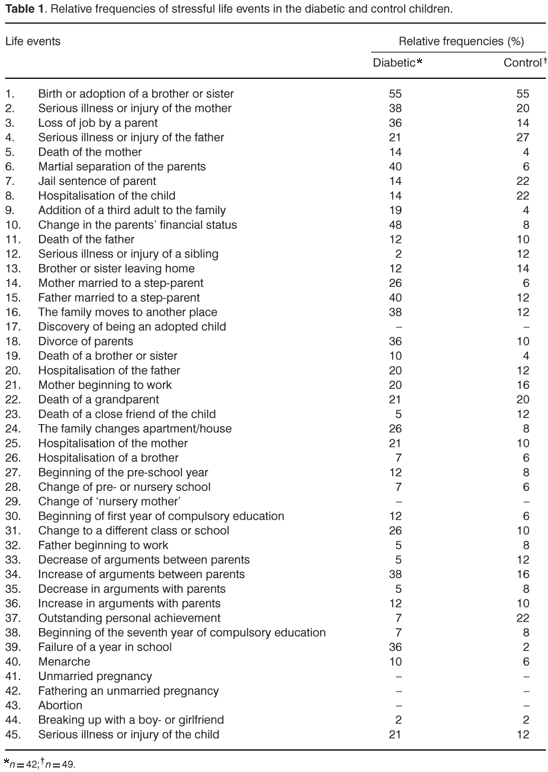
A total of 42 children aged 6–15 years with type 1 diabetes, and 49 control children aged 6-14 years, participated in this study. Life events during the year prior to the clinical onset of type 1 diabetes that occurred within the family were recorded on a survey consisting of 45 questions. The mean frequencies of these life events were higher in diabetic children (7.7) than in the healthy control group (4.9). Diabetic children were found to experience higher relative frequencies of stressful life events within the range of 38-48%, compared with the children of the control group (range 8-16%). The highest relative frequency of 55% for both groups was the birth or adoption of a brother or sister. Life events involving actual or threatened losses within the family, such as serious illness or death of the mother, death of brother or sister, or hospitalization of mother or father, showed significantly increased frequencies in the diabetic group (range 10-30%) than in control children (range 4-10%). We propose that these stressful life events may be factors that precipitate severe emotional stress, increasing consequent risk of later development of type 1 diabetes.
Introduction
Diabetes mellitus is a syndrome with disordered metabolism and inappropriate hyperglycaemia (high blood glucose) due to either a deficiency of insulin secretion or to a combination of insulin resistance and inadequate compensating insulin secretion.1 2 1
A background to the aetiology of diabetes has been given in a previous paper by the authors.3 4 5–9 Socio-demographic factors such as mother's educational level and age, and childbirth order have been related to the risk of IDDM in some study populations.10,11 Rapid weight and height gain during childhood have both been noted as risk determinants of type 1 diabetes.12–14 Several studies have suggested the possible aetiological role of stressful life events and psychological factors in the period preceding the clinical onset of diabetes.15–17
According to Hines and Moore,18 19 20–22 Psychosocial stimuli, including conditions of everyday life, are capable of evoking hormonal responses that may modulate immune function.20–23
Diabetes mellitus is increasing in previously disadvantaged groups in South Africa, Zimbabwe and other African countries, as well as in developed countries, including the Far East (Japan and China). Unlike North America, Scandinavian countries and Japan, Africa has very few epidemiological studies documenting such matters. The clinical characteristics and hyperglycaemic emergencies in black Africans with IDDM and NIDDM have been analysed, identifying infections as a leading precipitating factor for severe diabetic ketoacidosis and non-ketotic hyperglycaemia.24
The onset of type 1 diabetes in black African children has not been investigated and discussed in relation to stress and various harsh socio-economic and environmental circumstances. We now report on the frequency and the structure of the stressful life events as risk indicating factors for the onset of type 1 diabetes in black Zimbabwean children.
Subjects and methods
Details of the participating diabetic and control subjects have been given in our previous paper.3 et al.16
The study was approved by the Research Board of the National University of Science and Technology, Bulawayo. Informed consent was received from all families.
Results
The relative frequencies of identified stressful life events experienced by diabetic and control children are presented in Table 1 in supplementary material online. The most frequent event in both groups, with 55% relative frequency, is the birth or adoption of a brother or sister. Stressful life events (2, 3, 6, 10, 15, 16, 18, 34, 39) were recorded with relative frequencies within the range 36–48% in diabetic children. The same events are found to have significantly lower relative frequencies, ranging from 2% to 20%, in the control group. Life event 14 (mother married to a step-parent) occurred with relative frequency of 26% in diabetic children compared to 6% in the control group, whilst event 4 (serious illness or injury of the father) was of similar relative frequency in both groups.
Life events involving actual or threatened losses within the family such as serious illness of the mother, death of the mother, death of brother or sister, and hospitalization of mother or father show significantly increased frequencies in the diabetic group (range 10–30%) relative to the control children (range 4–10%).
The mean frequencies of life events experienced by diabetic and control groups were 7.7 and 4.7, respectively. The total number of life events experienced by the 42 diabetic children was also higher (324 versus 230 by the 49 controls).
Hagglof et al.16
We excluded the analysis of the results from the self-esteem analogue scale from our study.16 16
Discussion
The significant difference found between this study and our previous investigation could be ascribed to deteriorating socioeconomic conditions in the country. There is a change in terms of decrease in parents' financial status of 48% in this study, versus 33% in the previous report. Hines and Moore18
A larger number of severe stressful life events, with higher relative frequencies, was registered in the current study of diabetic children. Increase in number, and the intensity of the changes in the children's life over a specified period of time, raises the risk of undergoing a subsequent decrease in health status.25
A comparison between the control groups in our two studies showed almost similar mean frequencies (4.7 versus 4.2, respectively). We postulate that if the stress pattern of response to psychosocial stimuli is more frequent and/or lasts long enough, it may elicit a stronger pathogenic effect.
We compared the ranking of the life events considered as most stressful between our two studies in diabetic children. We observe that in the present study actual losses such as the death of a mother, death of a father, of a brother or sister had higher frequencies of 14%, 12% and 10%, compared to the death of a mother and death of a father of 5% each in our previous report. This report did not record any death of a brother and sister.
Hagglof et al.16
The immune system is modulated by psychological stress in various ways26 27 16 28
According to Ganong,2 et al. 16
The present study has some methodological problems. Retrospective completion of the questionnaire can introduce errors from memory lapses of interviewees. We found that the parents of a diabetic child, seeking a reason for the child's sickness, are inclined to retain memory of a greater number of life events prior to diabetes diagnosis, compared with the parents of a healthy child.16,29 This could introduce data bias.
Under harsh socio-economic conditions, the stressful life events adversely affect the day-to-day management of type 1 diabetes in African children. Parents and close relatives need to acquire coping skills, guided by professional experts in the care of diabetes.
Our findings shed light on the latent dimensions of life event stress and the event types' significance. This can be an aid to the implementation of social strategies for the management and control of fully overt type 1 diabetes and its complications.
We thank M. Nyathi and J. Waldman of Mpilo Hospital, Bulawayo, for their help and assistance. This work was partly funded by the Research Board of the National University of Science and Technology, Zimbabwe.
References
- 1. Masharani U. and Karam J.H. (2003). In Current Medical Diagnosis and Treatment, 42nd edn, eds L.M. Tierney, S.J. McPhee and M. Papadakis, chap. 13, pp.1152–1198. Lange Medical Books/ McGraw-Hill, New York.
- 2. Ganong W.F. (1997). Review of Medical Physiology, 19th edn, chap. 19 & 20, pp. 338–364. Prentice Hall, London.
- 3. Djarova T., Dube S., Tivchev G. and Chivengo A. (2006). Nutritional profiles, physical development and daily activities of African children in Zimbabwe with insulin-dependent diabetes mellitus. S. Afr. J. Sci. 102, 4–6.
- 4. Virtanen S.M. and Aro A. (1994). Dietary factors in the aetiology of diabetes. Annal. Med. 26, 469–478.
- 5. Dahlquist G., Blom L., Persson L-A., Sanstrom A. and Wall S. (1990). Dietary factors and the risk of developing insulin-dependent diabetes in childhood. Br. Med. J. 300, 1302–1306.
- 6. Pozzilli P. and Bottazzo G.F. (1991). Coffee or sugar. Which is to blame in IDDM. Diabetes Care 14, 144–145.
- 7. Akerblom H.K. et al. (1993). The case of elimination of cow's milk in early infancy in the prevention of type I diabetes: the Finnish experience. Diabetes/Metabolism Rev. 9, 269–278.
- 8. Virtanen S.M.L. et al. (1994). Nitrate and nitrite intake and the risk for Type 1 diabetes mellitus in Finnish children. Diabetic Med. 11, 656–662.
- 9. Gerstein H.C. (1994). Cow's milk exposure and type 1 diabetes mellitus. A critical overview of the clinical literature. Diabetes Care 17, 13–19.
- 10. Kostraba J. N. et al. (1992). Early infant diet and risk of IDDM in blacks and whites. Diabetes Care 15, 626–631.
- 11. Samuelsson U., Johansson C. and Ludvigsson J. (1993). Breast-feeding seems to play a marginal role in the prevention of insulin-dependent diabetes mellitus. Diabetes Res. Clin. Pract. 19, 203–210.
- 12. Dahlquist G., Blom L. and Lonnberg G. (1991), The Swedish childhood diabetes study a multivariate analysis of risk determinants for diabetes in different age groups. Diabetologia 34, 757–762.
- 13. Blom I., Persson L-A. and Dahlquist G. (1992). A high linesr growth is associated with an increased risk of childhood diabetes mellitus. Diabetologia 35, 528–533.
- 14. Jahansson C., Samuelsson U. and Ludvigsson J. (1994). A high weight gain early in life is associated with and increased risk of type 1 (insulin-dependent) diabetes mellitus. Diabetologia 37, 91–94.
- 15. Djarova T. and Dube N. (1998), Influence of stressful life events on the onset of Type 1 diabetes in childhood. Afr. J. Health Sci. 5, 1–5.
- 16. Hagglof B.L., Bloom, G. Dahlquist, Lonnberg G. and Sahlin B. (1991), The Swedish childhood diabetes study: indication of severe psychological stress as a risk factor for insulin-dependent diabetes mellitus in childhood. Diabetologia 34, 379–583.
- 17. Robinson N. et al. (1989). Psychological factors and the onset of Type 1 diabetes. Diab. Med. 6, 53–59.
- 18. Hines M and Moore K.A. (1997). Major life events: underlying dimensions. Health Perspectives: Research, Policy and Practice 1, 15–18.
- 19. Levi L. (1972). Stress and distress in response to psychosocial stimuli. Acta Med. Scand. 191, Suppl. 528.
- 20. Kagan A.R. and Levi L. (1975). Health and environment–psychological stimuli, a review. In Society, Stress and Disease, vol II, pp. 241–260. Oxford University Press, Oxford.
- 12. Dohrenwend B.S. and Dohrenwend B.P. (1978). Some issues in research on stressful life events. J. Nervous Mental Dis. 166, 7–15.
- 22. Henry S.P. and Stephens P.M. (1977). In Stress, Health and Social Environment. A Sociobiologic Approach, pp. 391–416. Springer Verlag, New York.
- 23. Selye H. (1971). The evolution of the stress concept. In Society, Stress and Disease: The Psychosocial Environment and Psychosomatic Diseases, pp. 299–311. Oxford University Press, Oxford.
- 24. Zouvanis M. et al. (1997). Clinical characteristics and outcome of hyperglycaemic emergencies in Johannesburg Africans. Diabetic Med. 14, 603–606.
- 25. Rahe H.H. and Arthur R.J. (1978). Life change and illness studies. J. Hum. Stress 4, 3–15.
- 26. Bateman A. et al. (1989). The immune–hypothalamic–pituitary adrenal axis. Endocrinol. Rev. 10, 92–112.
- 27. Yilmaz M.T. (1993). The remission concept of type 1 diabetes and its significance in the immune intervention. Diabetes/Metabolism Rev. 9, 337–348.
- 28. Roder M.E. (1994). Disproportionately elevated proinsulin levels preceed the onset of insulin-dependent diabetes mellitus in siblings with low first phase insulin responses. J. Clin. Endocrinol. Metab. 79, 1570–1575.
- 29. Seppanen S.M. et al. (1999). Coping and social support of parents with a diabetic child. Nursing Health Sci. 1, 63–70.
* Author for correspondence. E-mail:
Supplementary material to:
Djarova T., Dube S., Tivchev G. and Chivengo A. (2007). Frequency of stressful life events as risk indicating factors for the onset of type 1 diabetes in African children. S. Afr. J. Sci. 103, 286–288.