Deterioration of San rock art: new findings, new challenges
The heritage of San rock art in southern Africa is globally acknowledged, and was one of the primary reasons for the successful nomination of the uKhahlamba/ Drakensberg Park in South Africa as a World Heritage Site.1 Deterioration of rock paintings in the reserve could adversely affect the international status of the region, particularly as little has been achieved with regard to preserving the art for future generations. A study is currently under way in the Injisuthi and Giant's Castle areas of the park, to investigate the deterioration of San art; this article serves to introduce the project and to highlight some initial findings. Previous research on the weathering of San paintings has focused largely on either monitoring rock shelters2 or investigating rock surfaces that are adjacent to the paintings. None of the methods applied in earlier investigations has considered the interface between rock and pigments, mainly because of the potential damage that may result from the use of tactile monitoring equipment. Recent advances in weathering research, using improved techniques to measure conditions at the rock surface where the San art is painted,3 provide new insights into surficial processes and suggest new lines of investigation.
Deterioration of San rock art: new findings, new challenges
Kevin HallI, II, *; Ian MeiklejohnII; Joselito ArocenaIII; Linda PrinslooIV; Paul SumnerII; Lyndl HallV
IGeography Programme, University of Northern British Columbia, 3333 University Way, Prince George, BC, Canada, V2N 4Z9
IIDepartment of Geography, Geoinformatics and Meteorology, University of Pretoria, Pretoria 0002, South Africa
IIISoil and Environmental Science, University of Northern British Columbia
IVDepartment of Physics, University of Pretoria
VHexagram/XS Labs, University of Concordia, Montreal, QB, Canada, H3G 1MB
The heritage of San rock art in southern Africa is globally acknowledged, and was one of the primary reasons for the successful nomination of the uKhahlamba/ Drakensberg Park in South Africa as a World Heritage Site.1 2 3
New findings
New data, primarily from the Main Caves at Giant's Castle and at Battle Cave at Injisuthi, in the uKhahlamba/Drakensberg Park, South Africa, show that the rock surface onto which San art is painted, the preparation of this surface, and the nature of the paints themselves influence pigment response to the ambient environment. A key attribute of the application of pigments to rock, or indeed to any surface, is that they comprise a surface modifier.3,4 The pigments alter the surface's albedo, porosity, chemistry, and thermal properties, and this becomes even more complex5 6 3 20 3,7) the source of the white attribute of the white pigment. Both pigments may have plant sap as the origin of the whewellite, where that has been used as a binder and/or whitener.3,7 These findings appear to be consistent with those for other rock art sites in the world10–12 and with previous studies from southern Africa.17–20 Pigment mineralogy not only affects chemical responses9 3 3 10
A further new observation,7 Fig. 1). Application of a mineral-based ground (huntite) for paintings has also been reported from Australia, where such ground was found to be predisposed to advanced deterioration, especially under damp or humid conditions.11 8 3 to the rock (Fig. 1), and this has ramifications for remediation or preservation.
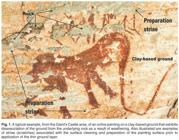
The pigments, at least where there is a clay base, do not penetrate the rock, but occur as discrete layers on the rock (see Fig. 4 of Hall et al.3Fig. 1, the painting deteriorates; not through weathering of the rock but as a result of separation of the clay from the rock. Changes in environmental conditions, notably of moisture and temperature, are suggested to affect the stability of the pigment– clay–rock bonds.3,13 It is argued3,7,15 that both climatic change and local, human-induced environmental changes may cause loss of stability of the rock–clay and clay–pigment bonds and, through other mechanisms,14 not on a clay base. It is also suggested, in respect of human-induced changes,3
In instances where the paints cover the clay ground (as observed in Fig. 1), the ground itself has a 'surface modifier' on it, inhibiting moisture from accessing the clay and thereby causing physical (expansive) and chemical changes. Evidence to date3,7,15 indicates that the thermal changes may induce cracking of both pigment and clay that thereby allow ingress of moisture (and endolithic organisms) and so cause accelerated deterioration of the art. Where there is no mineral base for the painting, a factor not yet reported (but currently under investigation), which can serve to enhance the pigment–rock thermal stresses, is that of light penetration into the sandstone.14 16 directly on the sandstone and that panel is exposed to solar radiation, therefore, there will be thermal differences between the pigment and the rock due to differential albedo and thermal properties. These thermal differences may be further exacerbated because all light-to-heat transformation will be at the surface, where there is pigment, and will occur also in the top few millimetres of the unpainted sandstone. This can lead to shearing forces that may induce cracking13 15
New challenges
On the basis of the above observations and findings,4,8,10,16 researchers at the universities of Pretoria, South Africa, and of Northern British Columbia in Canada are undertaking a detailed in situ study of the key parameters associated with the weathering of San rock art exposed, at least in part, to solar radiation (at Giant's Castle Main Caves). Field investigation is complemented by laboratory work involving X-ray diffraction, scanning electron microscopy and Raman spectroscopy analyses of pigments and pigment–rock associations. Reconstructions of the pigments, based on chemical analyses, are being undertaken at a fine arts research laboratory at the University of Concordia (Montreal, Canada) to evaluate the hues and tones of the original pigments and to understand better the means of application to the rock—the outcomes of this investigation will be used in laboratory simulations (see below). At the field site, thermal responses of white and ochre pigments and associated rock are monitored using a combination of infrared thermography and micro-thermocouples. Light penetration and heat flow into the rock is measured using progressive thicknesses of sandstone coupled with pyranometers and micro-thermocouples. Rock moisture conditions are being studied by means of newly patented micro-sensors located in situ at several depths within the first 5 mm of the surface zone of the sandstone; these sensors also monitor the salt content of any moisture present. All data are being collected at 10–20-s intervals. Laboratory simulations using rapid response (10°C min–1) thermal stages driven by field data on radiation receipts, rock temperature, and moisture will be used for micro-analysis of heat flow and pigment–pigment/pigment–rock stresses. The experiments will be conducted on pieces of local sandstone covered with ground and painted with various pigment reconstructions. Data from these field and laboratory studies will help us better to understand the stresses affecting the San paintings and their causes.
The challenge now is to evaluate and use these data to undertake real-time modelling of the surface conditions affecting the art and, hence, suggest possible protective or remedial actions that will not, by default, worsen the situation. Ancillary studies, notably analyses of the pigment composition, field-based Raman spectroscopic analyses of paintings, and the application of a new approach for classifying painting panels in terms of weathering attributes, are also being undertaken at other sites within the uKhahlamba/Drakensberg area.
References
- 1. UNESCO (2000). Report of the 24th session of the World Heritage Committee, 27 November 2000 – 2 December 2000, Cairns, Australia.
- 2. Hoerlé S. and Salmon A. (2004). Microclimatic data and rock art conservation at Game Pass Shelter in the Kamberg Nature Reserve, KwaZulu-Natal. S. Afr. J. Sci. 100, 340–341.
- 3. Hall K., Meiklejohn I. and Arocena J. (2007). The thermal responses of rock art pigments: Implications for rock art weathering in southern Africa. Geomorphology 91, 132–145.
- 4. Bullet T.R. and Prosser J.L. (1983). Paint: A surface modifier. Phys. Technol. 14, 491–500.
- 5. Mecklenburg M.F., McCormick-Goodhart M. and Tumosa C. (1994). Investigations into deterioration of paintings and photographs using computerized modeling of stress development. J. Am. Inst. Cons. 3, 153–170.
- 6. Loubser J.H.N. (1993). A guide to the rock paintings of Tandjesberg. Nav. Nas. Mus. (Bloemfontein) 9, 345–384.
- 7. Arocena J.M., Hall K. and Meiklejohn I. (in press). Minerals in pigments and their relevance to the origin and implications to conservation of San rock art (South Africa). Geoarchaeology.
- 8. Katz O., Reches Z. and Roegiers J.C. (2000). Evaluation of mechanical properties using a Schmidt hammer. Int. J. Rock Mech. Min. Sci. 37, 723–728.
- 9. Prinsloo L.C., Meiklejohn I., Barnard W. and Hall K. (in press). A preliminary Raman spectroscopic study of San rock art in the Ukhahlamba /Drakensberg Park, South Africa. Journal of Raman Spectroscopy.
- 10. Scott D.A. and Hyder W.D. (1993). A study of some Californian rock art pigments. Stud. Cons. 38, 155–173.
- 11. Ford B., MacLeod I. and Haydock P. (1994). Rock art pigments from Kimberley region of western Australia: Identification of the minerals and conservation mechanisms. Stud. Cons. 39, 57–69.
- 12. Russ J., Kaluarachchi W.D., Drummond L. and Edwards H.G.M. (1999). The nature of whewellite-rich rock crust associated with pictographs in southwestern Texas. Stud. Cons. 44, 91–103.
- 13. Spagnolo G.S., Paoletti D., Ambrosini D. and Guattari G. (1997). Electro-optic correlations for in situ diagnostics in mural frescoes. Pure Appl. Optics 6, 557–563.
- 14. Hall K. Guglielmin M. and Strini A. (in press). Weathering of granite in Antarctica I: Light penetration into rock and implications for rock weathering and endolithic communities. Earth Surface Processes and Landforms.
- 15. Arocena J.M., Hall K. and Meiklejohn I. (2007). San rock art: Minerals in the pigments. Proc. 13th European Archaeological Association Meeting, Zadar, Croatia.
- 16. Vincent W.F. (1988). Microbial Systems of Antarctica. Cambridge University Press, Cambridge.
- 17. Rudner I. (1983). Paints of the Khoisan artists. S. Afr. Archaeol. Soc. Goodwin Ser. 4, 14–20.
- 18. Peisach M., Pineda C.A. and Jacobsen L. (1991). Nuclear analytical study of rock paintings. J. Radioanal. Nucl. Chem. 151, 221–227.
- 19. van Rijssen W.J. (1990). Analysis of South African rock art pigments by X-ray fluorescence spectroscopy (EDS). S. Afr. Archaeol. Bull. 45, 58–59.
- 20. Mazel A.D. and Watchman A.L. (2003). Dating rock paintings in the uKhahlamba–Drakensberg and the Biggarsberg, KwaZulu-Natal, South Africa. Sthn Afr. Human. 15, 59–73.