The distribution and spread of the invasive alien common myna, Acridotheres tristis L. (Aves: Sturnidae), in southern Africa
Abstract
The common myna is an Asian starling that has become established in many parts of the world outside of its native range due to accidental or deliberate introductions by humans. The South African population of this species originated from captive birds that escaped in Durban in 1902. A century later, the common myna has become abundant throughout much of South Africa and is considered to pose a serious threat to indigenous biodiversity. Preliminary observations suggest that the common myna's distribution is closely tied to that of humans, but empirical evidence for this hypothesis is lacking. We have investigated the relationships between common myna distribution, human population size and land-transformation values at a quarter-degree resolution in South Africa. Common mynas were found more frequently than expected by chance in areas with greater human population numbers and land-transformation values. We also investigated the spatial relationship between the bird's range and the locations of South Africa's protected areas at the quarter-degree scale. These results indicate that, although there is some overlap, the common myna distribution is not closely tied to the spatial arrangement of protected areas. We discuss the original introduction, establishment and rate of spread of the common myna in South Africa and neighbouring countries and contrast the current distribution with that presented in The Atlas of Southern African Birds. We also discuss the factors that affect the common myna's success and the consequences that invasion by this species is likely to have, specifically in protected areas.
Introduction
The continually expanding human population causes massive land-use changes12134
Apart from the need to understand the processes and patterns of biological invasions in order to minimize their adverse effects, invasions are also of great academic interest because they provide quantifiable, relatively short-term examples of ecological and biogeographical processes. Owing to the large spatial and long temporal scales required, experimental manipulations of populations and communities for the investigation of, for example, range size constraints, competitive exclusion, differential extinction, establishment success, morphological character release, the relationship between community structure and community stability are expensive and time-consuming. However, the modelling of biological invasions provides a more practical evaluation of such processes, and has formed the focus of a multitude of recent ecological studies.3–8
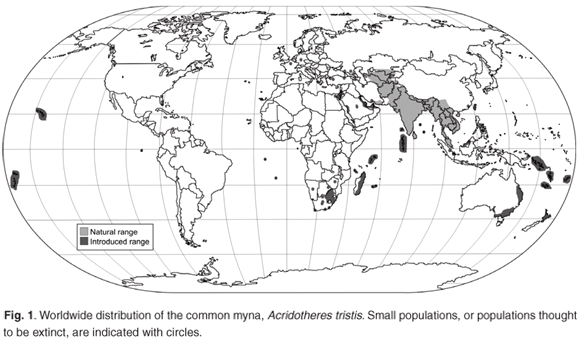
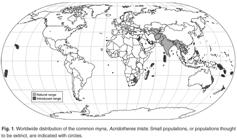
The postulated association between highly successful invasive birds, human distribution and modified habitats in South Africa is exemplified by the invasive alien common myna, Acridotheres tristis, one of only four alien species (out of 48) to have established a viable population and become invasive and widespread.910Fig. 1). It now occurs on all continents except South America and Antarctica, and is one of the most common birds on a number of islands in the Indian, Atlantic and Pacific oceans. In addition to deliberate introductions by humans, common mynas are currently also undergoing a natural range expansion at the margins of their native range (e.g. into Singapore, Malaysia and Turkey), probably as a result of extensive clearing of natural vegetation for agriculture111
In 2000, the World Conservation Union (IUCN) declared the common myna as one of only three birds among the 'World's 100 worst' invasive species.1210
Common mynas are currently undergoing a rapid and extensive range expansion in South Africa. Monitoring the continuing range increase of this species, and determining the relative importance of the influential factors determining its spread and density provides a valuable opportunity for ecologists to manage current, and predict future, avian invasion within the region. In particular, monitoring the common myna's historical and future response to South Africa's large range of climatological and environmental variables, and determining how the localized spatial distribution of major urban centres in South Africa affects its local population densities,13,14 should be prioritized. Ultimately, the results of such studies should be compared with those from other countries suffering similar invasive problems in order to generalize and address the invasion more efficiently.
Throughout its introduced range as well as within its native range,10
Methods
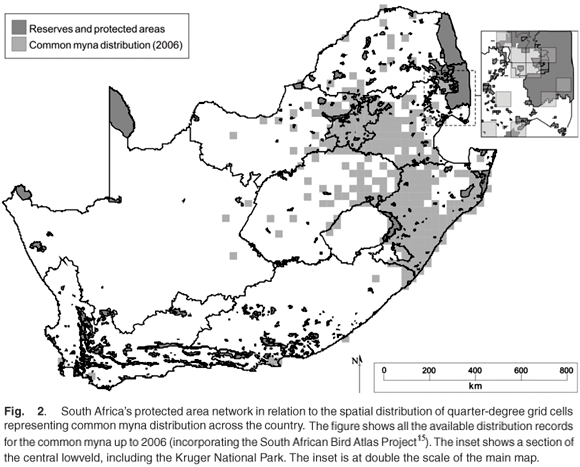
Based on the South African Bird Atlas Project (SABAP) data set,15c. 676 km21613,14 respectively, of these 256 cells. These values were then compared with the mean human population size and percentage land transformation, respectively, found in 10 000 random draws of 256 cells. These grid cells were selected from a pool of all possible grid cells with human population size and land transformation values, i.e. 1971 quarter-degree grid cells covering South Africa. In a similar fashion, we determined whether the cells representing common mynas contained smaller proportions of protected areas than expected by chance.
The 1996, South African population census data supplied by Statistics South Africa (as numbers of humans per quarter-degree grid cell)1617
Data on land transformation were obtained by calculating the percentage of each land-cover class in each quarter-degree cell, based on six transformed land-cover classes provided by Fairbanks et al.141318
In order to provide an updated distribution map of the common myna's range in South Africa, dates, locations and details of sight records were collected from a variety of Internet websites (including private birder websites, birding ecotourism sites and online atlassing sites19,20), birding mailing lists and from personal observations. In addition, specific requests for information were posted on South Africa's national birder communication mailing list, SABirdnet (400+ subscribers), and the regionally-based Pretoria BirdNet (380+ subscribers). These records were for the period 1997–2006, spanning almost a decade after the publication of The Atlas of Southern African Birds.1519201521et al.22
Results
Association with humans and prevalence in conservation areas
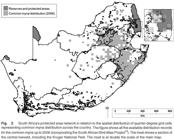
The quarter-degree grid cells representing common myna distribution had significantly greater human population densities and land transformation values, respectively, than expected by chance (P < 0.0001, 10 000 permutations). The total percentage of protected areas contained in the quarter-degree grid cells in which the common myna has been recorded was no different from that of the randomly drawn grid cells (P = 0.155, 10 000 permutations; see also Fig. 2). This indicates that there is some degree of spatial overlap (at this resolution) between the existing protected area network and common myna distribution based on the SABAP data set.15
However, more than a decade has passed since the data on which our analysis is based were collected. During this period, common mynas underwent a considerable range expansion, and it is likely that an analysis of the correlation between human distribution, protected areas and the latest distributional data for this species might yield different results. Given the poor spatial coverage of the latest available distributional data, however, such an analysis is better postponed until a more extensive data set, gathered in a standardized fashion, is available.
Original introductions and early spread (1888–1987)
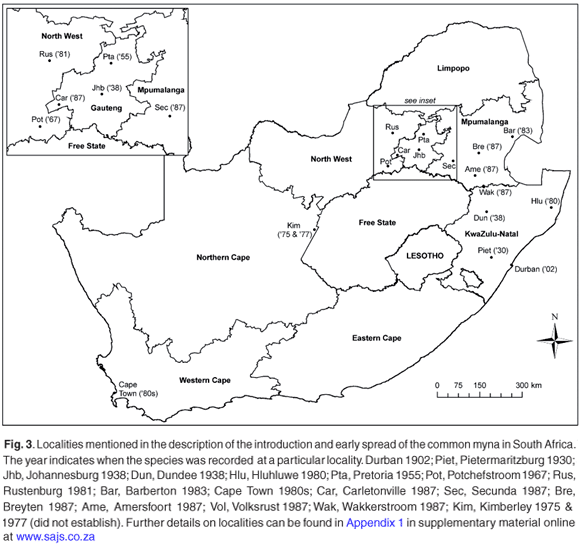
The common myna has been independently introduced into South Africa on at least two, or possibly three, occasions. First, an apparently unsuccessful introduction of birds from Mauritius occurred in Durban, KwaZulu-Natal, in 1888 (Fig. 3).23A. t. trist oides from Burma and Assam.242325A. t. tristis. However, the possibility that a smaller number of the birds introduced to Durban in 1902 were in fact of the nominate subspecies has been raised.2627tristoides subspecies makes the independence of these two introductions doubtful (see Discussion for more details).
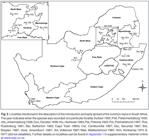
The Durban birds reached Pietermaritzburg (some 65 km inland from Durban) in approximately 28 years,23Fig. 3), and as far as southern KwaZulu-Natal (where predominantly recorded as a non-breeding visitor23
The spread of mynas in Gauteng (following the postulated 1930s introduction) seems to have progressed at a slower rate than those in KwaZulu-Natal. They were first recorded in Orchards and Bramley in the northern suburbs of Johannesburg in 1938 (where their distribution was estimated to be less than '10 square miles'252522
The propensity of common mynas to reach isolated locations is also demonstrated by records of breeding attempts in Cape Town in the early 1980s, sight records of single birds near Mahalapye, Botswana in 1975,24
The Southern African Bird Atlas Project data (1987–1991)
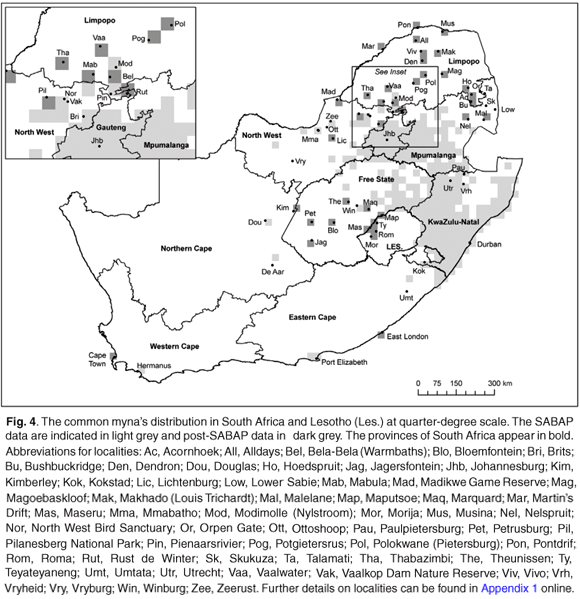
The publication of The Atlas of Southern African Birds15Fig. 4). The 256 quarter-degree grid cells in which the common myna was recorded represents a total of 5.6% of southern Africa's area, and was based on a total of 16 969 records.15Sturnus vulgaris). Out of a list of 48 alien birds introduced into South Africa,9Passer domesticus) (61 222 records), common starling (21 667 records) and the feral pigeon (Columba livia) (18 449 records).
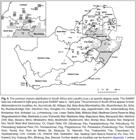
A comparison of the SABAP152115152115151515
In the former Transvaal province (Gauteng, Mpumalanga, Limpopo and the eastern North West), a more dramatic range expansion is revealed in the SABAP data (as compared with Tarboton et al.22Fig. 4). Small outlying populations of common mynas were also recorded in the North West province, e.g. near Mmabatho/Mafikeng and northwest of Vryburg, and in the Northern Cape, e.g. Douglas and north of De Aar.
Post-SABAP spread (1992–2006)
The continuing range expansion of the common myna in South Africa is poorly documented for the 15 years after data gathering for SABAP ended in December 1991. However, a large number of new records have been obtained (see Fig. 4 and Appendix 1 in supplementary material online at www.sajs.co.za) through the advent of birdwatching, e-mail newsgroups, particularly the national SABirdnet. During this period, mynas considerably expanded their range northwards into the Limpopo province and northeastwards into the lowveld of Limpopo and Mpumalanga provinces. In Gauteng, the common myna is now recorded from all the quarter-degree grid cells. In the North West province, common mynas are now well-established in several major urban centres (e.g. Lichtenberg, Brits) and also occur in, or in close proximity to, several conservation areas, such as Vaalkop Dam Nature Reserve, North West Bird Sanctuary, Pilanesberg National Park, Rooikoppies Dam Nature Reserve (near Brits) and Madikwe Game Reserve on the Botswana border.
Records of the common myna in the Limpopo province (in addition to the SABAP data) now exist for Vaalwater, Bela-Bela (Warmbaths), Mabula, Pienaarsrivier, Rust de Winter, Potgietersrus, Thabazimbi, Dendron, Vivo and Alldays (Fig. 4). It is also regularly reported on the Botswana border, e.g. the Pontdrif and Martin's Drift border posts on the Limpopo River. It is probably reasonable to assume that common mynas also occur around human habitation (albeit at low densities or in small, localized populations) in the intervening areas as well. The birds were first recorded breeding in Polokwane (Pietersburg) in 1997,24
Many urban centres in the lower-lying areas of Mpumalanga have also been invaded in recent years. Common mynas now seem to be resident in Hoedspruit, Acornhoek, Bushbuckridge, Nelspruit and Malelane, for example, but the extensive Kruger National Park remains largely uninvaded.28
In the Northern Cape, the common myna was first found breeding in Kimberley in 1975 but subsequently disappeared for almost three decades. However, reports of a pair of birds (possibly more) in Kimberley have been received on a regular basis since 2003. Bloemfontein is another large urban centre that is currently being colonized. The common myna has been reported with increasing frequency in Bloemfontein since 1999.27,30 By mid-2006 their numbers had risen to 37 birds observed near a presumed roost site (R.J. Nuttall, pers. obs.). Furthermore, the species seems to be well-established in Marquard (125 km northeast of Bloemfontein3031
Neighbouring countries
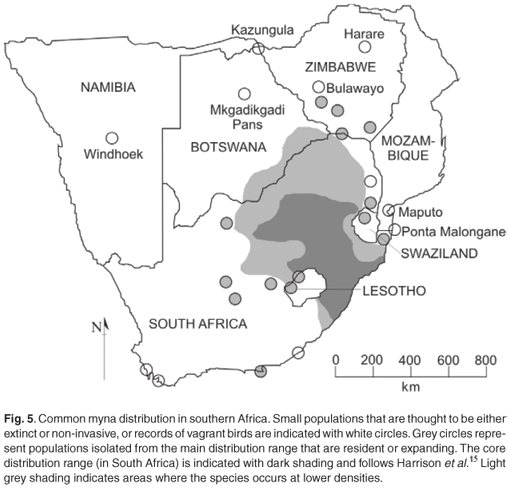
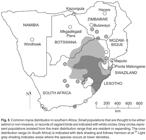
Common mynas were first recorded in Botswana in 1975 near Mahalapye,24243215333424Fig. 5).
Discussion
Historical distribution and invasion rate
The common myna has been deliberately introduced into many areas outside of its native range as a potential biological control agent of insects, particularly locusts and grasshoppers (the generic name Acridotheres literally means 'grasshopper-hunter'351024
Claims that the common myna was independently introduced into Durban (1902) and Johannesburg (1930s) are unsubstantiated. The paler ventral surfaces and less reddish dorsal plumage colouration of the Gauteng birds suggests that northern South Africa is predominantly inhabited by the nominate tristis subspecies, whereas the southern and eastern birds are of the subspecies tristoides.26tristoides24,26 or if both subspecies were present.32tristoides is not widely recognized (e.g. omitted from Feare & Craig1027Passer domesticus),36
As has been found in Australia,3795363839
Factors affecting common mynas' success in South Africa
Duncan et al.594013,14 both being highly suitable habitat conditions for the common myna.10,24 Indeed, at least for Israel, it has been suggested that agricultural fields may act as stepping-stones for mynas to expand their distribution range from one major urban area to another (S. Kark, pers. comm.). Furthermore, its large native range spans a variety of climatic and topographic zones,41et al.239
The success of invasive common mynas in South Africa is further explained by a number of biological, physiological and ecological characters. It meets most of the criteria given for successful invasion by Dean:910,23,26,42 In terms of its breeding biology, more beneficial characters exhibited by the common myna include solitary nesting, a high average clutch size, and adaptability in regard to choice of nest site.4344
Consequences for indigenous biodiversity and humans
Despite severe public persecution, the adverse effects of introduced common mynas on indigenous biodiversity in South Africa have not been well documented, and most descriptions are of an anecdotal nature (but see Birkhead4546474810Streptopelia senegalensis), crested barbet (Trachyphonus vaillantii), red-throated wryneck (Jynx ruficollis) Karoo thrush Turdus smithi), Cape sparrow (Passer melanurus), and southern masked-weaver (Ploceus velatus); R. Geyser, K. Hattingh, pers. comm.; D.S.P., pers. obs.) are occasionally witnessed, but potential displacement of indigenous species is believed to be limited to the local scale.2610
When insects are scarce, fruits and seeds make up a more important component of their diet. At such times, common mynas can become agricultural pests.41Lantana camara in Hawaii2Ornithonyssus bursa, which can cause dermatitis in humans47Plasmodium circumflexum1042
If the common myna is indeed a threat to biodiversity conservation in South Africa, its presence in conservation areas is of particular concern. Our results indicate that, although myna distribution is not explicitly tied to the distribution of protected areas, the species does not avoid such areas (see Fig. 2). Moreover, this result is probably quite conservative, seeing that our investigations were based on a scale that is probably too coarse to identify finer-scale patterns (see also ref. 49). Unfortunately, our study was limited to a relatively coarse scale (15' × 15' grid cells) as this was the scale at which the data for the Southern African Bird Atlas Project1540
The common myna's range expansion has been particularly rapid and extensive in South Africa's Limpopo province, and it now occurs in many urban centres adjacent to the extensive Kruger National Park for example (see Fig. 2 inset). Common mynas have been recorded in this reserve on occasion (e.g. at Lower Sabie, November 2000; Talamati camp, January 20012828
Conclusions
The continuing range expansion of the common myna in South Africa is a popular but contentious topic of debate among ecologists, birders and the general public. It is surprising, however, given the bird's abundance in thousands of suburban gardens throughout the country that very few empirical studies have quantitatively assessed the effects that increasing myna populations are having on indigenous birds. In particular, it is widely believed that they compete with, and eventually displace local birds, but evidence for this is lacking in the literature. Birders should be encouraged to keep notes on any such interspecific interactions and the introduction and spread of alien species in general. From a biogeographical viewpoint at least, the common myna is a fascinating and relevant study subject. We hope that this paper will stimulate further research (from both an ecological and conservation perspective) on invasive species and the common myna in particular.
We would like to thank the all the birders around the country who allowed us a peek into their notebooks: Geoff Lowe, Shaun Peard, Rihann Geyser, Chris Brewster, Pauline Leinberger, Greg Lock, Marius Wheeler, Chris Roche, Les Underhill, Mark Anderson, Peter Oosthuizen, John van Zyl, Etienne Marais, Greg Davies, Hans Schouwink, Oscan van Eyssen, Anthony Cooper, Lester Niss, Mike Bridgeford, Johan Snyman, Stuart Groom, Ross Wanless, David Weaver, Rob Webster, Richard Hurt, Giles Mulholland, Neil Whyte, Richard Rae, Adam Welz, John Bradshaw, Phil Penlington, John McAllister, Kobus Pienaar, Tony Archer, Richard Hurt, Rolf Becker, Ursula Franke and Phil Whittington. B.J.V.R. and D.S.P. acknowledge support from the DST-NRF Centre of Excellence for Invasion Biology.
References
- 1. Sala O.E., Chapin F.S., Armesto J.J., Berlow E., Bloomfield J., Dirzo R., Huber-Sanwald E., Huenneke L.F., Jackson B., Kinzig A., Leemans R., Lodge D.M., Mooney H.A., Oesterheld M., Poff N.L., Sykes M.T., Walker B.H., Walker M. and Wall D.H. (2000). Biodiversity—Global biodiversity scenarios for the year 2100. Science 287, 1770–1774.
- 2. Pimentel D., Lach L., Zuniga R. and Morrison D. (2000). Environmental and economic costs of nonindigenous species in the United States. BioScience 50, 53–65.
- 3. Blackburn T.M. and Duncan R.P. (2001). Establishment patters of exotic birds are constrained by non-random patterns in introduction. J. Biogeogr. 28, 927–939.
- 4. Case T.J. (1996). Global patterns in the establishment and distribution of exotic birds. Biol. Conserv. 78, 69–96.
- 5. Duncan R.P., Blackburn T.M. and Sol D. (2003). The ecology of bird introductions. Annu. Rev. Ecol. Syst. 34, 71–98.
- 6. Cassey P., Blackburn T.M., Jones K.E. and Lockwood J.L. (2004). Mistakes in the analysis of exotic species establishment: source pool designation and correlates of introduction success among parrots (Aves: Psittaciformes) of the world. J. Biogeogr. 31, 277–284.
- 7. Cassey P., Blackburn T.M., Russell G.J., Jones K.E. and Lockwood J.L. (2004). Influences on the transport and establishment of exotic bird species: an analysis of the parrots (Psittaciformes) of the world. Glob. Change Biol. 10, 417–426.
- 8. Cassey P., Blackburn T.M., Duncan R.P. and Lockwood J.L. (2005). Lessons from the establishment of exotic species: a meta-analytical case study using birds. J. Anim. Ecol. 74, 250–258.
- 9. Dean W.R.J. (2000). Alien birds in southern Africa: what factors determine their success? S. Afr. J. Sci. 96, 9–14.
- 10. Feare C. and Craig A. (1998). In Starlings and Mynas, pp. 157–161. Christoper Helm, London.
- 11. Lim H.C., Sodhi N.S., Brook B.W. and Soh M.C.K. (2003). Undesirable aliens: factors determining the distribution of three invasive bird species in Singapore. J. Trop. Ecol. 19, 685–695.
- 12. Lowe S., Browne M., Boudjelas S. and de Poorter M. (2000). 100 of the World's Worst Invasive Alien Species. A selection from the Global Invasive Species Database. The Invasive Species Specialist Group (ISSG), a specialist group of the Species Survival Commission (SSC) of the World Conservation Union (IUCN), Auckland.
- 13. Thompson M. (1996). The standard land-cover classification scheme for remote-sensing application in South Africa. S. Afr. J. Sci. 92, 34–42.
- 14. Fairbanks D.H.K., Thompson M.W., Vink D.E., Newby T., van den Berg H.M. and Everard D.A. (2000). The South African land-cover characteristics database: a synopsis of the landscape. S. Afr. J. Sci. 96, 69–86.
- 15. Harrison J.A., Allan D.G., Underhill L.G., Herremans M., Tree A.J., Parker V. and Brown C.J. (eds). (1997). The Atlas of Southern African Birds. BirdLife South Africa, Johannesburg.
- 16. Anon. (1996). Population Census 1996. Statistics South Africa, Pretoria.
- 17. Anon. (2001). Census 2001: Key Results. Statistics South Africa, Pretoria.
- 18. WDPA (2004). World database on protected areas. IUCN-WCPA and UNEP-WCMC, Washington, D.C.
-
19. BIRP (2005). Birds in Reserves Project. Online: www.birds.sanbi.org
» www.birds.sanbi.org -
20. PCC. (2005). Pretoria Conservation Challenge. Online:www.birding.co.za/ challenge
» www.birding.co.za/ challenge - 21. Cyrus D. and Robson N. (1980). Bird Atlas of Natal. University of Natal Press, Pietermaritzburg.
- 22. Tarboton W.R., Kemp M.J. and Kemp A.C. (1987). Birds of the Transvaal. Transvaal Museum, Pretoria.
- 23. Brooke R.K., Lloyd P.H. and De Villiers A.L. (1986). Alien and translocated terrestrial vertebrates in South Africa. In The Ecology and Management of Biological Invasions in Southern Africa, eds I.A.W. MacDonald, F.J. Kruger and A.A. Ferrar, pp. 63–74. Oxford University Press, Cape Town.
- 24. Craig A.J.F.K. (1997). Indian myna Acridotheres tristis. In The Atlas of Southern African Birds, vol. 2., eds J.A. Harrison, D.G. Allan, L.G. Underhill, M. Herremans, A.J. Tree, V. Parker and C.J. Brown, pp. 454–455. BirdLife South Africa, Johannesburg.
- 25. Carr A. (1988). The Indian myna—colonisation of Pretoria. Laniarius 32, 10–14.
- 26. Hockey P.A.R, Dean W.R.J. and Ryan P.G. (eds) (2005). Roberts – Birds of Southern Africa, 7th edn. The Trustees of the John Voelcker Bird Book Fund, Cape Town.
- 27. Oschadleus H.D. (2001). Report on recoveries received at SAFRING: July 2000—June 2001. Afring News 30, 74–81.
- 28. Foxcraft L.C. and Richardson D.M. (2003). Managing alien invasions in the Kruger National Park, South Africa. In Plant Invasions: Ecological Threats and Management Solutions, eds L.E. Child, J.H. Brock, G. Brundu, K. Prach, P.M. PyÓek and M. Williamson, pp. 385–403. Backhuys Publishers, the Netherlands.
- 29. Nuttall R.J. (1999). Sightings of interest: Free State Region. Mirafra 16(2), 27–28.
- 30. Colahan B.D. (2000). The European starling in central Bloemfontein—has the invasion begun? Mirafra 17(1&2), 10–11.
- 31. Nuttall R.J. (2001). Sightings of interest: Free State Region. Mirafra 18(1), 11–15.
- 32. Fry C.H., Keith S. and Urban E.K. (eds) (2000). The Birds of Africa, vol. 6, pp. 660–661. Academic Press, London.
- 33. Parker V. (1999). The Atlas of the Birds of Sul do Save, Southern Mozambique, p. 224. Avian Demography Unit and Endangered Wildlife Trust, Cape Town and Johannesburg.
- 34. Ambrose D. (2002). Sightings of interest in Lesotho: July 2000–June 2002. Mirafra 19(4), 53–56.
- 35. Clinning C. (1989). Southern African Bird Names Explained, p. 2. The Southern African Ornithological Society, Johannesburg.
- 36. Msimanga A. and Slotow R. (2000). The house sparrow Passer domesticus (Passeriformes: Ploceidae) invasion of southern Africa: rates and the Allee effect. Durban Mus. Novit. 25, 5–11.
- 37. Hone J. (1978). Introduction and spread of the common myna in New South Wales. Emu 78, 227–230.
- 38. Williamson M.H. and Fitter A. (1996). The characters of successful invaders. Biol. Conserv. 78, 163–170.
- 39. Holzapfel C., Levin N., Hatzofe O. and Kark, S. (2006). Colonisation of the Middle East by the invasive common myna (Acridotheres tristis, L.), with special reference to Israel. Sandgrouse 28, 44–51.
- 40. Chown S.L., van Rensburg B.J., Gaston K.J., Rodrigues A.S.L. and van Jaarsveld A.S. (2003). Energy, species richness, and human population size: conservation implications at a national scale. Ecol. Appl. 13, 1233–1241.
- 41. Martin W.K. (1996). The current and potential distribution of the common myna Acridotheres tristis in Australia. Emu 96, 166–173.
- 42. Yap C.A.M., Sodhi N.S. and Brook B.W. (2002). Roost characteristics of invasive mynas in Singapore. J. Wildl. Manage. 66, 1118–1127.
- 43. Tarboton W.R. (2001). A Guide to the Nests and Eggs of Southern African Birds. Struik, Cape Town.
- 44. Richardson D.M. (1992). Starlings: why have they been so successful? African Wildlife 46, 207–210.
- 45. Birkhead J. (1988). Indian mynas oust redbilled woodhoopoes and other hole nesters. Laniarius 33, 8–9.
- 46. Pell A.S. and Tidemann C.R. (1997). The impact of two exotic hollow-nesting birds on two native parrots in savannah and woodland in eastern Australia. Biol. Conserv. 79, 145–153.
- 47. Central Coast Indian Myna Action Group (2003). Research report: impact of the common (Indian) myna on health and the environment and recommendations of the implementation of a control program. Central Coast Indian Myna Action Group, Gosford, Australia.
- 48. Newton I. (1994). The role of nest sites in limiting the numbers of hole-nesting birds: a review. Biol. Conserv. 70, 265–276.
- 49. Van Rensburg B.J., Koleff P., Gaston K.J. and Chown S.L. (2004). Spatial congruence of ecological transition at the regional scale in South Africa. J. Biogeogr. 31, 843–854.
Supplementary material to:
Peacock D.S., van Rensburg B. J. and Robertson M. P. (2007). The distribution and spread of the invasive alien common myna, Acridotheres tristis, L. (Aves: Sturnidae), in southern Africa. S. Afr. J. Sci. 103, 465–473.