The evolution of fire and invasive alien plant management practices in fynbos
Abstract
The history and development of fire and invasive alien plant management policies in fynbos during the 20th century are reviewed. Fire was initially condemned outright as a destructive force, but as its vital role became better understood, management policies switched from protection to active burning in 1968. During the 1970s, large, coordinated research programmes were established, resulting in a solid basis of knowledge on which to develop fire management policies. Despite policies of prescribed burning, wild fires remain the dominant feature of the region, fortunately driving a variable fire regime that remains broadly aligned with conservation objectives. The problem of conserving fire-adapted fynbos is complicated by invading alien trees that are also fire-adapted. Research results were used to demonstrate the impacts of these invasions on water yields, leading to the creation of one of the largest alien plant control programmes globally. Despite improvements in control methods, alien trees, notably pines, continue to spread almost unchecked. Biological control offered some hope for controlling pines, but was ruled out as too high a risk for these commercially-important trees. Failure to address this problem adequately will almost certainly result in the severe degradation of remaining fynbos ecosystems.
biological control; conservation; pines; prescribed burning
Introduction
The fynbos shrublands of the nutrient-poor areas of the Western and Eastern Cape provinces in South Africa have high levels of endemism, with over 6 200 (69%) of the over 9 000 plant species being endemic.1 2
The invasion of fynbos by alien plants is also an increasingly important aspect of ecology. In fire-prone ecosystems, successful alien species are fire-adapted themselves, and they come to dominate as a result of superior growth rates and pre-adaptation to frequent fires. Managers wishing to control such species have to develop a sound understanding of their ecology in relation to fire, in order to develop effective control interventions.
This paper traces the evolution of fire management, and related invasive alien plant management policies in fynbos conservation areas during the 20th century and beyond. Over the years, management practices have changed in response to financial constraints, changing political dispensations, changing ecological paradigms, increased levels of understanding arising from research, and perceptions based on a range of factors. My purpose is to document the role that research has played in informing these changes. I conclude by sketching the challenges facing ecosystem managers today.
Fire management in fynbos ecosystems
Early understanding of the role of fire, and fire policies prior to prescribed burning
Early botanists regarded fires as a destructive force in fynbos, and agitated for protection from fire.3–7 There were also concerns about the possible detrimental effects of fire on water supplies. For example, the 1926 Drought Investigation Commission stated that veld burning was harmful, especially in important watershed areas, and they recommended that such areas should be protected from both grazing and fire.8 8
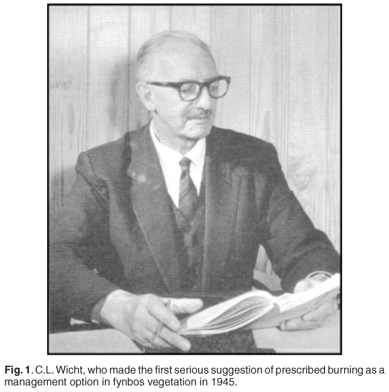
Against this background, there was also growing evidence that fire was not necessarily always detrimental,9 Fig. 1) proposed in 1945 that 'if grazing after burning can be prevented..., this treatment [fire] should have a definite place in any plan for preserving the sclerophyll scrub'.10 Protea repens, and pointed out that safe fire frequencies would almost certainly apply to other fynbos plant species.11 12 13 Orothamnus zeyheri and the blushing bride Serruria florida). Equally spectacular was their rapid recovery following unplanned fires, which stimulated soil-stored seed reserves to regenerate en masse.14–16 These realisations, combined with observations that protection of fynbos from fire could lead to declines in streamflow,17 8
The introduction of prescribed burning
A memorandum accepting prescribed burning as a management practice in the Department of Forestry was issued in 1968, and the first prescribed burn under this policy was conducted in the same year to stimulate germination in a senescing population of Orothamnus zeyheri.18 8 19 8
Policy documents at the time20
Research to support fire management
The South African Department of Forestry initiated a fynbos ecological research programme in the early 1970s, under the leadership of Fred Kruger. A second initiative, the Fynbos Biome Project, was established in 1977, under the guidance of Brian Huntley of the Council for Scientific and Industrial Research (CSIR), with the purpose of funding and coordinating research.21 22, 23 of how fire protection led to senescence and poor regeneration after long fire-free intervals,24,25 and of how to define acceptable, as well as unacceptable, seasons for burning.26–28 On the termination of the Fynbos Biome Project29 30–32
The practical implementation of prescribed burning
During the 1970s, managers of fynbos ecosystems made good progress with the implementation of prescribed burning. Conservation areas were divided into large 'compartments' and these were burnt on a planned frequency of 12–15 years. Compartment size ranged from 500–1000 ha, and sizes were determined by the availability of suitable firebreaks, and the area in which a burning operation could be completed in a single day. By 1981, approximately 40 burns were carried out in the fynbos biome per year.33
However, a steady decline in prescribed burns followed policy directives that restricted burning to the late summer/early autumn period. This arose from research that suggested that burning in spring would have detrimental effects on the vegetation,26, 28 thus eliminating the possibility of burning in September and October, the months with the safest weather for burning.33, 34 This change in policy resulted in a decline by 1988 of 75% in the area burnt in prescribed burns.33
There were other factors that constrained the application of prescribed burns in fynbos ecosystems in the late 1980s. Most important among these were declining funding, the need to incorporate the pre-fire treatment of invasive alien plants, and growing concerns about the safety of prescribed burning and legal liability in cases where prescribed burns escaped. In response, several new approaches were proposed, varying in the degree of interference in fire regimes from prescribed burning (where all fires were to be management fires) through to 'natural burning zones', where no prescribed burning was to be done, and natural (lightning-ignited) fires were allowed to burn.35 18 18 33 31
Effects of prescribed burning on fynbos fire regimes
One of the aims of prescribed burning was to reduce the number and extent of wildfires, by reducing fuel loads and creating a mosaic of vegetation patches of varying post-fire age. Whether or not this goal had been achieved was first examined in the Cedarberg, by comparing fire records collected between 1956 and 1972 (when fire suppression was practised) with records from 1973–1986 (when prescribed burning was practised).36
A similar detailed analysis of a 70-year fire record was recently completed for the Swartberg Mountains.37 37
The latest comprehensive analysis of fire records from 10 large nature reserves in the Western Cape over the past 40–50 years38, 39 showed that modern fynbos fire regimes are in fact dominated by wildfires, which account for more than 80% of the total area burnt, and that prescribed burning has played a relatively small role in contributing to these modern fire regimes. In addition, fynbos fire regimes are currently dominated by a few large wildfires. For example, of the 150 fires on record in the Cedarberg between 1945 and 2006, the 10 largest were responsible for 66% of the total area burnt.38 39
The above findings prompt the following conclusions:
(1) The assumption that prescribed burning would be necessary to prevent vegetation senescence and loss of species is not supported by evidence. Prescribed burning plays a minor role in modern fire regimes, and wildfires alone should provide sufficient opportunities for 'rejuvenation'.
(2) The assumption that prescribed burning would reduce and fragment fuel loads, leading to a reduction in the number and extent of wildfires, is also not supported by evidence. Reductions in fuel do not consistently prevent the spread of wildfires, which can burn through five-year post-fire vegetation provided that hot, dry, and windy conditions prevail.
(3) It appears that fire return periods are decreasing in some areas (possibly as a result of increasing human population densities and access), leading to increased opportunities for ignitions.39
(4) Increases in fire frequency could arise as a result of increased human populations leading to a higher number of ignition opportunities. This would be exacerbated if changes in climate lead to hotter and drier weather, leading to more fires and further reductions in fire return periods. Such trends would be difficult to reverse, and therefore represent a significant threat to fynbos ecosystems.
Current ecological understanding of the role of fire in fynbos
Current understanding of the role of fire in fynbos is relatively robust. Most plant species are resilient to a wide range of fire return intervals. For example, a study of 210 co-occurring fynbos species showed that most were able to resprout after fire, and 200 out of the 210 species could survive fire return intervals of between 10 years and 40 years.40 26 40 25 30 41
At the other end of the scale, excessively long fire-free periods (greater than the longevity of obligate seeding species—about 30 years or so) can lead to senescence and elimination of these species from the vegetation. When prescribed burning was introduced in 1970, one of the reasons given for its introduction was the removal of what was seen as the threat of over-protection that would lead to senescence.
Fire season is also an important determinant of recruitment. Serotinous shrubs (notably the genera Protea and Leucadendron) are sensitive to fire season, and the highest number of seedlings per parent plant occur after fires in summer and early autumn.26,28 In 1985 this led to recommendations to restrict management fires to this time of the year.30 42 43 ºE.
There is also evidence that variation in fire regimes is necessary to maintain plant diversity in the landscape.44, 45 Variation in the intervals between fires, in fire season, or fire intensity will induce variation in the density of proteaceous overstorey shrubs; and this variation is in turn associated with the maintenance of diversity in understorey species.44,45 Pre-fire stand densities may also affect the density of post-fire recruitment,46 44 25,47 Should large areas be subjected to repeated frequent burning, recolonisation would depend on a species' ability to disperse seeds from adjacent areas, sometimes over long distances.48,49 While this may be possible for some of the wind-dispersed Proteaceae, a large number of fynbos plant species that rely on soil-stored and ant-dispersed seeds50 51 Invasive alien plant management in fynbos ecosystems
Invasive alien plants in fynbos ecosystems
There are over 150 species of alien plants that are invasive in the fynbos biome.52 53 Pinus species), wattles (Acacia and Paraserianthes species), hakeas (Hakea species), and gums (Eucalyptus, notably Eucalyptus camaldulensis). All of these are trees or large shrubs, and two groups are of particular interest because of their wide distribution in the biome.
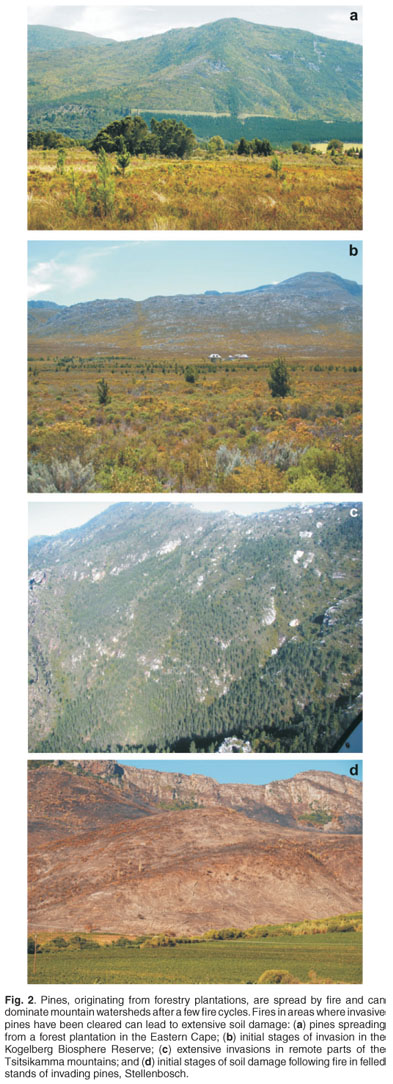
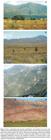
The first are the pines and hakeas. These serotinous trees and shrubs produce copious amounts of seeds held in cones or follicles, which are released on the death of the parent plants in fires. The seeds are winged, and can spread over great distances after fires. Pines and hakeas are therefore widespread, occurring across the biome. They can, and do, form dense and impenetrable stands (Fig. 2). The second group is the wattles. These species typically produce copious amounts of seeds, but these are released on ripening. The seeds are hard-coated and accumulate in the soil. The seeds are spread along rivers, by moving soil around, or by birds. Soil-stored seed banks are stimulated to germinate in dense stands by fire. Gums are a special case, in that the one species that appears to be aggressively invasive (the red river gum Eucalyptus camaldulensis) is restricted to river courses in lower-lying areas.
A range of methods are available to control invasive alien plants, including mechanical, chemical and biological control. While the first two methods can be used to contain infestations, neither provides a permanent or sustainable solution to the problem.54,55 Biological control options provide more sustainable solutions, but are only available for some of the invasive alien plant species in the fynbos.56 57 58
Research into the impacts and control of invasive alien plants in fynbos
Concerns about the impacts of invasive alien plants in South Africa are not new. Early botanists, including Peter MacOwan (in 1888) and Rudolf Marloth (in 1908), raised concerns that alien plants would replace natural vegetation.59 10
In 1982, the General Assembly of the Scientific Committee on problems of the Environment (SCOPE) identified the invasive spread of plants, animals and microorganisms, introduced by humans into areas remote from their centres of origin, as a problem of global concern. A large international project was initiated, with the purpose of reviewing and improving understanding of biological invasions and their implications. The South African component of this work led in 1986 to a synthesis volume,60 61,62 This work ultimately led to the development of the first robust model of invasive potential in a large group of plants.63
Most of the research conducted under the auspices of the SCOPE programme attracted no more than academic interest. It was not until researchers were able to demonstrate that invasions would have significant economic impacts on water resources that the issue went beyond academic debate and into the realms of action. Even then, it took a radical change of government to initiate the implementation of invasive plant clearing programmes. The idea that invasive alien trees could have negative impacts on streamflow (in much the same way as commercial forestry did) was first raised in 1977 by Kruger.64 65 30,66 This led to small funding grants for more research to quantify the impacts more clearly.
The first such attempt to estimate the impacts of invasive alien trees on water resources came about in 1996, when a spatially explicit model was developed.67 3 68 69
Subsequently, several other papers have estimated the economic consequences of alien plant invasions in fynbos ecosystems and elsewhere. All of these papers70–73 provide estimates showing that clearing invasive alien plants makes economic sense (in that they deliver positive cost–benefit ratios). These findings rely heavily on the age-biomass models described above, and all do not account for the total economic value which would consider the full suite of economic costs and benefits.74
Perhaps the biggest threat to water yields comes from the combined effects of unplanned wildfires and alien plants. Unplanned fires in fynbos result in additional costs in invaded areas, in one of a number of forms, depending on the action taken. First, invasive alien plant seedlings germinate after fires, and usually increase the density and extent of infestation. It is necessary to control these flushes of seedlings to prevent them becoming dominant over the next few years. Extensive unplanned fires will precipitate the need for additional effort in the form of 'follow-up' operations. CapeNature estimated in 2006 that these additional costs would amount to R17.5 million75 75 76 invaded fynbos will burn per year. This means that the additional costs to control these infestations (and prevent even worse environmental losses) would be around R100 million annually.
The quest for finding biological control solutions for invasive alien plants in the fynbos biome has also led to some innovative research and significant advances in understanding. Research started in the biome with a search for seed-feeding insects in the 1960s. It expanded over the next two decades to include releases on the invasive alien genera Ageratina, Hypericum, Acacia (eight species), Paraserianthes, Leptospermum, Sesbania, and Hakea (two species). Many of these projects were innovative; for example they made use of gall-forming and seed-feeding insects that had not been used elsewhere; the emphasis on weeds in conservation areas (as opposed to weeds in agricultural crops); and the predominance of woody invaders that have been targeted for biological control.56 56
Management responses
Attempts to control invasive alien plants began in the fynbos biome as early as the 1930s. Control efforts in the second half of the 20th century were done mostly for reasons of conserving natural vegetation, and not for any hydrological or agricultural benefits that might have accrued. The initial attempts at the control of invasive plants were at best uncoordinated and erratic, and did little to stem their spread. Although few campaigns were adequately documented, the existing evidence shows that poor understanding of the ecology of invasive species, as well as a lack of follow-through when clearing was done, led to much wasted effort and money. For example, 47 years of control attempts on the southern Cape Peninsula, were 'almost totally ineffective for the first 35 years'.77 78
The momentum of this work was lost in the late 1980s, due to many factors. The seasonal restrictions on burning meant that many prescribed fires, necessary for the control of seedlings after felling operations, could not be carried out. The government also split the functions of its forestry department, with plantation management becoming privatised, conservation management being devolved to unprepared and inexperienced provincial authorities, and the research arm being transferred to the CSIR. The net result of these changes was fragmentation, and loss of capacity and experience. The government of the day cut funding, resulting in further loss of capacity. The net result was that invasive alien plant control programmes fell behind, and cleared areas were under threat of re-invasion.
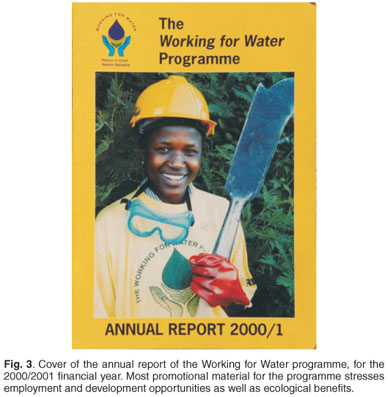
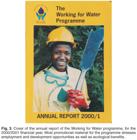
The development of economic arguments, based on the predicted impacts of alien trees on water resources in the fynbos biome, coincided with the formulation of South Africa's first democratically-elected government. This government created the Working for Water programme, an initiative that sought to reduce the impacts of invasive alien plants on water supplies through the employment of poor people in rural areas (Fig. 3). The events that led to the formation of this programme are documented elsewhere,79 77
The programme has attracted funding and gained local and international acclaim, but it relies heavily on political support and remains vulnerable for this reason. Political support for this programme stems almost entirely from its employment creation, upliftment and empowerment benefits. The economic benefits of invasive alien plant clearing projects (as opposed to employment benefits) are often viewed with some scepticism by decision makers, for a number of reasons.
The benefits of alien plant control, especially those in natural (rather than agricultural) environments are 'public good' benefits. In such cases, the individual marginal benefit (the amount of benefit gained by any one person) is small. Where individual marginal benefits are small, people tend not to take them seriously, despite the total benefit being large.
The projected benefits of alien plant control come about from avoiding future impacts rather than removing current impacts (for example, by preventing further spread of a weed that has not yet reached its full potential). People find it difficult to appreciate (or gain political benefit or advantage from) the avoidance of future impacts that are not yet manifesting themselves.
The predicted benefits of clearing invasive alien plants on water yields are based on plantation forestry, and there have been no rigorous attempts to quantify the actual gains from land cleared of invasive alien plants, rather than of clearfelling plantations. This is a serious weakness, and it makes the programme vulnerable in terms of its ability to compete for funding against other projects which may be supported by more tangible evidence of benefits.
The fact remains, however, that invasion by alien plants (especially woody species) poses arguably the greatest threat to the conservation of fynbos ecosystems and the services that they provide to humanity. The problem is exacerbated by the fact that fynbos is fire prone and that fires are inevitable. Fire-adapted invasive species thrive in such environments, so bringing them under control is the biggest challenge for managers of these ecosystems.
Prognosis for invasive alien plant control
Whether or not control attempts are having real impacts on the status of alien plant invasions is an important question. The Working for Water programme was initially proposed as a 20-year activity,80 54
The above also underscores the importance of biological control, which is seen by its proponents57 81,82 Those who hold these views believe that the outcomes of an introduction cannot be predicted precisely enough a priori to know that the benefits will outweigh the environmental costs. Examples of unintended consequences include impacts on non-target species, and the disruption of food webs. The evidence suggests that these concerns are often groundless, but they are nevertheless responsible for serious barriers to biological control.83
Integrating prescribed burning and alien weed control operations is also important. Fire regimes are difficult to manage, and wildfires are inevitable. There is therefore an urgent need to become more flexible with regard to follow-up operations after fires, to avoid either significantly increased control costs, or alternatively to suffer increased impacts. The degree to which managers are able to overcome resistance to biological control, and to gain a degree of control over fire regimes, may ultimately determine the fate of the unique fynbos vegetation.
Managing fire regimes: future challenges
Fire regimes are defined as the typical combination of frequency, season, intensity and type of fires that characterise a region.84 85 86 84 45
At the close of the Fynbos Biome Project in 1992, reviews of the fire management of fynbos ecosystems30,87 concluded that prescribed burns, combined with wildfires, firebreak burns in spring, and occasional longer periods between fires would provide sufficient stochasticity to ensure the survival of coexisting species. The same reviews also concluded that dealing with invasive alien plants presented a greater challenge than fires for managers of fynbos ecosystems. The reviews proposed four scenarios relating to the future of fynbos ecosystem management, based on different levels of funding (unchanged, increased, decreased and curtailed). They predicted that funding would probably decline, and that invasion would therefore continue largely unchecked. This was especially so in the case of pines, for which no biological control agents were available. In reality, the creation of the Working for Water programme80 55 58
This paper is dedicated to Fred Kruger, pioneer fynbos fire ecologist and exceptional mentor.
References
- 1. Goldblatt P. and Manning J. (2002). Plant diversity of the Cape region of South Africa. Annals of the Missouri Botanical Garden 89, 281–302.
- 2. Takhtajan A. (1969). Flowering Plants: Origin and Dispersal. Oliver and Boyd, Edinburgh.
- 3. Levyns M.R. (1924). Some observations on the effects of bush fires on the vegetation of the Cape Peninsula. S. Afr. J. Sci. 21, 346–347.
- 4. Pillans N.S. (1924). Destruction of indigenous vegetation by burning on the Cape Peninsula. S. Afr. J. Sci. 21, 348–350.
- 5. Marloth R. (1924). Notes on the question of veld burning. S. Afr. J. Sci. 21, 342–345.
- 6. Compton R.H. (1926). Veld burning and veld deterioration. S. Afr. J. Nat. Hist. 6 (1), 5–19.
- 7. Compton R.H. (1934). The results of veld burning. Educ. Gaz. 33, 644–655.
- 8. Bands D.P. (1977). Prescribed burning in Cape Fynbos. In Proceedings of the Symposium on the Environmental Consequences of Fire and Fuel Management in Mediterranean Ecosystems, General Technical Report WO-3, eds H.A. Mooney and C.E. Conrad, pp. 245–256. USDA Forest Service, Washington D.C.
- 9. Phillips J.F.V. (1930). Fire: its influence on biotic communities and physical factors in South and East Africa. S. Afr. J. Sci. 27, 352–367.
- 10. Wicht C.L. (1945). Report of the Committee on the Preservation of the Vegetation of the South Western Cape. Special Publication of the Royal Society of South Africa, Cape Town.
- 11. Jordaan P.G. (1949). Aantekeninge oor die voortplanting en brandperiodes van Protea mellifera Thunb. J. S. Afr. Bot. 15, 121–125.
- 12. Jordaan P.G. (1965). Die invloed van 'n winterbrand op die voortplanting van vier soorte van die Proteaceae. Tydskrif vir Natuurwetenskappe 5, 27–31.
- 13. Van der Merwe P. (1966). Die flora van Swartboskloof, Stellenbosch en die herstel van die soorte na 'n brand. Annals of the University of Stellenbosch 41, Series A, Number 14.
- 14. Boucher C. (1981). Autecological and population studies of Orothamnus zeyheri in the Cape of South Africa. In The Biological Aspects of Rare Plant Conservation, ed. H. Synge, pp. 343–353. John Wiley & Sons, New York.
- 15. Voigts M. (1982). South Africa's Proteaceae: Know Them and Grow Them. Struik, Cape Town.
- 16. Worth S.W. and van Wilgen B.W. (1988). The Blushing Bride: status of an endangered species. Veld & Flora 74, 123–124.
- 17. Van der Zel D.W. and Kruger F.J. (1975). Results of the multiple catchment experiments at the Jonkershoek Research Station, South Africa. II. Influence of protection of fynbos on stream discharge in Langrivier. Forestry in South Africa 16, 13–18.
- 18. Van Wilgen B.W., Richardson D.M. and Seydack A. (1994). Managing fynbos for biodiversity: constraints and options in a fire-prone environment. S. Afr. J. Sci. 90, 322–329.
- 19. Kruger F.J. (1977). Ecology of Cape fynbos in relation to fire. In Proceedings of the Symposium on the Environmental Consequences of Fire and Fuel Management in Mediterranean Ecosystems, General Technical Report WO-3, eds H.A. Mooney and C.E. Conrad, pp. 230–244. USDA Forest Service, Washington D.C.
- 20. Van Wilgen B.W. (1984). Prescribed Burning in Fynbos. Information Leaflet 11. Department of Environmental Affairs and Tourism, Pretoria.
- 21. Huntley B.J. (1987). Ten years of cooperative ecological research in South Africa. S. Afr. J. Sci. 83, 72–79.
- 22. Kruger F.J. and Bigalke R.C. (1984). Fire in fynbos. In Ecological Effects of Fire in South African Ecosystems, eds P. de V. Booysen and N.M. Tainton, pp. 67–114. Springer, Berlin.
- 23. Van Wilgen B.W., Richardson D.M., Kruger F.J. and van Hensbergen H.J. (1992). Fire in South African Mountain Fynbos: Species, Community and Ecosystem Response in Swartboskloof. Springer Verlag, Heidelberg.
- 24. Bond W.J. (1980). Fire and senescent fynbos in the Swartberg, Southern Cape. S. Afr. For. J. 114, 68–74.
- 25. Van Wilgen B.W. (1982). Some effects of post-fire age on the above-ground biomass of fynbos (macchia) vegetation in South Africa. J. Ecol. 70, 217–225.
- 26. Bond W.J., Vlok J. and Viviers M. (1984). Variation in seedling recruitment of Cape Proteaceae after fire. J. Ecol. 72, 209–221.
- 27. Bond W.J. (1984). Fire survival of Cape Proteaceae – influence of fire season and seed predators. Vegetatio 56, 65–74.
- 28. Van Wilgen B.W. and Viviers M. (1985). The effect of season of fire on serotinous Proteaceae in the western Cape and the implications for fynbos management. S. Afr. For. J. 133, 49–53.
- 29. Cowling R.M. (1992). The Ecology of Fynbos: Nutrients, Fire and Diversity. Oxford University Press, Cape Town.
- 30. Van Wilgen B.W., Bond W.J. and Richardson D.M. (1992). Ecosystem management. In The Ecology of Fynbos: Nutrients, Fire and Diversity, ed. R.M. Cowling, pp. 345–371. Oxford University Press, Cape Town.
- 31. Richardson D.M., van Wilgen B.W., Le Maitre D.C., Higgins K.B. and Forsyth G.G. (1994). A computer-based system for fire management in the mountains of the Cape Province, South Africa. Int. J. Wildl. Fire 4, 17–32.
- 32. Juhnke S.R. and Fuggle R.F. (1987). Predicting weather for prescribed burns in the south-western Cape, Republic of South Africa. S. Afr. For. J. 142, 41–46.
- 33. Van Wilgen B.W., Everson C.S. and Trollope W. S.W. (1990). Fire management in southern Africa: some examples of current objectives, practices and problems. In Fire in the Tropical Biota: Ecosystem Processes and Global Challenges, ed. J.G Goldammer, pp. 179–209. Springer, Berlin.
- 34. Van Wilgen B.W. and Richardson D.M. (1985). Factors influencing burning by prescription in mountain fynbos catchment areas. S. Afr. For. J. 134, 22–32.
- 35. Seydack A.W.H. (1992). Fire management options in fynbos mountain catchment areas. S. Afr. For. J. 161, 53–58.
- 36. Brown P.J., Manders P.T., Bands D.P., Kruger F.J. and Andrag R.H. (1991). Prescribed burning as a conservation practice: A case study from the Cedarberg mountains, Cape Province, South Africa. Biol. Cons. 56, 133–150.
- 37. Seydack A.H.W., Bekker S.J. and Marshall A.H. (2007). Shrubland fire regime scenarios in the Swartberg Mountain Range, South Africa: implications for fire management. Int. J. Wildl. Fire 16, 81–95.
- 38. Forsyth G.G. and van Wilgen B.W. (2007). Analysis of the fire history records from protected areas in the Western Cape. Report CSIR/NRE/ECO/ER/2007/0118/C, CSIR, Stellenbosch.
- 39. Forsyth G.G. and van Wilgen B.W. (2008). The recent fire history of the Table Mountain National Park, and implications for fire management. Koedoe 50, 3–9.
- 40. Van Wilgen B.W. and Forsyth G.G. (1992). Regeneration strategies in fynbos plants and their influence on the stability of community boundaries after fire. In Fire in South African Mountain Fynbos: Species, Community and Ecosystem Response in Swartboskloof, eds B.W. van Wilgen, D.M. Richardson, F.J. Kruger and H.J. van Hensbergen, pp. 55–80. Springer-Verlag, Heidelberg.
- 41. Kruger F.J. and Lamb A.J. (1979). Conservation of the Kogelberg State Forest. Preliminary assessment of the effects of management from 1967 to 1978. Report 79–02, Jonkershoek Forestry Research Centre, Stellenbosch.
- 42. Van Wilgen B.W. (1984). Fire climates in the southern and western Cape Province and their potential use in fire control and management. S. Afr. J. Sci. 80, 358–362.
- 43. Heelemann S., Procheş Ş., Cowling R.M., Rebelo A.G., van Wilgen B.W. and Porembski S. (2007). Fire season effects on the recruitment of non-sprouting serotinous Proteaceae in the eastern (bimodal-rainfall) fynbos biome, South Africa. Austral Ecol. 33, 119–127.
- 44. Cowling R.M. and Gxaba T. (1990). Effects of a fynbos overstorey shrub on understorey community structure: implications for the maintenance of community-wide species richness. S. Afr. J. Ecol. 1, 1–7.
- 45. Thuiller W., Slingsby J.A., Privett S.D.J. and Cowling R.M. (2007). Stochastic species turnover and stable coexistence in a species-rich, fire-prone plant community. Plos ONE 2(9): doi:10.1371/journal.pone.0000938
- 46. Bond W.J., Maze K. and Desmet P. (1995). Fire life histories and the seeds of chaos. Ecoscience 2, 252–260.
- 47. Van Wilgen B.W. (1981). Some effects of fire frequency on fynbos plant community composition and structure at Jonkershoek, Stellenbosch. S. Afr. For. J. 118, 42–55.
- 48. Bond W.J. (1988). Proteas as 'tumbleseeds': wind dispersal through the air and over soil. S. Afr. J. Bot. 54, 455–460.
- 49. Schurr F.M., Bond W.J., Midgley G.F. and Higgins S.I. (2005). A mechanistic model for secondary seed dispersal by wind and its experimental validation. J. Ecol. 93, 1017–1028.
- 50. Bond W.J. and Slingsby P. (1983). Seed dispersal by ants in shrublands of the Cape Province and its evolutionary implications. S. Afr. J. Sci. 79, 231–233.
- 51. Vlok J.H.J. and Yeaton R.I. (1999). The effect of overstorey proteas on plant species richness in South African mountain fynbos. Divers. Distrib. 5, 213–222.
- 52. Henderson L. (1998). Southern African Plant Invaders Atlas (SAPIA). Appl. Plant Sci. 12, 31–32.
- 53. Van Wilgen B.W., Reyers B., Le Maitre D.C., Richardson D.M. and Schonegevel L. (2008). A biome-scale assessment of the impact of invasive alien plants on ecosystem services in South Africa. J. Environ. Man. 89, 336–349.
- 54. Holmes P.M., Richardson D.M., van Wilgen B.W. and Gelderblom C. (2000). The recovery of South African fynbos vegetation following alien tree clearing and fire: implications for restoration. Austral Ecol. 25, 631–639.
- 55. Marais C., van Wilgen B.W. and Stevens D. (2004). The clearing of invasive alien plants in South Africa: a preliminary assessment of costs and progress. S. Afr. J. Sci. 100, 97–103.
- 56. Zimmermann H.G., Moran V.C. and Hoffmann J.H. (2004). Biological control of invasive alien plants in South Africa, and the role of the Working for Water programme. S. Afr. J. Sci. 100, 34–40.
- 57. Moran V.C., Hoffmann J.H., Donnelly D., Zimmermann H.G. and van Wilgen B.W. (2000). Biological control of alien invasive pine trees (Pinus species) in South Africa. In Proceedings of the Xth International Symposium on Biological Control of Weeds, ed. N.R. Spencer, pp. 941–953. Montana State University, Bozeman.
- 58. Lennox C.L., Hoffmann J.H., Coutinho T.A. and Roques A. (2009). A threat of exacerbating the spread of pitch canker precludes further consideration of a cone weevil, Pissodes validirostris, for biological control of invasive pines in South Africa. Biol. Control 50, 179–184.
- 59. Stirton C.H. (1978). Plant Invaders: Beautiful, but Dangerous. Department of Nature and Environmental Conservation, Cape Town.
- 60. Macdonald I.A.W., Kruger F.J. and Ferrar A.A. (1986). The Ecology and Management of Biological Invasions in Southern Africa. Oxford University Press, Cape Town.
- 61. Van Wilgen B.W. and Siegfried W.R. (1986). Seed dispersal properties of three pine species as a determinant of invasive potential. S. Afr. J. Bot. 52, 546–548.
- 62. Richardson D.M., van Wilgen B.W. and Mitchell D.T. (1987). Aspects of the reproductive ecology of four Australian Hakea species (Proteaceae) in South Africa. Oecologia 71, 345–354.
- 63. Rejmánek M. and Richardson D.M. (1996). What attributes make some plant species more invasive? Ecology 77, 1655–1677.
- 64. Kruger F.J. (1977). Invasive woody plants in Cape fynbos with special reference to the biology and control of Pinus pinaster. In Proceedings of the Second National Weeds Conference of South Africa, pp. 57–74. Stellenbosch.
- 65. Versfeld D.B. and van Wilgen B.W. (1986). Impacts of woody aliens on ecosystem properties. In The Ecology and Control of Biological Invasions in South Africa, eds I.A.W. Macdonald, F.J. Kruger and A.A. Ferrar, pp. 239–246. Oxford University Press, Cape Town.
- 66. Van Wilgen B.W. (1991). Water catchment areas in the fynbos: What of the future? Veld & Flora 77, 34–35.
- 67. Le Maitre D.C., van Wilgen B.W., Chapman R.A. and McKelly D. (1996). Invasive plants and water resources in the Western Cape Province, South Africa: modelling the consequences of a lack of management. J. Appl. Ecol. 33, 161–172.
- 68. Van Wilgen B.W., Cowling R.M. and Burgers C.J. (1996). Valuation of ecosystem services: a case study from the fynbos, South Africa. BioScience 46, 184–189.
- 69. Van Wilgen B.W., Little P.R., Chapman R.A., Görgens A.H.M., Willems T. and Marais C. (1997). The sustainable development of water resources: history, financial costs and benefits of alien plant control programmes. S. Afr. J. Sci. 93, 404–411.
- 70. Higgins S.I., Turpie J.K., Costanza R., Cowling R.M., Le Maitre D.C., Marais C. and Midgley G.F. (1997). An ecological economic simulation model of mountain fynbos ecosystems: dynamics, valuation and management. Ecol. Econ. 22, 155–169.
- 71. Hosking S.G. and du Preez M. (1999). A cost benefit analysis of removing alien trees in the Tsitsikamma mountain catchment. S. Afr. J. Sci. 95, 442–448.
- 72. Turpie J.K. and Heydenrych B.J. (2000). Economic consequences of alien infestation of the Cape Floral Kingdom's Fynbos vegetation. In The Economics of Biological Invasions, eds C. Perrings, M. Williamson and S. Dalmazzone, pp. 152–182. Edward Elgar, Cheltenham.
- 73. De Wit M., Crookes D. and van Wilgen B.W. (2001). Conflicts of interest in environmental management: estimating the costs and benefits of a tree invasion. Biol. Invasions 3, 167–178.
- 74. Turpie J. (2004). The role of resource economics in the control of invasive alien plants in South Africa. S. Afr. J. Sci. 100, 87–93.
- 75. Bekker S.J. (ed.). (2006). CapeNature report to the Provincial Disaster Management Committee regarding fire damage in the Overberg 30 January– 6 February 2006. CapeNature, Cape Town.
- 76. Versfeld D.B., Le Maitre D.C. and Chapman R.A. (1998). Alien invading plants and water resources in South Africa: a preliminary assessment. Report TT 99/98, Water Research Commission, Pretoria.
- 77. Macdonald I.A.W., Clark D.L. and Taylor H.C. (1989). The history and effects of alien plant control in the Cape of Good Hope Nature Reserve, 1941–1947. S. Afr. J. Bot. 55, 56–75.
- 78. Fenn J.A. (1980). Control of Hakea in the western Cape. In Proceedings of the Third National Weeds Conference of South Africa, eds S. Neser and A.L.P. Cairns, pp. 167–173. Balkema, Cape Town.
- 79. Van Wilgen B.W., Marais C., Magadlela D., Jezile N. and Stevens D. (2002). Win-win-win: South Africa's Working for Water programme. In Mainstreaming Biodiversity in Development: Case studies from South Africa, eds S.M. Pierce, R.M. Cowling, T. Sandwith and K. McKinnon, pp. 5–20. The World Bank, Washington D.C.
- 80. Van Wilgen B.W., Le Maitre D.C. and Cowling R.M. (1998). Ecosystem services, efficiency, sustainability and equity: South Africa's Working for Water programme. Trends Ecol. Evol. 13, 378.
- 81. Simberloff D. and Stiling P. (1996). Risks of species introduced for biological control. Biol. Cons. 78, 185–192.
- 82. Louda S.M. and Stiling P. (2003). The double-edged sword of biological control in conservation and restoration. Cons. Biol. 18, 50–53.
- 83. McFadyen R.F. (2004). Biological control: managing risks or strangling progress? In Proceedings of the 14th Australian Weeds Conference, eds B.M. Sindel and S.B. Johnson, pp. 78–81. Weed Society of New South Wales, Sydney.
- 84. Gill A.M. (1975) Fire and the Australian flora: a review. Aust. For. 38, 4–25.
- 85. Gill A.M., Bradstock R.A. and Williams J.E. (2002), Fire regimes and biodiversity: legacy and vision. In Flammable Australia: The Fire Regimes and Biodiversity of a Continent, eds R.A. Bradstock, J.E. Williams and A.M. Gill, pp. 429–446. Cambridge University Press, Cambridge.
- 86. Parr C.L. and Andersen A.N. (2006). Patch mosaic burning for biodiversity conservation: a critique of the pyrodiversity paradigm. Cons. Biol. 20, 1610–1619.
- 87. Richardson D.M. and van Wilgen B.W. (1992). Ecosystem, community and species response to fire in mountain fynbos: conclusions from the Swartboskloof experiment. In Fire in South African Mountain Fynbos: Species, Community and Ecosystem Response in Swartboskloof, eds B.W. van Wilgen, D.M. Richardson, F.J. Kruger and H.J. van Hensbergen, pp. 273–284. Springer-Verlag, Heidelberg.