The ground beneath our feet: A critical reflection on 135 years of landscape evolution models for southern Africa
Abstract
In his 1925 paper describing the Taung Child fossil, Dart makes various assertions about the landscape around Taung, inferring past climate dynamics, and the role these factors play in the evolution of our early prehuman relatives. He argues that this region of southern Africa is dry today and has been for much of the Cenozoic. This notion of long-term aridity and stability has dominated perspectives on southern African landscape evolution. Here, we present a review of this field, starting with the foundational studies from the late 1890s, which underpin Dart's hypothesis. We examine the work of 20th-century researchers who developed models of landscape evolution; however, almost all of these models have been qualitative. With technological advancements, new quantitative techniques have emerged to provide evidence of landscape evolution events and to test previous models, and we present a brief overview of these methods. We call for reflection on the framing and languaging of many of these landscape models, specifically the 'African land surface' model. While the evidence of a homogeneous and stable landscape is continually being challenged through scientific advancement, this terminology is rooted in outdated colonial thinking. We also note that the key narratives that have driven research on landscape evolution have been largely shaped by selected prominent Western-based scientists. As we mark the centenary of the Taung discovery, we look toward a new era of landscape evolution research: one characterised by technological advancements and more diverse, local teams that will produce more quantitative, nuanced models for southern Africa and create richer, more dynamic backdrops for our own human evolution. SIGNIFICANCE: We provide a review of over 100 years of models used to characterise landscape evolution in southern Africa. We argue that it is essential to reconsider current models of landscape evolution and assess their relevance in the southern African context. With technological advancements, we must question whether these models remain applicable or require revision. As scientists, we should also re-evaluate the terminology used in scientific dialogue to ensure it accurately reflects evolving perspectives. Finally, while the use of qualitative and quantitative methods have their unique benefits, we consider the application of more quantitative methods of landscape dating to test the existing models and build new, more complex ones.
landscape evolution; landscape reconstruction; African land surface; surface dating
Introduction
The 1925 publication describing the Taung Child fossil in South Africa by Dart11Australopithecus africanus, as well as the cercopithecid monkeys also recovered from Taung, is surprising given that,
at this extreme southern point in Africa [...] one does not associate with the present climatic conditions obtaining on the eastern fringe of the Kalahari Desert an environment favourable to higher primate life. 1
He goes on to argue that "it is generally believed by geologists that the climate has fluctuated within exceedingly narrow limits in this country since Cretaceous times"11
The southern African landscape is, at first order, determined by the extensive variety of its underlying geology, dating back as far as the Archaean. However, while the region has an undoubtedly long geological history, the present-day landscape and physical environment into which Dart's australopithecines evolved, have been shaped by a broad range of tectonic, topographic, and climatic events, both on the surface and subsurface.2345662
Landscape evolution in southern Africa
Since the early 20th century, the evolution of the southern African landscape has been the subject of great geographic and geomorphological interest7-1221314,1516
Various studies have explored the development of the southern African landscapes over time, with a focused interest in mountain-building processes17,1819-2323,2425-2930,3132 333435
In this contribution, to mark the centenary of the original Taung paper, we critically examine the longstanding theme of a dry, unchanging landscape as the backdrop for human evolution in southern Africa. We expand our focus beyond Taung, and assess the models invoked to describe and characterise the southern African landscape and its evolution. We look at how and where these intersected with the growing field of human evolution - as one thing Dart1
Models of landscape evolution: An historical overview
Landscape evolution studies began in the 19th century and are associated with Western-based L. Agassiz, J.W. Powell, G.K. Gilbert, W.M. Davis and A. Penck.3637-396 7-11,4028,37-39,41-4344
1890s
One of the most commonly applied landscape evolution models in the South African context, the Davisian model of Davis, suggests that landscapes evolve in a sequential form after an initial uplift.45Figure 1A, is then followed by age-related landform development (i.e. weathering and erosion processes) from youth, through maturity to old-age low-relief peneplains where, through the erosion and transport of weathered material, the landscape flattens into a low, featureless plain over time - a peneplain. Simply put, in this model, the landforms are seen as progressing through three stages: youth, maturity, and old age. According to Davis4545
In his model, Davis emphasises three crucial factors in shaping landforms: structure (lithological folding, faulting, jointing, and other such structural characteristics), process (weathering and erosion) and time. Changes in structure are related to geomorphic processes that occur over time. Time is somewhat of a complex factor in that it not only serves as a temporal metric but also as a process itself, driving the inevitable progression of landform changes, thereby necessitating the comparison of the landscape over a time process to decipher the evolution of the landscape.45
1900-1960S
Between the 1900s and 1960s, du Toit, Wellington, Dixey and King dominated southern African landscape evolution research. While mainly qualitative, their contributions remain foundational and underpin much of the subsequent quantitative research. Focusing mostly on the evolution of major drainage systems, du Toit7
Like du Toit, Wellington relied on field observations.11,46-494811
Dixey looked at erosion cycles in central and southern Africa, and, like King7650,515051
Through field observations, King52526,10,1310Figure 1B10
1980S-2000
In the development of landforms, Twidale explored the idea of etches, their development and how they contribute to the evolution of landscapes.53 545450,51,555266
In their 1987 review, Partridge and Maud6526
i. The African surface (85-42 Ma): spanning between the late Jurassic/early Cretaceous to the end of the early Miocene.
ii. Post-African I surface (19-15 Ma): spanning from the early to mid-Miocene to the late Pliocene, a minor uplift ranging between 150 m and 300 m.
iii. Post-African II surface (7-3 Ma): spanning the late Pliocene to the Holocene and resulting in the uplift of approximately 900 m of the eastern margin.
While there is a 20-year gap in the literature review between the 1960s and 1980s, it is important to note that after King's model and until Partridge and Maud's adaptation, there have not been any more explicit landscape evolution models that have come out of southern African research.
2000s to present: Introduction of new quantitative methods
Over recent decades, various methods have emerged to investigate landscape evolution, allowing for empirical testing of some of the previously proposed qualitative models. Computer-based systems, for instance, have replaced handheld maps, although they still require ground-truthing. Geochronology has become a common approach for examining landscape change, and integrating these techniques provides a more comprehensive view of landscape dynamics. Chronologically constrained data enable us to quantify rates of landscape change (e.g. using cosmogenic radionuclides), allowing comparisons with known tectonic and climatic events rather than assigning these by inference.
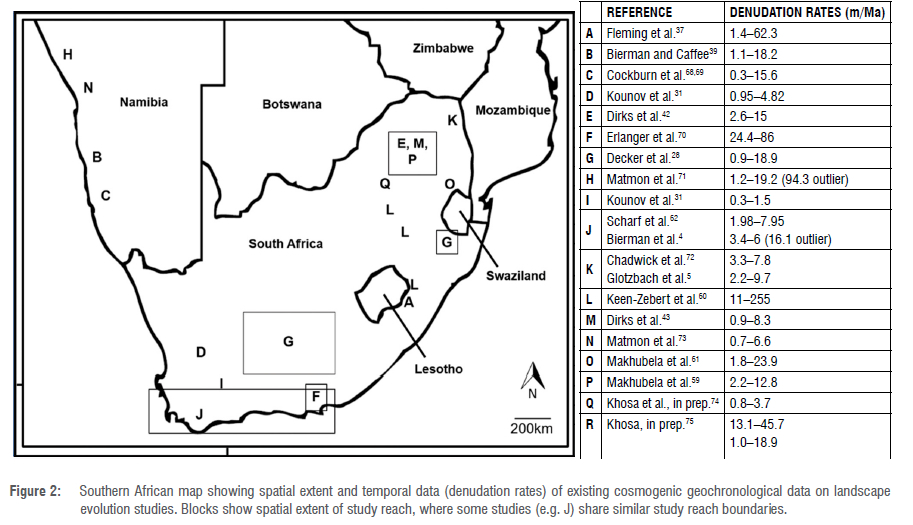
Recent geochronological data, particularly from cosmogenic radio-nuclides, show variable rates of landscape denudation across southern Africa. For example, average apparent cosmogenic 105942,4360361
The application of chronologically constrained data in determining landscape dynamics is relevant in many aspects of geo- and palaeoscience research, but here we draw attention to its relevance to human evolution. Contrary to earlier assumptions, our early prehuman relatives did not necessarily evolve in a steady, unchanging, dry landscape - it seems much more likely that southern Africa was a more dynamic place than previously recognised. Evidence from hominin-bearing caves in the Cradle of Humankind421
Figure 2 shows the spatial extent of geochronological data (mostly from cosmogenic radionuclide studies) that exist for the southern African region, showing that, with such temporal differences determined for the region, there are still knowledge gaps that need to be filled in order to fully review, with confidence, whether some of the previously postulated models are still relevant and can still be applied to how the landscape has developed over time. This underscores the need to reconsider terms such as 'the African surface' and adopt terminology that reflects both spatial and temporal evidence.
Owing to advancements in geological disciplines such as lithostratigraphy, chronostratigraphy and even biostratigraphy, Botha76
Botha employs practical methodologies that include field surveys using systematic data collection from various geological formations and landforms, providing empirical evidence for his theoretical constructs and geospatial analysis, and utilising remote sensing and Geographic Information System technologies to analyse and visualise geological and geomorphological patterns, enabling detailed mapping of landscapes, and sedimentological studies, where there are investigations into sediment composition and distribution that inform on past environments and depositional processes.
Why it is time to move on from 'the African land surface'
Andreoli et al.3453437,41,57,58,66,6925246
The challenge of recognising the different 'African surfaces' lies in the assumption that surfaces of similar altitude share comparable ages and, consequently, have experienced the same tectonic activity.4,567879
Aside from the weak evidence for single, old, stable land surfaces, there is a further issue with the 'African surface' hypothesis: one of language. The term 'Africa' is used loosely here, as all the publications cited here focus solely on southern Africa, with many centred specifically on South Africa. Yet, this hypothesis has been generalised to encompass the entire continental landmass of Africa - an area of 30 million km2no strong evidence for these so-called 'African surfaces', and existing models of landscape evolution remain largely qualitative. Examining these models requires moving beyond the scientific limitations of the time and considering the colonial context in which they were conceived and the lasting influence of colonial assumptions on theories of landscape evolution.
Once recognised, the impact of colonial thinking needs to be addressed. A straightforward and easily achievable measure is the evaluation and re-assessment of language used in fields such as geomorphology.82 76
The who of landscape evolution
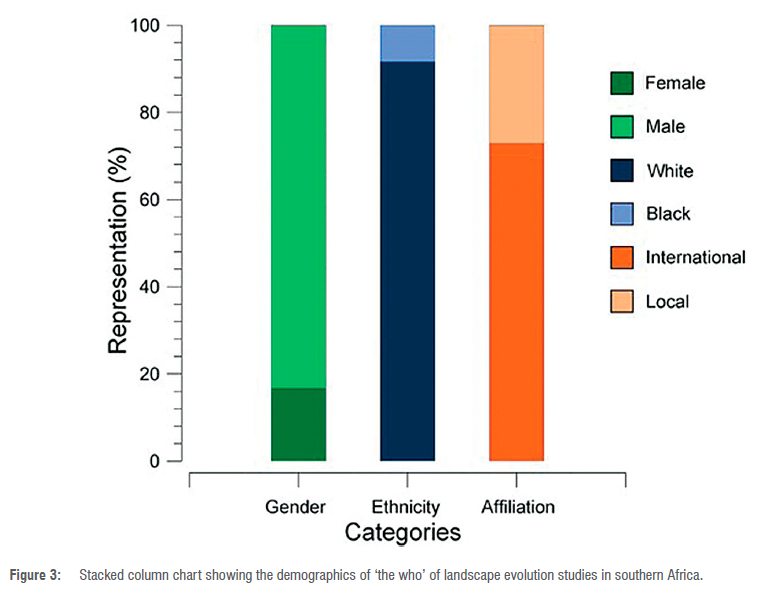
Geologists and geomorphologists from the early 20th century have made an invaluable contribution to understanding the development of the southern African landscape. It is important to note, however, that these landscape evolution studies in the Global South, and particularly in southern Africa, have mostly been dominated by researchers from the Global North. We base this assertion on an analysis of 44 authors who have contributed to landscape evolution studies in southern Africa (using first name as an indicator of gender, last name as an indicator of ethnicity, and affiliation as a marker of geographical location), which indicated that this field is predominantly composed of male researchers, most of whom are based in the Global North, and only a minority of whom are affiliated with South African institutions (Figure 3).
Advancing the field of geomorphology requires that, as a science, it should be based on observable facts, robust hypotheses, and models based on quantifiable theory with repeatable and verifiable methods. Local experts have called for improved experimentation with radiometric experimental techniques.3182,83
Conclusions
The southern African landscape has been a subject of interest for the last 135 years for multiple reasons, including the various drivers behind its evolution since the start of the Cenozoic. Several models to explain modern observations of the landscape and the processes driving their evolution have been put forward, all of which rely on qualitative, descriptive data. Beyond the three tectonic episodes of the so-called 'African surfaces', the stability hypothesis predicts that the landscape evolution of southern Africa is slow and steady, with little change over a long time period. However, the landscape and resultant landforms that we see today cannot be attributed to either a single time period of formation or a single forcing mechanism, but ought to be viewed as transient features that change through time.2 37,57,58,6841,43,59
From Figure 2, we note that many of the studies conducted have focused on areas along the Great Escarpment and Cradle of Humankind, which is understandable based on their significance to the history of the southern African landscape and human origins. There are spatial gaps that are not being addressed and we strongly recommend considering studies within the interior plateau regions outside the Cradle of Humankind, perhaps from the Free State Province towards the Northern Cape region.
We also look forward to a diversifying of 'the who' of landscape evolution and more local teams doing more locally relevant work in southern Africa. This is not a new idea - there have been previous calls for the decolonisation of the practitioner landscape in geology in South Africa.8485
Funding
We acknowledge support from the National Research Foundation of South Africa (NRF)-iThemba LABS and the NRF CSUR (grant number 98920). Furthermore, we acknowledge the Advancing Womxn by Womxn Meritorious Award from the University of Cape Town (R.K., R.P) and the University of Cape Town Vice Chancellor's 2030 Leadership grant (R.P, K.K.), as well as the NRF CPRR (grant number 120806, R.p).
Data availability
There are no data applicable to this paper.
Declarations
We have no competing interests to declare. We have no AI or LLM use to declare.
Authors' contributions
R.K.: Conceptualisation, methodology, data collection, data analysis, validation, writing - the initial draft, writing - revisions, project leadership, project management. V.M.: Writing - revisions, student supervision, funding acquisition. K.K.: Writing - the initial draft, writing -revisions. R.P!: Conceptualisation, methodology, writing - the initial draft, student supervision, project leadership, project management, funding acquisition. All authors read and approved the final version.
Acknowledgements
We thank Jan Kramers, Stephen Tooth and John Hancox for stimulating our interest in landscape evolution and for help in directing us to some of the older literature. Tyler Faith and Judy Sealy are thanked for ensuring the safe delivery of an out-of-print book that was invaluable in putting this review together. This research contributes towards the output of the Biogeochemistry Research Infrastructure Platform (BIOGRIP), supported by the Department of Science and Innovation, South Africa.
References
-
1. Dart RA. Australopithecus africanus: The man-ape of South Africa. Nature. 1925;115:195-199. https://doi.org/10.1038/115195a0
» https://doi.org/10.1038/115195a0 -
2. Knight J. The making of the South African landscape. In: Rogerson C, Knight J, editors. The geography of South Africa: Contemporary changes and new directions. Cham: Springer; 2018. p. 7-14. https://doi.org/10.1007/978-3-319-94974-1_2
» https://doi.org/10.1007/978-3-319-94974-1_2 - 3. Andreoli MAG, Doucoure M, Van Bever Donker J, Brandt D, Andersen NJB. Neotectonics of southern Africa - a review. Afr Geo Rev. 1996;3(1):1-16.
-
4. Bierman PR, Coppersmith R, Hanson K, Neveling J, Portenga EW, Rood DH. A cosmogenic view of erosion, relief generation, and the age of faulting in southern Africa. GSA Today. 2014;24(9):4-11. https://doi.org/10.1130/GSATG206A.1
» https://doi.org/10.1130/GSATG206A.1 -
5. Glotzbach C, Paape A, Baade J, Reinwarth B, Rowntree K, Miller J. Cenozoic landscape evolution of the Kruger National Park as derived from cosmogenic nuclide analyses. Terra Nova. 2016;28(5):316-322. https://doi.org/10.1111/ter.12223
» https://doi.org/10.1111/ter.12223 -
6. Partridge TC, Maud RR. Geomorphic evolution of southern Africa since the Mesozoic. S Afr J Geol. 1987;90:179-208. https://doi.org/10.4324/9781315537979-2
» https://doi.org/10.4324/9781315537979-2 -
7. Du Toit AL. The evolution of the river system of Griqualand West. Trans R Soc S Afr. 1910;1:247-361. https://doi.org/10.1080/00359191009520047
» https://doi.org/10.1080/00359191009520047 - 8. Du Toit AL. Crustal movement as a factor in the geographical evolution of South Africa. S Afr J Sci. 1933;16:3-20.
- 9. King LC. South African scenery: A textbook of geomorphology. 2nd ed. London: Oliver and Boyd; 1951.
-
10. King LC. Pediplanation and isostasy: An example from South Africa. Q J Geol Soc. 1955;111:353-359. https://doi.org/10.1144/gsl.jgs.1955.111.01-04.18
» https://doi.org/10.1144/gsl.jgs.1955.111.01-04.18 - 11. Wellington JH. Southern Africa: A geographical study. Vol. 1. Cambridge: University Press; 1955.
- 12. Burke K. The African plate. S Afr J Geol. 1996;99:341-109.
- 13. Partridge TC, Botha GA, Haddon IG, Johnson MR, Anhaeusser CR, Thomas RJ. Cenozoic deposits of the interior. In: The geology of South Africa. Pretoria: Council for Geoscience; 2006. p. 585-604.
-
14. Spray JG, Kelley SP, Reimold WU. Laser-probe 40Ar-39Ar dating of pseudo-tachyllites and the age of the Vredefort impact event. Meteoritics. 1995; 30:335-343. https://doi.org/10.1111/j.1945-5100.1995.tb01132.x
» https://doi.org/10.1111/j.1945-5100.1995.tb01132.x -
15. Kamo SL, Reimold WU, Krogh TE. Colliston WPA 2.023 Ga age for the Vredefort impact event and a first report of shock metamorphosed zircons in pseudotachylitic breccias and Granophyre. Earth Planet Sci Lett. 1996; 144:369-388. https://doi.org/10.1016/s0012-821x(96)00180-x
» https://doi.org/10.1016/s0012-821x(96)00180-x - 16. Eakin CM, Lithgow-Bertelloni C. An overview of dynamic topography: The influence of mantle circulation on surface topography and landscape. In: Hoorn C, Perrigo A, Antonelli A, editors. Mountains, climate and biodiversity. Hoboken, NJ: Wiley-Blackwell; 2018. p. 37-49.
-
17. Linol B, De Wit MJ. Origin and evolution of the Cape Mountains and Karoo Basin. Regional geology reviews. Cham: Springer; 2016. https://doi.org/10.1007/978-3-319-40859-0
» https://doi.org/10.1007/978-3-319-40859-0 -
18. Blewett SCJ, Phillips D, Matchan EL. Provenance of Cape Supergroup sediments and timing of Cape Fold Belt orogenesis: Constraints from high-precision 40Ar/39Ar dating of muscovite. Gondwana Res. 2019;70:201-221. https://doi.org/10.1016/j.gr.2019.01.009
» https://doi.org/10.1016/j.gr.2019.01.009 -
19. Tooth S, McCarthy TS. Anabranching in mixed bedrock-alluvial rivers: The example of the Orange River above Augrabies Falls, Northern Cape Province, South Africa. Geomorphology. 2004;57:235-262. https://doi.org/10.1016/s0169-555x(03)00105-3
» https://doi.org/10.1016/s0169-555x(03)00105-3 -
20. Keen-Zebert A, Tooth S, Rodnight H, Duller GAT, Roberts HM, Grenfell M. Late Quaternary floodplain reworking and the preservation of alluvial sedimentary archives in unconfined and confined river valleys in the eastern interior of South Africa. Geomorphology. 2013;185:54-66. https://doi.org/10.1016/j.geomorph.2012.12.004
» https://doi.org/10.1016/j.geomorph.2012.12.004 -
21. Entwistle N, Heritage G, Tooth S, Milan D. Regional geology reviews. Cham: Springer; 2016. https://doi.org/10.5194/piahs-367-215-2015
» https://doi.org/10.5194/piahs-367-215-2015 -
22. Grenfell SE, Grenfell MC, Rowntree KM, Ellery WN. Fluvial connectivity and climate: A comparison of channel pattern and process in two climatically contrasting fluvial sedimentary systems in South Africa. Geomorphology. 2014;205:142-154. https://doi.org/10.1016/j.geomorph.2012.05.010
» https://doi.org/10.1016/j.geomorph.2012.05.010 -
23. Heritage G, Tooth S, Entwistle N, Milan D. Long-term flood controls on semi-arid river form: Evidence from the Sabie and Olifants rivers, eastern South Africa. New Orleans, LA: IAHS Press; 2014. https://doi.org/10.5194/piahs-367-141-2015
» https://doi.org/10.5194/piahs-367-141-2015 -
24. Moon BP, Selby MJ. Rock mass strength and scarp forms in southern Africa. Geogr Ann A Phys Geogr. 1983;65A:135-145. https://doi.org/10.2307/520727
» https://doi.org/10.2307/520727 -
25. Singh RG, Botha GA, Richards NP, McCarthy TS. Holocene landslides in KwaZulu-Natal, South Africa. S Afr J Geol. 2008;111:39-52. https://doi.org/10.2113/gssajg.111.1.39
» https://doi.org/10.2113/gssajg.111.1.39 -
26. Bell FG, Maud RR. Dispersive soils: A review from a South African perspective. Q J Eng Geol Hydrogeol. 1994;27:195-210. https://doi.org/10.1144/gsl.qjegh.1994.027.p3.02
» https://doi.org/10.1144/gsl.qjegh.1994.027.p3.02 -
27. Compton JS, Herbert CT, Hoffman M, Schneider RR, Stuut J. A tenfold increase in the Orange River mean Holocene mud flux: Implications for soil erosion in South Africa. Holocene. 2010;20:115-112. https://doi.org/10.1177/0959683609348860
» https://doi.org/10.1177/0959683609348860 -
28. Decker JE, Niedermann S, De Wit MJ. Soil erosion rates in South Africa compared with cosmogenic 3He-based rates of soil production. S Afr J Geol. 2011;114:475-488. https://doi.org/10.2113/gssajg.114.3-4.475
» https://doi.org/10.2113/gssajg.114.3-4.475 -
29. Boardman J. How old are the gullies (dongas) of the Sneeuberg uplands, Eastern Karoo, South Africa? Catena. 2014;113:79-85. https://doi.org/10.1016/j.catena.2013.09.012
» https://doi.org/10.1016/j.catena.2013.09.012 -
30. Boardman J, Holmes PJ, Rhodes EJ, Bateman DM. Colluvial fan gravels, depositional environments and luminescence dating: A Karoo case study. S Afr Geogr J. 2005;87:73-79. https://doi.org/10.1080/03736245.2005.9713828
» https://doi.org/10.1080/03736245.2005.9713828 -
31. Kounov A, Niedermann S, de Wit MJ, Codilean AT, Viola G, Andreoli M, et al. Cosmogenic 21Ne and 10Be reveal a more than 2Ma alluvial fan flanking the Cape mountains, South Africa. S Afr J Geol. 2014;118:129-144. https://doi.org/10.2113/gssajg.118.2.129
» https://doi.org/10.2113/gssajg.118.2.129 -
32. Shaw PA, Thomas DSG. The Quaternary palaeoenvironmental history of the Kalahari, southern Africa. J Arid Environ. 1996;32:9-22. https://doi.org/10.1006/jare.1996.0002
» https://doi.org/10.1006/jare.1996.0002 -
33. Mills SC, Barrows TT, Telfer MW, Fifield LK. The cold climate geomorphology of the Eastern Cape Drakensberg: A reevaluation of past climatic conditions during the last glacial cycle in southern Africa. Geomorphology. 2017;278:184-194. https://doi.org/10.1016/j.geomorph.2016.11.011
» https://doi.org/10.1016/j.geomorph.2016.11.011 -
34. Knight J, Fitchett JM. Climate change during the Late Quaternary in South Africa. In: Knight J, Rogerson C, editors. The geography of South Africa: Contemporary changes and new directions. Cham: Springer; 2019. p. 37-45. https://doi.org/10.1007/978-3-319-94974-1_5
» https://doi.org/10.1007/978-3-319-94974-1_5 -
35. Fitchett JM. The Holocene climates of South Africa. In: Knight J, Rogerson C, editors. The geography of South Africa. World Regional Geography Book Series. Cham: Springer; 2019. p. 47-55. https://doi.org/10.1007/978-3-319-94974-1_6
» https://doi.org/10.1007/978-3-319-94974-1_6 -
36. Pazzaglia FJ. Landscape evolution models. Dev Quat Sci. 2003;1:247-274. https://doi.org/10.1016/S1571-0866(03)01012-1
» https://doi.org/10.1016/S1571-0866(03)01012-1 -
37. Fleming A, Summerfield MA, Stone JO, Fifield LK, Cresswell RG. Denudation rates for the southern Drakensberg escarpment, SE Africa, derived from /n-s/tu-produced 36Cl: Initial results. J Geol Soc London. 1999;156:209-212. https://doi.org/10.1144/gsjgs.156.2.0209
» https://doi.org/10.1144/gsjgs.156.2.0209 -
38. Gallagher K, Brown R. Denudation and uplift at passive margins: The record on the Atlantic margin of southern Africa. Philos Trans R Soc Lond A. 1999;357:835-859. https://doi.org/10.1098/rsta.1999.0354
» https://doi.org/10.1098/rsta.1999.0354 -
39. Bierman PR, Caffee M. Slow rates of rock surface erosion and sediment production across the Namib Desert and escarpment, southern Africa. Am J Sci. 2001;301:326-358. https://doi.org/10.2475/ajs.301.4-5.326
» https://doi.org/10.2475/ajs.301.4-5.326 -
40. King LC. Canons of landscape evolution. Geol Soc Am Bull. 1953;64:721-752. https://doi.org/10.1130/0016-7606(1953)64[721:cole]2.0.co;2
» https://doi.org/10.1130/0016-7606(1953)64[721:cole]2.0.co;2 -
41. Flowers RM, Schoene B. (U-Th)/He thermochronometry constraints on unroofing of the eastern Kaapvaal craton and significance for uplift of the southern African plateau. Geology. 2010;38(9):827-830. https://doi.org/10.1130/g30980.1
» https://doi.org/10.1130/g30980.1 -
42. Dirks PHGM, Kibii JM, Kuhn BF, Steininger C, Churchill SE, Kramers JD, et al. Geological setting and age of Australop/thecus sed/ba from southern Africa. Science. 2010;328(5975):205-208. https://doi.org/10.1126/science.1184950
» https://doi.org/10.1126/science.1184950 -
43. Dirks PHGM, Placzek CJ, Fink D, Dosseto A, Roberts E. Using 10Be cosmogenic isotopes to estimate erosion rates and landscape changes during the Plio-Pleistocene in the Cradle of Humankind, South Africa. J Hum Evol. 2016;96:19-134. https://doi.org/10.1016/j.jhevol.2016.03.002
» https://doi.org/10.1016/j.jhevol.2016.03.002 - 44. Davis WM. The rivers and valleys of Pennsylvania. Nat Geogr Mag. 1889;1:183-253.
-
45. Davis WM. The geographical cycle. J Geogr. 1899;14:481-504. https://doi.org/10.2307/1774538
» https://doi.org/10.2307/1774538 -
46. Wellington JH. The Kunene River and the Etosha Plain. S Afr Geogr J. 1938;20:21-32. https://doi.org/10.1080/03736245.1938.105591186
» https://doi.org/10.1080/03736245.1938.105591186 -
47. Wellington JH. The boundaries of the High Veld. S Afr Geogr J. 1944;26(1):76-81. https://doi.org/10.1080/03736245.1944.10559236
» https://doi.org/10.1080/03736245.1944.10559236 -
48. Wellington JH. A physiographic regional classification of South Africa. S Afr Geogr J. 1946;28(1):64-86. https://doi.org/10.1080/03736245.1946.10559249
» https://doi.org/10.1080/03736245.1946.10559249 -
49. Wellington JH. The Lake Chrissie problem. S Afr Geogr J. 1943;25(1):50-64. https://doi.org/10.1080/03736245.1943.10559227
» https://doi.org/10.1080/03736245.1943.10559227 - 50. Dixey F. Erosion cycles in central and southern Africa. Trans R Soc S Afr. 1942;151-181.
-
51. Dixey F. African landscape. Geogr Rev. 1944;34(3):457-l65. https://doi.org/10.2307/209976
» https://doi.org/10.2307/209976 -
52. King LC. On the age of African land-surfaces. Q J Geol Soc London. 1948;104(4):439-459. https://doi.org/10.1144/gsl.jgs.1948.104.01-04.20
» https://doi.org/10.1144/gsl.jgs.1948.104.01-04.20 -
53. Twidale CR. Etch and intracutaneous landforms and their implications. Aust J Earth Sci. 1987;367-386. https://doi.org/10.1080/08120098708729418
» https://doi.org/10.1080/08120098708729418 -
54. Twidale CR, Mueller JE. Etching as a process of landform development. Prof Geogr. 1988;379-391. https://doi.org/10.1111/j.0033-0124.1988.00379.x
» https://doi.org/10.1111/j.0033-0124.1988.00379.x - 55. Dixey F. Some observations on the physiographic development of central and southern Africa. Trans R Soc S Afr. 1938;41:113-172.
-
56. Twidale CR. Landscape analysis: Derivation and rediscovery of ideas. Z Geomorphol. 2012;18(3):259-277. https://doi.org/10.4000/geomorphologie.9900
» https://doi.org/10.4000/geomorphologie.9900 -
57. Tinker J, De Wit M, Brown R. Linking source and sink: Evaluating the balance between onshore erosion and offshore sediment accumulation since Gondwana break-up, South Africa. Tectonophysics. 2007;455(1-4):94-103. https://doi.org/10.1016/j.tecto.2007.11.040
» https://doi.org/10.1016/j.tecto.2007.11.040 -
58. Tinker J, de Wit M, Brown R. Mesozoic exhumation of the southern Cape, South Africa, quantified using apatite fission track thermochronology. Tectonophysics. 2008;455:77-93. https://doi.org/10.1016/j.tecto.2007.10.009
» https://doi.org/10.1016/j.tecto.2007.10.009 -
59. Makhubela TV, Kramers JD, Scherler D, Wittmann H, Dirks PHGM, Winkler SR. Effects of long soil surface residence times on apparent cosmogenic nuclide denudation rates and burial ages in the Cradle of Humankind, South Africa. Earth Surf Process Landforms. 2019;44(15):2968-2981. https://doi.org/10.1002/esp.4723
» https://doi.org/10.1002/esp.4723 -
60. Keen-Zebert A, Tooth S, Stuart FM. Cosmogenic 3He Measurements provide insight into lithologic controls on bedrock channel incision: Examples from the South African interior. J Geol. 2016;124(3):423-434. https://doi.org/10.1086/685506
» https://doi.org/10.1086/685506 -
61. Makhubela TV, Kramers JD, Konyana SM, Van Niekerk HS, Winkler SR. Erosion rates and weathering timescales in the eastern Great Escarpment, South Africa. Chem Geol. 2021;580, Art. #120368. https://doi.org/10.1016/j.chemgeo.2021.120368
» https://doi.org/10.1016/j.chemgeo.2021.120368 -
62. Scharf TE, Codilean AT, De Wit M, Jansen JD, Kubik PW. Strong rocks sustain ancient postorogenic topography in southern Africa. Geology. 2013;41(3):331-334. https://doi.org/10.1130/g33806.1
» https://doi.org/10.1130/g33806.1 -
63. Baby G, Guillocheau F, Morin J, Ressouche J, Robin C, Broucke O, et al. Postrift stratigraphic evolution of the Atlantic margin of Namibia and South Africa: Implications for the vertical movements of the margin and the uplift history of the South African Plateau. Mar Pet Geol. 2018;97:169-191. https://doi.org/10.1016/j.marpetgeo.2018.06.030
» https://doi.org/10.1016/j.marpetgeo.2018.06.030 -
64. Baby G, Guillocheau F, Boulogne C, Robin C, Dall'Asta M. Uplift history of a transform continental margin revealed by the stratigraphic record: The case of the Agulhas transform margin along the Southern African Plateau. Tectonophysics. 2018;731-732:104-130. https://doi.org/10.1016/j.tecto.2018.03.014
» https://doi.org/10.1016/j.tecto.2018.03.014 -
65. Baby G, Guillocheau F, Braun J, Robin C, Dall'Asta M. Solid sedimentation rates history of the southern African continental margins: Implications for the uplift history of the South African Plateau. Terra Nova. 2019;32(1):53-65. https://doi.org/10.1111/ter.12435
» https://doi.org/10.1111/ter.12435 -
66. Decker JE, Niedermann S, de Wit MJ. Climatically influenced denudation rates of the Southern African Plateau: Clues to solving a geomorphic paradox. Geomorphology. 2013;190:48-160. https://doi.org/10.1016/j.geomorph.2013.02.007
» https://doi.org/10.1016/j.geomorph.2013.02.007 -
67. Makhubela TV Winkler SR, Mbele V Kramers JD, Khosa RR, Moabi HP et al. Development of cosmogenic nuclide capabilities in South Africa and applications in southern African geomorphology. S Afr Geogr J. 2020; 103(1):99-118. https://doi.org/10.1080/03736245.2020.1775689
» https://doi.org/10.1080/03736245.2020.1775689 -
68. Cockburn HAP, Seidl MA, Summerfield MA. Quantifying denudation rates on inselbergs in the central Namib Desert using in situ-produced cosmogenic 10Be and 26Al. Geology. 1999;27(5):399. https://doi.org/10.1130/0091-7613(1999)027
» https://doi.org/10.1130/0091-7613(1999)027 - 69. Cockburn HAP Brown RW, Summerfield MA, Seidl MA. Quantifying passive margin denudation and landscape development using a combined fission-track thermochronology and cosmogenic isotope analysis approach. Earth Planet Sci Lett. 2000;179(3-4):429-435.
-
70. Erlanger ED, Granger DE, Gibbon RJ. Rock uplift rates in South Africa from isochron burial dating of fluvial and marine terraces. Geology. 2012;40(11):1019-1022. https://doi.org/10.1130/g33172.1
» https://doi.org/10.1130/g33172.1 -
71. Matmon A, Mushkin A, Enzel Y Grodek T, Team A. Erosion of a granite inselberg, Gross Spitzkoppe, Namib Desert. Geomorphology. 2013;201:52-59. https://doi.org/10.1016/j.geomorph.2013.06.005
» https://doi.org/10.1016/j.geomorph.2013.06.005 -
72. Chadwick OA, Roering JJ, Heimsath AM, Levick SR, Asner GP Khomo L. Shaping post-orogenic landscapes by climate and chemical weathering. Geology. 2013;41(11):1171-1174. https://doi.org/10.1130/g34721.1
» https://doi.org/10.1130/g34721.1 -
73. Matmon A, Enzel Y Vainer S, Grodek T, Mushkin A. The near steady state landscape of western Namibia. Geomorphology. 2018;313:72-87. https://doi.org/10.1016/j.geomorph.2018.04.008
» https://doi.org/10.1016/j.geomorph.2018.04.008 - 74. Khosa RR, Tooth S, Corbett LB, Bierman PR, Kramers JD, Winkler S, et al. A paired in-situ cosmogenic isotope (10Be and 26Al) approach to reveal the complex exposure and erosion history of bedrock outcrop along the anabranching Vaal River, South Africa. Manuscript in preparation.
- 75. Khosa RR. Using cosmogenic nuclide, 10Be, to quantify southern African landscape evolution through the erosion of mixed bedrock-alluvial anabranching rivers [PhD thesis]. Cape Town: University of Cape Town. In preparation.
-
76. Botha GA. Cenozoic stratigraphy of South Africa: Current challenges and future possibilities. S Afr J Geol. 2021;124(4):817-842. https://doi.org/10.25131/sajg.124.0054
» https://doi.org/10.25131/sajg.124.0054 -
77. Partridge TC, Dollar ESJ, Moolman J, Dollar LH. The geomorphic provinces of South Africa, Lesotho and Swaziland: A physiographic subdivision for earth and environmental scientists. Trans R Soc S Afr. 2010;65(1):1-47. https://doi.org/10.1080/00359191003652033
» https://doi.org/10.1080/00359191003652033 -
78. Blümel WD, Eitel B. Tertiary calcic sediment covers and calcretes in Namibia - origin and geomorphic significance. Z Geomorphol. 1994;38:385-403. https://doi.org/10.1127/zfg/38/1994/385
» https://doi.org/10.1127/zfg/38/1994/385 -
79. Marker ME, McFarlane MJ, Wormald RJ. A laterite profile near Albertina, Southern Cape: Its significance in the evolution of the African surface. S Afr J Geol. 2002;105:67-74. https://doi.org/10.2113/1050067
» https://doi.org/10.2113/1050067 - 80. Du Toit AL. The geology of South Africa. 3rd ed. Edinburgh: Oliver & Boyd; 1954.
- 81. King LC. Landscape study in southern Africa. S Afr J Geol. 1947;50(1):23-54.
-
82. Gosse JC, Phillips FM. Terrestrial in situ cosmogenic nuclides: Theory and application. Quat Sci Rev. 2001;20:1475-1560. https://doi.org/10.1016/s0277-3791(00)00171-2
» https://doi.org/10.1016/s0277-3791(00)00171-2 -
83. Von Blanckenburg F, Willenbring JK. Cosmogenic nuclides: Dates and rates of earth-surface change. Elements. 2014;10:341-346. https://doi.org/10.2113/gselements.10.5.341
» https://doi.org/10.2113/gselements.10.5.341 -
84. Bernard RE, Cooperdock EHG. No progress on diversity in 40 years. Nat Geosci. 2018;11(5):292-295. https://doi.org/10.1038/s41561-018-0116-6
» https://doi.org/10.1038/s41561-018-0116-6 -
85. Dutt K. Race and racism in the geosciences. Nat Geosci. 2020;13(1):2-3. https://doi.org/10.1038/s41561-019-0519-z
» https://doi.org/10.1038/s41561-019-0519-z

Revised: 04 Nov. 2024
Accepted: 25 Nov. 2024
Published: 07 Feb. 2025
Funding: South African National Research Foundation (98920,120806), University of Cape Town