Probing the Universe with cosmic rays using high performance computing
Abstract
I report on the research activities of the South African Centre for High Performance Computing carried out at the Unit for Space Physics at North-West University, Potchefstroom, during 2007/8. Background is given on the aims of the centre and the first three flagship projects that were selected in 2006 for computational-intensive tasks. The project in Computational Space Physics and Astrophysics, called 'Cosmic rays and us: From birth to death', is described in detail, and a summary given of research highlights so far.
Introduction
This article provides information concerning the new initiatives and developments in high performance computing in South Africa, in particular the establishment of the Centre for High Performance Computing (CHPC) in 2007, and the flagship research projects that followed. Most of this review is devoted to research activities of and results arising from the project on Computational Space Physics and Astrophysics, carried out at the Unit for Space Physics at North-West University in Potchefstroom during 2007/8.
Centre for High Performance Computing
The CHPC is an initiative of the Department of Science and Technology (DST), managed by the Meraka Institute of the South African CSIR. It was inaugurated on 22 May 2007 by the minister of science and technology, Mosibudi Mangena. The research objectives of the CHPC are to provide high-end computing resources and expertise for computational research in South Africa. The Cape Town facility fosters research that addresses grand challenges, with the aim to promote computational research alongside experimental and theoretical studies across the academic disciplines, functioning as a national research, training and service centre. The CHPC's mandate is to support world-class research, and skills and development training.
The first phase of computer procurement and integration was completed in May 2007, and the research operations officially started on 1 June 2007. The specifications and technical details on the IBM computer cluster involved can be viewed by visiting www.chpc.ac.za/infrastructure.html. The second phase of cluster expansion is due towards the end of 2008.
Flagship projects
Three research grants for flagship projects were awarded at the beginning of 2007 by the CHPC to the following: 1) the University of Cape Town with Bruce Hewitson and Frank Shillington as team leaders. This initiative is based upon two complementary sub-projects focused on multi-model seasonal climate forecasts and the coupling of ocean and atmosphere. The two themes share the common application of dynamical modelling of the components of the climate system. 2) The University of Limpopo with Phuti Ngoepe as team leader. This project focuses on the use of computational modelling to enhance the economics, energy and power density of high-power rechargeable batteries. 3) North-West University (NWU) with Marius Potgieter as team leader. This project, within the Unit for Space Physics (USP), is the main subject of this article.
All of these projects are conducted in collaboration with the CHPC. The centre provides financial support and computational resources to the scientists, while researchers assist in the career development of the centre's research officers and students through the inclusion of the latter in their research programmes. Further calls for additional flagship project proposals were announced in the second half of 2007 and were allocated during 2008 (for an updated list, see www.chpc.ac.za/research/flagships.php).
The Unit for Space Physics
The Unit for Space Physics at the NWU has been in existence under various names since the beginning of the space exploration era that began with the launch of Sputnik on 4 October 1957. It was established during the International Geophysical Year in 1957. Various aspects of space physics have been investigated over the years. Several experiments have been carried out at Potchefstroom and nearby, as well as further afield in southern Africa and in the Antarctic. Experimental research on astronomical sources of gamma rays began in the mid-1980s. Locally designed gamma-ray telescopes were used to investigate the limits of physics, focusing on astrophysical objects such as neutron stars, pulsars and supernovae. Currently, the USP is a partner in an international group based in Europe, building a world-class gamma-ray telescope in Namibia, called the HESS project (www.mpi-hd.mpg.de/hfm/HESS/). The USP has also been involved in radio astronomy since 1990, collaborating with the Hartebeesthoek Radio Astronomy Observatory west of Pretoria. Regions where star formation is taking place are studied by means of maser radiation that is characteristic of such phenomena.
With the development of more powerful computers, the emphasis of a large part of the research done in the USP has shifted to the numerical modelling of universal processes in space physics (particularly heliospace physics) and in astrophysics. Such theoretical and computational studies can be very cost-effective and provide ideal training for postgraduate students seeking rewarding careers after completing their studies.
The research activities of the USP have three main components: 1) Experimental research, which is funded partially by the South African National Antarctic Programme (SANAP) of the National Research Foundation (NRF). Cosmic ray monitors are operated continuously at Potchefstroom, Hermanus, Tsumeb and at the South African research base in Antarctica (SANAE). This research relates to aspects of space weather, discussed below. 2) Theoretical and numerical modelling; this focuses on heliospheric physics as the part of space physics dealing with the influence of the Sun, as a star, on our immediate galactic environment, including studies of solar activity cycles and magnetic field, the solar wind and its effect on the Earth's magnetic field, ionosphere and atmosphere. Numerical models have been developed that simulate charged-particle acceleration, transport and modulation in the galaxy, in the interstellar medium and in the helio- sphere, including Jovian electron transport. Theoretical work has been conducted on aspects of the solar magnetic field, diffusion and turbulence theory. 3) Experimental and modelling research in astrophysics; this focuses on gamma-ray astronomy, radio and optical astronomy, star formation, and cosmic ray sources.
Computational space physics and astrophysics
Scientific background
We use cosmic rays as probes to study the features and properties of the space surrounding the Sun, and far beyond. These particles are highly energetic, fully-ionized elemental nuclei that arise mostly from the enormous explosions of huge unstable stars, called supernovae, in our galaxy, the Milky Way. They have kinetic energies ranging from about 1 MeV to as high as 1021
Cosmic rays were discovered during 1911–13 by the Austrian scientist Victor Hess. Before his discovery, scientists had been puzzled by the fact that the air in electroscopes became ionized, regardless of how thoroughly the containers were electrically insulated. They attributed the phenomenon to ground-emitted radioac- tivity. In 1910, Theodore Wulf measured ionization at the bottom and top of the Eiffel Tower (about 300 m apart), and found that there was considerably more ionization at the top than would be expected from atmospheric attenuation of ground-emitted radiation, but his findings were generally rejected. Before making his historic balloon flights, Hess calculated the height at which ground radiation should cease to induce ionization, this being about 500 m, and designed instruments that would be resistant to large temperature and pressure changes. He then made ten historic balloon ascents, two in 1911, seven in 1912, and one in 1913, five of them at night, and found that ionization increased rapidly with altitude. His conclusion was that radiation of very high penetrating power enters the Earth's atmosphere from space, and is being attenuated by the constituents of air.
After making a flight during an almost total eclipse of the Sun on April 12, 1912, he further concluded that since ionization did not diminish during the eclipse, the Sun was not the main source of this radiation. His theory about 'rays from space' did not receive general acceptance at the time, but stimulated research after World War I, supporting and confirming his postulates. The newly discovered radiation was dubbed 'cosmic' by Robert Millikan in 1925. Hess received the Nobel prize for this accomplishment in 1936 (together with Carl Anderson, who discovered positrons: see www.mpi-hd.mpg.de/hfm/HESS/public/hessbio.html, and nobelprize.org/nobel_prizes/physics/laureates/1936/hess-bio.html).
Computational space physics and astrophysics at the USP
Members of the Unit for Space Physics involved with this project are Okkie de Jager, Adri Burger and Stefan Ferreira; postdoctoral fellows Ingo Büsching and Christo Venter; computer expert Mathew Holleran; Ph.D. students Rex Manuel, Mathew Holleran, Donald Ngobeni and Sibusiso Nkosi; and M.Sc. students Rendani Nndanganeni, Edwin Magidimisha, Du Toit Strauss and Michael Vorster.
Research and bursaries are financed mainly by statutory organizations such as the NRF, the Department of Science and Technology, and now the CHPC. Collaboration agreements between the USP and foreign research groups involved in the Voyager12,3 and SOHO missions of the European Space Agency (ESA) give the group access to the latest unpublished data and discoveries. An active post-doctoral programme is in place.
Astrophysicists now have models of how cosmic rays can be produced over such an enormous energy range, but still have no definitive proof, so that cosmic rays remain an active research field at the forefronts of space science and astrophysics. A remarkable feature is that a natural upper limit to the cosmic-ray spectrum has not yet been confirmed. Cosmic rays appear at energies as high as is measurable today, which is technologically very difficult and expensive, because of the very low number of cosmic ray particles arriving at the Earth with these higher energies. About one particle per square metre per second may reach the Earth at 100 GeV, whereas only about one particle per square metre per year arrives at 10154195,6 and cosmic-ray observations. Improved sensitivity is a key requirement in extending their role in the discovery of the origin of cosmic rays.
Space physicists attribute the bulk of galactic cosmic rays (E < 1016
The Sun is an active star, creating charged particles of its own, following an 11-year cycle. These energetic particles have much less energy than cosmic rays. They occur sporadically, especially during maximum solar activity, and have a characteristic energy limit. The largest solar events are called coronal mass ejections. This ejected matter is transported by the solar wind at a high velocity (average of 450 km s–1) towards and past the Earth, causing distortion of the Earth's magnetic field, creating electromagnetic disturbances (magnetic storms) that affect radio, satellite, other forms of wireless communication, and electricity supply networks. These phenomena are features of what is called space weather. The activity of the Sun changes with time, the 11-year cycle being the best known. A 22-year cycle is also evident, arising from the solar magnetic field reversing its polarity every 10 to 12 years. This creates a charge-sign dependence7,8 in cosmic rays because of the gradient and curvatures in the global heliospheric magnetic field.
The theme of this flagship project is 'Cosmic rays and us: from birth to death'. Because cosmic rays can be harmful to life, they need to be studied in detail, from their cosmic origin to their detection on Earth by a large number of balloon experiments, as well as using satellites and spacecraft. The flagship project, through three main programmes, studies the origin of cosmic rays, their propagation in the galactic and interstellar medium, to where they encounter the heliosphere, and eventually reach our planet.
The local interstellar conditions through which the heliosphere moves can change dramatically over thousands of years. These very long-term changes in our interstellar and heliospheric environment are a feature of space climate. Since life on Earth has taken millions of years to evolve, space climate is an important issue and must have played a role. This aspect will be discussed briefly in the last section of this paper.
Fortunately for us, there are three important natural protection barriers against galactic cosmic rays. They are:
1. The heliosphere9c. 149.5 million km). Two Voyager spacecraft are already exploring the outer heliosphere. Voyager 1 is at c.110 AU and Voyager 2 at c. 87 AU, moving in the nose direction (opposite end to the trailing tail) of the heliosphere, about 60° apart in heliolatitude.1,10
2. The Earth's magnetic field9
3. The Earth's atmosphere9
If humans are to occupy a sustainable base on the Moon, effective protection against cosmic and solar particle events will have to be installed, as our natural satellite has no protective atmosphere or adequately strong magnetic field. The same precautions will be necessary if travelling to Mars over periods of several months to set up a long-term base there. Advanced knowledge of a fundamental as well as a practical nature of the propagation and modulation processes of cosmic rays in the interstellar medium, the heliospheric and interplanetary medium and through the Earth's magnetosphere and atmosphere is therefore crucially important.
Purpose and aims of the project
The project focuses on the computational modelling of heliospace physics, interstellar physics and astrophysics, using numerical codes that have been developed in the USP over the years. It aims to design, construct, link and expand numerical models in order to simulate the transport and acceleration of cosmic rays, from their creation in the galaxy to their arrival at Earth. The acceleration of these particles as a result of astrophysical shocks in supernova remnants, their propagation in the galaxy and the transport in our local turbulent astrosphere need to be computed for this purpose. Emphasis is on particle propagation, the study of the formation of the physical structure and geometry of supernova remnants and the heliosphere, stellar and solar wind flow, magnetic fields and more. These simulations are used to test different theories, and to explain recent observations and measurements from various spacecraft near and far from the Earth, and using large telescopes such as employed by the HESS collaboration in Namibia. The end results will be applicable to studies of the influence of cosmic rays, space weather and space climate on the environment of the Earth, to long-duration missions to Mars, and to working environments on the Moon and the planet. It has indeed become possible with the establishment of the CHPC facility to embark on ambitious projects on numerical modelling of the nature described here over the longer term, some of which are described below.
Heliospheric modelling
The solar wind. The solar corona, like the Earth's atmosphere, is captured by the Sun's gravity. Although the Sun's gravitational field is very strong, the topmost 'atmospheric' layers easily escape at temperatures of millions of degrees Celsius. This coronal, plasmatic flow of particles away from the Sun has been named the solar wind. It fills and shapes the vast region of space surrounding the Sun to form the heliosphere. The Earth's magnetosphere is also shaped and significantly affected by the solar wind.
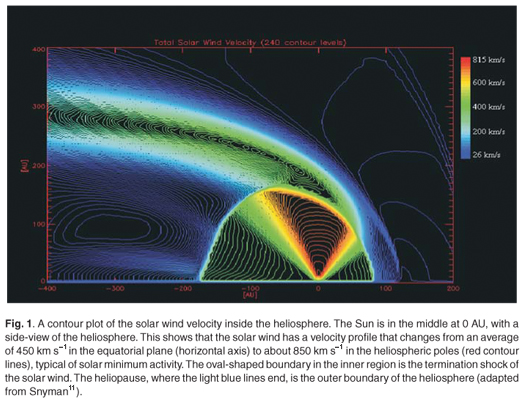
Two solar wind speed regimes have been observed by the Ulysses mission.3c. 800 km s–1 with fluctuations of c. 10%. The areas emitting the fast solar wind can be associated with visually darker areas in light images of the Sun, for example, in the emission of the Fe XII line (see http://sohowww.estec.esa.nl). During low solar activity the polar region of each hemisphere is covered by 'coronal holes', which can extend to the heliographic equator and beyond. The slow solar wind has typical speeds that vary around c. 450 km s–1. The slow wind is significantly more variable than the fast. Closed magnetic fields are observed near the heliospheric equator, above the solar streamer belt.
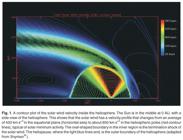
Figure 1 is a contour plot of the global solar wind velocity inside the heliosphere, in the meridional heliocentric plane. It is based on the results of a sophisticated hydrodynamic model11
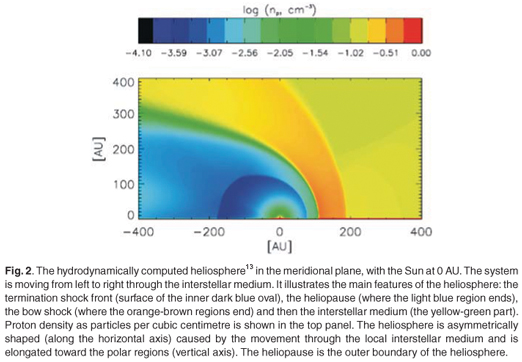
Heliospheric structural geometry. The solar wind blows away from the Sun into the interstellar medium (the rarefied hydrogen and helium gas that permeates the galaxy). The point where the solar wind is no longer sufficient to push back the interstellar medium is known as the heliopause, and is often considered to be the outer 'boundary' of the solar system. The distance to the heliopause depends on the velocity of the solar wind and the local density of the interstellar medium, and by computation using sophisticated models12
The space between the Sun and nearby stars is filled with interstellar plasmas, magnetic fields, energetic-but-neutral particles, and charged particles. The Sun moves through the interstellar medium (ISM) with a velocity of c. 25 km s–1 so that an asymmetric heliospheric interface is formed. The solar wind prevents the interstellar medium from flowing into the heliosphere. From a particle astronomy point of view, the heliosphere is considered to be a small but typical astrosphere. The extent of an astrosphere depends on the ram pressure of the stellar wind, compared to the total pressure of the ISM. In this context, the heliosphere extends over at least 500 AU in its equatorial plane and at least 250 AU in the polar plane. Because it is moving through the ISM, the heliosphere is asymmetrical with respect to the Sun, with the tail much more extended than the nose region, this being the direction in which it is moving.
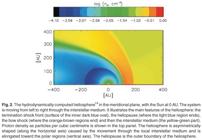
The main constituents of the heliosphere are shown in Fig. 2, based on hydrodynamic computational models.1314–1) to subsonic speeds at distances between 85 and 105 AU.13,15 As predicted, Voyager 1 encountered the TS in December 2004 at a distance of c. 94 AU from the Sun, at a heliolatitude of c. 30° N. This observation1,16 is of considerable importance and quite an accomplishment for this 30-year-long mission.
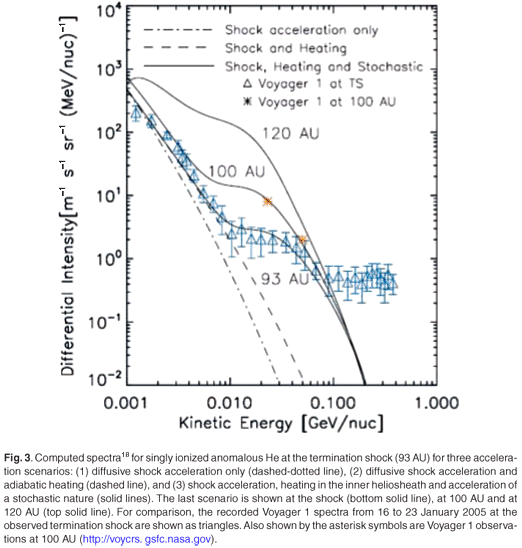
Anomalous cosmic rays in the heliosphere. Anomalous cosmic rays (ACRs)171c. 3 MeV/nucleon) are clearly accelerated, confirming that acceleration does indeed occur at the TS.
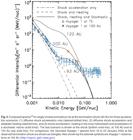
Using the computational facilities at the CHPC, it was recently shown18Fig. 3). This field of research, with the focus on the outer heliosphere, is currently actively pursued, with several challenges and issues to be clarified.8
Galactic cosmic ray modelling
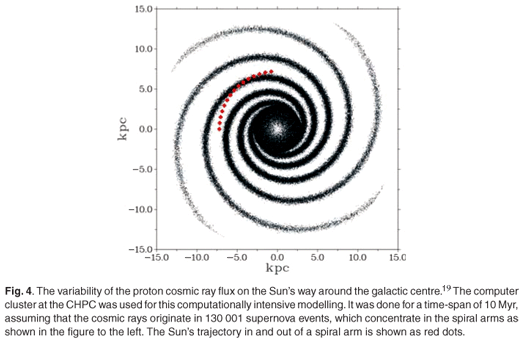
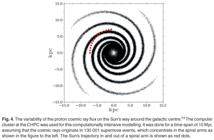
The discovery of direct evidence for the acceleration of high energy cosmic ray particles in supernova remnants in our galaxy has underlined the need to compute the cosmic ray particle distribution in the Milky Way. Supernovae, as sources of galactic cosmic rays, change with time and location in space, resulting in a range of possible cosmic ray spectra at a given location in the galaxy. Supernovae are found most commonly within the galactic spiral arms, so that it can be expected that a significant difference in cosmic ray intensity may occur inside and outside the spiral arms, as the Sun makes its very long journey around the galactic centre. The variability of the local interstellar cosmic ray proton spectrum during the motion of the Sun around the centre of the Milky Way, has been investigated.19Fig. 4. The averaged cosmic ray flux outside a spiral arm was found to be about 50% of that inside a spiral arm, with spatial and temporal variations inside the arms.
Computational astrophysics
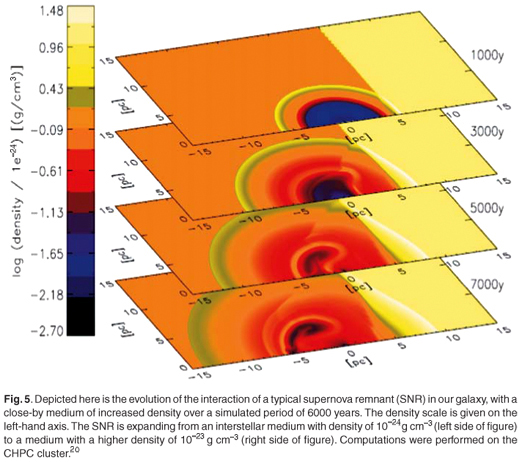
The explosion of a massive star as a supernova will result in an expanding supernova remnant (SNR) with a speed typically in the range 1089–1, depending on both the ejection energy and ejecta mass. Using the CHPC facility extensively, it has been possible to show how different parameters may influence the evolution of an SNR in a uniform and non-uniform ISM.20
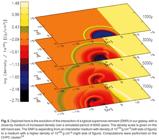
Figure 5 depicts the evolution of the interaction of a typical SNR in our galaxy with a close-by medium of increased density over a simulated period of 6000 years. The density scale is given on the left. The SNR is expanding from an interstellar medium with a density of 10–24 g cm–3 (left side of figure) to a medium with a higher density of 10–23 g cm–3 (right side of figure).
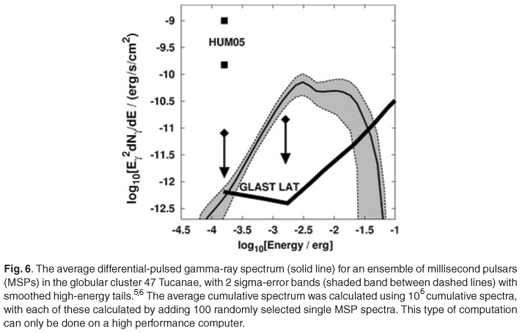
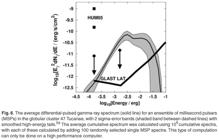
The pulsed and unpulsed gamma-ray radiation from a population of millisecond pulsars (MSPs) in the globular cluster 47 Tucanae was modelled5,6 using the CHPC. The pulsed radiation from each of a population of 70 MSPs was calculated iteratively using an MSP model, and these individual spectra were added to obtain a cluster-pulsed gamma-ray spectrum (Fig. 6). The idea of predicting cumulative gamma-ray fluxes was generalized, and consequential cosmic ray fluxes from a globular cluster were used in these predictions to constrain the underlying MSP models in a way that is independent of individual (unknown) MSP geometries.
Space climate
The solar system can be considered an archive for storing changes of the local interstellar medium over eons, with the Earth as a special archive to us, because it could contain important clues as to how and why we live, as well as explain our climate and the way that it has developed, correlating with the information locked into ice cores, ice sheets, ocean sediments, tree rings, and so on. The terrestrial archives, however, have multiple input variables that arise from complex geological and climatological processes, making this information difficult to view in isolation from the solar-terrestrial and galactic-terrestrial factors.
The best archives, in the form of large data sets, are provided by the 14101414101410142 and enters the carbon cycle, where it is rapidly exchanged between the atmosphere, biosphere, and the oceans.
As a consequence, the analysis of these nuclides in their respective archives provides information not only on the production history but also on atmospheric transport and mixing processes before being stored in their respective depositories. Cosmogenic radionuclides in terres- trial archives are useful tools2110
Researchers who are convinced that a cosmic ray link2223199
In view of the apparent lack of in situ data (such as the local interstellar spectra), more sophisticated modelling is required, as well as in situ observations of the local interstellar and galactic medium. All these effects should be taken into account when interpreting cosmogenic data. Empirical evidence for an influence of 'space weather and climate' on planetary environments, especially on the terrestrial climate, exists for many time scales, from decades up to a billion years. It makes sense to distinguish between solar-terrestrial and interstellar-terrestrial relations, that is, to distinguish between an internal solar and external interstellar trigger for influence on Earth and its environment.
In contrast to solar forcing, cosmic ray forcing operates, in principle, on all time scales. In both cases the processes relevant to an influence on climate are unclear. Nonetheless, the evidence for cosmic ray forcing is increasing, as is the understanding of its physical principles. Cosmic rays, despite their negligible energy when compared with solar irradiance, are the main source of ionization in the troposphere. The detailed chain of processes connecting variable cosmic ray flux with terrestrial climate (that is, via cloud formation) has still to be identified. Given the potentially massive changes in the structure of the heliosphere along its path around the galactic centre, it is likely that not only galactic but also anomalous cosmic rays are mediators of the interstellar-terrestrial relations. The investigation of this problem has only recently started. The complexity of the topic evidently needs an interdisciplinary approach, which alone has great potential for directing research to new frontiers.
Advantages of using the CHPC
The availability of the CHPC has contributed significantly to increased computational research output from the USP during the past two years. A single MSP calculation takes about 5 hours on a fast desktop PC, so that computations for a population of 70 MSPs will normally require about two weeks. In contrast, on the CHPC cluster, it takes a single day. Investigation of the distributions of primary cosmic rays in and outside galactic spiral arms has been shortened by several months, with faster publication of final results and conclusions. Furthermore, the CHPC allows the opportunity to contemplate more ambitious projects that were previously considered to be impossible to do in this country. This is not only for the benefit of the USP but also for all scientists who need computational-intensive support in South Africa.
Financial support from the CHPC is acknowledged for the period April 2007 to March 2009, in particular, for the post-doctoral study of Ingo Büsching, as well as for students at M.Sc. and Ph.D. levels. The NRF is also acknowledged for partial financial support. I furthermore thank the Stellenbosch Institute for Advanced Study (STIAS) for my visit there during March–April 2008.
References
- 1. Stone E.C., Cummings A.C., McDonald F.B., Heikkila B.C., Lal N. and Webber W.R. (2005). Voyager 1 explores the termination shock region and the heliosheath beyond. Science 309, 2017– 2020.
- 2. Marsden R.G. (2002). The rising phase of solar cycle 23 as seen by Ulysses. Adv. Space Res. 29, 401–409.
- 3. Heber B. and Potgieter M.S. (2006). Cosmic rays at high heliolatitudes. Space Sci. Rev. 127, 117–194.
- 4. Cronin J.W., Gaisser T.K. and Swordy S.P. (1997). Cosmic rays at the energy frontier. Sci. Am. 276(1), 32–37.
- 5. Venter C. (2008). Millisecond pulsars and pulsar nebulae as sources of gamma rays. Ph.D. thesis, North-West University, South Africa.
- 6. Venter C. and de Jager O.C. (2008). A General- Relativistic frame-dragging model for pulsed radiation from a population of millisecond pulsars in 47 Tucanae using GLAST LAT. Astrophys. J. 680, L125–L128.
- 7. Potgieter M.S. (2008). Solar cycle variations and cosmic rays. J. Atmos. Solar-Terres. Phys. 70, 207–218.
- 8. Potgieter M.S. (2008). Challenges to cosmic ray modeling: from beyond the solar wind termination shock. Adv. Space Res. 41, 245–258.
- 9. Scherer K., Fichtner H., Borrmann T., Beer J., Desorgher L., Fahr H-J., Ferreira S.E.S., Langner U.W., Potgieter M.S., Heber B., Masarik J., Shaviv N. and Veizer J. (2006). Interstellar-terrestrial relations: variable cosmic environments, the dynamic heliosphere, and their imprints on terrestrial archives and climate. Space Sci. Rev. 127, 327–465.
- 10. Webber, W.R., Cummings A.C., McDonald F.B., Stone E.C., Heikkila B.C. and Lal N. (2007). Passage of a large interplanetary shock from the inner heliosphere to the heliospheric termination shock and beyond: its effects on cosmic rays at Voyagers 1 and 2. Geophys. Res. Lett. 34, L20107:1–4.
- 11. Snyman J.L. (2007). Modelling of the heliosphere and cosmic ray transport. M.Sc. thesis, North-West University, South Africa.
- 12. Scherer K., Fichtner H., Heber B., Ferreira S.E.S. and Potgieter M.S. (2008). Cosmic ray flux at the Earth in a variable heliosphere. Adv. Space Res. 41, 1171–1176.
- 13. Ferreira S.E.S., Potgieter M.S. and Scherer K. (2007). Modeling of the heliospheric interface, magnetic field, and cosmic-ray transport. Astrophys. J. 659, 1777–1783.
- 14. Fahr H.J. (2004). Global structure of the heliosphere and interaction with the local interstellar medium: three decades of growing knowledge. Adv. Space Res. 34, 3–13.
- 15. Zank G.P. (1999). Interaction of the solar wind with the local interstellar medium: A theoretical perspective. Space Sci. Rev. 89, 413–688.
- 16. Decker R.B., Krimigis S.M., Roelof E.C., Hill M.E., Armstrong T.P., Gloeckler G., Hamilton D.C. and Lanzerotti L.J. (2005). Voyager 1 in the foreshock, termination shock, and heliosheath. Science 309, 2020–2024.
- 17. Garcia-Munoz M., Mason G.M. and Simpson J.A. (1973). A new test for solar modulation theory: the 1972 May–July low-energy galactic cosmic-ray proton and helium spectra. Astrophys. J. 182, L81–L84.
- 18. Ferreira S.E.S., Potgieter M.S. and Scherer K. (2007). Transport and acceleration of anomalous cosmic rays in the inner heliosheath. J. Geophys. Res. 112, A11101, doi:10.1029/2007JA012477.
- 19. Büsching I. and Potgieter M.S. (2008). The variability of the proton cosmic ray flux on the Sun's way around the galactic center. Adv. Space Res. 42, 504–509.
- 20. Ferreira S.E.S. and de Jager O.C. (2008). Supernova remnant evolution in uniform and non-uniform media. Astron. Astrophys. 478, 17–29.
- 21. Beer J. (2000). Long-term indirect indices of solar variability. Space Sci. Rev. 94, 53–66.
- 22. Svensmark H. (2006). Imprint of galactic dynamics on Earth's climate. Astron. Nachr. 9, 866–870.
- 23. Shaviv N.J. (2003). The spiral structure of the Milky Way, cosmic rays, and ice age epochs on Earth. New Astron. 8, 39–77.