Where are our universities going? A review, twenty years later
Introduction
The classification and rating of universities has long been of policy interest, both nationally1,2 and internationally.3,4 While the emphasis has been in ranking these institutions mainly on the basis of research outputs, the numbers of graduates that emerge with the necessary skills required by the market is also considered to be of importance. Skills shortages have become a permanent political issue in South Africa. We quote from a recent Organization for Economic Co-operation and Development (OECD) report on the South African innovation system:
A very large gap appears to be opening up between the supply of design, engineering and related managerial and technical capabilities and the demand for such resources being generated by the increased rate of investment across the economy. This engineering gap threatens not only i) to constrain the full achievement of this surge of investment-driven innovation, but also ii) to undermine the efficiency with which new and existing facilities will be operated, iii) to limit the extent to which improved infrastructural services will actually be delivered – especially to more remote areas and more deprived communities, and iv) to frustrate the exploitation of major opportunities to expand engineering-intensive services and exports. (ref. 5, p. 7)
Institutional ethos and trends
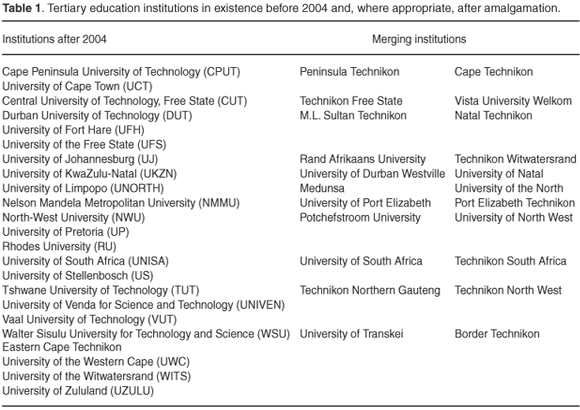
From 2004 onwards, the higher education sector in South Africa has been transformed through a series of mergers and incorporations that aim to 'rationalize' 36 universities and technikons into just 22 institutions (Table 1). Three types of public higher education institutions have thereby been created. These are identified as the so-called traditional universities, universities of technology, and the comprehensive universities. The Department of Education has stated that the purpose of restructuring is to establish institutions that address current national skills needs, equalizing student access, and sustaining growth in student numbers.
Following Pouris's similar analysis of the period 1984–88,2
We use the Higher Education Management Information System (HEMIS)7ª Numbers are compared with graduates qualifying jointly from all other faculties together (arts and humanities graduates, A&H). We categorize universities that educate similar numbers of A&H and SET graduates (ratio 1:1) as 'general universities'. Those that produce approximately twice as many A&H graduates as SET graduates are classed as 'arts & humanities' universities. Those where SET graduates are approximately double the A&H numbers are categorized as 'SET universities'.
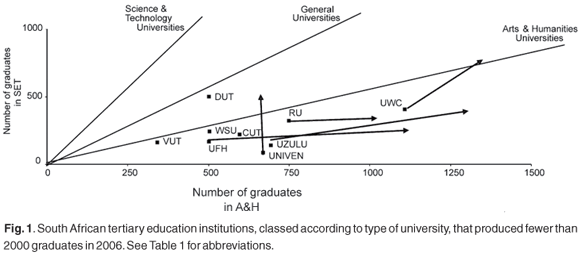
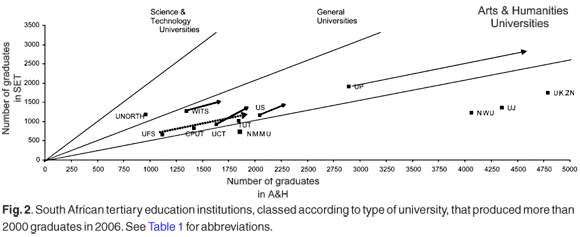
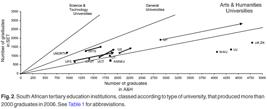
Figures 1 and 2 show the groupings of South African universities in terms of these criteria. Changes from 2000 to 2006 are given only for universities that did not merge with another institution, as these mergers radically change the reference base and skew comparisons. Institutions formed by mergers after 2004 have their status depicted as it was in 2006. The arrows in the figures indicate trends in graduating numbers over the period. The universities are styled as either 'small' (Fig. 1) or 'large' (Fig. 2). This grouping is to identify whether economies of scale (vis-à-vis funding mechanisms) appear to influence university performance. The figures indicate that South Africa had no 'technological' universities in the period 2000–06.
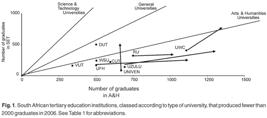
Of the nine institutions represented in Fig. 1, only the Durban University of Technology (DUT) ranks as a general university (SET, 496; A&H, 502). The University of Venda (UNIVEN) was conspicuous in growing its SET graduates in relation to arts graduates, but it remains an A&H university (SET, 443; A&H, 661). The universities of Zululand and of the Western Cape show a greater increase in the SET numbers in relation to A&H graduates (Zululand 148% and Western Cape 71% with respect to SET, compared with 88% and 20% for A&H, respectively).
The expansion of student numbers at universities that were not involved in amalgamations (Western Cape, Zululand, Rhodes, Venda, and Fort Hare) has been noteworthy. Their average growth in graduates from 2000 to 2006 was 61.3%, with the University of Fort Hare enjoying an exceptional 100%, from 669 qualifying in 2000 to 1340 in 2006. A similar trend is illustrated in Fig. 2, with most of the 'large' institutions being categorized as A&H. Exceptions are the University of the Witwatersrand (WITS) and University of Limpopo (UNORTH), which are ranked as general universities. Limpopo is unique in having a position to the SET side of the general university norm (SET, 1183; A&H, 960).
There has been a notable growth in graduate numbers at the University of Pretoria (UP): from 4807 in 2000 to 7423 in 2006, a rise of 54%. Numbers at the University of the Free State (UFS) grew even more, by 70% (from 1773 in 2000 to 3018 in 2006). Both institutions' A&H graduate numbers increased by more than those qualifying in SET subjects.
The overall character of our universities therefore remains similar to the 1988 situation reported in 1991. Most can be classed as predominantly A&H in nature. The general trend in the past two decades has been to train ever more arts and humanities graduates in relation to those completing SET courses.
Discussion
We postulate that an important factor influencing the observed growth in graduate numbers relates to university funding. While it can be, and is, argued that the secondary school system does not produce adequate numbers of matriculants qualified for science-related courses and that the science and engineering professions may not appear attractive to students, we suggest that, with a different kind of funding formula, some universities would have been able to change their character and become more effective as centres of technological education and training.
The funding framework introduced by government at the beginning of the 1980s led to changes in the graduate mix, as was reflected in the 1991 findings. That framework had the fundamental feature of treating prospective students as individuals with the freedom to select courses or institutions of their choice, guided by their perception of the needs of the labour market. Furthermore, government subsidies for universities and technikons were expected to be based on the actual costs of reasonably efficient institutions, and on decisions as to which of these costs were claimable from the state.
Intrinsic to the formula was the separation of courses into two broad categories: natural sciences (here embracing health sciences, engineering, life and physical sciences, agriculture, mathematical and computer sciences), and arts and humanities (all other disciplines). Funding formula coefficients were then derived for a student subsidy to the university, dependent upon whether this was for the humanities or the natural sciences. The relationship between these coefficients and student subsidies to universities was based on actual institutional costs, as well as on certain normative assumptions as to what optimized student-to-staff ratios and costs are to be expected in tertiary education institutions, given particular numbers and categories of students. The outcome was that universities received substantially more funding per student than the technikons. The assignment of monetary values to the various cost units was reviewed annually to allow for inflation, and other changes in the cost components.
The education white paper of 19978
The new funding framework9
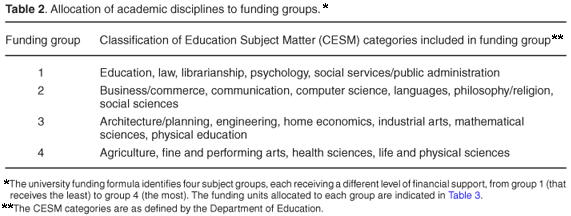
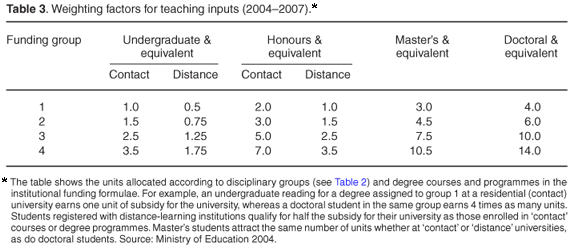
The teaching input grants are determined according to a funding grid. Table 2 shows the scientific disciplines that belong to each group. Students studying architecture/planning, engineering, home economics, industrial arts, mathematical sciences, or physical education belong to the same group and receive the same weights appearing in Table 3. The latter illustrates the current weightings and indicates, for example, that a university receives for an undergraduate in funding group 1 one unit of subsidy whereas for an enrolled student in funding group 3 it receives 2.5 units.
We conclude that both funding mechanisms have failed to steer our universities in a more desirable direction in terms of the supply of skills needed by the country. We regard it necessary for the Department of Education to re-examine the current university funding formulae, and amend the relevant coefficients. However, more than amending the relative weightings is necessary to bring about the desired changes. Making marginal alterations only to the weighting factors is likely to be ineffective, as universities could lose more money from the A&H student subsidy than they earn from enrolling SET students. Thus, if currently a university has three times more A&H students than enrollments in SET it will have to receive three units of subsidy extra for SET for the loss of one unit of A&H in the funding formula.
The costs of educating science and engineering students vary considerably from one university to another. Moreover, the 1980s formula estimated that university costs were three times higher overall than technikon costs. Economies of scale in each discipline have also played an important role in the past, and probably still exert their influence today. Altering the relevant coefficients in a simplistic way across the board could have more adverse than beneficial effects on universities that take on SET students.
We consider that the Department of Education should adopt a two-pronged approach if it wishes to exert a more constructive influence and increase the numbers of students in different scientific disciplines graduating from our universities. The first prong is to negotiate with selected institutions that are prepared to meet specified graduate targets in the priority disciplines (such as engineering). Additional resources should be provided to these institutions after deciding on mutually agreed targets. The second prong is to introduce coefficients that support the priority disciplines in all aspects of the funding formula (for example, as they affect institutional factors and research outputs). Such a policy will send a clear message to our universities that the government is interested in encouraging graduates in particular disciplines; it will impact upon a larger component of the formula and will influence all aspects of the university system. For example, differential subsidies for research publications according to topic could facilitate the establishment of research posts in particular disciplines.
References
- 1. Pouris A. (2007). The international performance of the South African academic institutions: A citation assessment. Higher Education 54, 501–509
- 2. Pouris A. (1991). Where are our universities going? S. Afr. J. Sci. 87, 218.
-
3. Times Higher Education Supplement (2005). Online at: www.thes.co.uk
» www.thes.co.uk -
4. US News (2006). America's best colleges. Online at: www.usnews.com/usnews/issue/home.htm
» www.usnews.com/usnews/issue/home.htm - 5. OECD (2007). Review of South Africa's Innovation Policy. Organization for Economic Cooperation and Development, Paris
- 6. Steyn W. G. A. and De Villiers P.A. (2007). Public funding of higher education in South Africa by means of formulae. Council for Higher Education, Pretoria.
-
7. Higher Education Management and Information System: Directorate documents (2007). Online at: www.education.gov.za/dynamic/dynamic.aspx?pageid=326& drid=14
» www.education.gov.za/dynamic/dynamic.aspx?pageid=326& drid=14 - 8. Department of Education (1997). Education White Paper 3: A Programme for the Transformation of Higher Education. General Notice 1196 of 1997. Pretoria.
- 9. Ministry of Education (2004). Statement on higher education funding 2004/05 to 2006/07, Pretoria.
a The SET disciplines include: agriculture and renewable natural resources; architecture and environmental design; computer science and data processing; engineering and engineering technology; health care and health sciences; home economics; industrial arts, trades and technology; life sciences and physical sciences; mathematical sciences; military sciences