Truthful answers to tough South African questions
Gillian Rennie
Retired Researcher, Port Alfred, South Africa. Email:
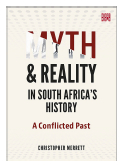
Book Title: Myth & Reality in South Africa's History: A Conflicted Past
Author: Christopher Merrett
ISBN: 9781928246695 (paperback, 256pp)
Publisher: Best Red, Cape Town; ZAR495
Published: 2025
There is a sense, when opening Christopher Merrett's Myth & Reality in South Africa's History, that he has handed you dominion over this country's notoriously fractious recent decades. The table of contents reaches from Bishop Colenso, moves swiftly through the 1950s to the 1960s ("possibly the most desolate decade"), 1970s, 1980s and then 1990s, before swelling into the 21st century with 33 essays. Merrett's incisive and thoughtful analysis crosses 20+ years of national turmoil and, too often for comfort, national shame.
The 79 chapters making up the book's six sections are drawn from Merrett's columns in The Witness, a KwaZulu-Natal daily newspaper. His distinctive line of expressive analysis began as a side-career but quickly blossomed into a vital editorial intervention.
Previously named The Natal Witness, the title's tenaciously independent ownership until 2000 attracted writers with a corresponding intellectual independence. Christopher Merrett, being one such contributor, has surveyed his country's history (often as it happened), lived through most of the contents of this book, participated in much of it, and then wrote what he observed and thought.
The sum of these parts delivers a body of work featuring attention to detail in league with articulate elegance. Like all good journalism, this book debunks, explains, contextualises, reminds, declaims and persuades. Merrett does not pursue the predictable trope of pulling on a thread to see where it takes him. Rather, with fastidious accuracy, he excavates specific threads to show us the place of each one in the great South African tapestry, and how each thread has come to bind our social order, to harness us to history, to throttle our futures.
KwaZulu-Natal and, in particular, Pietermaritzburg, are front and centre of the Merrett viewfinder - hardly surprising considering his many decades there. But his range is widely national and, when appropriate, international, so that Pietermaritzburg becomes more the focaliser for a bigger picture than a parochial teacup in which to locate a few storms. In this, Merrett's essays exemplify everything The Natal Witness brought to South African newspapering: working on the margins required diligence and thoughtfulness; turning news from the margins into something that mattered took pluck and eloquence.
In recognising the value of the micro view to the macro picture, it is worth noting that Pietermaritzburg has been Merrett's home - personally, professionally, politically and practically, and he still lives there - as well as home to Alan Paton, the Liberal Party and multiracial cricket. For South Africa, Pietermaritzburg has been one of its crucibles, the site of a bloody "dirty war". His far-ranging purview also includes the Unity Movement, the Liberal Party, industrial action, Black Consciousness, cricket and the United Democratic Front. Merrett writes about all these topics in such measured and insightful ways that the reader emerges with fresh illumination to light a new way of being South African now.
The eponymous conflict delineated so successfully by this book is an important one and familiar to thoughtful historians who wrestle with it in the interests of accuracy and balance. As he writes towards the book's close, mythologising "can, and usually does, lead to all manner of misunderstandings and ahistoricism". South Africa's history abounds with myth. Merrett sets about, column after column, demythologising. It is meticulous and ominous work - up to and including his closing episodes filled with dire darkness that even include a reference to the 1930s in Germany. "We live in increasingly dangerous times", he wrote in 2008 as Zuma cast long shadows across the land. Almost 20 years have passed, but he could be writing now.
Perhaps the most spirited parsing of the myth vs reality conflict is the 2004 column examining the responses of Gary Player and Helen Suzman to illegitimate power. And Merrett is particularly strong in drawing uncompromising comparisons: Navalny and Biko, South Africa and Russia, two books on Luthuli and Buthelezi, the fires of the Reichstag in 1933 and SA Parliament in 2022, New Age and New Age. He also excels at exposing "blatant, ahistoric nonsense" by opposing accepted myth - such as which South Africans play rugby - with reality (aka sanity).
Most chapters end with suggestions for further reading, offering the analogue equivalent of Internet rabbit holes. The lists are not intimidatingly exhaustive, and they exclude recent titles (Jonny Steinberg's portrait of the Mandela marriage1
In his opening essay that offers an overview of South Africa's modern history, Merrett frames the pivotal questions that motivate his writing: What is South Africa? Who is a South African? Answering takes unflinching honesty and the reminder, which is a great gift of Myth & Reality, that history is the eternal now as well as our future.
Occasionally, Merrett's texts dabble in time travel. The Witness published 'Street renaming and the airbrushing of history' in 2003, but the 2026 round of name changes makes this 23-year-old column still fresh, still apposite. Graaff-Reinet, for instance, has now been renamed Robert Sobukwe, so that the columnist's plea for more reminders of the illustrious leader's name is somewhat satisfied. More gravely, the 2025 judgment in the reopened inquest into Chief Albert Luthuli's death ruled that Luthuli died as a result of circumstances associated with an assault - a finding which significantly re-angles Merrett's original 2013 column.
Merrett tells us that Bishop Colenso's "meticulous" collection and reading of documents was a "key factor in establishing the truth and countering government propaganda". With his characteristic eye for echo, Merrett likens the brave bishop's excommunication from the church - in a rigged trial arranged by opponents - to the treason trials of apartheid years. Colenso, he writes, was "unafraid to confront the powerful with uncomfortable truth". With these columns, assembled here in meaningful sequence, Christopher Merrett does precisely that, too.
"No one can afford to ignore the past", he declares. This book now assists us in that project.