Yesterday, today and tomorrow: A snapshot of our journal
2024 is a landmark year for South Africa, South African science, and for our journal. South Africa is now 30 years into our democracy, and this marks an important opportunity for reflection on the achievements and the disappointments of the past 30 years. As far as science is concerned, there is little doubt that there is greater visibility of South African science than there was 30 years ago, with some of the leadership associated with research related to COVID-19, built on the infrastructure of existing HIV-related research and expertise.
It is also true that among our generation of emerging researchers, many are now 'born frees', born into a hopeful and complex democracy and now tasked with taking research forward into South Africa's future and into that of our continent and planet. This is a time for reflection on how far we have come in the transformation of science and the application of science to think about and solve pressing problems. We South Africans are publishing more, but are we doing better science? There are many initiatives looking critically at schemes to incentivise higher publication and many people are concerned with this question. And the strong need we held for a larger and more diverse pipeline of very well qualified young people entering universities also needs, and is gaining, attention, as huge inequities in our education system persist and appear to widen. What went right, and what went wrong?
We hope that readers of our journal will submit for possible publication their reflections on the achievements and challenges of the past 30 years. Later this year, in addition, we will be publishing a special issue to reflect on the 120-year history of the South African Journal of Science. Against the backdrop of this 120-year history, it is important and instructive to reflect on the extent to which there are continuities and discontinuities in our long history. What do we have to build on and to celebrate, and what, given the wisdom of hindsight, would we, and should we, have done differently?
It is in the nature of good scientific practice to take stock of research traditions and to make an assessment of how we as a scientific community are faring. Given that part of the vision of our journal is to "inform policymakers and the public", it is also important that we encourage debate on contemporary issues. Challenges with service delivery have been described as 'crises' since the early days of our democracy, and are certainly in the news currently in this election year. For this reason, we have opened a call for commentaries for a discussion series on service delivery, and we hope to feature analyses and proposed solutions to a range of challenges from a range of disciplines and interdisciplinary teams and groups. We hope that the discussion series will be of use and interest not just to researchers, but also to those tasked with taking very practical and pressing challenges forward.
In the spirit of looking back, and looking forward, it is noteworthy that a new opportunity and challenge for our journal, for all journals, and for the academic community as a whole, is the challenge posed by developments in artificial intelligence (AI) and large language models (LLMs). We ran what we have found to be a very helpful commentary on this topic in a recent issue, and after a period of consultation, we have recently published our AI and LLM policy. We anticipate (and, indeed, we hope) that there will be some contestation and discussion about this policy. As with all our policies, this policy will be subject to change and refinement. Nobody can precisely predict the future of academic publishing in the environment of rapid changes with AI and LLMs, and we want to work together with our readers and contributors to do the best we can to keep up. Please continue to help us.
On the topic of how well we are doing, since 2022, we have been reporting briefly on some of the trends we have observed in the life of the journal year by year. In 2023, a total of 420 original research and review articles were submitted to the journal - 38% of these submissions were from South Africa, and 23% were from elsewhere on the continent. We published 57 peer-reviewed articles across the six issues published in 2023. About 61% of the published authors were from South Africa, with 23% from the rest of Africa - an increase on last year's 15%. Although the focus of our journal has historically been on South Africa, we now take a more broadly continental view as we are an inextricable part of Africa. This said, we state clearly in our mission statement that we will consider submissions from other African countries only if they show relevance or application beyond a single country to broader issues facing the continent. Our very high desk rejection rate (81%) is to an extent fuelled by submissions from other African countries but of relevance only to those countries (many excellent but very locally focused African papers form part of the 26% of desk rejected papers which are submitted from other African countries). Distressingly, almost half of our desk rejections (46%) are for submissions of varying quality from authors outside of Africa and on topics which do not have an African focus, with these authors effectively wasting their own time and resources in submitting to our journal. At the same time, this high figure of 46% of desk rejections should encourage African and South African authors, as the desk rejection rate falls by almost half when only African and South African authors are considered.
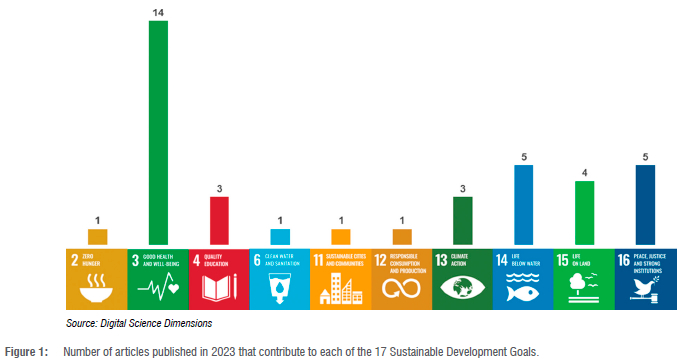
Our commitment to multidisciplinarity and to research relevant to contemporary African questions is reflected in Figure 1. The articles published in 2023 fall within 22 research categories, as classified by Dimensions, and contributed to 10 of the 17 Sustainable Development Goals.
In terms of the reach of the journal, we have a small but growing social media presence, which is focused on promoting published content and increasing its visibility and reach across a wider readership. We encourage readers to follow us on X [Twitter], Facebook, LinkedIn and Instagram and to engage with us through these platforms. Media reports on articles published in the journal can be viewed on our website here. In 2023, there were 92 media mentions of published articles, with a global online reach of 3.5 million. We are acutely aware of the need to balance the accessibility and reach of the journal with rigour and scientific quality, and our rigorous peer review and expert reader processes assist us in this regard. It remains the case, though, with our journal and anecdotally with what we believe to be the majority of other academic journals, that speedy, high-quality, peer review is a challenge.
In 2023, it took on average 10 months from submission of a manuscript to final decision (this excludes revision rounds). In common with our authors, we would wish this time were much shorter - the time delays are a source of frustration to all. In 2023, in order to find two reviewers for each submitted article, we had to approach on average seven reviewers. In 2023, we approached 736 reviewers, of whom 201 completed a peer review and 5 completed two or more peer reviews. The average time to accept a review invitation was 17 days. A large number of reviewers do not respond, and a proportion of those who do agree to review do not complete their reviews. Our journal is certainly not alone in experiencing frustration and difficulties around peer review, and this makes us all the more grateful to those who do complete reviews, or, if unable to review, tell us so promptly and suggest alternatives. Our associate editors with their mentees, and our peer reviewers, are absolutely central to the vitality and health of our journal, and we thank them all (a list of those who reviewed for us in 2023 can be found here; current associate editors and mentees are listed at https://sajs.co.za/about/editorialTeam).
At the South African Journal of Science, we work as a close team, and any success of the journal owes a great deal to teamwork and to the support of the Academy of Science of South Africa. As always, we want to do better as a journal, and we welcome constructive and helpful feedback.