Food-based dietary guidelines in Africa and their inclusivity of plant-based dietary patterns
Abstract
Food-based dietary guidelines (FBDGs) are powerful country-level policies that can guide healthy diets from sustainable food systems. They are associated with several Sustainable Development Goals (SDGs), particularly SDG 2 (zero hunger), SDG 3 (good health and well-being) and SDG 13 (climate action). However, most FBDGs still favour animal-based food consumption despite increasing global adoption of plant-based dietary patterns to meet health and climate targets. Our objectives were to review the extent of African FBDGs and to analyse their inclusivity of plant-based dietary patterns. A state-of-the-art literature review was conducted, including qualitative analysis and quantitative scoring using the Balanced Food Choice Index system. We found that 12 African countries had FBDGs, although these contained less information about plant-based dietary patterns than the global average. The most balanced guidelines were from South Africa, Namibia, Benin, Gabon and Zambia. One-quarter of FBDGs in Africa refer to the sustainability of plant-based foods or dietary patterns. However, there was a significant lack of awareness of some forms of plant-based diets, with only two FBDGs discussing vegetarian diets. Five African dietary guidelines included plant-based alternatives to meat, milk or dairy. Future African FBDGs are encouraged to be inclusive of plant-based dietary choices and balance the various health, economic, environmental and ethical aspects that play a role in people's food choices. SIGNIFICANCE: • We reviewed food-based dietary guidelines (FBDGs) in Africa, finding a considerable shortfall in official recommendations for the broad spectrum of plant-based diets. Only 12 African countries have FBDGs, representing one-quarter of the Food and Agriculture Organization (FaO) member countries from Africa. • According to our analysis, sustainability is included in one-quarter of African guidelines, because they explain the environmental benefits of plant-based foods or dietary patterns. Two guidelines discuss vegetarian diets, and five guidelines include plant-based alternatives to meat, milk or dairy.
nutrition policy; plant-based diet; dietary guidelines; Africa; Sustainable Development Goals
Introduction
Food-based dietary guidelines (FBDGs) can become crucial to fostering sustainable food systems.123
Sustainability in food-based dietary guidelines
A sustainable food system ensures food security and nutrition for all by offering access to affordable, culturally acceptable, equitable and safe sustainable diets.445
FBDG policies have significance in transforming food systems and shaping dietary patterns by including recommendations for adopting sustainable diets.6,787
Global food systems are a leading driver of climate change, responsible for about one-third of global greenhouse gas emissions.889 6,7,10
Plant-based dietary patterns, including vegetarian and vegan, vary in the extent to which they exclude animal products.11111111
State of nutrition in Africa
A small proportion of African countries have country-level FBDGs. In 2022, only seven countries had government recommendations for healthy diets in the form of an FbDG policy, and none of these FBDGs had integrated concepts of sustainability.12
The African continent, home to over 1.2 billion people, faces a profound nutrition crisis with rising hunger, food insecurity and undernutrition, all indicators of SDG 2.13131313
There is a 'double burden' of malnutrition in Africa, where coexisting patterns of under- and overnutrition drive increasing rates of overweight and obesity and the risk factors for developing non-communicable diseases (NCDs).141617 181919
The growing burden of diet-related NCDs is explained by nutrition transitions resulting from rapid urbanisation and economic development across Africa.13,16,192119201313
Preserving traditional plant-forward dietary patterns and avoiding shifts towards Western diets are crucial for sustainable and just food systems in Africa.2223 24
In this review, we aimed to determine the inclusivity of plant-based dietary patterns in African FBDGs. The objectives were to (1) review the extent of African FBDGs and (2) analyse their content using the Balanced Food Choice Index (BFCI) scoring system, a tool used to index countries' FBDGs for their inclusion of basic principles promoting healthy and sustainable plant-based dietary choices.10
Methods
The study design was a state-of-the-art literature review2525
The protocol for our review and analysis of publicly available FBDG documents was cleared by the North-West University Health Research Ethics Committee (NWU-00075-24-A1). Our team included researchers based in South Africa, Germany and Nigeria. African FBDGs were collected between January and March 2024. The FAO online repository for FBDGs2627
We chose to use the 47 African FAO member countries.272812 26
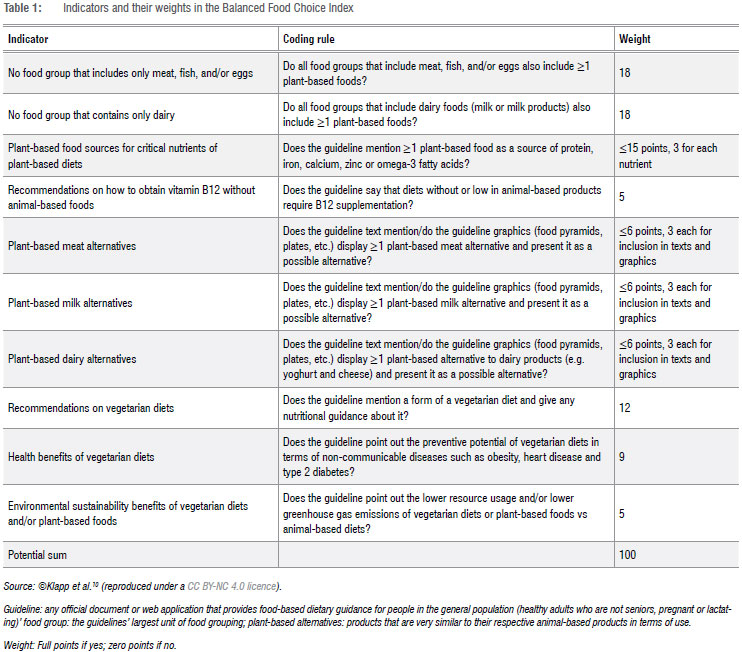
The data extraction and analysis of the FBDG documents were guided by the BFCI scoring system. The FBDGs were collected and studied, and qualitative data were extracted according to the BFCI indicators to allocate points to their score. Points were allocated for inclusive food groups, plant food sources of nutrients, a position on vegetarian diets, recommendations for plant-based alternatives, and associated health and sustainability aspects. This system was applied in a global analysis by Klapp et al.10Table 1. Four blinded researchers scored the FBDG documents and discussed their results to form a consensus for each country's score. A summary of updated scores for African FBDGs using the BFCI tool between 2022 and 2024 is provided in the supplementary material.
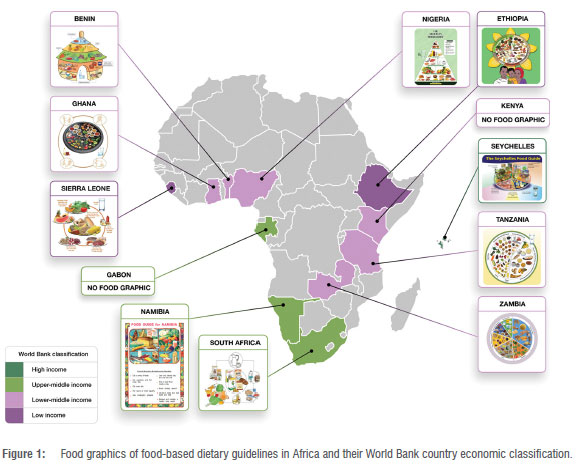
A map of food graphics from food-based dietary guidelines in Africa and their World Bank country economic classification was created, inspired by the analysis by Kraak et al.29Figure 1).
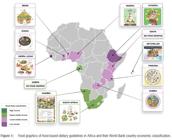
A colour key was added which corresponds to The World Bank Group30 13,1931
Results
Extent of dietary guidelines in Africa
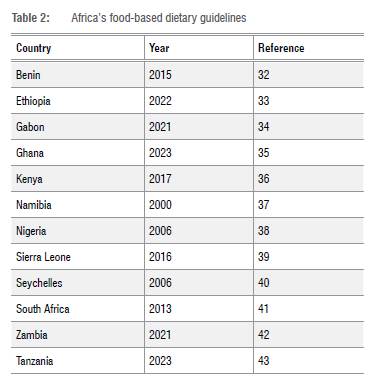
Twelve African countries had FBDGs: Benin323334353637383940414243Table 2). These countries represent only one-quarter of FAO member countries from Africa. Figure 1 shows the food graphics of FBDGs in Africa with their World Bank economic classification. Countries' economic classification varied, but the majority (50%) of the African countries with FBDGs were lower-middle-income countries. Almost half (42%) of these guidelines were recently published, between 2020 and 2024; two were translated from French (Benin3234
Balanced Food Choice Index for African dietary guidelines
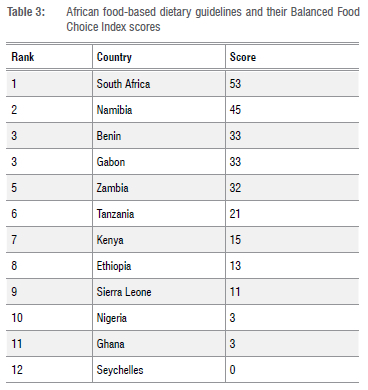
Balanced FBDGs are guidelines that include food choices across ethical, ecological, religious and economic aspects and, therefore, cover accurate information for the broad spectrum of plant-based diets.10Table 3 shows the BFCI scores for FBDGs in Africa according to our analysis and a summative table of the individual indicator scores per country is included in the supplementary material. The average BFCI score was 21.83 out of 100 points, compared with a global average of 33.58.10
With 53 points, South Africa had the most balanced guideline among African countries. This score was because of the mention of plant food sources of five critical nutrients (protein, iron, calcium, zinc, omega-3 fatty acids) and vitamin B12 recommendations. South Africa's guidelines had a position on vegetarian diets that highlighted several associated health benefits.41
Namibia, Benin, Gabon and Zambia had relatively high scores. However, these countries lacked information on vitamin B12 supply in the spectrum of plant-based diets. Seychelles was in last place with zero points, indicating a considerable lack of information regarding healthy and sustainable food choices.
Factors contributing to the BFCI score are discussed in the following subsections in decreasing order of weight (as shown in Table 1).
Inclusive food groups
Inclusive food groups contribute the most points to the BFCI scoring system, and exclusive animal-product-only meat and dairy groups are allocated no points. Three countries (Benin, Namibia and Gabon) received points for inclusive meat and dairy groups, meaning that they list animal- and plant-based foods together in one food group. Namibia's FBDG recommended "eat[ing] beans or meat regularly".3732
The Tanzanian FBDG documents replaced an inclusive food group with an exclusive one. Previous Tanzanian policies grouped proteins into a "pulses, nuts and animal-source food" group.4343
Recommendations for vegetarian diets
Dietary guidelines received 12 points for providing recommendations on vegetarian diets. Among the 12 African FBDGs analysed, the word "vegetarian" only appears in those of two countries: South Africa and Zambia.41,42
South Africa's guidelines provided a comprehensive position on vegetarian diets, recommending a vegetarian meal at least once a week. The quoted paragraph covers many aspects of information contributing to South Africa's overall highest score:
People choose to follow a vegetarian diet for a variety of reasons. Well-planned vegetarian diets can be both nutritious and healthy. These have been associated with a lower risk of heart disease, type 2 diabetes, obesity and certain types of cancer, and lower blood cholesterol levels. However, restrictive or unbalanced vegetarian diets may lead to nutritional deficiencies, particularly in situations of high metabolic demand. The nutrients of major concern in a vegetarian diet are protein, iron, calcium, vitamin B12 and n-3 fatty acids. 41
Zambia's guidelines provided nutrient recommendations for vegetarian diets but had no comprehensive position on these diets.
For vegetarians and those who are not eating fish, insects and [animal-source foods], taking two servings of pulses, nuts and seeds will ensure an adequate intake of proteins and other micronutrients that fish, insects and [animal-source foods] provide.42
Health benefits of vegetarian diets
A dietary guideline received nine points for mentioning the health benefits of vegetarian diets. As described, "vegetarian" diets were rarely referred to in African guidelines. Only South Africa's guidelines met the criterion of describing the health benefits associated with vegetarian diets, including lowered blood cholesterol and protection against NCDs such as "heart disease, type 2 diabetes, obesity and certain types of cancer"41
The Zambian guideline described the health benefits associated with plant-forward diets. The scoring system did not allocate points for the information found in the Zambian FBDG, because there was no reference to vegetarian diets. However, one paragraph raises awareness of the NCD-protective benefits of plant-forward diets:
There is increasing evidence of the health benefits of plants (grains, legumes, nuts and a variety of fruits and vegetables) on human health ... Reducing the intake of red meats and processed meats like bacon, ham, sausages and burgers, and replacing these with healthier plant-based food options, insects and fish helps to reduce the risk of obesity and associated [non-communicable diseases] such as heart disease, diabetes and cancer.42
Environmental sustainability
Three African countries met the criteria for including the sustainability benefits of vegetarian diets or plant-based foods. The Zambian FBDG demonstrated a comprehensive statement on sustainability, mentioning a range of environmental parameters such as greenhouse gas emissions, land and water requirements, deforestation and soil health:
Eating a diet predominantly based on whole grains, legumes, fruits and vegetables, fish and insects is not only good for our health, but it is good for planetary health too. Growing whole grains, legumes, fruit and vegetables, and producing fish and insects does not produce as much greenhouse gas as raising cattle or large livestock. Raising livestock produces 14.5 percent of all greenhouse gas emissions, with cattle (raised for both beef and milk, as well as for inedible outputs like manure and draft power) contributing 65 percent of the livestock sector's emissions. Whole grains, pulses, fruits and vegetables, insects and fish also help reduce waste and lower pollution. Such a dietary pattern also reduces water and land use, slows deforestation and reduces the destruction of topsoil, among other benefits. 42
Guidelines from Sierra Leone and Ethiopia received points for underscoring the role of beans, pulses and legumes in sustainable food systems and promoting protein diversification.
[Pulses and legumes] have important nitrogen-fixing qualities needed for enhancing soil fertility, hence they have a positive impact on the sustainable environment in the context of the changing climatic conditions.39
Food system transformation processes that target improving diet quality must consider actions needed to increase production diversification, must include production and productivity of legume crops.33
Nutrient recommendations
The literature often describes five critical nutrients that require special attention in a predominantly plant-based diet: protein, iron, calcium, zinc and omega-3 fatty acids. The BFCI awards three points for each nutrient if a guideline mentions plant-based foods that can provide these nutrients. More points are allocated for sourcing vitamin B12 (five points) recommendations for people who consume few or no animal products in the form of fortified foods and supplements.
Only two (17%) guidelines recommended sourcing vitamin B12 when animal products are excluded. Zambia's guidelines highlight the risk of vitamin B12 deficiency when omitting animal products from the diet.
All vitamin B12 requirements must be met from animal sources of food or from supplementation, as there is virtually no vitamin B12 in plant food sources. 41
Vitamin B12 is mainly found in fish, poultry meat and dairy products. Not consuming ASF [animal-source foods] can lead to vitamin B12 deficiency.42
Plant proteins were found in most (83%) African dietary guidelines. The Ghanaian FBDG recognised plant-based protein as an adequate, healthy and affordable alternative to animal protein.
Eat a variety of beans, nuts and legume seeds every day as part of a healthy diet. Beans, nuts and legumes are an important source of protein and nutrients from plant foods. Food from this group is a particularly important substitute for animal protein, since they are cheaper than animal sources for protein and micronutrients. 35
Three-quarters (75%) of African guidelines covered plant-food sources of iron. Several countries expressed concerns about the absorption and bioavailability of plant-based iron. Some guidelines provided recommendations for increasing bioavailability by combining plant-based sources of iron with vitamin-C-rich fruit and vegetables.
Citrus fruit, e.g. grapefruits and lime are also available as well as fresh tomatoes all of which are high in vitamin C, and when eaten with foods containing iron will enhance the absorption of the iron e.g. spinach, okra, etc... It is important to recognize that iron from animal-based foods, commonly known as heme iron are better absorbed compared to plant based iron i.e. non-heme iron. 39
Half (50%) of the guidelines presented plant food sources of calcium. FBDGs often position cow's milk as the superior source of calcium in a diet, which is the case in the South Africa guidelines:
The inclusion of milk (especially calcium and potassium) in the diet is essential in order to meet the nutrient needs of most South Africa. Adequate calcium intake is difficult to achieve with dairy free diets, even when other nutrient recommendations are met. 41
However, there are many sources of calcium among plant foods, as demonstrated in the Zambian guideline:
If milk is not available, eat calcium-rich foods such as moringa, amaranthus, cowpeas leaves, cassava leaves, baobab fruit or leaves, tamarind leaves. 42
Plant food sources of zinc were found in only one-third (33%) of guidelines, and Zambia's guidelines highlighted the risks of zinc bioavailability.42
Zinc is mainly found in animal protein sources such as meat, and is also more easily absorbed and used from animal protein sources than plant sources. 42
Plant food sources of omega-3 fatty acids were mentioned the least in African FBDGs, at 25%. Risks associated with vegetarian diets and lower omega-3 fatty acids are mentioned in two guidelines (the South African and Zambian):
With regard to fatty acids, the body has the ability to convert some ALA [alpha-linolenic acid] into the n-3 [omega-3] PUFAs [polyunsaturated fatty acids], EPA [eicosapentaenoic acid] and DHA [docosahexaenoic acid], yet this conversion isn't very efficient. If no fish is consumed, a supplement of DHA [docosahexaenoic acid] should be considered.41
DHA [docosahexaenoic acid] is an essential omega-3 fat found in fatty fish. It is important for brain health and is difficult to get from plant sources.42
Plant-based alternatives
The BFCI awards points for FBDGs that mention plant-based alternatives to meat, milk or dairy in the text or the food graphic.
Plant-based alternatives to cow's milk were mentioned in four African guidelines (those of Benin3234434243
Alternate between skimmed dairy products (milk, yoghurt) and cow's milk substitutes (sole, white beans, soya, sesame) during the week. 34
Treatment [of cow's milk allergy] consists of total avoidance of exposure to the allergens through elimination diets, and replacing cow's milk with soy or rice milk.41
Use of coconut milk in moderation; not more than one-third of a cup per person per day. 43
Plant-based meat was also mentioned in four FBDGs (Kenya36324134
Many soy foods, such as soy beans, soy nuts, soy flour, textured soy protein and tempeh, are rich in fibre. However, isolated soy protein does not include dietary fibre. 4
Supper: Stewed matoke, soya meat, steamed amaranth, melon slice...36
Discussion
We have presented a review and analysis of FBDGs in Africa. Objective one was to review the extent of FBDGs in Africa, revealing a concerningly low proportion of country-level guidelines on the continent. Only 12 out of the 47 African member countries of the FAO had FBDGs, leading to a significant gap in access to official information on what constitutes healthy diets across Africa. This should prompt urgent coordination from national governments and regional FAO groups to develop FBDGs in African countries and review outdated policies against the latest scientific evidence.
It is challenging to access up-to-date FBDG documents from countries around the world. Information on the latest documents and processes is usually limited to the country level, and it is uncertain when the FAO repository was last updated. The literature does indicate the development of newer FBDGs in African countries, with Tanzanian guidelines citing development in Zimbabwe, Rwanda, Eswatini, Gambia and Botswana.43
Objective two was to analyse African guidelines for their inclusivity of basic information on plant-based dietary patterns. This is relevant because many people in Africa limit animal-source foods for economic, health, environmental, religious or ethical reasons.8,13,4410104137323442
The greatest opportunity for FBDGs to achieve a high BFCI score is with inclusive food groups combining animal and plant proteins, as found in Namibia373234103335haricot blanc, soja, sesame)34, to Zambia's plant food sources of calcium, "moringa, amaranthus, cowpeas leaves, cassava leaves, baobab fruit or leaves, tamarind leaves".42
In terms of nutrient recommendations, the African guidelines commonly presented plant-based food options for protein and iron. This was a strength across the FBDGs in Africa. There were fewer recommendations for calcium, zinc and omega-3 fatty acids, and rarely for vitamin B12 supplementation. These are all important to address as foundational concepts of plant-based nutrition.10,11
Many of the African guidelines criticise the bioavailability of nutrients found in plant foods. Few discuss how to effectively increase the bioavailability of nutrients. For example, plant-based food sources of iron can be combined with vitamin-Crich fruit and vegetables as a practical strategy to prevent iron deficiencies.454647 48
Milk alternatives should be incorporated into African dietary guidelines, as an estimated 70% of the global population experiences challenges in fully digesting lactose, with higher prevalence among black and Indigenous communities as well as low- and middle-income countries.49,104943501051
Our results show that more African FBDGs are incorporating aspects of sustainability, compared with a 2022 review12422952,5354 55
FBDGs in Africa largely miss the opportunity to promote the health benefits of plant-based dietary patterns. The NCD-protective benefit of plant-based dietary patterns was only explained in the FBDGs from South Africa414256
Conclusion
Africa needs more FBDGs to promote healthy diets from sustainable food systems. These FBDGs should be inclusive of plant-based dietary patterns and provide information for people who choose to eat plant-forward diets for health, environmental, religious or ethical reasons, or out of necessity because of food insecurity and lack of access to animal-source foods.
Funding
We acknowledge funding from ProVeg Grants (Jul2023-0000001842).
Data availability
The data supporting the results of this study are available upon request to the corresponding author.
Declarations
We have no competing interests to declare. We have no AI or LLM use to declare. The protocol for a review and analysis of publicly available FBDG documents was cleared by the North-West University Health Research Ethics Committee (NWU-00075-24-A1).
Authors' contributions
N.W.: Conceptualisation, methodology, data collection, sample analysis, data analysis, data curation, writing - the original draft, writing -revisions, project leadership, project management, funding acquisition. A-L.K.: Conceptualisation, methodology, data collection, sample analysis, data analysis, data curation, writing - the original draft, writing -revisions, funding acquisition. P.N.: Data collection, sample analysis, data analysis, writing - the original draft, project management. M.U.: Data collection, sample analysis, data analysis, writing - the original draft. C.N.: Methodology, validation. All authors read and approved the final manuscript.
Acknowledgements
We thank Raz Arnold Design for their design contributions.
References
-
1. United Nations Food and Agriculture Organization (FAO). Food systems-based dietary guidelines: An overview. Rome: FAO; 2024. https://openknowledge.fao.org/handle/20.500.14283/cc9394en
» https://openknowledge.fao.org/handle/20.500.14283/cc9394en -
2. United Nations Food and Agriculture Organization (FAO). Food-based dietary guidelines: Background [webpage on the Internet]. No date [cited 2024 Jun 24]. Available from: https://www.fao.org/nutrition/education/food-dietary-guidelines/background/en/
» https://www.fao.org/nutrition/education/food-dietary-guidelines/background/en/ -
3. World Health Organization (WHO). Preparation and use of food-based dietary guidelines. Geneva: WHO; 1996. Available from: https://www.fao.org/4/x0243e/x0243e00.htm
» https://www.fao.org/4/x0243e/x0243e00.htm -
4. United Nations Food and Agriculture Organization (FAO). Sustainable diets and biodiversity: Directions and solutions for policy, research and action. Rome: FAO; 2010. Available from: https://www.fao.org/4/i3004e/i3004e00.htm
» https://www.fao.org/4/i3004e/i3004e00.htm -
5. Grosso G, Mateo A, Rangelov N, Buzeti T, Birt C. Nutrition in the context of the Sustainable Development Goals. Eur J Public Health. 2020;30(1):119-123. https://doi.org/10.1093/eurpub/ckaa034
» https://doi.org/10.1093/eurpub/ckaa034 -
6. James-Martin G, Baird DL, Hendrie GA, Bogard J, Anastasiou K, Brooker PG, et al. Environmental sustainability in national food-based dietary guidelines: A global review. Lancet Planet Health. 2022;6(12):977-986. https://doi.org/10.1016/S2542-5196(22)00246-7
» https://doi.org/10.1016/S2542-5196(22)00246-7 -
7. Springmann M, Spajic L, Clark MA, Poore J, Herforth A, Webb P, et al. The healthiness and sustainability of national and global food based dietary guidelines: Modelling study. BMJ. 2020;370, Art. #2322. https://doi.org/10.1136/bmj.m2322
» https://doi.org/10.1136/bmj.m2322 -
8. Intergovernmental Panel on Climate Change (IPCC). Summary for policymakers. In: Climate change and land: An IPCC special report on climate change, desertification, land degradation, sustainable land management, food security, and greenhouse gas fluxes in terrestrial ecosystems. Cambridge: Cambridge University Press; 2022. p. 1-36. https://doi.org/10.1017/9781009157988.001
» https://doi.org/10.1017/9781009157988.001 -
9. United Nations Food and Agriculture Organization (FAO) and World Health Organization (WHO). Sustainable healthy diets: Guiding principles. Rome: FAO/WHO; 2019. Available from: https://www.who.int/publications/i/item/9789241516648
» https://www.who.int/publications/i/item/9789241516648 -
10. Klapp AL, Feil N, Risius A. A global analysis of national dietary guidelines on plant-based diets and substitutions for animal-based foods. Curr Dev Nutr. 2022;6(11), Art. #144. https://doi.org/10.1093/cdn/nzac144
» https://doi.org/10.1093/cdn/nzac144 -
11. Tuso PJ, Ismail MH, Ha BP Bartolotto C. Nutritional update for physicians: Plant-based diets. Perm J. 2013;17(2): 61-66. https://doi.org/10.7812/TPP/12-085
» https://doi.org/10.7812/TPP/12-085 -
12. Ainuson-Quampah J, Amuna N, Holdsworth M, Aryeetey R. A review of food-based dietary guidelines in Africa: Opportunities to enhance the healthiness and environmental sustainability of population diets. Afr J Food Agric Nutr Dev. 2022;22(2):19471-19495. https://doi.org/10.18697/ajfand.107.21790
» https://doi.org/10.18697/ajfand.107.21790 -
13. FAO, IFAD, UNICEF, WFP WHO. The state of food security and nutrition in the world: Urbanization, agrifood systems transformation and healthy diets across the rural-urban continuum. Rome: FAO; 2023. https://doi.org/10.4060/cc3017en
» https://doi.org/10.4060/cc3017en -
14. Onyango AW, Jean-Baptiste J, Samburu B, Mahlangu TLM. Regional overview on the double burden of malnutrition and examples of program and policy responses: African region. Ann Nutr Metab. 2019;75(2):127-130. https://doi.org/10.1159/000503671
» https://doi.org/10.1159/000503671 -
15. Bosu WK. An overview of the nutrition transition in West Africa: Implications for non-communicable diseases. Proc Nutr Soc. 2015;74(4):466-477. https://doi.org/10.1017/s0029665114001669
» https://doi.org/10.1017/s0029665114001669 -
16. Hunter-Adams J, Yongisi BN, Dzasi K, et al. How to address non-communicable diseases in urban Africa. Lancet Diabetes Endocrinol. 2017;5(12):932-934. https://doi.org/10.1016/S2213-8587(17)30220-6
» https://doi.org/10.1016/S2213-8587(17)30220-6 -
17. Bigna JJ, Noubiap JJ. The rising burden of non-communicable diseases in sub-Saharan Africa. Lancet Glob Health. 2019;7(10):1295-1296. https://doi.org/10.1016/S2214-109X(19)30370-5
» https://doi.org/10.1016/S2214-109X(19)30370-5 -
18. Amugsi DA, Dimbuene ZT, Blessing M, Muthuri S, Ezeh AC. Prevalence and time trends in overweight and obesity among urban women: An analysis of demographic and health surveys data from 24 countries, 1991-2014. BMJ. 2017;7, Art. #017344. https://doi.org/10.1136/bmjopen-2017-017344
» https://doi.org/10.1136/bmjopen-2017-017344 -
19. Peer N, Kengne AP Motala AA, Mbanya JC. Diabetes in Africa: An update. Diabetes Res Clin Pract. 2013;103(2):197-205. http://dx.doi.org/10.1016/j.diabres.2013.11.006
» http://dx.doi.org/10.1016/j.diabres.2013.11.006 -
20. Mbogori T, Mucherah W. Nutrition transition in Africa: Consequences and opportunities. Glob J Transform Educ. 2019;1(1):5-10. https://doi.org/10.14434/gjte.v1i1.26141
» https://doi.org/10.14434/gjte.v1i1.26141 -
21. Juma K, Juma P A, Shumba C, Otieno P Asiki G. Non-communicable diseases and urbanization in African cities: A narrative review. In: Anugwom EE, Awofeso N, editors. Public health in developing countries - Challenges and opportunities. London: IntechOpen; 2020. http://dx.doi.org/10.5772/intechopen.89507
» http://dx.doi.org/10.5772/intechopen.89507 -
22. Akinola R, Pereira LM, Mabhaudhi T, de Bruin FM, Rusch L. A review of indigenous food crops in Africa and the implications for more sustainable and healthy food systems. Sustainability. 2020;12(8), Art. #3493. https://doi.org/10.3390/su12083493
» https://doi.org/10.3390/su12083493 -
23. Aworh O. From lesser-known to super vegetables: The growing profile of African traditional leafy vegetables in promoting food security and wellness. J Sci Food. 2018;98(10):3609-3613. https://doi.org/10.1002/jsfa.8902
» https://doi.org/10.1002/jsfa.8902 -
24. United Nations Food and Agriculture Organization (FAO). Compendium of forgotten foods in Africa - A companion publication for integrating Africa's forgotten foods for better nutrition. Accra: FAO; 2024. https://doi.org/10.4060/cc5044en
» https://doi.org/10.4060/cc5044en -
25. Barry ES, Merkebu J, Varpio L. State-of-the-art literature review methodology: A six-step approach for knowledge synthesis. Perspect Med Educ. 2022;11:281-288. https://doi.org/10.1007/s40037-022-00725-9
» https://doi.org/10.1007/s40037-022-00725-9 -
26. United Nations Food and Agriculture Organization (FAO). Food-based dietary guidelines [webpage on the Internet]. No date [cited 2024 Jun 24]. Available from: https://www.fao.org/nutrition/education/food-based-dietary-guidelines
» https://www.fao.org/nutrition/education/food-based-dietary-guidelines -
27. United Nations Food and Agriculture Organization (FAO). FAO regional office for Africa: Member countries in Africa [webpage on the Internet]. No date [cited 2024 Jun 24]. Available from: https://www.fao.org/africa/about-us/our-offices/en
» https://www.fao.org/africa/about-us/our-offices/en -
28. African Union. Member states [webpage on the Internet]. No date [cited 2024 Jun 24]. Available from: https://au.int/en/member_states/countryprofiles2
» https://au.int/en/member_states/countryprofiles2 -
29. Kraak VI, Stanley KC, Patino SRG, Houghtaling B, Shanks CB. How the G20 leaders could transform nutrition by updating and harmonizing food-based dietary guidelines. Transforming nutrition. UN-Nutr J. 2022;11(1):69-89. https://doi.org/10.4060/cc2805en
» https://doi.org/10.4060/cc2805en -
30. The World Bank Group. The world by income and region [webpage on the Internet]. c2024 [cited by 2024 Jun 24]. Available from: https://datatopics.worldbank.org/world-development-indicators/the-world-by-income-and-region.html
» https://datatopics.worldbank.org/world-development-indicators/the-world-by-income-and-region.html -
31. The World Bank Group. World Bank country and lending groups [webpage on the Internet]. No date [cited 2024 Jun 24]. Available from: https://datahelpdesk.worldbank.org/knowledgebase/articles/906519-world-bank-country-and-lending-groups
» https://datahelpdesk.worldbank.org/knowledgebase/articles/906519-world-bank-country-and-lending-groups -
32. Government of Benin. Benin's dietary guidelines [document on the Internet]. c2015 [cited 2024 Jun 24]. Available from: https://wiredhealthresources.net/presentations/82/story_content/external_files/Benin.pdf
» https://wiredhealthresources.net/presentations/82/story_content/external_files/Benin.pdf -
33. Federal Government of Ethiopia, Ministry of Health, Ethiopian Public Health Institute. Ethiopia: Food-based dietary guidelines - 2022 [document on the Internet]. Addis Ababa:Federal Government of Ethiopia, Ministry of Health, Ethiopian Public Health Institute; 2022. Available from: https://ephi.gov.et/wp-content/uploads/2021/02/FBDG_MotherDocument_WebVersion.pdf
» https://ephi.gov.et/wp-content/uploads/2021/02/FBDG_MotherDocument_WebVersion.pdf -
34. Government of Gabon. Guide et recommandations alimentaires nationales pour des régimes sains - Gabon [National dietary guidelines and recommendations for healthy diets - Gabon]. Rome: FAO; 2021. French. Available from: https://faolex.fao.org/docs/pdf/gab208778.pdf
» https://faolex.fao.org/docs/pdf/gab208778.pdf -
35. Ministry of Food and Agriculture, University of Ghana School of Public Health. Ghana: National food-based dietary guidelines - 2023. Accra: Ministry of Food and Agriculture and University of Ghana School of Public Health; 2023. Available from: https://drive.google.com/file/d/1eZcCt0dhkNjDOUA13-BiGAfs23uOpkVl/view?usp=sharing
» https://drive.google.com/file/d/1eZcCt0dhkNjDOUA13-BiGAfs23uOpkVl/view?usp=sharing -
36. Kenyan Ministry of Health. National guidelines for healthy diets and physical activity. Nairobi: Government of Kenya; 2017. Available from: http://www.nutritionhealth.or.ke/wp-content/uploads/Downloads/National%20Guidelines%20for%20Healthy%20Diets%20and%20Physical%20Activity%202017.pdf
» http://www.nutritionhealth.or.ke/wp-content/uploads/Downloads/National%20Guidelines%20for%20Healthy%20Diets%20and%20Physical%20Activity%202017.pdf -
37. Namibian Ministry of Health and Social Services, Food and Nutrition Unit. Food and nutrition guidelines for Namibia: Food choices for a healthy life. Windhoek: Ministry of Health and Social Services; 2000. Available from: https://openknowledge.fao.org/server/api/core/bitstreams/d66a1136-9262-408c-93ef-a69f6f40e3fc/content
» https://openknowledge.fao.org/server/api/core/bitstreams/d66a1136-9262-408c-93ef-a69f6f40e3fc/content -
38. Nigerian Federal Ministry of Health, Nutrition Division. Food-based dietary guideline for Nigeria: A guide to healthy eating [webpage on the Internet]. Abuja: Federal Ministry of Health; 2006. Available from: https://openknowledge.fao.org/server/api/core/bitstreams/53d6c163-3ffe-426f-a6b3-ff3357e96754/content
» https://openknowledge.fao.org/server/api/core/bitstreams/53d6c163-3ffe-426f-a6b3-ff3357e96754/content -
39. Sierra Leonean Ministries of Agriculture. Sierra Leone: Food-based dietary guidelines for healthy eating [document on the Internet]. c2016 [cited 2024 Jun 24]. Available from: https://openknowledge.fao.org/server/api/core/bitstreams/22cb889f-b539-4ef9-8572-2afcc3bcfa39/content
» https://openknowledge.fao.org/server/api/core/bitstreams/22cb889f-b539-4ef9-8572-2afcc3bcfa39/content -
40. Nutrition Unit, Seychelles Ministry of Health and Social Services. The Seychelles dietary guidelines [document on the Internet]. c2006 [cited 2024 Jun 24]. Available from: https://openknowledge.fao.org/server/api/core/bitstreams/a51d10c3-3bd8-43c5-9dee-bc6c20c1841e/content
» https://openknowledge.fao.org/server/api/core/bitstreams/a51d10c3-3bd8-43c5-9dee-bc6c20c1841e/content -
41. Vorster HH, Badham JB, Venter CS. An introduction to the revised food-based dietary guidelines for South Africa. S Afr J Clin Nutr. 2023;26(suppl):S5-S12. Available from: https://www.sajcn.co.za/index.php/SAJCN/article/view/2244
» https://www.sajcn.co.za/index.php/SAJCN/article/view/2244 -
42. Zambian Ministry of Agriculture. Zambia food-based dietary guidelines: Technical recommendations. Lusaka; Ministry of Agriculture; 2021. Available from: https://nfnc.org.zm/download/zambia-food-based-dietary-guidelines-technical-recommendations-2021-produced-by-the-ministry-of-agriculture/
» https://nfnc.org.zm/download/zambia-food-based-dietary-guidelines-technical-recommendations-2021-produced-by-the-ministry-of-agriculture/ -
43. Ministry of Health of the United Republic of Tanzania. Tanzania mainland food-based dietary guidelines for a healthy population: Technical recommendations. Dodoma: Ministry of Health; 2023. Available from: https://www.moh.go.tz/storage/app/uploads/public/658/295/d4b/658295d4bbcba467264195.pdf
» https://www.moh.go.tz/storage/app/uploads/public/658/295/d4b/658295d4bbcba467264195.pdf -
44. Chouraqui JP Turck D, Briend A, Darmaun D, Bocquet A, Feillet F, et al. Religious dietary rules and their potential nutritional and health consequences. Int J Epidemiol. 2021;50(1):12-26. https://doi.org/10.1093/ije/dyaa182
» https://doi.org/10.1093/ije/dyaa182 -
45. Heffernan A, Evans C, Holmes M, Moore JB. The regulation of dietary iron bioavailability by vitamin C: A systematic review and meta-analysis. Proc Nutr Soc. 2017;76(OCE4), Art. #E182. https://doi.org/10.1017/S0029665117003445
» https://doi.org/10.1017/S0029665117003445 -
46. Bourassa MW, Abrams SA, Belizán JM, Boy E, Cormick G, Quijano CD, et al. Interventions to improve calcium intake through foods in populations with low intake. Ann N Y Acad Sci. 2022;1511(1): 40-58. https://doi.org/10.1111/nyas.14743
» https://doi.org/10.1111/nyas.14743 -
47. Buchowski BS. Chapter 1: Calcium in the context of dietary sources and metabolism. In: Preedy VR, editor. Calcium: Chemistry, analysis, function and effects. London: The Royal Society of Chemistry; 2015. p. 3-20. https://doi.org/10.1039/9781782622130
» https://doi.org/10.1039/9781782622130 -
48. Samtiya M, Aluko RE, Dhewa T. Plant food anti-nutritional factors and their reduction strategies: An overview. Food Prod Process Nutr. 2020;2, Art. #6. https://doi.org/10.1186/s43014-020-0020-5
» https://doi.org/10.1186/s43014-020-0020-5 -
49. Li A, Zheng J, Han X, Jiang Z, Yang B, Yang S, et al. Health implication of lactose intolerance and updates on its dietary management. Int Dairy J. 2023;140, Art. #105608. https://doi.org/10.1016/j.idairyj.2023.105608
» https://doi.org/10.1016/j.idairyj.2023.105608 -
50. Batugal PV, Ramanatha R, Oliver J, editors. Coconut genetic resources. Serdang: International Plant Genetic Resources Institute; 2005. Available from: https://cgspace.cgiar.org/server/api/core/bitstreams/7bbe5f2a-26a0-4c37-8d57-0472a870d112/content
» https://cgspace.cgiar.org/server/api/core/bitstreams/7bbe5f2a-26a0-4c37-8d57-0472a870d112/content - 51. Begum AA, Mazumder AR. Soymilk as source of nutrient for malnourished population of developing country: A review. Int J Adv Sci Tech Res. 2016;5(6): 192-201.
-
52. Semba RD, Ramsing R, Rahman N, Kraemer K, Bloem MW. Legumes as a sustainable source of protein in human diets. Glob Food Sec. 2021;28, Art. #100520. https://doi.org/10.1016/j.gfs.2021.100520
» https://doi.org/10.1016/j.gfs.2021.100520 -
53. Foyer CH, Lam HM, Nguyen HT, Siddique KHM, Varshney RK, Colmer TD, et al. Neglecting legumes has compromised human health and sustainable food production. Nat Plants. 2016;2, Art. #16112. https://doi.org/10.1038/nplants.2016.112
» https://doi.org/10.1038/nplants.2016.112 -
54. United Nations Food and Agriculture Organization (FAO). World Pulses Day [webpage on the Internet]. No date [cited 2024 Jun 24]. Available from: https://www.fao.org/world-pulses-day/en/
» https://www.fao.org/world-pulses-day/en/ -
55. Mendes V, Niforou A, Kasdagli MI, Ververis E, Naska A. Intake of legumes and cardiovascular disease: A systematic review and dose-response meta-analysis. Nutr Metab Cardiovasc Dis. 2023;33(1):22-37. https://doi.org/10.1016/j.numecd.2022.10.006
» https://doi.org/10.1016/j.numecd.2022.10.006 -
56. Springmann M, Godfray HC, Rayner M, Scarborough P. Analysis and valuation of the health and climate change cobenefits of dietary change. Proc Natl Acad Sci USA. 2016;113(15):4146-4151. https://doi.org/10.1073/pnas.1523119113
» https://doi.org/10.1073/pnas.1523119113

Revised: 02 Apr. 2025
Accepted: 15 Apr. 2025
Published: 11 Aug. 2025
Funding: ProVeg Grants (Jul2023-0000001842)