Fertigation of Brassica rapa L. using treated landfill leachate as a nutrient recycling option
Abstract
Optimising nutrient availability and minimising plant metal contamination are vital in sustainable agriculture. This paper reports experiments in which treated leachate was used at different concentrations with predetermined N content for fertigation of Brassica rapa L. (leafy vegetable). An inorganic fertiliser, with N content equivalent to the leachate amount, was also prepared, as well as a control. Growth (leaf length, leaf width and stem height), harvest parameters (total number of leaves, root length and root dry weight) and specific growth rates (mm/day) were determined for three consecutive seasons. The dry weights of leaves, roots and stems in the leachate treatments were within the ranges of 1.95-3.60 g, 1.18-3.60 g and 0.33-1.37 g, with biomasses of 1.75 g, 1.14 g and 0.2 g, respectively, which were higher than those of the control. B. rapa L fertigated with 25% diluted treated leachate recorded high specific growth rate and a leaf length of 0.53 mm/day and 0.23.17±0.58 cm, respectively (%N=0.023; p<0.05). The maximum permissible mineral concentration set by the Food and Agricultural Organization of the United Nations/World Health Organization (FAO/WHO) was compared with that of the grown plants. Treated leachate can increase plant nutrient content.
fertigation; landfill; treated leachate; Brassica rapa L; nutrient
Introduction
Fertigation is the technique of supplying dissolved fertiliser to crops through irrigation systems. This approach can improve application efficiency and reduce the need to export fertiliser off-field.1,2 Current nutrient management practices using chemical fertilisers exhibit adverse environmental effects. Continuous production of crops under intensified agriculture over years, has resulted in large-scale removal of nutrients from soil, thereby causing a negative nutrient balance and declining soil fertility.345,6 Health risks caused by heavy metal contamination of soil have been widely reported.7-12 Crops and vegetables grown in soils contaminated with heavy metals may have a larger accumulation of metals than those grown in uncontaminated soils. Risk assessment of heavy metal accumulation in wastewater irrigated leafy vegetables, such as palak (Beta vulgaris L.), amaranthus (Amaranthus caudatus L.), and cabbage (Brassica oleracea L.) was reported by Anita et al.613,14 Intawongse and Dean15
Malaysia has approximately 260 landfills, of which 10% are engineered (safe collection and leachate treatment facilities) and 90% are un-engineered.161616,17 The complex pollution and toxicity impacts of leachates have imposed the need to standardise pre-treatments prior to discharge for quality improvement.1819-21,5 Cheng and Chu222324Acacia confusa, Leucaena leuocephala and Eucalyptus torelliana. Cureton et al.25Phalaris arundinacea, Salix babylonica and Populus nigra subjected to leachate application; however, phytotoxicity symptoms, such as brown leaves and necrotic spots, were observed in poplar leaves. Mapanda et al.26(Zea mays) and leafy vegetables (Brassica spp.). Growth rate and biomass production are common indicators of imposed stress. Although leaf length, leaf width and shoot length exhibit fluctuating asymmetry, non-directional deviation from anticipated symmetry is proposed as an environmental stress indicator.27,28 Nominal consumers consider undamaged, dark green and large leaves as characteristics of good-quality leafy vegetables; however, the external morphology of vegetables cannot guarantee safety from contamination. In particular, heavy metals rank the highest among the chief contaminants of leafy vegetables.26,29,30
Leafy vegetables grow in places with adequate water supply and well-drained, fertile and preferably alkaline soils. These plants prefer a pH range of 5.5-8.2 although they can tolerate a pH within the range of 4.3-7.5.3132Brassica and mustards need adequate nitrogen and sulfur33Brassica species. Treated landfill leachate can be utilised as a source of water or plant nutrients, and as a soil conditioner for crop production.
This study aimed to characterise leachate from the Ampar Tenang landfill and compare its performance with conventional inorganic fertiliser at different leachate concentrations for fertigation. The yields of Brassica at specific N concentrations in leachates and inorganic fertiliser were analysed to ascertain the effects of nutrients on plants and to compare them with the permissible concentration standards set by the Ministry of Agriculture, Fisheries and Forest, United Kingdom and the Food and Agricultural Organization of the United Nations/World Health Organization (FAO/WHO).
Materials and method
Site description
The Ampar Tenang landfill, located in the Sepang district of Selangor, Malaysia, began its operations in the year 2000 and was closed on 26 January 2010. Under the management of Alam Flora Sdn. Bhd., a waste management company, the 4-ha landfill received about 150 tonnes of domestic waste daily from Sepang and its environs. Leachate from this landfill indiscriminately leached into nearby un-engineered 'erosion' holes after precipitation.
Analysis of leachates
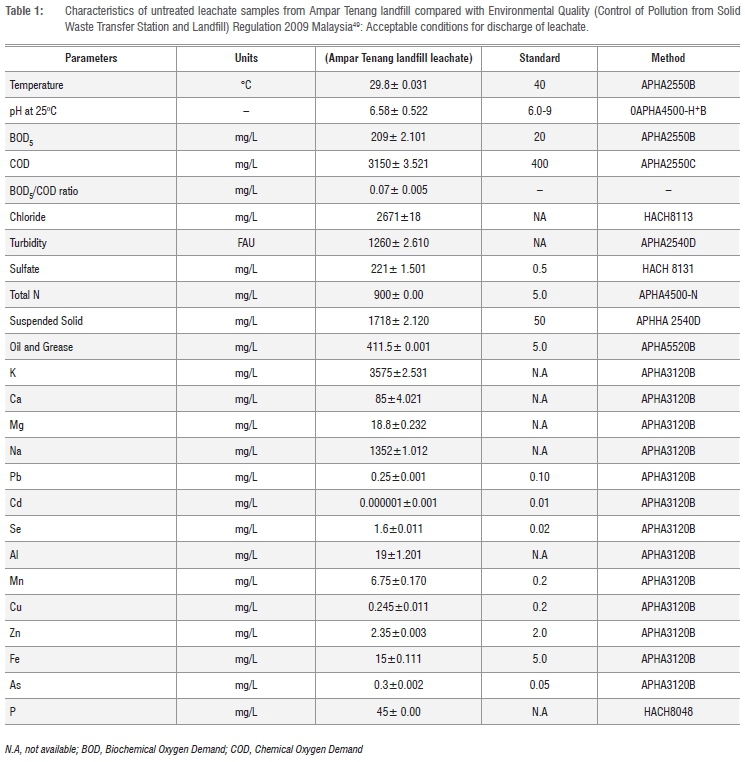
Specific characteristics of the leachate are displayed in Table 1. The pH and conductivity of the leachate were measured using a pH and conductivity probe (Hanna Model, No. 8033, Clarkson Laboratory, Chula Vista, CA, USA.). Total suspended solids and colour were determined using a spectrophotometer (HACH Model, DR/4000, Hach Company, Loveland, CO, USA). Biochemical Oxygen Demand (BOD5), Chemical Oxygen demand (COD), and total-N were analysed according to the standard methods of the America Public Health Association (APHA), the America Works Association (AWWA) and the Water Environment Federation (WEF), respectively.3435
Experimental design and growth conditions
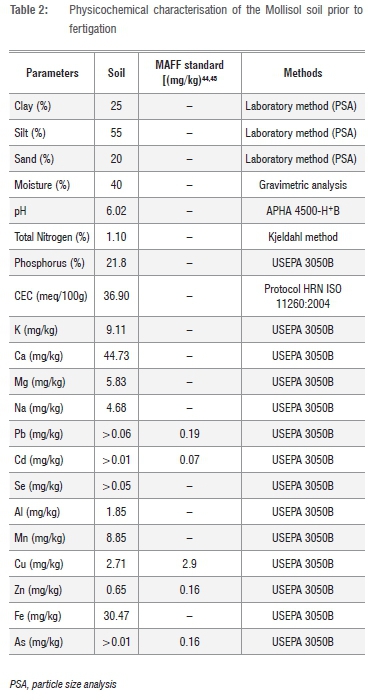
The study was conducted in a designed greenhouse (1.2 m x 1.2 m x 3.3 m) near the IGS building, University of Malaya. Brassica rapa L. were grown in free-draining 4-L nursery poly bags, each containing 5 kg of soil, classified as Mollisol36Table 2). Ten seeds were sown in germination pots to which distilled water of pH 6.94 (without metal contaminants) was applied daily. At day 6 after germination, uniform seedlings were selected and transplanted at a rate of two plants per bag (0.2 m x 0.2 m), spaced 8 cm apart to reduce inter-plant competition for nutrients. All plants were watered well daily until leachate application began on day 19 after seed germination. At this time, the plants had an average leaf length of 3.5 cm, 2.5 cm leaf width and 2.8 cm root length, as determined by destructive sampling. The experiment progressed for three consecutive growing seasons and the measured parameters were averaged over this period of analysis.
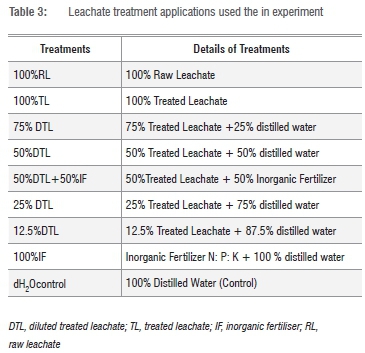
Nine treatments (Table 3) were imposed in a randomised complete block (RCB) design with stringent elimination of weeds. Each treatment contained two plants per bag with three replicates. Both 100% raw and treated leachate presented the same total N contents (0.090 N), whereas the 75-12.5% diluted treated leachate (DTL) contained 0.068-0.012% N. The N content of 50% DTL and 100% inorganic fertiliser (IF) was standardised at 0.045% N. For each treatment, 200 mL of leachate was applied by dripping twice a day (before 8:00 and after 17:00) until the plants expanded. At this time, higher evapotranspiration occurred and thus fertigation was increased to 250 mL (twice a day) to ensure 70% soil water holding capacity. The total leachate treatment period was 36 days. No pesticide was applied to the plants until the end of the experiment.
After day 56 (which is equivalent to 36 consecutive days of leachate application), the plants were harvested by uprooting. Fresh weights of leaves, stems and roots were determined, as well as total leaf number. Leaf length (LL), leaf width (LW) and stem height (SH) were measured prior to harvesting and root length was measured immediately after harvest.
The leaves, stems, and roots were dried at 70 °C in a forced draft oven (GO-251, Durham Geo-Enterprises Inc. Stone Mountain, GA, USA) for 3 days until constant weight to determine dry matter yield. All data generated were subjected to statistical analysis with one-way analysis of variance (ANOVA) using SPSS 17.0. Specific growth rate for leaf length, leaf width root length, and stem height were determined using the equation stated by Dimitriou et al.37

where L1 and L2 are the initial and final lengths at the exponential phases, respectively and t1 and t2 are the initial and final selected time intervals, respectively. Data were analysed using ANOVA and Microsoft Excel.
Heavy metal analysis
After drying, the weight of the plant and soil samples was recorded to the nearest gram. The samples were individually mashed to pass through the 2 mm screen in a laboratory mill (Serial no. 39017, Christy and Norris LTD, Chelmsford, England) and then 1 g of the sample was accurately weighed and placed into a 500 mL volumetric flask. For the plant samples, 1 mL of 65% HNO3 and 10 mL of distilled water were added into the 500 mL volumetric flask and refluxed for 10 min by mounting the flask on a digestion heater (EAM9203 heating mantle, Camlab Ltd., Cambridge, UK) at 105 °C. Another 5 mL of 65% HNO3 was added after 15 min and the mixture was allowed to digest until the solution became transparent. For the soil samples, 3 mL of (30%) H2O2 and 10 mL of HCl were added into the 50 mL volumetric flask while refluxing for 15 min. The resulting solutions were allowed to cool before being filtered and diluted with 50 mL of deionised water. The solutions were analysed for K, Ca, Mg, Na, Pb, Cd, Se, Al, Mn, Cu, Zn, Fe and As through inductively coupled plasma optical emission spectrometry.
Results and discussion
Overview of leachate characteristics for fertigation
The total N content of the raw leachate sample was 900 mg/L (Table 1). The high N concentration can be attributed to the breakdown of nitrogenous substances during organic waste decomposition.385/COD ratio between 0.06 and 0.08 and pH within the range of 6.12-7.04. Christensen et al.3917
After leachate treatment with 4 g/L FeCl3 at pH 7, the contents of Cd, Al, Fe, Pb, Cu and Zn decreased by 100%, 64.4%, 51.9%, 82%, 56.8% and 96.6%, respectively. The optimal removal capacity for suspended solids (SS) was 80%. Hamidi et al.40
Plant physical growth evaluation
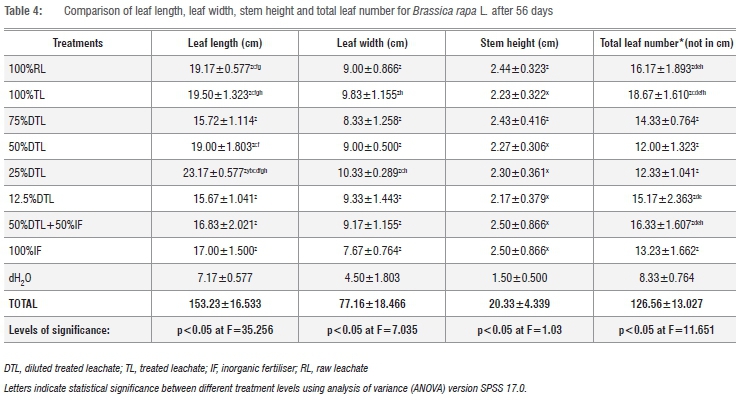
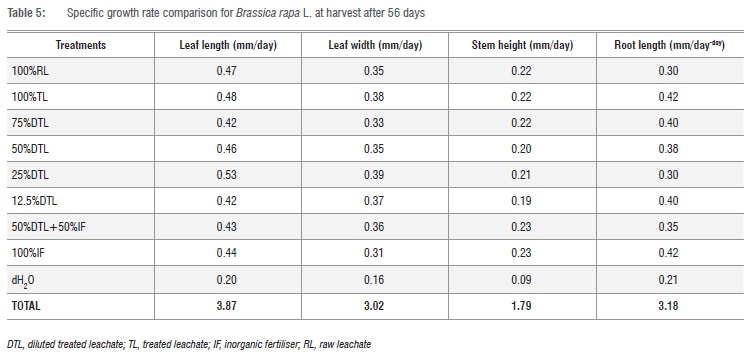
B. rapa L. survived until harvest, although common symptoms of soil salinisation such as chlorosis and leaf burn were noticed on 100%RL to 100%TL. This finding was not observed in plants irrigated with 75%DTL-12.5%DTL, probably because of the changes and/ or decrease in concentration gradient. Plants receiving 25%DTL produced significantly longer leaves (23.17±0.577 cm) than those in the other treatments (p<0.05) (Table 4). Plants treated with 25%DTL presented wider leaves, with 1.36 and 3.23 times higher width than plants receiving inorganic fertiliser [100% IF (N15:P15:K15)] and the control. Less expanded leaf length and width were also observed in plants treated with the control compared with those in other treatments, which may be a clear indication of nutrient deficiency and differential N proportions.41,37 Overall, 25%DTL could be the optimal nutrient requirement level for leaf expansion of B. rapa L. (Table 5), at a specific growth rate of 0.53 mm/day.
Dry biomass weight evaluation
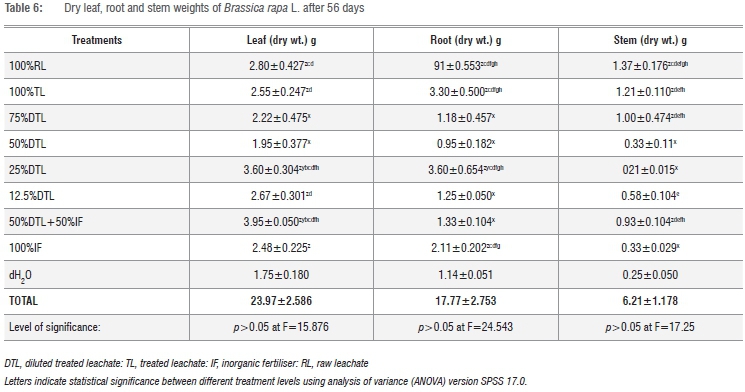
B. rapa L. that received 50%DTL+50%IF presented 2.25 and 1.60 times higher dry weight of leaf biomass than plants treated with the control and 100%IF (Table 6). This phenomenon may be attributed to the synergistic effect of N, which enhanced moisture retention in plants treated with 50%DTL+50%IF plants.4243Table 6). Initial low biomass yield, moisture content in the control and optimum growth nutrient requirements may be the implicating and/or limiting factors. Dry stem biomass was 5.48 times lower in control plants (0.25±0.050 g) than that in plants with 100%RL (1.37±0.176 g, p<0.05). The zero N supplementation during fertigation hindered the yield and subsequent biomass.
Heavy metal analysis in soil and plants, pH impact and N dynamics
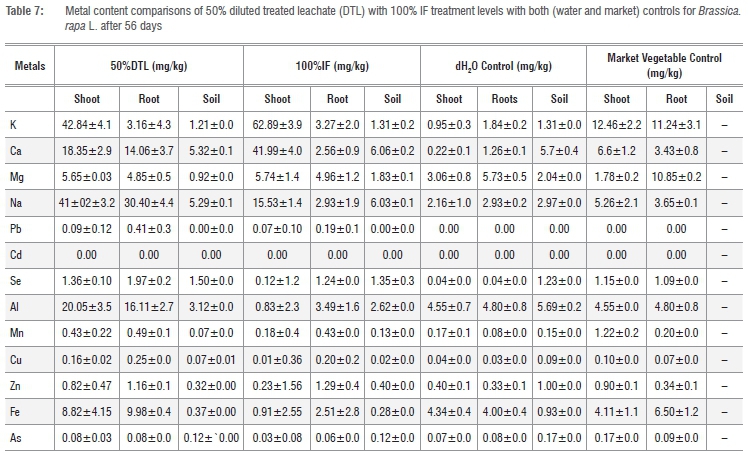
The overall concentrations of heavy metals present in the soil prior to fertigation were lower than the detection and maximum permissible limits.44,45 Application of leachate generally altered the physicochemical characteristics of the soil and the heavy metal uptake by vegetables.46,6 A comparison between edible (plant) parts, namely, shoots collected 1 cm above the soil surface, showed that plants treated with 50%DTL and 100%IF and market samples of B. rapa L. (as control), contained zero Cd (Tables 7 and 8), while the permissible limit for Cd is 0.2 mg/kg.47,48
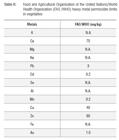
Traces of Pb ranging from 0.07-0.09 mg/kg were detected in B. rapa L. edible parts treated with 50%DTL and 100%IF, whereas zero Pb content was observed in the market sample. Nevertheless, Pb concentration was still lower than the maximum permissible concentration of 3 mg/kg. Moreover, arsenic content was lower than the maximum permissible concentration limit of 1.0 mg/kg, as proposed by the Food Quality and Standard Control Division, Ministry of Health Malaysia49
Large amounts of K, Ca, Mg, Na, Al, and Fe accumulated in the edible parts of B.rapa L. treated with 50%DTL were compared with those in the market sample, but the concentration of these elements was still within the acceptable range. This result is in agreement with a previous study by Liu et al.5051 51
The soil pH was 6.02±0.01 before fertigation began and then decreased to 6.0±0.001 and 6.01±0.002 for the undiluted (100%) and diluted (12.5-75%) treatments, respectively. Cation exchange capacity, clay fraction, and soil organic matter were implicated in influencing the buffering system in acid soils, as reported by Jiang et al.525354 B. rapa L. Based on this urea content, which is equivalent to 35.7 kmol N/ha per year, the estimated N input to 5 kg of Mollisol in a poly bag is 0.14 kmol N kg/ha per year. As the N concentration of undiluted leachate (100%) was 0.09% and that of diluted leachate (12.5-75%) ranged from 0.012-0.068%, the increase in H+ protons(pro) caused by nitrification (Ni), amounted to 0.013 and 0.002 to 0.009 kmol kg/ha per year respectively, as calculated using Equation 255
H+(pro) (Ni) = 0.14 x % N(Leachate) kmol kg/ha per year Equation 2
Thus, N use efficiency from harvested plants in the undiluted (100%) and diluted (12.5-75%) leachate treatments amounted to 40% and 60%, respectively. Hence, H+ proton deposition(dep) in soil calculated using Equation 3,56
H + (dep)(uptake) = 0.14 x %N(utilised) Equation 3
The duration (1/T) for a unit decrease in soil pH on account of leachate treatments was estimated with Equation 4:
1/T = H+(dep) x Bulk Density [BD = 0.02: mass (5 kg)/vol. (250mL)] Equation 4
For the undiluted (100%) and diluted (12.5-75%) leachates, the estimated duration was 625 years and 833 years, respectively. The soil acidification rate induced by N fertigation with leachate was approximately 0.01 unit pH/year.
Conditions such as extreme biogeochemical/anthropogenic disruptions in the soil ecosystem may alter and/or decrease soil pH and enhance cation bioavailability and desorption from soil matrices. In cases with rapid changes in soil pH because of fertigation with leachate, application should be terminated and waste composition from the leachate source, treatment facility, and concentrations applied to soil should be re-evaluated.
Generally, B. rapa L. exhibits higher mineral accumulation tendencies at their leaf region. This study revealed that K, Ca, Mg, Na, Al, and Fe were the most dominant minerals present in the plant. Pb and Cd concentrations were lower than the permissible levels.
Conclusion
This study attested that treated landfill leachate, similar to inorganic fertiliser, can be an effective source of nutrients for irrigated B. rapa L. Leachates can be recycled and utilised as bio-fertiliser for edible and non-edible plants, even for ornamental and timber species. The heavy metal levels in the treated leachate-grown B. rapa L. were lower than the stipulated permissible concentrations based on the FAO/WHO standards. Therefore, this treatment strategy will reduce the impact of chemical fertilisers on our ecosystem.
Authors' Contributions
F.O.A. was the principal researcher, while the PA. was the project head and investigator. Both authors collaborated effectively to complete the study.
Acknowledgements
This research was supported by the IPPP-University of Malaya, Malaysia under grant No. IPPP/PV054/2011A. We thank the Solid Waste Laboratory, Institute of Graduate Studies, University of Malaya and the graduate students who supported this research work.
References
-
1. Dillion J, Edinger-Marshall S, Letey J. Farmers adopt new irrigation and fertilizer techniques. Calif Agr. 1999;53:24-28. http://dx.doi.org/10.3733/ca.v053n01p24
» http://dx.doi.org/10.3733/ca.v053n01p24 -
2. Keletso CM, Alphonsus KB, Felix DD. Symbiotic N nutrition, C assimilation, and plant water use efficiency in Bambara groundnut (Vigna subterranea L. Verdc) grown in farmers' fields in South Africa, measured using 15N and l3C natural abundance. Biol Fert Soils. 2014;50:307-319. http://dx.doi.org/10.1007/s00374-013-0841-3
» http://dx.doi.org/10.1007/s00374-013-0841-3 - 3. Suja G, Sreekumar J. Implications of organic management on yield, tuber quality and soil health in yams in the humid tropics. Int J Plant Prod. 2014;8(3):291-310.
-
4. Swarnam TP Vel Murugan A. Evaluation of coconut wastes as an amendment to acidic soils in low-input agricultural system. Commun Soil Sci Plan. 2014;45(8):1071-1082. http://dx.doi.org/10.1080/00103624.2013.867059
» http://dx.doi.org/10.1080/00103624.2013.867059 - 5. Cui Y, Li Y, Lu G, Sha Z. Nitrogen movement and transformation with different water supply for paddy rice. Adv Wat Sci. 2004;15:280-285.
- 6. Anita S, Rajesh KS, Madhoolika A, Fiona MM. Risk assessment of heavy metal toxicity through contaminated vegetables from waste water irrigated area of Varanasi, India. Int J Trop Ecol. 2010;51(2S):375-387.
-
7. Eriyamremu GE, Asagba SO, Akpoborie A, Ojeaburu SI. Evaluation of lead and cadmium levels in some commonly consumed vegetables in the Niger-Delta oil area of Nigeria. B Environ Contam Tox. 2005;75:278-283. http://dx.doi.org/10.1007/s00128-005-0749-1
» http://dx.doi.org/10.1007/s00128-005-0749-1 -
8. Muchuweti M, Birkett JW, Chinyanga E, Zvauya R, Scrimshaw MD, Lester JN. Heavy metal content of vegetables irrigated with mixture of waste water and sewage sludge in Zimbabwe: Implications for human health. Agr Ecosyst Environ. 2006;112:41-48. http://dx.doi.org/10.1016/j.agee.2005.04.028
» http://dx.doi.org/10.1016/j.agee.2005.04.028 - 9. Satarug S, Haswell-Elkins MR, Moore MR. Safe levels of cadmium intake to prevent renal toxicity of human subjects. Brit J Nutr. 2000;84:791-802.
- 10. Marshall FM, Holden J, Ghose C, Chisala B, Kapungwe E, Volk J, Agrawal M, Sharma RK, Singh RP. Contaminated irrigation water and food safety for the urban and periurban poor: Appropriate measures for monitoring and control from field research in India and Zambia. Inception Report: DFID Enkar R8160. Brighton: SPRU, University of Sussex; 2007.
-
11. Sharma RK, Agrawal M, Marshall FM. Heavy metals contamination in vegetables grown in waste water irrigated areas of Varanasi, India. B Environ Contam Tox. 2006;77:311-318. http://dx.doi.org/10.1007/s00128-006-1065-0
» http://dx.doi.org/10.1007/s00128-006-1065-0 -
12. Sharma RK, Agrawal M, Marshall FM. Heavy metals contamination of soil and vegetables in suburban areas of Varanasi, India. Ecotox Environ Safe. 2007;66:258-266. http://dx.doi.org/10.1016/j.ecoenv.2005.11.007
» http://dx.doi.org/10.1016/j.ecoenv.2005.11.007 -
13. Vusumzi P Ewa C, Luke C. Metal and flavonol contents of Moringa oleifera grown in South Africa. S Afr J Sci. 2013;109(3/4), Art. #835, 7 pages. http://dx.doi.org/10.1590/sajs.2013/835
» http://dx.doi.org/10.1590/sajs.2013/835 -
14. Frank AS, Kees WV, Piet FO. A tiered approach for the human health risk assessment for consumption of vegetables from with cadmium-contaminated land in urban areas. Env Res. 2013;126:223-231. http://dx.doi.org/10.1016/j.envres.2013.08.010
» http://dx.doi.org/10.1016/j.envres.2013.08.010 -
15. Intawongse M, Dean JR. Uptake of heavy metals by vegetable plants grown on contaminated soil and their bioavailability in the human gastrointestinal tract. Food Addit Contam. 2006;23:36-48. http://dx.doi.org/10.1080/02652030500387554
» http://dx.doi.org/10.1080/02652030500387554 - 16. Agamuthu P. Characterization of municipal solid waste and leachate from selected landfills in Malaysia. Malays J Sci. 1999;18:99-103.
-
17. Aziz HA, Daud Z, Adlan MN, Hung YT. The use of poly aluminum chloride for removing colour, COD and ammonia from semi-aerobic leachate. Int J Environ Eng. 2009;1:20-35. http://dx.doi.org/10.1504/IJEE.2009.026440
» http://dx.doi.org/10.1504/IJEE.2009.026440 -
18. Öman CB, Junestedt C. Chemical characterization of landfill leachates - 400 parameters and compounds. Waste Manage. 2008;28:1876-1891. http://dx.doi.org/10.1016/j.wasman.2007.06.018
» http://dx.doi.org/10.1016/j.wasman.2007.06.018 -
19. Santos DV Sousa PL, Smith RE. Model simulation of water and nitrate movement in a level-basin under fertigation treatments. Agri Water Manage. 1997;32:293-306. http://dx.doi.org/10.1016/S0378-3774(96)01273-5
» http://dx.doi.org/10.1016/S0378-3774(96)01273-5 - 20. Guo D, Xiong Q, Xie C, Feng Y Study on the relationship between the transforming of NO3-N in soil and soil moisture under irrigation. Irrig Drain.2001;20:66-70.
- 21. Ju XT, Liu XJ, Zhang FS. 2003. [Accumulation and movement of NO3-N in soil profile in winter wheat/summer maize rotation system.] Acta Pedo Sin. 40:538546. [Chinese].
- 22. Cheng CY Chu LM. Phytotoxicity data safeguard the performance of the recipient plants in leachate irrigation. Environ Pollut. 2007;145:195-202.
- 23. Menser HA, Infant WM, Benneth OL. Spray irrigation with landfill leachate. Biocycle. 1983;24(3):22-25.
- 24. Liang J, Zhang J, Wong MH. Landfill leachate used as irrigation water on landfill sites during dry seasons. In: Wong MH, Wong JWC, Baker AJM, editors. Remediation and management of degraded lands. Boco Raton, FL: CRC Press LLC; 1999.
-
25. Cureton PM, Groenevelt PH, McBride RA. Landfill leachate recirculation: Effects on vegetation vigor and clay surface cover infiltration. J Environ Qual. 1991;20:17-24. http://dx.doi.org/10.2134/jeq1991.00472425002000010005x
» http://dx.doi.org/10.2134/jeq1991.00472425002000010005x -
26. Mapanda F, Managwayana EN, Nyamangara J, Giller KE. The effects of longterm irrigation using wastewater on heavy metal contents of soils under vegetable in Harare, Zimbabwe. Agr Ecosyst Envon. 2005;107:151-123. http://dx.doi.org/10.1016/j.agee.2004.11.005
» http://dx.doi.org/10.1016/j.agee.2004.11.005 -
27. Alados CL, Navarro T, Escòs J, Cabezudo B, Emlem JM. Translational and fluctuating asymmetry as tools to detect stress in stress-adapted and non-adapted plants. Int J Plant Sci. 2001;162(3):607-616. http://dx.doi.org/10.1086/320130
» http://dx.doi.org/10.1086/320130 -
28. Zvera EL, Kozlov MV Haukioja E. Stress responses of Salix borealis to pollution and defoliation. J Appl Ecol. 1997;34(6):1387-1396. http://dx.doi.org/10.2307/2405256
» http://dx.doi.org/10.2307/2405256 - 29. Mangwayana ES. Heavy metals pollution from sewage sludge and effluent of soil and grasses at Crowborough Farm [BSc thesis]. Harare: University of Zimbabwe; 1995. p. 63.
- 30. Nyamangara J, Mzezewa J. The effect of long-term sewage sludge application on Zn, Cu, Ni and Pb levels in a clay loam soil under pasture grass in Zimbabwe. Agr Ecosyst Envon. 1999;73:99-204.
- 31. Huxley A. The new RHS dictionary of gardening. New York: MacMillan Press; 1992.
- 32. Larkcom J. Oriental Vegetables. London: John Murray; 1991.
-
33. Grinsted MJ, Hedley MJ, White RE, Nye PH. Plant-induced changes in the rhizosphere of rape (Brassica napus var. Emerald) seedlings. I. pH change and the increase in P concentration in the soil solution. New Phytol. 1982;91:19-29. http://dx.doi.org/10.1111/j.1469-8137.1982.tb03289.x
» http://dx.doi.org/10.1111/j.1469-8137.1982.tb03289.x - 34. Robinson HD. Development of methanogenic condition within landfill. Second International Waste Management and Landfill Symposium; 1989 Oct 9-13; Porto Coute, Sardinia, Italy.
- 35. Said NA. Physicochemical treatment of Bukit Tagar sanitary landfill leachate using Praestol 189K and aluminum chloride [Masters dissertation]. Kuala Lumpur: University of Malaya. 2008. p. 120.
- 36. United States Department of Agriculture. Soil Taxonomy. A basic system of soil classification for making and interpreting soil surveys. 2nd Ed. Washington, DC: Natural Resources Conservation Service; 1999.
-
37. Dimitriou I, Aronsson IP Weih M. Stress tolerance of five willow clones after irrigation with different amounts of landfill leachate. Bioresource Technol. 2006;97:150-157. http://dx.doi.org/10.1016/j.biortech.2005.02.004
» http://dx.doi.org/10.1016/j.biortech.2005.02.004 -
38. Peter K, Morton A, Balaz A, Rooker P Anders B, Anna L, et al. Present and long term composition of MSW landfill leachate: A review. Crit Rev Env Sci Technol. 2002;32(4):297-336. http://dx.doi.org/10.1080/10643380290813462
» http://dx.doi.org/10.1080/10643380290813462 - 39. Christensen TH, Jensen DL, Filip Z, Gron C, Christen TH. Characterization of the dissolved organic carbon in landfill polluted ground water. Water Res. 1999;23:125.
-
40. Hamidi AA, Salina A, Mohd NA, Faridah AH, Asaari MSZ. Colour removal from landfill leachate by coagulation and flocculation processes. Bioresource Technol. 2007;98:218-220. http://dx.doi.org/10.1016/j.biortech.2005.11.013
» http://dx.doi.org/10.1016/j.biortech.2005.11.013 - 41. Aronsson P. Nitrogen retention in vegetation filters of short rotation willows coppice [PhD thesis]. Uppsala: Swedish University of Agricultural Sciences. 2000. p.161.
-
42. Zalesny JA, Zalesny Jr RS, Coyle DR, Hall RB. Growth and biomass of Populus irrigated with landfill leachate. Forest Ecol Manag. 2007;248:143-152. http://dx.doi.org/10.1016/j.foreco.2007.04.045
» http://dx.doi.org/10.1016/j.foreco.2007.04.045 -
43. Montree I, Qifu M, David WT. Photosynthetic and growth responses of juvenile Chinese kale (Brassica oleracea var. alboglabra) and caisin (Brassica rapa sub sp. parachinensis) to water logging and water deficit. Scientia Hortic-Amsterdam. 2007;111:107-113. http://dx.doi.org/10.1016/j.scienta.2006.10.017
» http://dx.doi.org/10.1016/j.scienta.2006.10.017 - 44. Ministry of Agriculture, Fisheries and Forests and Department of the Environment (MAFF). Review of the rules for sewage sludge application to agricultural land. Report of the Independence Scientific Committee: PB 1561. London: MAFF; 1993.
- 45. Ministry of Agriculture, Fisheries and Forests and Department of the Environment (MAFF). Survey of the cadmium contained in agricultural products. Japan: MAFF; 2002. p.1-45.
-
46. Monu A, Bala K, Shweta R, Anchal R, Barinder K, Neeraj M. Heavy metal accumulation in vegetables irrigated with water from different sources. Food Chem. 2008;111:811-815. http://dx.doi.org/10.1016/j.foodchem.2008.04.049
» http://dx.doi.org/10.1016/j.foodchem.2008.04.049 - 47. Codex Alimentarius. Maximum levels for cadmium in cereals, pulses and legumes. CAC/GL 39-2001. Rome: Joint Food and Agricultural Organization of the United Nations/World Health Organization; 2001.
- 48. Codex Alimentarius. Maximum levels for lead. Codex STAN 230-2001. Rome: Joint Food and Agricultural Organization of the United Nations/World Health Organization; 2001.
-
49. Ministry of Health Malaysia. Food safety and quality division [document on the Internet]. c2013 [cited 2014 Nov 18]. Available from http://fsq.moh.gov.my.
» http://fsq.moh.gov.my -
50. Liu WH, Zhoa JZ, Ouyang ZY Soderlund L, Liu GH. Impacts of sewage irrigation on heavy metals distribution and contamination. Environ Int. 2005;31:805-812. http://dx.doi.org/10.1016/j.envint.2005.05.042
» http://dx.doi.org/10.1016/j.envint.2005.05.042 -
51. Weiping C, Sidan L, Wentao J, Meie W. Reclaimed water: A safe irrigation water source? Environ Dev. 2013;8:74-83. http://dx.doi.org/10.1016/j.envdev.2013.04.003
» http://dx.doi.org/10.1016/j.envdev.2013.04.003 - 52. Jiang J, Xu RK, Zhao AZ. [Determination of pH buffer capacity of acid red soils by acid-base titration.] Chinese J Soil Sci. 2006;37:1247-1248. Chinese.
-
53. VanBreemen N, Mulder J, Driscoll C. Acidification and alkalinisation of soils. Plant Soil. 1983;75:283-308. http://dx.doi.org/10.1007/BF02369968
» http://dx.doi.org/10.1007/BF02369968 -
54. Huang P, Zhang J-B, Xin X-L, Zhu A-N, Zhang C-Z, Ma D-H, et al . Proton accumulation accelerated by heavy metal chemical nitrogen fertilization and its long-term impact on acidifying rate in a typical arable soil in the Huang-Huai Plain. J Integr Agr. 2015;14(1):148-157. http://dx.doi.org/10.1016/S2095-3119(14)60750-4
» http://dx.doi.org/10.1016/S2095-3119(14)60750-4 -
55. Xing GX, Zhu ZL. An assessment of N loss from agricultural fields to the environment in China. Nutrient Cycl Agroecosys. 2000;57:67-73. http://dx.doi.org/10.1023/A:1009717603427
» http://dx.doi.org/10.1023/A:1009717603427 -
56. Zhang YM, Chen DL, Zhang JB, Edis R, Hu CS, Zhu AN. Ammonia volatilization and denitrification losses from an irrigated maize-wheat rotation field in the North China plain. Commun Soil Sci Plan. 2004;35(19/20). http://dx.doi.org/10.1081/css-200036499
» http://dx.doi.org/10.1081/css-200036499
Frank Alaribe
Institute of Biological Sciences, Faculty of Science, University of Malaya
50603 Kuala Lumpur, Malaysia
Revised: 19 July 2015
Accepted: 25 Aug. 2015