Exploring farmers' seasonal climate forecast needs: Co-producing forecasts for food security
Abstract
Seasonal climate forecasts (SCFs) are explored as an additional tool for farmers to use to act against seasonal climate fluctuations and to support greater food security for themselves and their customers. In this study, we compared the SCF needs and possible emerging farming actions of commercial farmers and smallholder farmers while exploring the prospects for developing SCF tools to aid farmers. Our intent was not to produce a new SCF, but to improve the farmers' reception, understanding and uptake of existing SCFs. The results show that both farmer groups saw value in SCFs in improving their farming actions (and, by implication, improving their food security) and provided detailed information on their specific SCF needs to support their decision-making, such as how to improve trust, the type of information they would like to receive, how to make SCFs more understandable, and how to make SCFs relevant for their farming actions. The needs of the two groups differed marginally, but the major barrier for smallholder farmers was SCF access as a result of a lack of smartphones and network coverage. SIGNIFICANCE: The findings help us to understand what farmers need to know to perceive a use and make use of SCFs, and to provide guidance in bridging the gap between existing SCF products and farmers taking more informed farming actions that will increase their resilience to climate change and improve their food security. This will enable us to build seasonal climate forecasting information tools that can be easily accessed and understood by commercial and smallholder farmers alike.
food security; information needs; seasonal climate forecasting; climate variability; technology access
Introduction
While proportionally low in comparison to other African countries, malnourishment and perceptions of food insecurity are both on the rise in South Africa - 4.7 million South Africans are malnourished and 5.3 million report severe food insecurity.1234,5
Significant research efforts have explored adaptation strategies to mitigate the long-term effects of the changing climate through modelling and remote sensing assimilation67891011,121314
Although the benefits of SCFs are clear, historically they have not been frequently adopted in the agricultural sector15,161718192021
While there is recent and ongoing work contributing to the development of knowledge on SCF production (i.e. how to produce better-suited and easier-to-understand information), this study purposefully explored the users' (farmers') needs and how existing accessible SCFs could be better accessed, understood and appropriately weighted in farmers' decision processes. Several literature reviews have summarised the problems experienced with SCF adoption by farmers across Africa. Hansen et al.14 2223
In summary, farmers expressed problems accessing SCFs, understanding the information on the SCFs if they could access them, and finding the relevance of SCFs for their farming decisions.
SCF tool co-production for South African farmers
Current SCF information available in South Africa is either produced in-country, either by the South African Weather Service for official dissemination or in an academic context (e.g. Forecast Worx), or is produced globally by, for example, the European Centre for Medium-Range Weather Forecasts or the International Research Institute for Climate and Society. Such products are largely developed as top-down data dissemination tools, although, for effective forecasting, the World Meteorological Organization24 2325262728
This study initiates the co-production process for an SCF exploration platform for crop farmers, which intends to address the needs of both smallholder and commercial farmers in South Africa. These are often the two groups into which farmers are placed in South Africa.292928
The aims of this study were therefore twofold in comparing the smallholder and commercial crop farmers: (1) to compare the SCF exploration needs and (2) to compare the possible farming actions that enable sustainable food production. There are currently no studies comparing the SCF exploration needs of smallholder and commercial farmers in South Africa, or that have looked at how these two farmer groups might use SCFs to enhance their farming decision-making.
Methods
Procedure
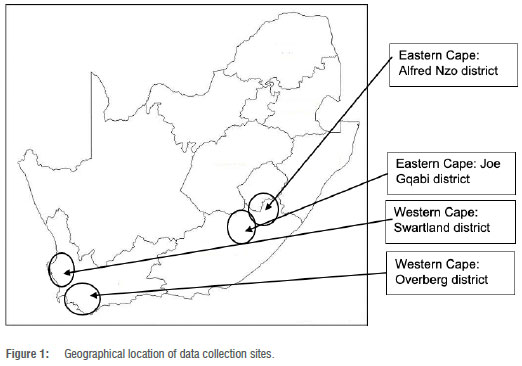
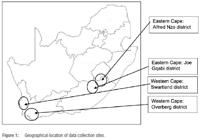
The qualitative study followed ethical procedures for human participants approved by the respective ethics committees at the University of the Witwatersrand (MAORG/21/03 and MAORG/21/03) and the University of Cape Town (FSREC 064-2021). The data were collected in two stages. The sampling strategy was purposive, based on where the research team had contacts and access, to enable the comparison between commercial farmers and smallholder farmers, to be able to consider winter and summer crop farming, and to reflect experiences in locations known for differing SCF skills. Contacts in Overberg Agri helped identify potential interviewees and focus group participants in the Western Cape. Grain SA and extension officers helped identify potential interviewees and focus group participants in the Eastern Cape. The first stage involved semi-structured, in-depth interviews. Interviews took place in farmers' homes, offices or community halls, in September and October 2021. Interviews were conducted in English or Afrikaans (Western Cape) and English or Xhosa (Eastern Cape) and lasted approximately 1 hour. The interviews were audio-recorded and professionally translated/transcribed into English for analysis. The second stage involved focus group discussions to corroborate the interview data and to identify new issues. Focus groups were held in Caledon (Overberg district, Western Cape) and Moorreesburg (Swartland district, Western Cape) in July 2022 and in Nqanqarhu, Mount Fletcher (Gqabi district, Eastern Cape) and Bizana, eMaxesibeni (Alfred Nzo district, Eastern Cape) in November 2022. The focus groups took place in the Overberg Agri offices (Western Cape) and community halls (Eastern Cape). Each focus group lasted approximately 120 minutes. In the Western Cape, the focus group facilitator spoke Afrikaans, whereas in the Eastern Cape, the facilitator was assisted by a Xhosa-speaking extension officer using the Xhosa version of the focus group questions. The geographical areas from where participants were drawn are shown in Figure 1. Data were collected until saturation was noted in the responses. The researchers were constantly reflexive during data collection and data analysis to understand how their own assumptions, beliefs and judgements might bias the research process.
Instruments
The interview schedule started with biographical questions about the farmer, their farming activities, and their use of climate services, to establish a rapport. Next, farmers were asked about their SCF exploration needs with regard to their farming activities. Last, farmers were asked about the types of actions they could take based on SCFs.
The focus group discussions started with an explanation of SCFs and the issues of probability and forecasting skill. Next, the farmers' perceptions regarding the usefulness, understandability and trustworthiness of SCFs were probed, as well as suggested exploration capacity improvements. Finally, farmers were asked about the actions that they could adopt based on SCFs.
The interview and focus group schedules were developed in English and translated into Afrikaans and Xhosa.
Participants
Commercial farmers
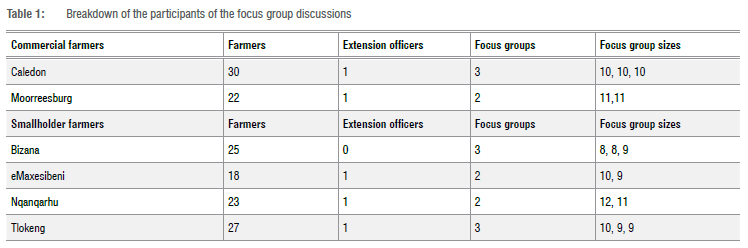
Although the Western Cape encompasses commercial and smallholder farmers, all commercial farmers we interviewed were based in the Western Cape. In the Western Cape, 13 interviews were held with commercial grain farmers growing various winter rainfall grains, mostly wheat and barley, and 2 interviews were held with extension officers from Overberg Agri. All interviewees were white men who spoke Afrikaans as their home language. This was followed by two workshops with 52 commercial grain farmers and 2 extension officers as participants. Participants were assigned to smaller focus groups for the discussions and then each focus group reported back to the larger workshop (see Table 1). All participants were white Afrikaans speakers; 4 were women and 50 were men.
Smallholder farmers
Similarly, although the Eastern Cape encompasses commercial and smallholder farmers, all smallholder farmers we interviewed were based in the Eastern Cape. In the Eastern Cape, 16 interviews were held with smallholder crop farmers who grow a wide range of summer rainfall crops, including maize, cabbages, beans and potatoes. All interviewees were black and spoke Xhosa as their home language; 4 were women and 12 were men. Interviews were followed by four workshops with 93 smallholder crop farmers and 3 extension officers as participants. Participants were assigned to smaller focus groups as per the commercial farmers (Table 1). All participants were black Xhosa speakers; 51 were women and 45 were men.
Analysis
After transcribing the interview and focus group recordings, a random sample of the transcriptions was checked against the recordings by an independent reviewer for accuracy. The interview and focus group data were imported into Nvivo and analysed using thematic analysis. The six-phase approach to a thematic analysis was followed30
Results
Most interviewees had not used SCFs (77% of smallholder farmers and 77% of commercial farmers) and many had not even heard of SCFs (69% of smallholder farmers and 15% of commercial farmers), with some smallholder and commercial farmer interviewees sceptical that seasonal forecasting was even possible. For this reason, the focus groups started with a presentation on SCFs and what they were potentially capable of achieving. Attention was paid to the need to present SCF capacity as fairly as possible, including the various South African SCFs, and clarification of inherent uncertainties and skill variations.
SCF exploration needs
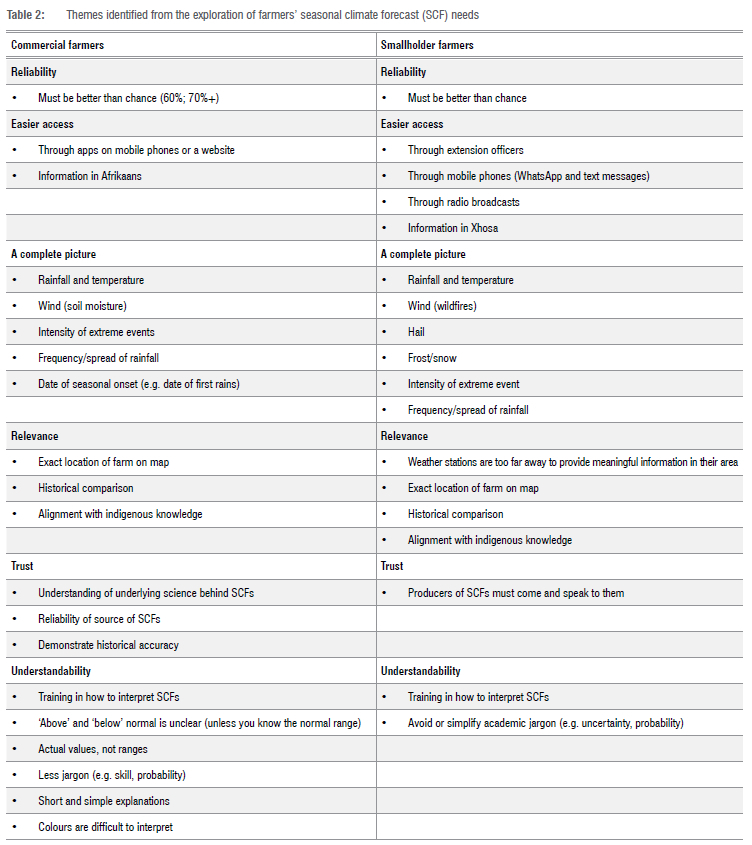
Six themes were identified from the interviews and focus groups regarding the needs of farmers from SCFs (see Table 2), although differences were noted between the commercial and smallholder farmers.
R eliability
Both the commercial and smallholder farmers specified that they needed to appreciate SCF reliability for SCFs to be considered usable. The commercial farmers specified what they considered to be acceptable reliability levels (levels of either 60% or 70% accuracy), whereas the smallholder farmers indicated that reliability should be better than random chance (i.e. 50% or better).
Easier access
While accessibility of SCFs was a theme for both the commercial and smallholder farmers, their needs were different. Commercial farmers wanted access either through an application on their mobile phone or from a website. The smallholder farmers had poorer access to smartphones/computers and limited Internet/network connectivity, and therefore expressed a preference for access through their mobile phones either as text messages or WhatsApp messages or through radio broadcasts like weather forecasts. Smallholder farmers also expressed an interest in having SCFs explained to them by extension officers or other authority figures (e.g. by an experienced local farmer or by the SCF producers themselves). Both farmer groups wanted the information accessible in their home language.
A complete picture
To provide the necessary support for their farming operations, both groups of farmers felt that an SCF exploration tool should provide a "complete" picture of meteorological information. However, the two groups differed in what was considered "complete". Both groups indicated that rainfall, temperature, the likelihood of extreme events (e.g. heavy rainfall, floods and drought), and the spread of rainfall across the season (e.g. how many days of rain and when the rain was expected during the forecast period) were important. Both groups felt that wind information was important, but for different reasons. The commercial farmers needed this information in conjunction with rainfall and temperature to determine soil moisture. The smallholder farmers needed temperature and wind information to determine the likelihood of wildfires that might threaten their crops. Smallholder farmers were interested in the likelihood of hail, frost and snow that might damage their crops. All the farmers were interested in the onset date of the rainfall season (particularly in anticipation of the planting) as well as the distribution of rain across the season (i.e. whether it would fall regularly or whether there was a likelihood of extreme rainfall events).
Relevance
Both farmer groups struggled to identify their own farms/locations on a larger map and wanted the functionality to zoom into the maps to more accurately identify their specific location (and therefore also their specific probabilistic estimates). The smallholder farmer group was also concerned that forecasts were being made based on data collection points that were far away and not relevant to their specific locality (e.g. the meteorological station was in a town 70 km away). Both groups of farmers expressed a need to consider the historical accuracy (i.e. against their own records or own recollections). This would allow the farmers to make a connection with the forecasts. Both farmer groups also wanted an SCF exploration tool aligned with their own indigenous knowledge experiences (e.g. March lilies flowering in March).
Trust
Generally, both farmer groups felt that more could be done to improve user trust in SCFs. The smallholder farmers felt that trust could be established by the SCF producers speaking to them in person. They valued a personal connection and the ability to be able to ask questions and engage in dialogue. The commercial farmers wanted information on the sources of the SCFs to be able to identify whether the information came from trustworthy sources. They thought that understanding the science underlying SCFs and that demonstrating the historical accuracy of predictions would increase their trust in SCFs.
Understandability
The smallholder farmers were aware that they would be unable to interpret the SCFs without some form of training or support (e.g. from extension officers, educated farmers, or younger farmers who would be familiar with technology). Commercial farmers also felt that they would benefit from training in how to interpret SCFs, but also suggested other ways to improve their understanding. Some of these issues relate to the existing SCF representations which are often presented as terciles (e.g. 'above normal', 'normal', or 'below normal' rainfall) using colours or colour gradients. The terms 'above' and 'below' normal were considered unhelpful unless the normal rainfall for the specific region and time of year were known. Instead, the commercial farmers wanted a short, simple explanation. The use of technical terms (e.g. ROC curves, skill, probability), which the farmers considered to be jargon, was also identified as problematic.
Actions available at a seasonal scale
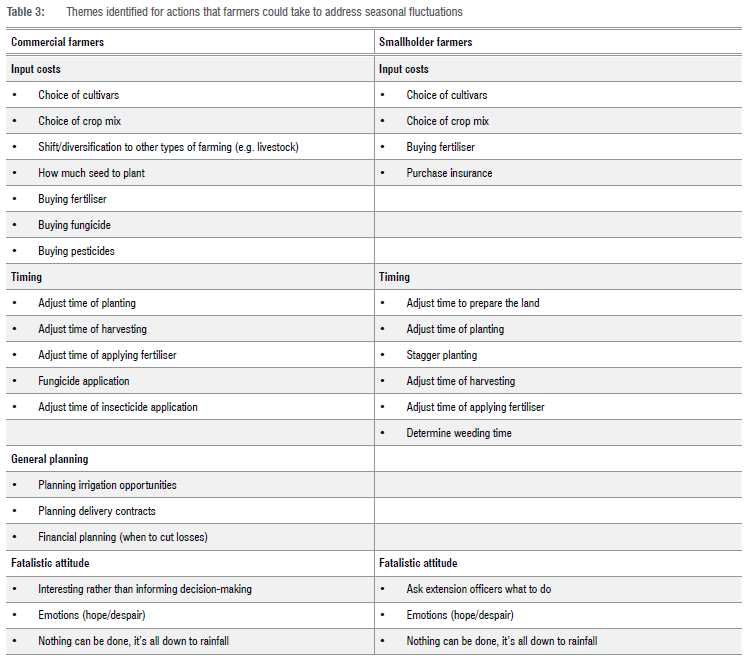
Farmers need to know that SCFs will add value to their farming practices. It was therefore important to understand what actions the different farmer groups felt they could take based on information obtained from exploring SCFs. It is unsurprising that the actions available to smallholder farmers were fewer than those for commercial farmers (Table 3), although there were still many actions available to smallholder farmers.
Input costs
All the farmers indicated that they could use SCF information to regulate their input costs. The number and variety of these input costs was far greater for the commercial farmers. Both farmer groups could regulate the choice of cultivars (e.g. drought-resistant cultivars in a dry season, early or late maturing), the mix of crops (e.g. changing the proportion of different crops planted or the types of crops planted) to suit the expected conditions, and whether to buy fertiliser (i.e. if good rainfall was expected). The commercial farmers indicated that they could also switch to other types of farming (e.g. shifting to livestock farming). This might also have been possible for some smallholder farmers, although it was not mentioned. Related to this, commercial farmers could also decide how much seed to plant to optimise yields. Commercial farmers indicated that they could also make decisions about how much fertiliser, pesticide and fungicide (especially if rainfall was expected to be high) to purchase. Smallholder farmers were further limited to deciding whether to purchase insurance to secure against poor yields or crop failures. Presumably, this would also be available to commercial farmers, although it was not mentioned by them.
Timing
Both farmer groups could use SCF information to adjust the time of planting, the time of harvesting, and the time when fertiliser would be applied. While the flexibility to adjust some of these timings was limited, the information could also help farmers in preparing for these activities (e.g. ensuring equipment was ready, personnel were in place, or the land was prepared). The smallholder farmers also indicated that they could use SCF information to adjust when they would start preparing their land and when they would need to weed the land (if rains had been good). For smallholder farmers, these activities are usually manual and labour intensive because they generally do not have regular access to motorised technology. They would therefore benefit from advanced warnings to enable preparation. Smallholder farmers also indicated that they could decide to stagger their planting rather than planting all their seeds at the same time. For example, if a dry season was expected, they could plant less seed at the start of the season and if the rains arrived, they could plant more seed.
General planning
The commercial farmers also indicated that there were other general planning activities that would benefit from SCFs. If irrigation possibilities existed (e.g. if they had a water-use licence for extracting from a water source or for storing water), they could start planning the irrigation distribution (e.g. laying pipes or digging irrigation channels). Most commercial farmers also had contractual agreements with grain buyers. The SCF information could help these farmers to determine profitable and realistic delivery contracts. Additionally, the commercial farmers indicated that they could use the SCF information to make general farming decisions, such as whether to suspend farming operations (e.g. if the predicted conditions were highly unfavourable). None of the smallholder farmers mentioned any general farm planning activities.
Fatalistic attitude
Both farmer groups also expressed responses that suggested that there was little direct, physical action that could be taken. Both farmer groups indicated that SCF information only promoted an emotional response. Farmers suggested that their emotional responses could range from hope (e.g. hope that the SCF was wrong or that it was correct) to despair (e.g. it is going to be a bad year). Both farmer groups felt that there was nothing that they could do in response to the future weather. The smallholder farmers suggested that they could ask their extension officer what they could do. Commercial farmers were more likely to feel that the SCFs were interesting, but not necessarily informative. Nevertheless, the commercial farmers did feel that exploring SCFs more efficiently would be a further resource to their existing decision-making processes. Despite the limitations, both groups of farmers welcomed additional information, which could confirm (or disconfirm) the decisions and actions that they were already thinking of making and which would either increase their confidence or result in uncertainty.
Discussion
The identified needs and concerns were broadly similar to those identified in previous literature reviews8,14,22,231418
Both farmer groups expressed the need for greater trust in SCFs. Alexander and Block1514
While both farmer groups wanted to access the SCFs in their home language, how the two groups envisaged accessing SCFs differed. The commercial farmers were more technologically inclined, preferring to access the SCFs through mobile phones or a website. Access for the smallholder farmers was more complicated. If smallholder farmers had mobile phones, they wanted to receive the SCF information as text (either text messages or WhatsApp messages). This is probably related to the sporadic network coverage in many of the more geographically remote farming areas. Smallholder farmers also considered accessing SCFs from radio (and television) broadcasts, which is the usual way of accessing weather forecasts. Independently of the medium, it is highly likely that smallholder farmers would need some type of intermediary mechanism (or person) to access or pre-interpret the SCFs.
Similarly to Hansen et al.14
Future developments and limitations
While it is not possible to address all the needs, seasonal climate information still offers some level of value that is largely unexploited. Without attempting to improve the inherent skill of SCFs, this study emphasises numerous avenues for improvement from a farmer's perspective. Such improvement could arise from a farmer's tailored exploration of SCFs to farmers' needs, offering local relevance, and expressing more honestly the success and failure potential of SCFs. Equipped with this increased explorative capacity of seasonal climate information, farmers would be better able to support their farming operations for improved food security. On the other end of the spectrum, research31
Funding
This research was made possible through a South African National Research Foundation grant for Global Change Social Sciences Research Programme, project UID 129479: "Engaging South African farmers on climate variability and change through the use of climate services: a behaviour change approach".
Data availability
The data are available upon request to the corresponding author.
Authors' contributions
A.T.: Conceptualisation, methods, data collection, data analysis, writing - the original draft, student supervision, funding acquisition. O.C.: Conceptualisation, project leadership, methods, data collection, student supervision, writing - the original draft. PJ.: Conceptualisation, methods, data collection, data analysis, writing - the original draft. A.D.: Methods, data collection, data analysis, writing - the original draft. All authors read and approved the final manuscript.
Declarations
We have no competing interests to declare. We have no AI or LLM use to declare. The qualitative study followed ethical procedures for human participants approved by the respective ethics committees at the University of the Witwatersrand (MAORG/21/03 and MAORG/21/03) and the University of Cape Town (FSREC 064-2021).
Acknowledgements
We thank the following postgraduate students who helped collect data: Sinazo Nyudwana (UCT), Abenathi Mantshiyose (UCT), Yanga-Inkosi Nocezo (UFH) and Tebogo Mathabela (Wits).
References
-
1. FAO, AUC, ECA and WFP. Africa - Regional overview of food security and nutrition 2023: Statistics and trends. Accra: FAO, AUC, ECA and WFP; 2023. https://doi.org/10.4060/cc8743en
» https://doi.org/10.4060/cc8743en -
2. Ray DK, West PC, Clark M, Gerber JS, Prishchepov AV, Chatterjee S. Climate change has likely already affected global food production. PLoS One. 2019;14(5), Art. #e0217148. https://doi.org/10.1371/journal.pone.0217148
» https://doi.org/10.1371/journal.pone.0217148 -
3. Holleman C, Rembold F, Crespo O, Conti V. The impact of climate variability and extremes on agriculture and food security - An analysis of the evidence and case studies. FAO Agricultural Development Economics Technical Study no. 4. Rome: FAO; 2020. https://doi.org/10.4060/cb2415en
» https://doi.org/10.4060/cb2415en -
4. Berrang-Ford L, Ford JD, Paterson J. Are we adapting to climate change? Glob Environ Change. 2011;21(1):25-33. https://doi.org/10.1016/j.gloenvcha.2010.09.012
» https://doi.org/10.1016/j.gloenvcha.2010.09.012 -
5. Talanow K, Topp EN, Loos J, Martín-López B. Farmers' perceptions of climate change and adaptation strategies in South Africa's Western Cape. J Rural Stud. 2021;81:203-219. https://doi.org/10.1016/j.jrurstud.2020.10.026
» https://doi.org/10.1016/j.jrurstud.2020.10.026 -
6. Rusere F, Dicks LV, Mkuhlani S, Crespo O. Integrating a crop model with a greenhouse gas calculator to identify low carbon agricultural intensification options for smallholder farmers in rural South Africa. Clean Technol Environ Pol. 2022;24(6):1663-1680. https://doi.org/10.1007/s10098-022-02272-7
» https://doi.org/10.1007/s10098-022-02272-7 -
7. Masipa T. The impact of climate change on food security in South Africa: Current realities and challenges ahead. Jàmbá J Disaster Risk Stud. 2017;9(1):1-7. https://doi.org/10.4102/jamba.v9i1.411
» https://doi.org/10.4102/jamba.v9i1.411 -
8. Ebhuoma EE. Factors undermining the use of seasonal climate forecasts among farmers in South Africa and Zimbabwe: Implications for the 1st and 2nd Sustainable Development Goals. Front Sustain Food Syst. 2022;6, Art. #761195. https://doi.org/10.3389/fsufs.2022.761195
» https://doi.org/10.3389/fsufs.2022.761195 -
9. Palmer TN, Doblas-Reyes FJ, Weisheimer A, Rodwell MJ. Toward seamless prediction: Calibration of climate change projections using seasonal forecasts. Bull Am Meteorol Soc. 2008;89(4):459-470. https://doi.org/10.1175/BAMS-89-4-459
» https://doi.org/10.1175/BAMS-89-4-459 -
10. Weisheimer A, Palmer TN. On the reliability of seasonal climate forecasts. J R Soc Interface. 2014;11(96), Art. #20131162. https://doi.org/10.1098/rsif.2013.1162
» https://doi.org/10.1098/rsif.2013.1162 -
11. Hansen JW. Integrating seasonal climate prediction and agricultural models for insights into agricultural practice. Philos Trans R Soc Lond B Biol Sci. 2015;360(1463):2037-2047. https://doi.org/10.1098/rstb.2005.1747
» https://doi.org/10.1098/rstb.2005.1747 -
12. Parton K, Crean J, Hayman P, Mullen J. How do probabilistic seasonal climate forecasts compare with other innovations that Australian farmers are encouraged to adopt? Aust J Agric Res. 2007;58(10):975-984. https://doi.org/10.1071/AR06200
» https://doi.org/10.1071/AR06200 -
13. Guido Z, Zimmer A, Lopus S, Hannah C, Gower D, Waldman K, et al. Farmer forecasts: Impacts of seasonal rainfall expectations on agricultural decisionmaking in Sub-Saharan Africa. Clim Risk Manag. 2020;30, Art. #100247. https://doi.org/10.1016/j.crm.2020.100247
» https://doi.org/10.1016/j.crm.2020.100247 -
14. Hansen JW, Mason SJ, Sun L, Tall A. Review of seasonal climate forecasting for agriculture in sub-Saharan Africa. Exp Agric. 2011;47(2):205-240. https://doi.org/10.1017/S0014479710000876
» https://doi.org/10.1017/S0014479710000876 -
15. Alexander S, Block P. Integration of seasonal precipitation forecast information into local-level agricultural decision-making using an agent-based model to support community adaptation. Clim Risk Manag. 2022;36, Art. #100417. https://doi.org/10.1016/j.crm.2022.100417
» https://doi.org/10.1016/j.crm.2022.100417 -
16. Golding N, Hewitt C, Zhang P, Bett P, Fang X, Hu H, et al. Improving user engagement and uptake of climate services in China. Clim Serv. 2017;5:39-45. https://doi.Org/10.1016/j.cliser.2017.03.004
» https://doi.Org/10.1016/j.cliser.2017.03.004 -
17. Klemm T, McPherson RA. The development of seasonal climate forecasting for agricultural producers. Agric For Meteorol. 2017;232:384-399. https://doi.org/10.1016/j.agrformet.2016.09.005
» https://doi.org/10.1016/j.agrformet.2016.09.005 -
18. Hansen JW, Dinku T, Robertson AW, Cousin R, Trzaska S, Mason SJ. Flexible forecast presentation overcomes longstanding obstacles to using probabilistic seasonal forecasts. Front Clim. 2022;4, Art. #908661. https://doi.org/10.3389/fclim.2022.908661
» https://doi.org/10.3389/fclim.2022.908661 -
19. Bruno Soares M, Dessai S. Barriers and enablers to the use of seasonal climate forecasts amongst organisations in Europe. Clim Change. 2016;137:89-103. https://doi.org/10.1007/s10584-016-1671-8
» https://doi.org/10.1007/s10584-016-1671-8 -
20. Ash A, Mcintosh P, Cullen B, Carberry P, Smith MS. Constraints and opportunities in applying seasonal climate forecasts in agriculture. Aust J Agric Res. 2007;58(10):952-965. https://doi.org/10.1071/AR06188
» https://doi.org/10.1071/AR06188 -
21. Briley L, Brown D, Kalafatis SE. Overcoming barriers during the co-production of climate information for decision-making. Clim Risk Manag. 2015;9:41-49. https://doi.org/10.1016/j.crm.2015.04.004
» https://doi.org/10.1016/j.crm.2015.04.004 -
22. Chisadza B, Mushunje A, Nhundu K, Phiri EE. Opportunities and challenges for seasonal climate forecasts to more effectively assist smallholder farming decisions. S Afr J Sci. 2020;116(1/2), Art. #4649. http://dx.doi.org/10.17159/sajs.2020/4649
» http://dx.doi.org/10.17159/sajs.2020/4649 -
23. Muita R, Dougill A, Mutemi J, Aura S, Graham R, Awolala D, et al. Understanding the role of user needs and perceptions related to sub-seasonal and seasonal forecasts on farmers' decisions in Kenya: A systematic review. Front Clim. 2021;3, Art. #580556. https://doi.org/10.3389/fclim.2021.580556
» https://doi.org/10.3389/fclim.2021.580556 -
24. World Meteorological Organization (WMO). Early warnings for all: Executive action plan 2023-2027. Geneva: WMO; 2023. Available from: https://library.wmo.int/doc_num.php?explnum_id=11426
» https://library.wmo.int/doc_num.php?explnum_id=11426 -
25. Sánchez-García E, Rodríguez-Camino E, Bacciu V, Chiarle M, Costa-Saura J, Garrido MN, et al. Co-design of sectoral climate services based on seasonal prediction information in the Mediterranean. Clim Serv. 2022;28, Art. #100337. https://doi.org/10.1016/j.cliser.2022.100337
» https://doi.org/10.1016/j.cliser.2022.100337 -
26. Steinke J, Ortiz-Crespo B, van Etten J, Borman GD, Hassena M, Kretschmer M, et al. Seasonal seed scenario planning: Co-design of a generic framework for matching seed supply and demand using seasonal climate forecasts. Clim Serv. 2023;32, Art. #100410. https://doi.org/10.1016/j.cliser.2023.100410
» https://doi.org/10.1016/j.cliser.2023.100410 -
27. Bojovic D, Clair AL, Christel I, Terrado M, Stanzel P, Gonzalez P, et al. Engagement, involvement and empowerment: Three realms of a coproduction framework for climate services. Glob Environ Change. 2021;68, Art. #102271. https://doi.org/10.1016/j.gloenvcha.2021.102271
» https://doi.org/10.1016/j.gloenvcha.2021.102271 -
28. Dul J, Bruder R, Buckle P, Carayon P, Falzon P, Marras WS, et al. A strategy for human factors/ergonomics: Developing the discipline and profession. Ergonomics. 2012;55(4):377-395. https://doi.org/10.1080/00140139.2012.661087
» https://doi.org/10.1080/00140139.2012.661087 -
29. Carelsen CRR, Ncube B, Fanadzo M. Classification and characterisation of smallholder farmers in South Africa: A brief review. S Afr J Agric Ext. 2021;49(2):97-106. https://doi.org/10.17159/2413-3221/2021/v49n2a12821
» https://doi.org/10.17159/2413-3221/2021/v49n2a12821 - 30. Braun V Clarke V. Thematic analysis. Washington DC: American Psychological Association; 2012.
-
31. Landman WA, Tadross M, Archer E, Johnston R. Probabilistic vs deterministic forecasts - interpreting skill statistics for the benefit of users. Water SA. 2023;49(3):192-198. https://doi.org/10.17159/wsa/2023.v49.i3.4058
» https://doi.org/10.17159/wsa/2023.v49.i3.4058

Revised: 12 Feb. 2025
Accepted: 03 Apr. 2025
Published: 11 Aug. 2025
Funding: South African National Research Foundation (UID 129479)