Automation of gamma-ray spectra: Convolutional neural networks versus traditional machine learning
Abstract
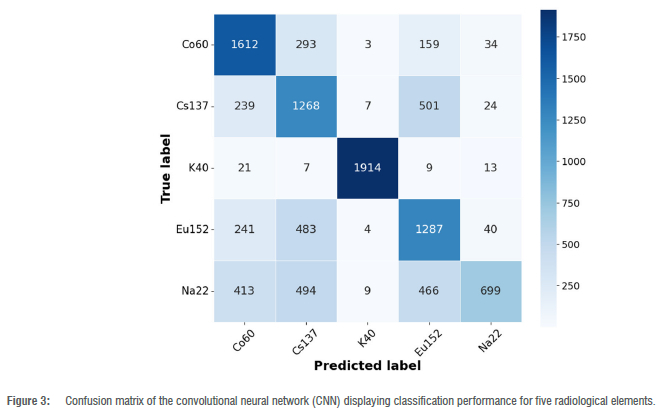
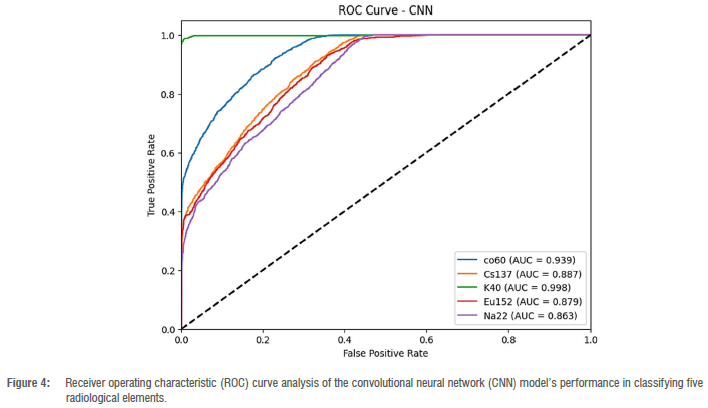
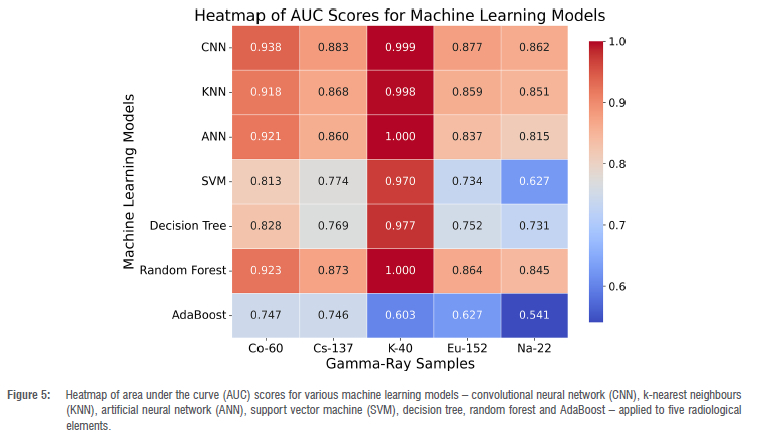
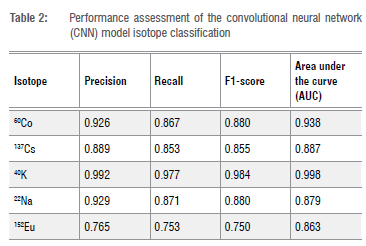
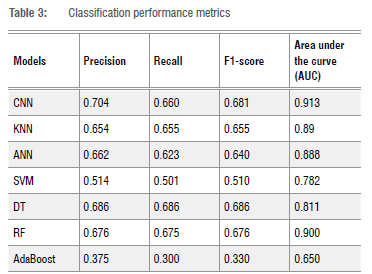
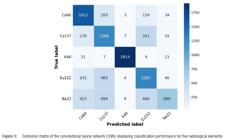
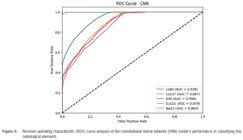
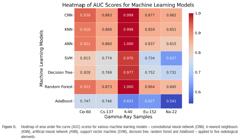
Gamma (γ)-ray spectrometry plays a crucial role in nuclear science, environmental radioactive monitoring and environmental safety. Traditional classification methods often struggle with overlapping spectral features, leading to misclassification errors. In this study, we investigated the use of convolutional neural networks (CNNs) for the automated classification of γ-ray spectra, evaluating the impact of various machine learning hyperparameters and data-preprocessing techniques on classification performance. We demonstrate that StandardScaler normalisation and dropout regularisation significantly improve the CNN's generalisation ability, reducing overfitting while maintaining high accuracy. We explored the importance of spectral features such as energy, peak area and centroid calculation in enhancing model performance. Our analysis reveals that, while deep learning significantly improves classification accuracy, careful feature selection and model optimisation are essential for achieving optimal results. Based on receiver operating characteristic (ROC) curve analysis, confusion matrices, precision, recall, F1-score, area under the ROC curve (AUC) values and heatmaps, the CNN model achieves the highest classification performance, with an F1-score of 0.681 and an ROC AUC of 0.913. The random forest and decision tree models also performed well, while AdaBoost struggled significantly, achieving an F1-score of 0.33 and an ROC AUC of 0.65, indicating limited classification ability. We conclude that deep learning models, particularly CNNs, offer substantial improvements in γ-ray spectrometry classification, providing a robust alternative to traditional machine learning algorithms. SIGNIFICANCE: This study demonstrates the potential of deep learning, particularly CNNs, to significantly improve the automation and accuracy of γ-ray spectrometry. By outperforming traditional machine learning algorithms and reducing reliance on manual feature extraction, the proposed CNN model enhances isotope classification, even in cases with overlapping spectral features. These findings support the development of faster, more reliable and scalable spectrometry systems for environmental radiation monitoring and nuclear safety applications. The work provides a foundation for integrating artificial intelligence-driven automation into routine laboratory workflows, improving both efficiency and analytical precision.
CNN; gamma-ray spectra; environmental radioactive monitoring; machine learning; deep learning
 Thumbnail
 Thumbnail
 Thumbnail
 Thumbnail
 Thumbnail