Automation of gamma-ray spectra: Convolutional neural networks versus traditional machine learning
Abstract
Gamma (γ)-ray spectrometry plays a crucial role in nuclear science, environmental radioactive monitoring and environmental safety. Traditional classification methods often struggle with overlapping spectral features, leading to misclassification errors. In this study, we investigated the use of convolutional neural networks (CNNs) for the automated classification of γ-ray spectra, evaluating the impact of various machine learning hyperparameters and data-preprocessing techniques on classification performance. We demonstrate that StandardScaler normalisation and dropout regularisation significantly improve the CNN's generalisation ability, reducing overfitting while maintaining high accuracy. We explored the importance of spectral features such as energy, peak area and centroid calculation in enhancing model performance. Our analysis reveals that, while deep learning significantly improves classification accuracy, careful feature selection and model optimisation are essential for achieving optimal results. Based on receiver operating characteristic (ROC) curve analysis, confusion matrices, precision, recall, F1-score, area under the ROC curve (AUC) values and heatmaps, the CNN model achieves the highest classification performance, with an F1-score of 0.681 and an ROC AUC of 0.913. The random forest and decision tree models also performed well, while AdaBoost struggled significantly, achieving an F1-score of 0.33 and an ROC AUC of 0.65, indicating limited classification ability. We conclude that deep learning models, particularly CNNs, offer substantial improvements in γ-ray spectrometry classification, providing a robust alternative to traditional machine learning algorithms. SIGNIFICANCE: This study demonstrates the potential of deep learning, particularly CNNs, to significantly improve the automation and accuracy of γ-ray spectrometry. By outperforming traditional machine learning algorithms and reducing reliance on manual feature extraction, the proposed CNN model enhances isotope classification, even in cases with overlapping spectral features. These findings support the development of faster, more reliable and scalable spectrometry systems for environmental radiation monitoring and nuclear safety applications. The work provides a foundation for integrating artificial intelligence-driven automation into routine laboratory workflows, improving both efficiency and analytical precision.
CNN; gamma-ray spectra; environmental radioactive monitoring; machine learning; deep learning
Introduction
Gamma (γ)-ray spectroscopy is a technique used to measure the energy and intensity of γ-rays emitted by radioactive substances.1,2 γ-rays are a form of high-energy electromagnetic radiation, typically released during the radioactive decay of atomic nuclei. By examining a sample's γ-ray emission spectrum, researchers can identify the specific radionuclides present and determine their concentrations.1 Radionuclides that emit γ-rays, such as potassium-40 (40K), cobalt-60 (60Co), thorium-232 (232Th) and uranium (238U), can be detected, identified and quantified using γ-ray spectrometry.3 This technique is fundamental for radionuclide monitoring, as it allows for the simultaneous analysis of multiple radionuclides, often with minimal sample preparation.4 The instrumentation typically involves solid-state detectors, such as hyper-pure germanium crystals, which are cooled by liquid nitrogen or electrically. These detectors are connected to electronic systems that process the electrical pulses generated by the detected γ-rays.5-7 In environmental radioactive laboratories, automating spectrometry procedures significantly enhances productivity and reduces the likelihood of human error.3 This is particularly important when handling large sample volumes or samples with hazardous radiation levels. Automation ensures accurate and reliable results while safeguarding the health and safety of laboratory personnel. By streamlining the analysis process and minimising manual intervention, laboratories can obtain results more quickly and efficiently. Automated systems also facilitate the tracking and analysis of large data sets, enabling the identification of patterns and trends that might otherwise be difficult to detect.
Despite the effectiveness of γ-ray spectrometry, automated isotope identification remains challenging due to overlapping spectral peaks, detector noise, spectral distortions and the large volume of data generated in environmental monitoring laboratories. Traditional machine learning (ML) methods often require manual feature engineering and may struggle to generalise when spectral features overlap significantly. Although several ML approaches have been explored for isotope classification, many studies rely on curated data sets, computationally intensive architectures or limited isotope classes. Furthermore, comparatively few studies investigate lightweight convolutional neural network (CNN) architectures suitable for real-time deployment in environmental radioactive monitoring laboratories.
Radioactive isotope
Due to their unique radioactive properties, 40K, 60Co, caesium-137 (137Cs), sodium-22 (22Na) and europium-152 (152Eu) are significant isotopes used in various applications. 60Co decays via beta (β)-emission and γ-radiation, emitting two prominent γ-rays at 1.17 MeV and 1.33 MeV, respectively. With a half-life of 5.27 years, it is widely used in industrial radiography, cancer treatment and the sterilisation of medical equipment.8 However, due to the high-energy γ-rays it emits, handling 60Co requires stringent safety precautions to mitigate radiation risks. 137Cs, which has a half-life of 30.17 years, undergoes beta decay and releases γ-radiation at 0.662 MeV. It is commonly used in radiotherapy, industrial gauges and environmental research. Additionally, 137Cs is a major radioactive waste product from nuclear accidents such as those at Fukushima and Chernobyl.9 Environmental radiation from 137Cs is a significant concern, as internal exposure can pose serious health risks.
40K is a naturally occurring isotope that contributes to background radiation and is also used in geological dating.7,10 152Eu is commonly used as a calibration source in research laboratories because of its well-defined γ-ray spectrum, although it requires careful handling due to radiation risks. 22Na emits γ-rays and positrons and is widely used in spectrometer calibration and positron emission tomography imaging, requiring proper shielding for safe use.7
Justification for using CNN models
CNNs offer several advantages for classification and data analysis in γ-ray spectroscopy.11 It excels at automatically extracting features from raw data, eliminating the need for labour-intensive manual feature engineering. This capability is particularly beneficial for γ-ray spectra, which often exhibit complex relationships between different energy levels. The architecture of CNNs, designed to capture spatial hierarchies, enables them to distinguish between different γ-ray sources effectively.12 CNNs are also resilient to noise, a common issue in spectroscopic data caused by background radiation and electronic interference.13 By focusing on relevant features and filtering out irrelevant variations, CNNs can improve the accuracy of classification tasks. Their deep architectures often achieve superior performance compared to traditional ML algorithms, especially in complex fields such as signal processing. Furthermore, pre-trained CNN models can be fine-tuned using γ-ray spectroscopy data through transfer learning, allowing researchers to leverage knowledge from large data sets in related domains.14-16 Lightweight CNNs reduce training complexity, decrease inference time and are more suitable for deployment in laboratory or embedded radiation monitoring systems where computational resources may be constrained. This capability is particularly useful when working with limited spectroscopic data. Additionally, CNNs are well suited for handling large data sets, making them ideal for extensive applications in γ-ray spectroscopy, where they enhance model performance and generalisation.
Traditional algorithms
Traditional ML algorithms have been widely applied in γ-spectroscopy and provide a strong foundation for various tasks.11,17,18 In γ-ray spectroscopy, various ML algorithms are employed to classify radiation types based on their energy levels and spectral signatures. The k-nearest neighbours (KNN) algorithm classifies data by identifying the closest points in the feature space, assuming similar data lie nearby.16,17 Artificial neural networks (ANNs) effectively capture complex, non-linear relationships for isotope identification and pattern recognition but require large data sets and careful tuning.16 Support vector machines (SVMs) separate classes by finding optimal hyperplanes, offering strong performance but at high computational cost.11,17 Decision trees (DTs) make classifications through sequential if-then rules, while random forests (RFs) enhance accuracy by averaging multiple DTs.11 Finally, AdaBoost combines several weak classifiers into a single strong one by emphasising misclassified instances, improving overall classification performance.16,18
Methodology
We evaluated supervised learning techniques for analysing training data sets in γ-ray spectroscopy, with a particular focus on developing and applying CNN architectures to assess their predictive accuracy and efficiency. The methodology encompasses data collection, energy calibration, feature extraction, CNN model design and hyperparameter optimisation. Each step is described in detail below.
Data collection
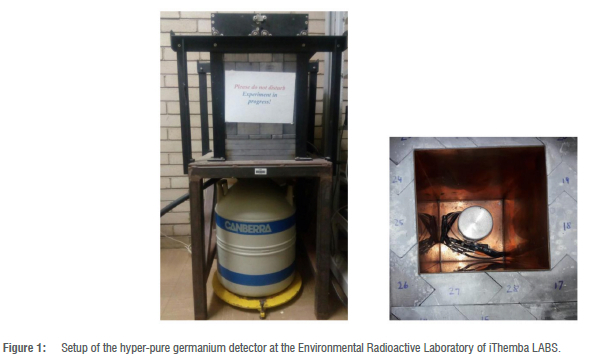
The data set used in this study consists of five known radioactive isotope samples: 40K, 60Co, 137Cs, 22Na and 152Eu. Each sample contains 8192 data points, representing the γ-ray spectra collected using a high-resolution hyper-pure germanium detector at the Environmental Radioactive Laboratory of iThemba LABS (Laboratory for Accelerator Based Science), as seen in Figure 1. The hyper-pure germanium detector, cooled by liquid nitrogen, ensures precise energy measurements and high-quality spectral data, which are critical for accurate identification and classification of radioactive isotopes.
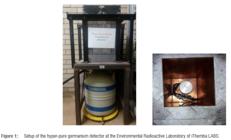
The samples were purchased from certified suppliers and prepared under controlled laboratory conditions to ensure consistency and reproducibility. The data-acquisition parameters, including detector type, sample size and environmental conditions, were standardised across all measurements to enhance the robustness of the predictive models. This standardisation is essential for automating γ-ray spectrometry and improving performance in applications such as environmental radiation monitoring.
Energy calibration
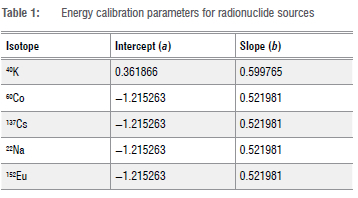
Energy calibration is a critical step in γ-ray spectrometry, as it ensures that the energy readings from the detector correspond accurately to the actual γ-ray energies. Detectors, such as scintillation or semiconductor detectors, initially provide output in 'channel numbers', which must be converted to energy values using a calibration equation. The calibration equation is typically linear and can be expressed as:

where E is the energy in keV, a is the intercept and b is the slope. These parameters are determined for each isotope based on known γ-ray energies and their corresponding channel numbers. Table 1 provides the calibration parameters and spectral data for the isotopes analysed in this study.
Feature extraction
To create a CNN model and apply traditional ML algorithms, several features were extracted from the γ-ray spectra. These features include peak height, full width at half-maximum (FWHM), peak area and centroid calculation. Each feature is described in full below.
FWHMThe FWHM is a measure of the width of an energy peak at half of its maximum height. It provides valuable information about the energy resolution of the detector and can help differentiate between isotopes with overlapping spectral features.19 The FWHM is calculated as:

where Ef and Ei are the energy values at half the maximum peak height.
Peak area
The peak area represents the total energy deposited within a peak and is proportional to the number of detected γ-rays.20 It is calculated by summing the counts within the peak region:

where Ni is the count (intensity) corresponding to energy.
Centroid
The centroid calculation determines the 'centre of mass' of a peak region in terms of channel numbers and their corresponding counts.21 A smoothed count is first obtained using a rolling window of five rows, which serves as the weight in the calculation. The centroid is then calculated as:

This weighted average represents the central channel number of the peak, taking into account both the channel positions and their associated intensities.22
CNN model design
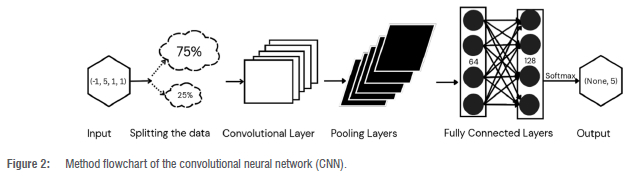
The preprocessing of γ-ray spectroscopy data, the construction of a CNN model and the evaluation of its effectiveness are central to this study. The data set, comprising channel, count, energy, peak area and centroid features, was split into training (75%), validation (15%) and test (10%) sets. The data were standardised using the Standard Scaler to ensure consistent scaling across features. Figure 2 illustrates the flowchart of the CNN model.
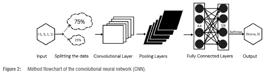
The CNN model consists of five convolutional layers with increasing filter sizes (16, 32, 64, 128, 256), each followed by a max-pooling layer. The activation function used in the convolutional and fully connected layers is the rectified linear unit (ReLU), while the output layer employs the softmax activation function for multi-class classification. After feature extraction, the network includes two fully connected layers with 64 and 128 neurons, respectively, and a dropout rate of 0.2 to prevent overfitting.
Hyperparameters
Hyperparameters were selected experimentally through manual tuning based on validation loss and classification performance. The CNN model was optimised using several key hyperparameters to enhance its performance for multi-class classification. A learning rate of 0.001 was chosen for the Adam optimiser to ensure efficient weight updates and faster convergence. A batch size of 32 was used to balance computational efficiency and model stability, while the number of epochs was set to 140 to ensure sufficient training iterations. Early stopping with a patience of 50 epochs was implemented to halt training when the validation loss stopped improving, thereby preventing overfitting. The dropout rate of 0.2 was applied in the fully connected layers to randomly deactivate neurons, further enhancing generalisation and decreasing overfitting.13,17
The evaluation of the CNN model involved several metrics, including precision, accuracy, recall, F1-score, the area under the receiver operating characteristic curve (AUC) score and a confusion matrix. These measurements offer a thorough assessment of the model's classification performance and ensure its suitability for γ-ray spectroscopy applications.
Traditional models configuration
Comparing ML models is essential for identifying the most effective algorithm for γ-ray spectrometry. Different models have unique strengths and weaknesses, impacting their ability to handle specific data, generalise across data sets and resist overfitting. The traditional ML models used in this study, along with their corresponding parameters and selected default values, are described as follows. The KNN model was configured with five neighbours and uniform weighting. The ANN, implemented as a multi-layer perceptron, utilised a single hidden layer of 100 neurons with a maximum of 1000 iterations. For the SVM, the regularisation parameter was set to 1.0, using the radial basis function and enabling probability estimation. The DT classifier was based on the Gini criterion with no maximum depth constraint. The RF model consisted of 100 estimators and also employed the Gini criterion. Lastly, the AdaBoost classifier was trained with 50 estimators and a learning rate of 1.0. These parameter configurations were chosen to ensure consistency and maintain the reliability of the models for comparative analysis.18,23,24
Results and discussion
The CNN model achieved an accuracy of 68%, indicating that it correctly classified 68% of the samples in the test set. While this is a reasonable performance, the accuracy metric alone does not provide a comprehensive view of the model's efficacy, particularly in the presence of class imbalance.
Classification matrices
Confusion matrix
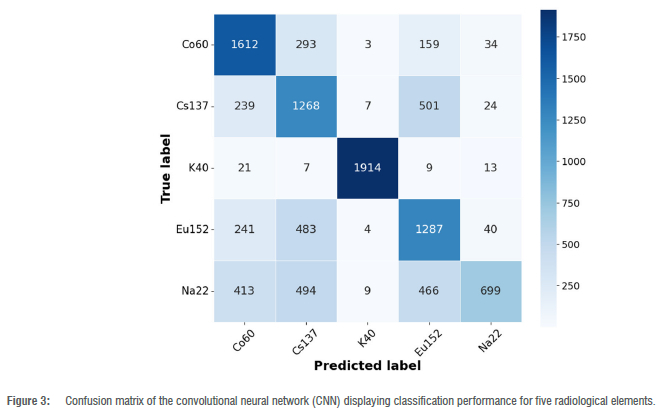
The model's classification performance is broken down in detail by the confusion matrix showing the number of correct and incorrect predictions for each class. Figure 3 presents the confusion matrix for the CNN model, which was used to classify five radiological elements.
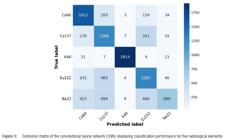
Each row of the confusion matrix represents the true labels (actual classes), while each column corresponds to the predicted labels (model predictions). The diagonal elements indicate correct predictions, while the off-diagonal elements represent misclassifications. The CNN model demonstrates strong performance for 40K, with 1914 samples correctly classified. However, significant confusion is observed between 152Eu and 137Cs, with 483 152Eu samples misclassified as 137Cs and 501 137Cs samples misclassified as 152Eu due to similarities in spectral peak distributions and overlapping energy regions, which reduce feature separability. This suggests that the model struggles to distinguish between these two isotopes, likely due to overlapping spectral features.
ROC curve
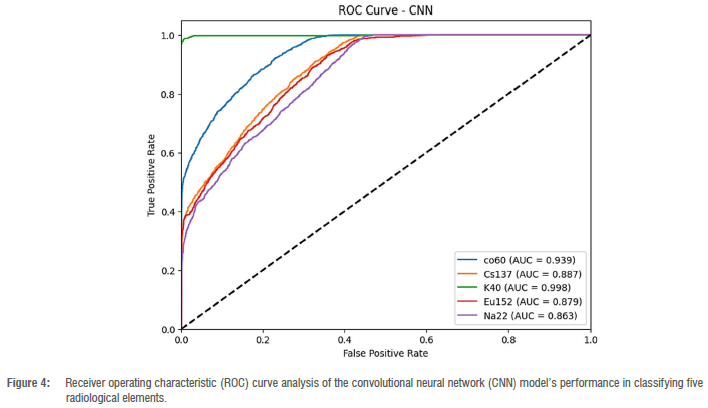
The ROC curve (Figure 4) illustrates the model's ability to differentiate between classes by plotting the true positive rate (sensitivity) against the false positive rate (1 minus specificity) at various threshold settings.
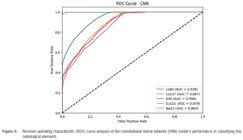
Each isotope's classification performance is represented by a unique curve, with the AUC providing a numerical summary of performance. An AUC closer to 1 indicates strong classification ability, while an AUC closer to 0.5 suggests random guessing.
40K exhibits the highest AUC value, indicating near-perfect separability. 60Co also performs well, with a high AUC, demonstrating strong classification capability. 137Cs, 152Eu and 22Na have slightly lower AUC values, suggesting that the model can distinguish these isotopes but with less consistency compared to 40K and 60Co. Although the CNN achieved a high AUC score, the moderate F1-score indicates challenges associated with class imbalance and spectral overlap. This suggests that, while the model separates classes effectively overall, misclassification remains present for certain isotopes.
Performance metric
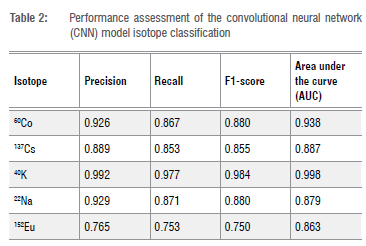
Recall, precision and F1-score are critical metrics for evaluating the performance of a classification model, especially in imbalanced data sets. Precision measures the model's ability to correctly identify positive instances, while recall evaluates its ability to capture all actual positive instances. The F1-score provides a balanced measure of precision and recall, making it particularly useful when both false positives and false negatives are of concern. These metrics from Table 2, along with the AUC values, offer a more comprehensive understanding of the model's performance than accuracy alone.
Comparison across models
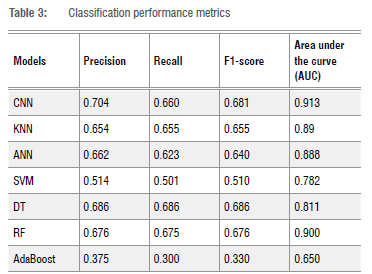
Table 3 compares the precision, recall, F1-score and AUC values for each model. These metrics are critical for evaluating classification performance, especially in imbalanced data sets.
The CNN model achieves the highest performance, with an F1-score of 0.681 and an AUC of 0.913, making it the most effective model. RF and DT also perform well, with F1-scores of 0.676 and 0.686, respectively. KNN and ANN show moderate performance, while SVM exhibits lower predictive ability. AdaBoost performs the worst, with significantly reduced precision, F1-score and recall values, making it unsuitable for this task.
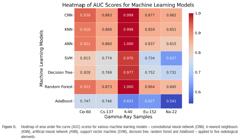
Heatmap of AUC scores
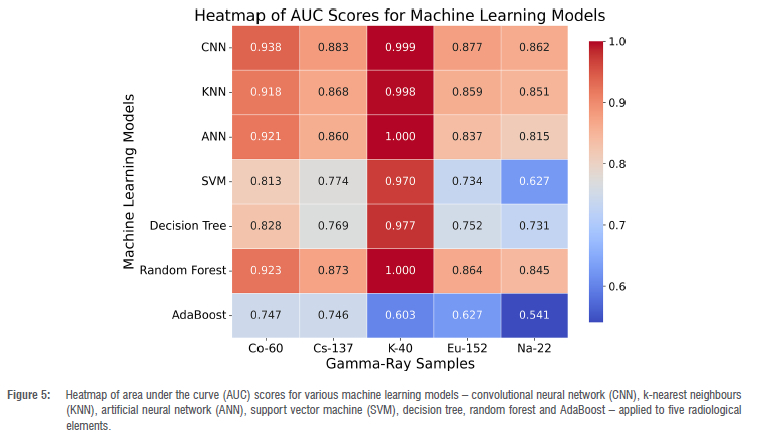
The performance from Figure 5 shows that deep learning models (CNN and ANN) achieve consistently high AUC scores, with CNN achieving an AUC of 0.999 and ANN achieving a perfect AUC of 1.000 for 40K. This makes them highly suitable for precise isotope identification. RF also performs exceptionally well, achieving a perfect AUC for 40K, demonstrating its robustness in handling spectral data. In contrast, AdaBoost struggles with significantly lower AUC scores (40K: 0.603, 152Eu: 0.627, 22Na: 0.541), likely due to its reliance on weak learners. SVM and DT perform moderately, although SVM struggles with 22Na (AUC = 0.627), indicating potential challenges in learning spectral features.
Discussion
The CNN model's performance significantly outperformed traditional ML models in classifying γ-ray spectroscopy samples, as evidenced by its higher precision, recall and F1-score. The confusion matrix revealed that the CNN model was particularly effective in identifying 40K and 60Co, with minimal misclassification. However, notable confusion was observed between 137Cs and 152Eu, as well as between 152Eu and 22Na. This suggests that overlapping spectral features pose a significant challenge, even for advanced deep learning models such as CNNs. Among the traditional ML models, RF and DT performed relatively well, achieving competitive F1-scores and AUC values. RF, in particular, demonstrated robust classification performance, indicating its ability to handle the complexity of spectral data effectively. This is likely due to RF's ensemble nature, which combines multiple decision trees to reduce overfitting and improve generalisation. However, models such as SVM and KNN exhibited moderate classification capabilities, struggling to maintain high recall values.
Importantly, this study has several limitations. First, the data set size was relatively limited and consisted of only five isotope classes. Additionally, spectra were acquired under controlled laboratory conditions, which may not fully represent complex environmental monitoring scenarios. Future studies should incorporate larger data sets, mixed-isotope spectra and real-time deployment evaluations.
Overall, the findings emphasise the importance of model selection based on application-specific requirements. For high-risk domains such as nuclear facility monitoring and radioactive contamination detection, models with high AUC scores, such as CNNs and RF, should be prioritised to ensure accurate identification, and the ability of CNNs to automatically extract relevant features from raw spectral data, combined with their robustness to noise, makes them particularly well-suited for this task.
Conclusion
This study demonstrates that CNN-based models significantly enhance the classification accuracy of γ-ray spectroscopy compared to traditional ML techniques. The superior performance of CNN, particularly in classifying 40K and 60Co, highlights the effectiveness of deep learning in feature extraction and pattern recognition. While RF and DT also showed competitive results, models such as SVM and KNN exhibited moderate success, and AdaBoost proved to be highly inadequate due to its weak classification power. The confusion matrix analysis underscores the challenge of distinguishing certain isotopes with overlapping spectral characteristics, particularly 137Cs and 152Eu. Future research could focus on optimising feature selection, exploring hybrid models or incorporating additional spectral features to further improve classification accuracy. Additionally, the use of transfer learning or more advanced architectures, such as attention mechanisms, could help address the limitations observed in distinguishing isotopes with similar spectral signatures.
The heatmap and ROC curve confirm that CNN outperforms traditional models, making it a promising tool for γ-ray spectrometry automation. Overall, this study provides a strong case for integrating CNN models into nuclear science applications, offering a robust, efficient and scalable solution for γ-ray spectrometry. The findings suggest that deep learning-based methods will play a crucial role in advancing automated spectrometry analysis, improving both efficiency and reliability in nuclear radiation detection and monitoring. By leveraging the strengths of CNNs, future work can further enhance the accuracy and applicability of γ-ray spectrometry in environmental monitoring, nuclear safety and other critical domains.
Funding
This research was made possible through the generous support and funding provided by the South African Institution of Nuclear and Technology Science (SAINTS), the South African National Research Foundation (NRF) and NRF-iThemba LABS.
Data availability
The data supporting the results of this study are available upon request to the corresponding author.
Declarations
We have no competing interests to declare. We have no AI or LLM use to declare. Ethical clearance was provided by the University of Venda (ethical clearance no: FSEA/24/PHY/06). Parts of this work were previously presented as a poster at the Centre for High Performance Computing National Conference 2025, South Africa. This work also forms part of V.M.'s MSc dissertation submitted to the University of Venda, South Africa.
Authors' contributions
V.M.: Formal analysis, methodology, writing - original draft, project administration. F.N.: Supervision, writing - review and editing. E.N.: Supervision, formal analysis, writing - review and editing. N.N.: Supervision, data curation, writing - review and editing. P.M.: Supervision, data curation, writing - review and editing. All authors read and approved the final manuscript.
Acknowledgements
We thank the National Research Foundation iThemba Laboratory for Accelerator Based Science (iThemba LABS) for granting access to their state-of-the-art facilities and resources. Special thanks are due to the Separated Sector Cyclotron Department for providing access to the Environmental Radioactivity Laboratory and the HPGe detector, which were instrumental to this study.
References
-
1. Salvador F, Marchais T, Perot B, Allinei PG, Morales F, Gueton O, et al. Low and high-resolution gamma-ray spectroscopy for the characterization of uranium contamination. Nucl Instrum Methods Phys Res Sect A. 2024;1065, Art. #169549. https://doi.org/10.1016/j.nima.2024.169549
» https://doi.org/10.1016/j.nima.2024.169549 - 2. Qiao J, Nielsen S. Radiochemical methods: Radionuclide monitoring. In: Worsfold P, Poole C, Townshend A, Miró M, editors. Encyclopedia of analytical science. 3rd ed. Amsterdam: Academic Press; 2019. p. 31-39.
-
3. Mrdja D, Forkapic S, Hansman J, Knezevic Radic J, Velimirovic D, Demirhan K. Low-level gamma ray counting on environmental samples. J Environ Radioact. 2024;278, Art. #107511. https://doi.org/10.1016/j.jenvrad.2024.107511
» https://doi.org/10.1016/j.jenvrad.2024.107511 - 4. Buchtela K. Radiochemical methods: Gamma-ray spectrometry. In: Worsfold P, Poole C, Townshend A, Miró M, editors. Encyclopedia of analytical science. 3rd ed. Amsterdam: Academic Press; 2019. p. 15-22.
-
5. Lee J, Kim H, Kye YU, Lee DY, Kim JK, Jo WS, et al. Source and LVis based coincidence summing correction in HPGe gamma-ray spectrometry. Nucl Eng Technol. 2022;54(5):1754-1759. https://doi.org/10.1016/j.net.2021.11.008
» https://doi.org/10.1016/j.net.2021.11.008 -
6. Quintana B, Pedrosa MC, Vázquez Canelas L, Santamaría R, Sanjuán MA, Puertas F. A method for the complete analysis of NORM building materials by gamma-ray spectrometry using HPGe detectors. Appl Radiat Isot. 2018;134:470-476. https://doi.org/10.1016/j.apradiso.2017.07.045
» https://doi.org/10.1016/j.apradiso.2017.07.045 -
7. Moniakowska A, Zhang D, Block-Łaszewska K, Olszewski G, Zaborska A, Strumińska-Parulska D. Radioactive isotopes 40K, 137Cs, 226Ra, 228Ra, 234Th in algae supplements - potential radiotoxicity of aquatic superfoods. J Food Compos Anal. 2022;114, Art. #104862. https://doi.org/10.1016/j.jfca.2022.104862
» https://doi.org/10.1016/j.jfca.2022.104862 -
8. Zhou Y, Chen X, Zhan Y, Sun F, Zhang J, He W. Research on the shielding performance of concrete in a 60Co irradiation environment. Nucl Eng Des. 2023;413, Art. #112575. https://doi.org/10.1016/j.nucengdes.2023.112575
» https://doi.org/10.1016/j.nucengdes.2023.112575 -
9. Guo X, Liu Y, Xu Z, Jin Z, Liu K, Yuan Z, et al. Multi-level radioisotope batteries based on 60Co γ source and radio voltaic/radio-photovoltaic dual effects. Sens Actuat A. 2018;275:119-128. https://doi.org/10.1016/j.sna.2018.04.010
» https://doi.org/10.1016/j.sna.2018.04.010 -
10. Poręba GJ, Murray A. Sediment tracing using environmental radionuclides; the distribution and behaviour of 137Cs and natural radioisotopes in a small loess agricultural watershed. Ecohydrol Hydrobiol. 2006;6(1):153-161. https://doi.org/10.1016/S1642-3593(06)70137-9
» https://doi.org/10.1016/S1642-3593(06)70137-9 -
11. Allinei PG, Pérot N, Pérot B, Marchais T, Fondement V, Toubon H, et al. Estimation of uranium concentration in ore samples with machine learning methods on HPGe gamma-ray spectra. Nucl Instrum Methods Phys Res A. 2022;1032, Art. #166597. https://doi.org/10.1016/j.nima.2022.166597
» https://doi.org/10.1016/j.nima.2022.166597 -
12. Deev V, Panchuk V, Boichenko E, Kirsanov D. Spectrum is a picture: Feasibility study of two-dimensional convolutional neural networks in spectral processing. Microchem J. 2024;205, Art. #111329. https://doi.org/10.1016/j.microc.2024.111329
» https://doi.org/10.1016/j.microc.2024.111329 -
13. Yu L, Wang J, Guo D, Peng W, Qiao R, Gong K, et al. CNN-based track reconstruction study for gamma-ray pair telescopes. Astron Comput. 2024;48, Art. #100834. https://doi.org/10.1016/j.ascom.2024.100834
» https://doi.org/10.1016/j.ascom.2024.100834 -
14. Nguyen-Duc T, Do-Dinh H, Fujita G, Tran-Thanh S. Multi 2D-CNN-based model for short-term PV power forecast embedded with Laplacian attention. Energy Rep. 2024;12:2086-2096. https://doi.org/10.1016/j.egyr.2024.08.020
» https://doi.org/10.1016/j.egyr.2024.08.020 -
15. Xie Y, Sun W, Ren M, Chen S, Huang Z, Pan X. Stacking ensemble learning models for daily runoff prediction using 1D and 2D CNNs. Expert Syst Appl. 2023;217, Art. #119469. https://doi.org/10.1016/j.eswa.2022.119469
» https://doi.org/10.1016/j.eswa.2022.119469 -
16. Galib SM, Bhowmik PK, Avachat AV, Lee HK. A comparative study of machine learning methods for automated identification of radioisotopes using NaI gamma-ray spectra. Nucl Eng Technol. 2021;53(12):4072-4079. https://doi.org/10.1016/j.net.2021.06.020
» https://doi.org/10.1016/j.net.2021.06.020 -
17. Khatiwada A, Klasky M, Lombardi M, Matheny J, Mohan A. Machine learning technique for isotopic determination of radioisotopes using HPGe γ-ray spectra. Nucl Instrum Methods Phys Res A. 2023;1054, Art. #168409. https://doi.org/10.1016/j.nima.2023.168409
» https://doi.org/10.1016/j.nima.2023.168409 -
18. Qi S, Zhao W, Chen Y, Chen W, Li J, Zhao H, et al. Comparison of machine learning approaches for radioisotope identification using NaI(Tl) gamma-ray spectrum. Appl Radiat Isot. 2022;186, Art. #110212. https://doi.org/10.1016/j.apradiso.2022.110212
» https://doi.org/10.1016/j.apradiso.2022.110212 - 19. Mirion Technologies. Improved FWHM fitting model in Genie 4.0: Application note. Meriden, CT: Mirion Technologies; 2023.
- 20. US Environmental Protection Agency (EPA). High resolution gamma-ray spectrometry analyses for normal operations and radiological incident response, EPA 402-B-17-001. Montgomery, AL: Office of Radiation and Indoor Air, National Analytical Radiation Environmental Laboratory; 2019.
-
21. Peterson RS. Experimental γ ray spectroscopy and investigations of environmental radioactivity. Oak Ridge, TN: Spectrum Techniques; 1996. Available from: https://web.physics.ucsb.edu/~phys128/experiments/gamma/GammaSpectroscopy.pdf
» https://web.physics.ucsb.edu/~phys128/experiments/gamma/GammaSpectroscopy.pdf -
22. Mousa A, Shahin I, Nassif AB, Elnagar A. Detection of Arabic offensive language in social media using machine learning models. Intell Syst Appl. 2024;22, Art. #200376. https://doi.org/10.1016/j.iswa.2024.200376
» https://doi.org/10.1016/j.iswa.2024.200376 -
23. Cho M, Hwang J, Lee S, Ko K, Kim W, Cho G. A counting-time optimization method for artificial neural network (ANN) based gamma-ray spectroscopy. Nucl Eng Technol. 2024;56(7):2690-2697. https://doi.org/10.1016/j.net.2024.02.029
» https://doi.org/10.1016/j.net.2024.02.029 -
24. Zhang Y, Ye Y, Qiu J, Fu C, Huang H, Wang R, et al. Study on quantitative interpretation of uranium spectral gamma-ray logging based on machine learning algorithm. Nucl Eng Technol. 2024;56(12):4959-4965. https://doi.org/10.1016/j.net.2024.07.004
» https://doi.org/10.1016/j.net.2024.07.004
Revised: 22 May 2026
Accepted: 04 July 2026
Published: 29 Sep. 2026
Funding: South African National Research Foundation, South African Institution of Nuclear and Technology Science