Taung and beyond: The mining history, geology and taphonomy of Australopithecus in South Africa
Abstract
South Africa is host to the single richest early hominin fossil record worldwide, including many examples of the endemic species Australopithecus africanus fossils. This species was first described by Raymond Dart in 1925 from the deposits near the town of Taung. Later, many more fossils, of different species and genera, were found in the caves of the Sterkfontein and Makapan Valleys. To understand this rich and diverse fossil record, we must understand how the landscape formed (cave formation processes) and changed (mining), when this happened (geochronology), and how the fossils were accumulated and modified (taphonomy). Here we provide a review of these themes to mark the centenary of the Taung Child discovery. We mark this moment in our field by critically reflecting on the role of extractive practices, especially centred around past mining of the Caves and the exclusion of many members of research teams. The South African Fossil Hominid sites provide a unique opportunity to expand our understanding of the intersection between human evolution and changing environmental conditions, as the karstic landscape and remnant cave systems preserve both fossils and sedimentary archives of past environmental change. We offer a perspective on future research areas: more standardised excavation practices and techniques to raise the quality of data collected from the caves and new techniques to date and extract palaeoclimate data from cave deposits themselves, to provide novel insights into the world of the early australopiths. SIGNIFICANCE: This review introduces the reader to the important fossil remains and palaeoclimate archives preserved within South Africa, highlighting the key species Australopithecus africanus and marking the centenary of its first description from the site of Taung. We review the geological and exploration history of the South African hominin fossil sites and discuss how they are intrinsically linked. We explore the impact of past extractive practices on the fossil and palaeoclimatic archives for past, current and future research. We go on to emphasise members of research teams who have been crucial to the discovery and recovery of fossils but have often been excluded and remained unnamed.
Australopithecus africanus; geological history; taphonomy; cave sediment; speleothems
Introduction
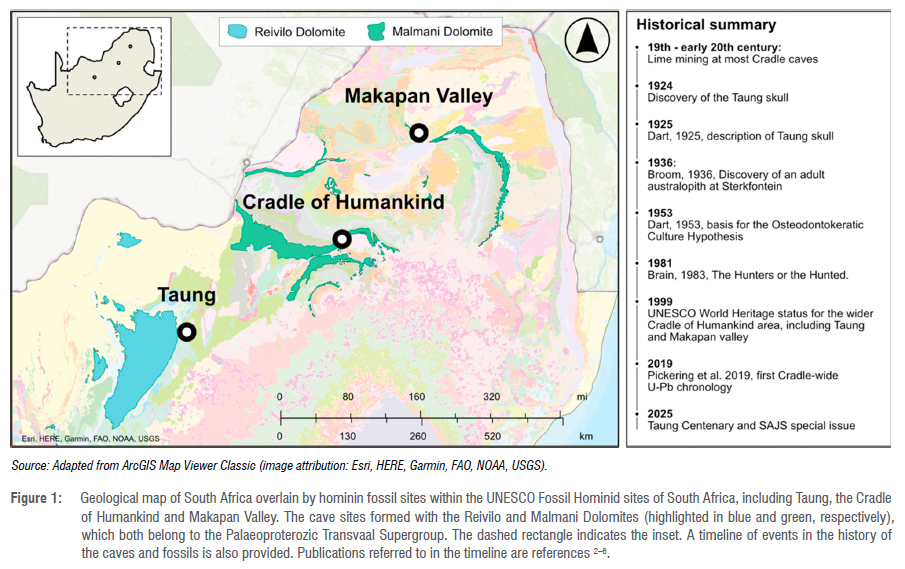
Fossils of Australopithecus africanus have been recovered from three localities within the UNESCO Fossil Hominid sites of South Africa: Taung, Makapan Valley, and the cave systems of the Cradle of Humankind (hereafter referred to as 'the Cradle'). These caves and palaeocave remnants formed within the Palaeoproterozoic Malmani (the Cradle and Makapan Valley) and Reivilo (Taung) Dolomites within the Transvaal Supergroup1Figure 1). In this contribution marking the centenary of the Taung Child discovery2Australopithecus africanus in context. We specifically zoom in on past extractive practices on the fossils and speleothems and how these impacted subsequent research, and emphasise people crucial to the history of scientific study who have largely remained unnamed and unacknowledged.
Historically, the bulk of early hominin research in southern Africa has been conducted in the Cradle, as it is by far the most densely packed fossil site in this region with localised cave systems, many of which have yielded hominin fossils. While this contribution marks the centenary of the Taung Child discovery, it is important to look at the wider UNESCO Fossil Hominid sites of South Africa (primarily the Cradle of Humankind and, to a lesser extent, Makapansgat Limeworks in Makapan Valley) to fully understand the history of scientific study. The bridge between the geological history and history of exploration/mining is that the specific geological processes created caves of interest to the mining industry, which, in turn, exposed the significance of the fossil material, marking the start of palaeontological research in South Africa. We go on to highlight the potential of innovative methods to further our understanding of the environmental context of the Taung Child and other key fossils within the UNESCO Fossil Hominin sites of South Africa.
Cave formation, sedimentation and climate dynamics
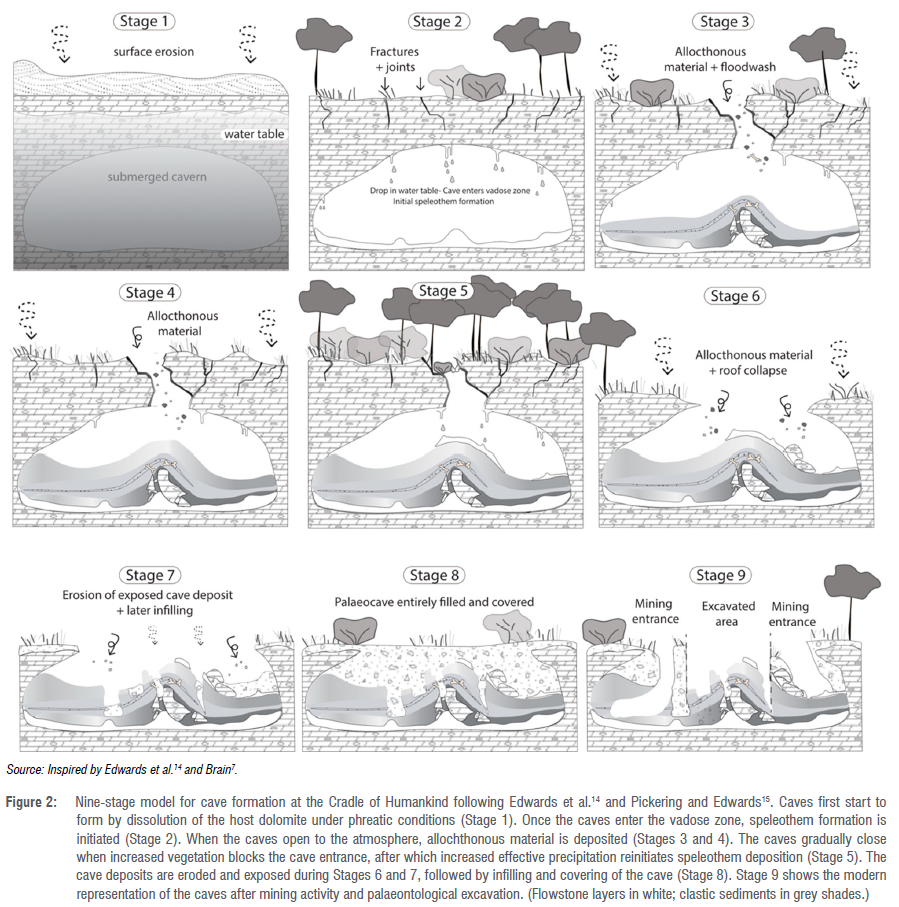
Previously, researchers divided up the cave sediments of the Cradle (palaeo-)caves into members based on their lithologies, leading to stratigraphies emphasising complexity.7-12131415Figure 2), albeit with site-specific characteristics and nuances. They show that, at the simplest level, only two sediment types are found within the caves: externally derived, fossil-rich clastic sediments (also referred to as breccia in the older literature) and in-situ speleothems (secondary cave carbonates, including stalagmites, stalactites, and flowstones). The caves we see today (Figure 2; Stage 9) are the result of speleothem and clastic deposition, erosion and sediment infill, mining and excavation. This model builds on previous work by Brain71613,17,186,1913,16
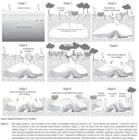
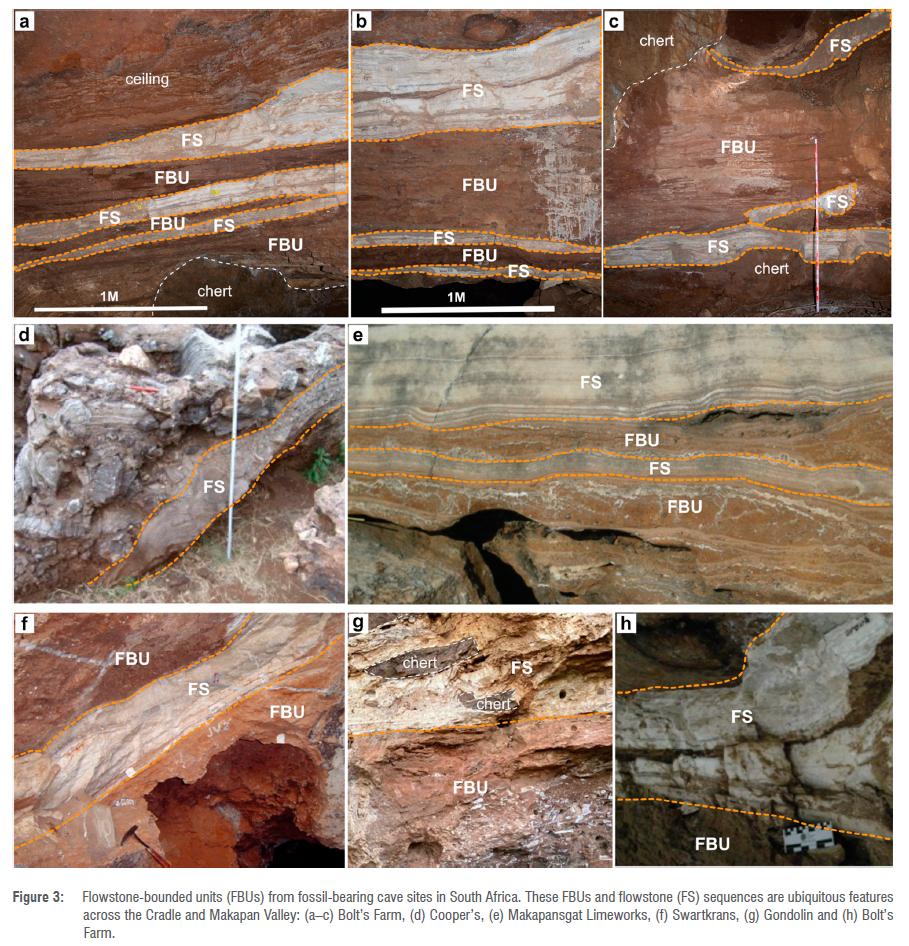
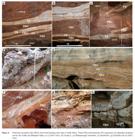
Speleothems can only form when they are uninterrupted by clastic sediment input, thus when the caves are closed or when little to no surface flooding occurs (Figure 2; Stage 2 and 5). Flowstones are horizontally bedded speleothems that form on walls and floors of caves from a central water drip source and are ubiquitous features in all Cradle caves6,13Figure 3). Speleothems, including flowstones, form only under the right climatic conditions when there is sufficient vegetation cover above the cave and water infiltrating the karst. In subtropical, semi-arid regions such as the Cradle, speleothem growth is primarily linked to climatic moisture availability2013,21Figure 3). These externally derived clastic and bone material can, naturally, only enter the cave when there is a direct connection to the surface above the cave.7,13,226Figure 2; Stage 3, 4, 6 and 7). By extension, the fossil record is also restricted to these dry periods, and represents short-lived, highly episodic sedimentation phases, meaning that our understanding of floral, faunal and hominin evolution is biased towards arid-adapted species.6,13
The evident cycles of deposition, erosion, and redeposition (Figure 2) in South African cave deposits23-2525,2627
Palaeoclimatic reconstruction using fossil fauna and flora, from different sites, points to the existence of mosaic habitats (a combination of open grassland, savannah woodland, and few patches of closed forest) (see Reynolds and Kibii2528
Fossil-bearing sediments formation, calcification and decalcification
The continued solution of dolomitic limestone by meteoric waters passing through fissures or joints leads to the formation of sinkholes and shafts that connect the ground surface to the caverns below.2930292913
The reverse process, sediment decalcification, occurs when calcium carbonate is removed or dissolved from sediment. Percolation of slightly acidic groundwater through the rock drives this process, leading to chemical weathering and dissolution over time. As the calcium carbonate is removed, the cementing material weakens, and the sediment may become less cohesive and more prone to fragmentation.5131931,32
Dating the caves, their infills and the fossils
There are several analytical techniques well suited to dating fossil cave sites and remains. The method used depends on the type of material (clastic sediment, speleothem, bone, tooth enamel) and the suspected age. Due to the limited range of methods applied to dating the Taung site, we refer to the wider UNESCO Fossil Hominid sites of South Africa (including Taung, the Cradle of Humankind and Makapan Valley).
To date, only palaeomagnetic analysis alone has provided an age for the Taung Child3333233,3435
Within the Cradle, fossils occur in clastic cave fill which exists in discrete packages sandwiched between extensive, horizontally bedded speleothems and are referred to as 'flowstone bounded units' (FBUs). In comparison, key early hominin fossils in eastern Africa are preserved between volcanic ash beds, allowing for potassium/argon (K/Ar) or argon/argon (Ar/Ar) dating, which brackets fossils and provides accurate radiogenic age estimates.36,373839,404142
The most widely applied dating technique is palaeomagnetism - a correlative technique which measures changes in Earth's magnetic field as they are recorded in rocks and sediments and makes comparisons against known archives (e.g. Geomagnetic Instability Timescale [GIT] and Geomagnetic Polarity Time Scale [GPTS]). Ideally, palaeomagnetic records will be anchored by some form of radiogenic date, i.e. uranium-lead (U-Pb), electron spin resonance (ESR) dating or cosmogenic nuclide dating. The applicability of palaeomagnetic techniques relies on the completeness of a sediment package and a thorough understanding of the depositional or formational environment.433314,4445464748493247,50 51-538,41,47,50,54
Dating speleothems directly is possible with the radiometric U-Th and U-Pb technique. The U-Pb method is well established and usually applied to small resistant silicate minerals such as zircon. Indeed, the challenge was adapting the sample preparation and measurement protocols to be applicable to carbonate minerals555617,576,14,44,4558
Cosmogenic nuclide dating aims to apply a chronology to the evolution of landscapes, including erosion and fluvial incision rates, sedimentary deposition and soil formation.515159-61Australopithecus specimen 'Little Foot' (StW573) from Sterkfontein via cosmogenic nuclide burial dating resulted in an age of 3.67 ± 0.16 Ma.606162,6340,41,6431,62,63
The Witwatersrand gold rush and cave exploration and mining
Palaeontological and archaeological discoveries in South Africa are heavily intertwined with gold rushes and cave exploration/mining.65 66676869703)70657172
Hierarchy in mining and its relevance to fossil discoveries
The first formal mining operations in South Africa were established in 1852737475767778
Mining activity was divided into two factions: the 'unskilled' labour contingent made up of people of colour and the 'skilled' overseers who dictated how operations were run.7479
Quarrying at Taung began after World War 1 (c. 1918) by the Northern Lime Company, and formally closed in 1977 under the name Pretoria Portland Cement Company Limited (commonly PPC Cement). The economic boom of the country was underpinned by the discovery of both diamonds (mostly from Kimberley, discovered in 1867) and gold along the Witwatersrand Reef in Johannesburg (c. 18867480
What is known is that life for these mine workers was dangerous and short. Many migrant workers, whose families lived distantly, died in mine hospitals and were considered "unclaimed".818282,83
There is some shift in the ethos surrounding people considered "technicians". For example, Stephen Motsumi and Nkwane Molefe were acknowledged for the critical role they played in the discovery of Little Foot, the Australopithecus prometheus partial skeleton.84Homo aff. erectus specimen, DHN 134, Simon, after him.468586
Challenges and biases introduced by lime mining
Mining activities in South Africa have played a pivotal role in the discovery of fossil hominins, with finds like the Taung Child skull capturing the attention of the scientific community worldwide. However, alongside these discoveries, come ethical concerns surrounding the exploitation of natural resources and the cultural ownership of palaeontological finds. Questions arise regarding the transparency of fossil disclosure and the extent to which fossils found by miners were properly documented and donated to institutions, such as the Ditsong Museum (see Black et al. in this issue87
Most Cradle sites were exploited for lime during the 19th and early 20th centuries, although there are few records of these activities during this time and almost no scientific or historical studies were done (to the best of our knowledge). Mining removed large amounts of cave carbonate, often transported and combusted in on-site lime kilns, such as those seen at caves like Gondolin and Bolt's Farm.47,71488686589
The Osteodontokeratic culture and later cave taphonomy research
Discovery of the Taung Child prompted further exploration into similar lime-rich deposits across South Africa. These included the White Limes Limited Limeworks, a crude quarry operation in the Makapansgat Caves, Limpopo Province.90909090,9192
These unique assemblages, with their peculiar skeletal representations, when viewed from the lens of the researchers who had just lived through two major global wars939490,953(p.209). This was used to explain modern human violence9396,979697
One researcher in particular, Charles Kimberlin Brain, began to develop alternative explanations for the accumulation of fossil bones based on his excavations at Swartkrans Cave in the Cradle. Brain revolutionised the field of taphonomy by including a range of different observational and actualistic experiments. These included not only the accumulating behaviours of hyaenids, but also expanded to show that leopards (Panthera pardus) were capable of amassing large ungulate fauna into cave systems below their preferred tree caches.5
Cave taphonomy also offers perspectives on palaeoenvironments, palaeoecology, and the relationships that would have existed between living things and cave systems over time. Although earlier researchers were primarily concerned with the taxonomic composition of vertebrate remains in the caves in South Africa, the last seven decades have seen a concerted effort in reconstructing depositional histories and cave taphonomy. Reconstructing the complex taphonomic history of fossil assemblages has taken a multiproxy approach, including geochronology9,17,40,51,985,25,99,100101102103104
Taphonomic studies on the direct impact of mining on fossils have not been done. That said, the broader impact of dynamite blasting for speleothems in caves has certainly impacted cave geology and interpretation, with nearly every site in the Cradle of Humankind preserving a fossiliferous 'miners dump'. Several of these dumps (such as that of Gondolin mentioned above89105Australopithecus prometheus 'Little Foot' and Australopithecus sediba, fossil finds in the dumps have been placed in actual in-situ stratigraphic locations in the caves and turned out to be the discovery of partial skeletons.84,10691107108
The curious case of the Taung Child's taphonomy
The Taung Child is, to date, the only known hominin specimen recovered from the pink clay and siltstone (PCS, aka 'Pink Fill') deposits, formerly the Dart Pinnacle341092,38,96,110
In his description of the Taung faunal assemblage111
These features identified in the faunal assemblage, and the Taung Child skull itself, are now attributed to eagle activity.112113{Aquila verreauxii); crowned eagle (Stephanoaetus coronatus); and martial eagle (Polemaetus bellicosus). Subsequent research argued that the crowned eagle left the most similar markings on the crania of small primates.114-116112113
Prospects of cave research and conclusions
Much of the clastic sediments and speleothems were removed or displaced during mining in the late 19th and early 20th centuries. Consequently, invaluable parts of the fossil record, within the clastic sediments, and the climatic record archived by the speleothems were lost. Nonetheless, the antiquity of Australopithecus africanus and other hominins is now well understood and constrained through the dating of fossil deposits and flowstones.6,33,44
The missing piece of the puzzle, however, is understanding how climatic and environmental change influenced the rise and demise of Australopithecus and other hominins. Speleothems are invaluable archives, recording such changes via multiple proxies. Despite having lost the bulk of speleothem deposits due to mining activities, flowstones are still ubiquitous features in the Cradle and Makapansgat caves and provide an under-studied resource for palaeoclimatic and -environmental reconstructions. Speleothem and fluid inclusion stable isotopes, coupled with analyses of the abundance of GDGT lipids (TEX86) within the same speleothems, allow for direct comparison of the two palaeothermometry methods and thus provide robust temperature reconstructions117,1181196120
Another important and recent research development is the establishment of world-class dating facilities in South Africa. Historically, the lack of such facilities in the country, and in fact on the continent, meant that all U-Th and U-Pb dating of speleothems was done overseas, where analytical costs were high and there was very limited investment in local human capacity building. The new dating capabilities at several universities (including the University of Cape Town and the University of Johannesburg) allow for in-country analysis, leading to both job and critical skills development within South Africa and the African continent.
One of the major challenges in South African cave research is the lack of standardised methodology and excavation protocols. Research teams use different methods for collecting and analysing data, making it difficult to compare results across studies/sites as different research teams bring their own experience, perspective and knowledge and thus their own way of conducting research. This leads to differences in excavation practices, sampling methods and data recording. To clarify the depositional and post-depositional histories, future studies must incorporate new technologies and analytical techniques. For instance, advances in imaging, geochemical analysis, and data modelling offer exciting opportunities for a more comprehensive understanding of past ecosystems and the processes that shaped them. The integration of advanced technologies, such as LiDAR scanning and 3D mapping, to create detailed 3D models of cave systems can provide valuable insights into their formation and development over time, and provide detailed data with which to test taphonomic interpretations.12112214,44,52,123
To our best knowledge, none of these techniques described above has been applied to understanding depositional processes and environmental change at Taung. While more challenging for tufa deposits, the Taung carbonates could be dated with U-Th and U-Pb to refine the existing palaeomagnetic ages. Additionally, trace element analyses could provide valuable palaeohydrological proxy data, further improving our understanding of the environmental context of Australopithecus africanus at Taung. Similarly, additional work on the faunal assemblages, very little of which has been revisited in the past two decades (last assessed in McKee124
The history of South Africa's palaeontological and archaeological discoveries is closely linked to gold rushes and cave exploration (see Ackermann et al. in this issue66
Funding
We gratefully acknowledge our funders: the South African National Research Foundation African Origins Platform and Rated Researchers Grant Scheme (R.P), NRF-DSI Centre of Excellence in Palaeosciences/ GENUS for postgraduate, postdoc and operations grants (R.P., T.R.E.), the University of Cape Town Vice Chancellors VC2030 Future Leaders grant (R.P, T.R.E., R.W.), University of Cape Town #AdvancingWomxn grant (r.P, G.L.), Oppenheimer Memorial Trust (R.W.), the INQUA Fellowship for International Mobility (R.W.), BIOGRIP (T.R.E., R.W.), Francis H. Brown African Scholarship Fund (Leakey Foundation; G.L.), the Organization for Women in Science for the Developing World (OSWD; G.L.) and the Swedish International Development Cooperation Agency (SIDA; G.L.). This research contributes towards the output of the Biogeochemistry Research Infrastructure Platform (BIOGRIP), supported by the South African Department of Science, Technology and Innovation.
Data availability
There are no data pertaining to this study/article.
Declarations
We have no competing interests to declare. We have no AI or LLM use to declare.
Authors' contributions
R.W.: Conceptualisation, methodology, writing - initial draft, student supervision, project management, funding acquisition. S.E.B.: Conceptualisation, methodology, writing - initial draft, writing -revisions, project management. T.R.E.: Conceptualisation, methodology, writing - initial draft, funding acquisition. J.K.: Conceptualisation, methodology, writing - initial draft, writing - revisions, project management. G.L.: Conceptualisation, methodology, writing - initial draft. R.P: Conceptualisation, methodology, writing - initial draft, funding acquisition. All authors read and approved the final manuscript.
Acknowledgements
We thank the various landowners and custodians for access to their properties. We also thank the South African Heritage Resource Agency, the Cradle Management Authority, and the Taung Skull Fossil World Heritage Site Management Authority for their contribution to permitting, monitoring and preserving national heritage resources. We acknowledge the contributions of the many unnamed and forgotten mine workers and field specialists throughout the decades of cave research in South Africa. We thank the two anonymous reviewers for their critical but insightful comments which improved this manuscript and the SAJS team for careful editorial handling.
References
- 1. Walraven F, Martini J. Zircon Pb-evaporation age determinations of the oak tree formation, Chuniespoort group, Transvaal sequence: Implications for Transvaal-Griqualand west basin correlations. S Afr J Geol. 1995;98:58-67.
-
2. Dart RA. The Taungs skull. Nature. 1925;116:462. https://doi.org/10.1038/116462a0
» https://doi.org/10.1038/116462a0 - 3. Dart RA. The predatory transition from ape to man. In: International anthropological and linguistic review. Vol. 1. Leiden: Brill; 1953.
-
4. Broom R. New fossil anthropoid skull from South Africa. Nature. 1936; 138:486-488. https://doi.org/10.1038/138486a0
» https://doi.org/10.1038/138486a0 - 5. Brain CK. The hunters or the hunted?: An introduction to African cave taphonomy. Chicago, IL: University of Chicago Press; 1983. p. 365.
-
6. Pickering R, Herries AI, Woodhead JD, Hellstrom JC, Green HE, Paul B, et al. U-Pb-dated flowstones restrict South African early hominin record to dry climate phases. Nature. 2019;565:226-229. https://doi.org/10.1038/s41586-018-0711-0
» https://doi.org/10.1038/s41586-018-0711-0 - 7. Brain CK. The Transvaal ape-man-bearing cave deposits. Transvaal Museum Memoir 11. Pretoria: Transvaal Museum; 1958.
- 8. Partridge TC. Hominid-bearing cave and tufa deposits. In: Partridge TC, Maud RR, editors. The Cenozoic in southern Africa. Oxford: Oxford University Press; 2000. p. 100-125.
-
9. Partridge TC. Re-appraisal of lithostratigraphy of Sterkfontein hominid site. Nature. 1978;275:282-287. https://doi.org/10.1038/275282a0
» https://doi.org/10.1038/275282a0 -
10. Bruxelles L, Clarke RJ, Maire R, Ortega R, Stratford D. Stratigraphic analysis of the Sterkfontein StW 573 Australopithecus skeleton and implications for its age. J Hum Evol. 2014;70:36-48. https://doi.org/10.1016/j.jhevol.2014.02.014
» https://doi.org/10.1016/j.jhevol.2014.02.014 - 11. Bruxelles L, Maire R, Couzens R, Thackeray JF, Braga J. A revised stratigraphy of Kromdraai. In: Braga J, Thackeray JF, editors. Kromdraai, a birthplace of Paranthropus in the Cradle of Humankind. Toronto: Sun Media Metro; 2016. p. 31-47.
-
12. Stratford D, Grab S, Pickering TR. The stratigraphy and formation history of fossil- and artefact-bearing sediments in the Milner Hall, Sterkfontein Cave, South Africa: New interpretations and implications for palaeoanthropology and archaeology. J Afr Earth Sci. 2014;96:155-167. https://doi.org/10.106/j.jafrearsci.2014.04.002
» https://doi.org/10.106/j.jafrearsci.2014.04.002 -
13. Pickering R, Hancox PJ, Lee-Thorp JA, Grün R, Mortimer GE, McCulloch M, et al. Stratigraphy, U-Th chronology, and paleoenvironments at Gladysvale Cave: Insights into the climatic control of South African hominin-bearing cave deposits. J Hum Evol. 2007;53:602-619. https://doi.org/10.1016/j.jhevol.2007.02.005
» https://doi.org/10.1016/j.jhevol.2007.02.005 -
14. Edwards TR, Pickering R, Mallett TL, Herries AI. Reconstructing the depositional history and age of fossil-bearing palaeokarst: A multidisciplinary example from the terminal Pliocene Aves Cave Complex, Bolt's Farm, South Africa. Results Geophys Sci. 2020;1, Art. #100005. https://doi.org/10.1016/j.ringps.2020.100005
» https://doi.org/10.1016/j.ringps.2020.100005 - 15. Pickering R, Edwards TR. A simple Cradle-wide sedimentological model demystifying the complexity of the South African Paranthropus-bearing cave deposits. In: Constantino PJ, Reed KE, Wood BA, editors. Paleobiology of Paranthropus: The forgotten lineage(s). Cham: Springer. In press 2024.
-
16. Moriarty KC, McCulloch MT, Wells RT, McDowell MC. Mid-Pleistocene cave fills, megafaunal remains and climate change at Naracoorte, South Australia: Towards a predictive model using U-Th dating of speleothems. Palaeogeogr Palaeoclimatol Palaeoecol. 2000;159:113-143. https://doi.org/10.1016/S0031-0182(00)00036-5
» https://doi.org/10.1016/S0031-0182(00)00036-5 -
17. Pickering R, Kramers JD, Partridge T, Kodolanyi J, Pettke T. U-Pb dating of calcite-aragonite layers in speleothems from hominin sites in South Africa by MC-ICP-MS. Quat Geochronol. 2010;5:544-558. https://doi.org/10.1016/j.quageo.2009.12.004
» https://doi.org/10.1016/j.quageo.2009.12.004 -
18. Pickering R, Kramers JD, Hancox PJ, de Ruiter DJ, Woodhead JD. Contemporary flowstone development links early hominin bearing cave deposits in South Africa. Earth Planet Sci Lett. 2011;306:23-32. https://doi.org/10.1016/j.epsl.2011.03.019
» https://doi.org/10.1016/j.epsl.2011.03.019 - 19. Brain C. The influence of climatic changes on the completeness of the early hominid record in southern African caves, with particular reference to Swartkrans. In: Vrba ES, Denton GH, Partridge TC, Burkle L, editors. Paleoclimate and evolution, with emphasis on human origins. New Haven, CT: Yale University Press; 1995. p. 451-458.
-
20. Weij R, Sniderman JK, Woodhead J, Hellstrom J, Brown JR, Drysdale R, et al. Elevated southern hemisphere moisture availability during glacial periods. Nature. 2024;626:319-326. https://doi.org/10.1038/s41586-023-06989-3
» https://doi.org/10.1038/s41586-023-06989-3 -
21. Ayliffe LK, Marianelli PC, Moriarty KC, Wells RT, McCulloch MT, Mortimer GE, et al. 500 ka Precipitation record from southeastern Australia: Evidence for interglacial relative aridity. Geology. 1998;26:147-150. https://doi.org/10.1130/0091-7613(1998)026<0147:KPRFSA>2.3.CO;2
» https://doi.org/10.1130/0091-7613(1998)026<0147:KPRFSA>2.3.CO;2 -
22. Weij R, Woodhead JD, Sniderman JK, Hellstrom JC, Reed E, Bourne S, et al. Cave opening and fossil accumulation in Naracoorte, Australia, through charcoal and pollen in dated speleothems. Commun Earth Environ. 2022;3:210. https://doi.org/10.1038/s43247-022-00538-y
» https://doi.org/10.1038/s43247-022-00538-y - 23. De Ruiter D. Revised faunal lists for members 1-3 of Swartkrans, South Africa. Ann Transvaal Mus. 2003;40:29-41.
-
24. Herries AI, Curnoe D, Adams JW. A multi-disciplinary seriation of early Homo and Paranthropus bearing palaeocaves in southern Africa. Quat Int. 2009;202:14-28. https://doi.org/10.1016/j.quaint.2008.05.017
» https://doi.org/10.1016/j.quaint.2008.05.017 - 25. Reynolds SC, Kibii JM. Sterkfontein at 75: Review of paleoenvironments, fauna, dating and archaeology from the hominin site of Sterkfontein (Gauteng Province, South Africa). Palaeontol Afr. 2011;46:59-88.
-
26. Hopley PJ, Maslin MA. Climate-averaging of terrestrial faunas: An example from the Plio-Pleistocene of South Africa. Paleobiology. 2010;36:32-50. https://doi.org/10.1666/0094-8373-36.1.32
» https://doi.org/10.1666/0094-8373-36.1.32 -
27. Knight J, Fitchett JM. Climate change during the late quaternary in South Africa. In: Raboral R, editor. The geography of South Africa: Contemporary changes and new directions. Cham: Springer; 2019. p. 37-45. https://doi.org/10.1007/978-3-319-94974-1_5
» https://doi.org/10.1007/978-3-319-94974-1_5 -
28. Hopley PJ, Weedon GP, Brierley CM, Thrasivoulou C, Herries AI, Dinckal A, et al. Orbital forcing and the spread of C4 grasses in the late Neogene: Stable isotope evidence from South African speleothems. J Hum Evol. 2007;53:620-634. https://doi.org/10.1016/j.jhevol.2007.03.007
» https://doi.org/10.1016/j.jhevol.2007.03.007 -
29. O'Connor S, Barham A, Aplin K, Maloney T. Cave stratigraphies and cave breccias: Implications for sediment accumulation and removal models and interpreting the record of human occupation. J Archaeol Sci. 2017;77:143-159. https://doi.org/10.1016/j.jas.2016.05.002
» https://doi.org/10.1016/j.jas.2016.05.002 - 30. Kowalski K. Paleontology of caves: Pleistocene mammals. In: Culver DC, White WB, editors. Encyclopedia of caves. Cambridge, MA: Elsevier Academic Press; 2004. p. 431-435.
-
31. Makhubela T, Kramers J, Scherler D, Wittmann H, Dirks P, Winkler S. Effects of long soil surface residence times on apparent cosmogenic nuclide denudation rates and burial ages in the Cradle of Humankind, South Africa. Earth Surf Process Landforms. 2019;44:2968-2981. https://doi.org/10.1002/esp.4723
» https://doi.org/10.1002/esp.4723 -
32. Stratford D. The geological setting, cave formation, and stratigraphy of the fossil-bearing deposits at Sterkfontein Caves. In: Zipfel B, Richmond BG, Ward CV, editors. Hominin postcranial remains from Sterkfontein, South Africa, 1936-1995. Oxford: Oxford University Press; 2020. p. 8-20. https://doi.org/10.1093/oso/9780197507667.003.0002
» https://doi.org/10.1093/oso/9780197507667.003.0002 -
33. Herries AI, Pickering R, Adams JW, Curnoe D, Warr G, Latham AG, et al. A multi-disciplinary perspective on the age of Australopithecus in southern Africa. In: Kimbel WH, Delezene LK, editors. The paleobiology of Australopithecus. Dordrecht: Springer; 2013. p. 21-10. https://doi.org/10.1007/978-94-007-5919-0_3
» https://doi.org/10.1007/978-94-007-5919-0_3 -
34. Hopley PJ, Herries AI, Baker SE, Kuhn BF, Menter CG. Brief communication: Beyond the South African cave paradigm - Australopithecus africanus from Plio-Pleistocene paleosol deposits at Taung. Am J Phys Anthropol. 2013;151:316-324. https://doi.org/10.1002/ajpa.22272
» https://doi.org/10.1002/ajpa.22272 -
35. McKee JK. Return to the Taung cave paradigm. Am J Phys Anthropol. 2016;159:348-351. https://doi.org/10.1002/ajpa.22883
» https://doi.org/10.1002/ajpa.22883 -
36. Deino AL. 40Ar/39Ar dating of Laetoli, Tanzania. In: Harrison T, editor. Paleontology and geology of Laetoli: Human evolution in context. Vertebrate paleobiology and paleoanthropology series. Dordrecht: Springer; 2011. p. 77-97. https://doi.org/10.1007/978-90-481-9956-3_4
» https://doi.org/10.1007/978-90-481-9956-3_4 -
37. McDougall I. K-Ar and 40Ar/39Ar dating of the hominid-bearing Pliocene-Pleistocene sequence at Koobi Fora, Lake Turkana, northern Kenya. Geol Soc Am Bull. 1985;96:159-175. https://doi.org/10.1130/0016-7606(1985)96<159:KAADOT>2.0.CO;2
» https://doi.org/10.1130/0016-7606(1985)96<159:KAADOT>2.0.CO;2 -
38. McKee JK. Faunal turnover rates and mammalian biodiversity of the late Pliocene and Pleistocene of eastern Africa. Paleobiology. 2001;27:500-511. https://doi.org/10.1666/0094-8373(2001)027<0500:FTRAMB>2.0.CO;2
» https://doi.org/10.1666/0094-8373(2001)027<0500:FTRAMB>2.0.CO;2 - 39. Clarke R, Kuman K. The Sterkfontein caves palaeontological and archaeological sites. Johannesburg: University of the Witwatersrand; 2000.
-
40. Pickering R, Kramers JD. Re-appraisal of the stratigraphy and determination of new U-Pb dates for the Sterkfontein hominin site, South Africa. J Hum Evol. 2010;59:70-86. https://doi.org/10.1016/j.jhevol.2010.03.014
» https://doi.org/10.1016/j.jhevol.2010.03.014 -
41. Herries AI, Shaw J. Palaeomagnetic analysis of the Sterkfontein palaeocave deposits: Implications for the age of the hominin fossils and stone tool industries. J Hum Evol. 2011;60:523-539. https://doi.org/10.1016/j.jhevol.2010.09.001
» https://doi.org/10.1016/j.jhevol.2010.09.001 -
42. Frost SR, White FJ, Reda HG, Gilbert CC. Biochronology of South African hominin-bearing sites: A reassessment using cercopithecid primates. Proc Natl Acad Sci USA. 2022;119, e2210627119. https://doi.org/10.1073/pnas.2210627119
» https://doi.org/10.1073/pnas.2210627119 -
43. Bosák P Pruner IP Kadlec J. Magnetostratigraphy of cave sediments: Application and limits. Stud Geophys Geod. 2003;47:301-330. https://doi.org/10.1023/A:1023723708430
» https://doi.org/10.1023/A:1023723708430 -
44. Edwards TR, Pickering R, Mallett TL, Herries AI. Challenging the antiquity of the Cradle of Humankind, South Africa: Geochronological evidence restricts the age of Eurotomys bolti and Parapapio to less than 2.3 Ma at Waypoint 160, Bolt's Farm. J Hum Evol. 2023;178, 103334. https://doi.org/10.1016/j.jhevol.2023.103334
» https://doi.org/10.1016/j.jhevol.2023.103334 -
45. Pickering R, Herries AI. A new multidisciplinary age of 2.61-2.07 Ma for the Sterkfontein Member 4 australopiths. In: Zipfel B, Richmond BG, Ward CV, editors. Hominin postcranial remains from Sterkfontein, South Africa, 1936-1995. Oxford: Oxford University Press; 2020. p. 21-30. https://doi.org/10.1093/oso/9780197507667.003.0003
» https://doi.org/10.1093/oso/9780197507667.003.0003 -
46. Herries AI, Martin JM, Leece A, Adams JW, Boschian G, Joannes-Boyau R, et al. Contemporaneity of Australopithecus, Paranthropus, and early Homo erectus in South Africa. Science. 2020;368, eaaw7293. https://doi.org/10.1126/science.aaw7293
» https://doi.org/10.1126/science.aaw7293 -
47. Herries AI, Adams JW, Kuykendall KL, Shaw J. Speleology and magnetobiostratigraphic chronology of the GD 2 locality of the Gondolin hominin-bearing paleocave deposits, North West Province, South Africa. J Hum Evol. 2006;51:617-631. https://doi.org/10.1016/j.jhevol.2006.07.007
» https://doi.org/10.1016/j.jhevol.2006.07.007 - 48. Lacruz R, Brink JS, Hancox P Skinner A, Herries A, Schmid P et al. Palaeontology and geological context of a Middle Pleistocene faunal assemblage from the Gladysvale Cave, South Africa. Palaeontol Afr. 2002;38:99-114.
- 49. Thackeray J, Kirschvink JL, Raub TD. Palaeomagnetic analyses of calcified deposits from the Plio-Pleistocene hominid site of Kromdraai, South Africa. S Afr J Sci. 2002;98:537-540.
-
50. Herries AI, Reed KE, Kuykendall KL, Latham AG. Speleology and mag-netobiostratigraphic chronology of the Buffalo Cave fossil site, Makapansgat, South Africa. Quat Res. 2006;66:233-245. https://doi.org/10.1016/j.yqres.2006.03.006
» https://doi.org/10.1016/j.yqres.2006.03.006 -
51. Dirks PH, Kibii JM, Kuhn BF, Steininger C, Churchill SE, Kramers JD, et al. Geological setting and age of Australopithecus sediba from southern Africa. Science. 2010;328(5978):205-208. https://doi.org/10.1126/science.1184950
» https://doi.org/10.1126/science.1184950 -
52. Herries AI, Murszewski A, Pickering R, Mallett T, Joannes-Boyau R, Armstrong B, et al. Geoarchaeological and 3D visualisation approaches for contextualising in-situ fossil bearing palaeokarst in South Africa: A case study from the -2.61 Ma Drimolen Makondo. Quat Int. 2018;483:90-110. https://doi.org/10.1016/j.quaint.2018.01.001
» https://doi.org/10.1016/j.quaint.2018.01.001 -
53. Pickering R, Dirks PH, Jinnah Z, De Ruiter DJ, Churchill SE, Herries AI, et al. Australopithecus sediba at 1.977 Ma and implications for the origins of the genus Homo. Science. 2011;333(6048):1421-1423. https://doi.org/10.1126/science.1203697
» https://doi.org/10.1126/science.1203697 -
54. Partridge TC, Shaw J, Heslop D, Clarke RJ. The new hominid skeleton from Sterkfontein, South Africa: Age and preliminary assessment. J Quat Sci. 1999;14(4):293-298. https://doi.org/10.1002/(SICI)1099-1417(199907)14:4<293::AID-JQS471>3.0.CO;2-X
» https://doi.org/10.1002/(SICI)1099-1417(199907)14:4<293::AID-JQS471>3.0.CO;2-X -
55. Richards DA, Bottrell SH, Cliff RA, Ströhle K, Rowe PJ. U-Pb dating of a speleothem of Quaternary age. Geochim Cosmochim Acta. 1998;62(19):3683-3688. https://doi.org/10.1016/S0016-7037(98)00256-7
» https://doi.org/10.1016/S0016-7037(98)00256-7 -
56. Woodhead J, Hellstrom J, Maas R, Drysdale R, Zanchetta G, Devine PP et al. U-Pb geochronology of speleothems by MC-ICPMS. Quat Geochronol. 2006; 1(3):208-221. https://doi.org/10.1016/j.quageo.2006.08.002
» https://doi.org/10.1016/j.quageo.2006.08.002 -
57. Woodhead J, Hellstrom J, Pickering R, Drysdale R, Paul B, Bajo P. U and Pb variability in older speleothems and strategies for their chronology. Quat Geochronol. 2012;14:105-113. https://doi.org/10.1016/j.quageo.2012.02.028
» https://doi.org/10.1016/j.quageo.2012.02.028 -
58. Makhubela TV Kramers JD. Testing a new combined (U, Th)-He and U/Th dating approach on Plio-Pleistocene calcite speleothems. Quat Geochronol. 2022;67, Art. #101234. https://doi.org/10.1016/j.quageo.2021.101234
» https://doi.org/10.1016/j.quageo.2021.101234 -
59. Gibbon RJ, Pickering TR, Sutton MB, Heaton JL, Kuman K, Clarke RJ, et al. Cosmogenic nuclide burial dating of hominin-bearing Pleistocene cave deposits at Swartkrans, South Africa. Quat Geochronol. 2014;24:10-15. https://doi.org/10.1016/j.quageo.2014.07.004
» https://doi.org/10.1016/j.quageo.2014.07.004 -
60. Granger DE, Gibbon RJ, Kuman K, Clarke RJ, Bruxelles L, Caffee MW. New cosmogenic burial ages for Sterkfontein member 2 Australopithecus and member 5 Oldowan. Nature. 2015;522(7555):85-88. https://doi.org/10.1038/nature14268
» https://doi.org/10.1038/nature14268 -
61. Granger DE, Stratford D, Bruxelles L, Gibbon RJ, Clarke RJ, Kuman K. Cosmogenic nuclide dating of Australopithecus at Sterkfontein, South Africa. Proc Natl Acad Sci USA. 2022;119(43), e2123516119. https://doi.org/10.1073/pnas.2123516119
» https://doi.org/10.1073/pnas.2123516119 -
62. Kramers JD, Dirks PH. The age of fossil StW573 ('Little Foot'): An alternative interpretation of 26Al/10Be burial data. S Afr J Sci. 2017;113(1-2), Art. #2016-0085. https://doi.org/10.17159/sajs.2017/20160085
» https://doi.org/10.17159/sajs.2017/20160085 -
63. Kramers JD, Dirks PH. The age of fossil StW573 ('Little Foot'): Reply to comments by Stratford et al. (2017). S Afr J Sci. 2017;113(7-8), Art. #a0222. https://doi.org/10.17159/sajs.2017/a0222
» https://doi.org/10.17159/sajs.2017/a0222 -
64. Berger LR, Lacruz R, De Ruiter DJ. Revised age estimates of Australopithecus-bearing deposits at Sterkfontein, South Africa. Am J Phys Anthropol. 2002; 119(2):192-197. https://doi.org/10.1002/ajpa.10156
» https://doi.org/10.1002/ajpa.10156 - 65. Draper D. Report of meeting, 8th April 1895. Geological Society of South Africa. Trans Geol Soc S Afr. 1896;1:1-12.
-
66. Ackermann RR, Athreya S, Molopyane K.Unpacking the 'explorer' narrative and its impacts on African palaeoanthropology. S Afr J Sci. 2025;121(1/2), Art.#18572. https://doi.org/10.17159/sajs.2025/18572
» https://doi.org/10.17159/sajs.2025/18572 - 67. Worsfold WB. The gold era in South Africa. Fortnightly. 1896;59:260-268.
-
68. Thackeray JF. A summary of the history of exploration at the Sterkfontein Caves in the Cradle of Humankind World Heritage Site. In: Hominin postcranial remains from Sterkfontein, South Africa, 1936-1995. Oxford: Oxford University Press; 2020. p. 1. https://doi.org/10.1093/oso/9780197507667.003.0001
» https://doi.org/10.1093/oso/9780197507667.003.0001 -
69. Maclaurin J. XXII: Action of potassium cyanide solutions on New Zealand gold and silver. J Chem Soc Trans. 1895;67:199-212. https://doi.org/10.1039/CT8956700199
» https://doi.org/10.1039/CT8956700199 -
70. Du Plessis C, Lambert H, Gärtner RS, Ingram K, Slabbert W, Eksteen JJ. Lime use in gold processing - A review. Miner Eng. 2021;174, Art. #107231. https://doi.org/10.1016/j.mineng.2021.107231
» https://doi.org/10.1016/j.mineng.2021.107231 -
71. Edwards TR, Armstrong BJ, Birkett-Rees J, Blackwood AF, Herries AI, Penzo-Kajewski P, et al. Combining legacy data with new drone and DGPS mapping to identify the provenance of Plio-Pleistocene fossils from Bolt's Farm, Cradle of Humankind (South Africa). PeerJ. 2019;7, e6202. https://doi.org/10.7717/peerj.6202
» https://doi.org/10.7717/peerj.6202 - 72. Gommery D, Kgasi L, Vilakazi N, Sénégas F, Hancox J, Brink J. Waypoint 160, Bolt's Farm Cave System: First in situ primate remains. Ann Ditsong Natl Mus Nat Hist. 2019;8:1-5.
- 73. Hall H. In: Hurst JT, editor. Southern Africa. London: Spons' Information for Colonial Engineers; 1876.
- 74. Johnstone FA. Class, race and gold: A study of class relations and racial discrimination in South Africa. London: Routledge & K. Paul; 1976.
- 75. Davenport J. Digging deep: A history of mining in South Africa. Johannesburg / Cape Town: Jonathan Ball Publishers; 2013.
- 76. Wentzel M, Tlabela K. Historical background to South African migration. In: Crush J, Williams V editors. Migration in South and southern Africa: Dynamics and determinants. Cape Town: Southern African Migration Project; 2006. p. 71-96.
-
77. Meyer KW, Feng W, Breecker DO, Banner JL, Guilfoyle A. Interpretation of speleothem calcite 613C variations: Evidence from monitoring soil CO2, drip water, and modern speleothem calcite in central Texas. Geochim Cosmochim Acta. 2014;142:281-298. https://doi.org/10.1016/j.gca.2014.07.027
» https://doi.org/10.1016/j.gca.2014.07.027 -
78. Leon RN, Davies A, Salamon M, Davies J. Commission of inquiry into safety and health in the mining industry. Pretoria: Department of Mineral Resources and Energy, Republic of South Africa; 1995. Available from: https://www.dmre.gov.za/mineral-resources/mine-health-and-safety/resource-center#collapse09
» https://www.dmre.gov.za/mineral-resources/mine-health-and-safety/resource-center#collapse09 - 79. Bakken GM. The mining law of 1872: Past, politics, and prospects. Albuquerque, NM: University of New Mexico Press; 2011.
-
80. Otlogetswe T, Chebanne A. Setswana. In: Mesthrie R, editor. The social and political history of southern Africa's languages. London: Palgrave Macmillan; 2018. p. 187-221. https://doi.org/10.1057/978-1-137-01593-8_12
» https://doi.org/10.1057/978-1-137-01593-8_12 -
81. Dayal MR, Kegley AD, Strkalj G, Bidmos MA, Kuykendall KL. The history and composition of the Raymond A. Dart Collection of human skeletons at the University of the Witwatersrand, Johannesburg, South Africa. Am J Phys Anthropol. 2009;140(2):324-335. https://doi.org/10.1002/ajpa.21072
» https://doi.org/10.1002/ajpa.21072 - 82. Legassick M, Rassool C. Skeletons in the cupboard: South African museums and the trade in human remains 1907-1917. Cape Town: South African Museum; 2000.
-
83. LAbbé E, Loots M, Meiring J. The Pretoria bone collection: A modern South African skeletal sample. Homo. 2005;56(3):197-205. https://doi.org/10.1016/j.jchb.2004.10.004
» https://doi.org/10.1016/j.jchb.2004.10.004 - 84. Clarke RJ. First ever discovery of a well-preserved skull and associated skeleton of Australopithecus. S Afr J Sci. 1998;94(9-10):460-463.
- 85. Kgotleng DW. Addressing the state of transformation in South Africa: Solutions towards an inclusive discipline. S Afr Archaeol Bull. 2021;76(3):171-174.
-
86. Kgotleng DW, Basinyi S, Black W, Chiwara-Maenzanise P. 100 years of palaeo-research and its relevance for transformation and social cohesion in southern Africa. S Afr J Sci. 2025;121(1/2), Art. #18624. https://doi.org/10.17159/sajs.2025/18624
» https://doi.org/10.17159/sajs.2025/18624 -
87. Black W, Zipfel B, Tawane M, Alard G, Hine P Hominin heritage: How institutional repositories are managing collections, collaboration and repatriation. S Afr J Sci. 2025;121(1/2), Art.#18569. https://doi.org/10.17159/sajs.2025/18569
» https://doi.org/10.17159/sajs.2025/18569 -
88. Thackeray JF. The possibility of lichen growth on bones of Homo naledi: Were they exposed to light? S Afr J Sci. 2016;112(7/8), Art. #a0167. https://doi.org/10.17159/sajs.2016/a0167
» https://doi.org/10.17159/sajs.2016/a0167 -
89. Menter CG, Kuykendall KL, Keyser AW, Conroy GC. First record of hominid teeth from the Plio-Pleistocene site of Gondolin, South Africa. J Hum Evol. 1999;37(3):299-307. https://doi.org/10.1006/jhev.1999.0329
» https://doi.org/10.1006/jhev.1999.0329 - 90. Dart R. The Transvaal ape-man-bearing cave deposits: Makapan limeworks. Transvaal Mus Mem. 1958;11:101-118.
- 91. Eitzman WI. Reminiscences of Makapansgat Limeworks and its bone-breccial layers. S Afr J Sci. 1958;54:177-182.
-
92. Schroeder L, Madison P, Ackermann RR. Why heads matter in palaeoanthropology: The impacts and consequences of collecting skulls. S Afr J Sci. 2025;121(1/2), Art.#18481. https://doi.org/10.17159/sajs.2025/18481
» https://doi.org/10.17159/sajs.2025/18481 - 93. Derricourt R. The enigma of Raymond Dart. Int J Afr Hist Stud. 2009; 42(2):257-282.
-
94. Kuljian C. Contesting a legendary legacy: A century of reflection on Raymond Dart and the Taung skull. S Afr J Sci. 2025;121(1/2), Art. #18323. https://doi.org/10.17159/sajs.2025/18323
» https://doi.org/10.17159/sajs.2025/18323 -
95. Dart RA. The Makapansgat proto-human Australopithecus prometheus. Am J Phys Anthropol. 1948;6(3):259-284. https://doi.org/10.1002/ajpa.1330060304
» https://doi.org/10.1002/ajpa.1330060304 -
96. Washburn SL. Australopithecines: The hunters or the hunted? Am Anthropol. 1957;59(4):612-614. https://doi.org/10.1525/aa.1957.59.4.02a00040
» https://doi.org/10.1525/aa.1957.59.4.02a00040 -
97. Maguire JM, Pemberton D, Collett M. The Makapansgat limeworks grey breccia: Hominids, hyaenas, hystricids or hillwash? Palaeontol Afr. 1980; 23:75-98. http://hdl.handle.net/10539/16322
» http://hdl.handle.net/10539/16322 - 98. Partridge TC, Watt IB. The stratigraphy of the Sterkfontein hominid deposit and its relationship to the underground cave system. Palaeontol Afr. 1991;28:35-40.
- 99. Pickering TR. Taphonomic interpretations of the Sterkfontein early hominid site (Gauteng, South Africa) reconsidered in light of recent evidence. Madison, WI: University of Wisconsin-Madison; 1999.
- 100. Bountalis AC, Kuhn BF. Cave usage by multiple taphonomic agents: Issues towards interpreting the fossil bearing cave deposits in South Africa. Am J Zool Res. 2014;2(1):55-61.
-
101. Njau JK, Blumenschine RJ. A diagnosis of crocodile feeding traces on larger mammal bone, with fossil examples from the Plio-Pleistocene Olduvai Basin, Tanzania. J Hum Evol. 2006;50(1):142-162. https://doi.org/10.1016/j.jhevol.2005.08.008
» https://doi.org/10.1016/j.jhevol.2005.08.008 -
102. Pokines JT, Baker SE, Pollock C. Avian taphonomy. In: Pokines JT, LAbbe EN, Symes SA, editors. Manual of forensic taphonomy. Oxford: CRC Press; 2021. p. 581-604. https://doi.org/10.4324/9781003171492-16
» https://doi.org/10.4324/9781003171492-16 -
103. Senyane L, Bradfield J, Lotter M. An assessment of whether saturated sediment ablation on stationary bone can mimic bone tool use-wear from Earlier Stone Age contexts. J Archaeol Sci Rep. 2023;49, Art. #104026. https://doi.org/10.1016/j.jasrep.2023.104026
» https://doi.org/10.1016/j.jasrep.2023.104026 -
104. Pokines JT, LAbbe EN, Symes SA. Manual of forensic taphonomy. Oxford: CRC Press; 2021. https://doi.org/10.4324/9781003171492
» https://doi.org/10.4324/9781003171492 - 105. Gommery D, Sénégas F, Thackeray J, Potze S, Kgasi L, Claude J, et al. Plio-Pleistocene fossils from femur dump, Bolt's Farm, Cradle of Humankind World Heritage Site. Ann Transvaal Mus. 2008;45:67-76.
-
106. Berger LR, de Ruiter DJ, Churchill SE, Schmid P Carlson KJ, Dirks PH, et al. Australopithecus sediba: A new species of Homo-like australopith from South Africa. Science. 2010;328(5975):195-204. https://doi.org/10.1126/science.1184944
» https://doi.org/10.1126/science.1184944 -
107. Dusseldorp G. Digging fast, digging slow: Mining and archaeology, an uneasy relationship. Paper presented at: Gaping Holes: Towards multi-species histories and ethnographies of mining in southern Africa; 2022 June 01-03; Leiden, the Netherlands. Available from: https://scholarlypublications.universiteitleiden.nl/handle/1887/3503873
» https://scholarlypublications.universiteitleiden.nl/handle/1887/3503873 -
108. Durand J, Meeuvis J, Fourie M. The threat of mine effluent to the UNESCO status of the Cradle of Humankind World Heritage Site. TD: J Transdisciplinary Res South Afr. 2010;6:73-92. https://doi.org/10.4102/td.v6i1.125
» https://doi.org/10.4102/td.v6i1.125 - 109. Kuhn BF, Hopley P Herries AI, Baker SE, Menter CG, Caruana M, et al. Taung... A river ran through it. Paper presented at: The 71st Annual Meeting of the Society of Vertebrate Palaeontology; 2011 November 02-05; Las Vegas, NV USA. McLean, VA: Society of Vertebrate Palaeontology; 2011. p. 139.
-
110. McKee JK, Kuykendall KL. The Dart deposits of the Buxton limeworks, Taung, South Africa, and the context of the Taung Australopithecus fossil. J Vert Paleontol. 2016;36, e1054937. https://doi.org/10.1080/02724634.2015.1054937
» https://doi.org/10.1080/02724634.2015.1054937 - 111. Dart R. Taungs and its significance. Nat Hist. 1926;26:315-327.
-
112. Berger LR, Clarke RJ. Eagle involvement in accumulation of the Taung child fauna. J Hum Evol. 1995;29(3):275-299. https://doi.org/10.1006/jhev.1995.1060
» https://doi.org/10.1006/jhev.1995.1060 - 113. Baker SE. Accumulation behaviours and taphonomic signatures for extant Verreaux's eagle nests, Aquila verreauxii, in southern Africa. Johannesburg: University of the Witwatersrand; 2013.
-
114. McGraw WS, Cooke C, Shultz S. Primate remains from African crowned eagle (Stephanoaetus coronatus) nests in Ivory Coast's Tai Forest: Implications for primate predation and early hominid taphonomy in South Africa. Am J Phys Anthropol. 2006;131(1):151-165. https://doi.org/10.1002/ajpa.20420
» https://doi.org/10.1002/ajpa.20420 -
115. Gilbert CC, McGraw WS, Delson E. Brief communication: Plio-Pleistocene eagle predation on fossil cercopithecids from the Humpata Plateau, southern Angola. Am J Phys Anthropol. 2009;139(3):421-429. https://doi.org/10.1002/ajpa.21004
» https://doi.org/10.1002/ajpa.21004 - 116. De Ruiter D, Copeland SR, Lee-Thorp J, Sponheimer M. Investigating the role of eagles as accumulating agents in the dolomitic cave infills of South Africa. J Taphonomy. 2010;8(2):129-154.
-
117. Wassenburg JA, Vonhof HB, Cheng H, Martínez-García A, Ebner P-R, Li X, et al. Penultimate deglaciation Asian monsoon response to North Atlantic circulation collapse. Nat Geosci. 2021;14:937-941. https://doi.org/10.1038/s41561-021-00851-9
» https://doi.org/10.1038/s41561-021-00851-9 -
118. Levy EJ, Vonhof HB, Bar-Matthews M, Martínez-García A, Ayalon A, Matthews A, et al. Weakened AMOC related to cooling and atmospheric circulation shifts in the last interglacial Eastern Mediterranean. Nat Commun. 2023;14, Art. #5180. https://doi.org/10.1038/s41467-023-40880-z
» https://doi.org/10.1038/s41467-023-40880-z -
119. Hopley PJ, Weedon GP Brierley CM, Thrasivoulou C, Herries AI, Dinckal A, et al. Orbital precession modulates interannual rainfall variability, as recorded in an Early Pleistocene speleothem. Geology. 2018;46(9):731-734. https://doi.org/10.1130/G45019.1
» https://doi.org/10.1130/G45019.1 -
120. Chase BM. Orbital forcing in southern Africa: Towards a conceptual model for predicting deep time environmental change from an incomplete proxy record. Quat Sci Rev. 2021;265, Art. #107050. https://doi.org/10.1016/j.quascirev.2021.107050
» https://doi.org/10.1016/j.quascirev.2021.107050 -
121. Zlot R, Bosse M. Three-dimensional mobile mapping of caves. J Cave Karst Stud. 2014;76:1-6. https://doi.org/10.4311/2012EX0287
» https://doi.org/10.4311/2012EX0287 - 122. Schwarz D. Neutron tomography of internal structures of vertebrate remains: A comparison with X-ray computed tomography. Palaeontol Electron. 2005;8(1):1.
-
123. Smith HE, Morley MW, Louys J. Taphonomic analyses of cave breccia in Southeast Asia: A review and future directions. Open Quat. 2020;6:13. https://doi.org/10.5334/oq.75
» https://doi.org/10.5334/oq.75 -
124. McKee JK. Faunal dating of the Taung hominid fossil deposit. J Hum Evol. 1993;25(3):363-376. https://doi.org/10.1006/jhev.1993.1055
» https://doi.org/10.1006/jhev.1993.1055

Revised: 25 Oct. 2024
Accepted: 29 Oct. 2024
Published: 07 Feb. 2025
Funding: South African National Research Foundation (AOP150924142990 and 120806), NRF-DSI Centre of Excellence in Palaeosciences/GENUS (COE2022-RP), University of Cape Town, Oppenheimer Memorial Trust, INQUA Fellowship for International Mobility, Biogeochemistry Research Infrastructure Platform, Leakey Foundation, Organization for Women in Science for the Developing World, Swedish International Development Cooperation Agency