Viability of investing in ecological infrastructure in South Africa's water supply areas
Abstract
Ecological infrastructure (natural ecosystems that provide important services and save on built infrastructure costs) can have an important role in securing water supply, particularly in water-scarce areas, but this importance is not reflected in investment decisions, partly due to a lack of evidence. In South Africa, one of the main threats to water supply is the proliferation of woody invasive alien plants which significantly reduce stream flow and water yields. We used existing spatial data and estimates of the impact of woody invasive plants on flows and water yields and on restoration costs to analyse the viability of investing in ecological infrastructure at the scale of major water supply areas. The analysis involved comparison of the costs and effects on water yields of catchment restoration with those of planned built infrastructure interventions designed to meet increasing water demands in the medium to long term. The cost-effectiveness analysis used the unit reference value as a measure of comparison, which is based on the discounted flows of costs and water supplied over a defined time. Restoration could supply 24% of the combined yield of planned built infrastructure interventions by 2050, and is not only cost-effective but has the added advantage of a range of co-benefits delivered by improving ecosystem health. This finding suggests that investing in ecological infrastructure should be considered ahead of new built-infrastructure projects. SIGNIFICANCE: • Clearing invasive alien plants from South Africa's main water catchment areas could increase water yields by 997 million m3 by 2050 relative to a business-as-usual approach, equivalent to a quarter of the yield gains through implementation of built infrastructure interventions planned over the same period. • Invasive alien plant clearing would be more cost-effective than built infrastructure interventions in all water supply systems, except one, the Orange River System. • These findings add to the growing body of literature that advocates for ecological infrastructure investments to secure hydrological ecosystem services.
ecological infrastructure; invasive; alien plants; water security; ecosystem health; cost-effectiveness; analysis
Introduction
Water security is becoming increasingly important globally, especially in regions that already experience water scarcity in relation to increasing human demands due to low or declining rainfall and/or inadequate water supply infrastructure.1
As is the case in most parts of the world, water security in South Africa has been addressed almost entirely through the planning and construction of water supply infrastructure, including sophisticated interlinked systems of reservoirs and inter-basin transfer schemes.23-678-12
This kind of evidence has led to the idea of solving what were traditionally engineering problems using 'nature-based solutions', which is gaining traction globally as the exponential trajectory of human impacts on the environment start to reach a critical scale.1314,151617
Natural ecosystems that provide important services that reduce the costs of built infrastructure can be referred to as 'ecological infrastructure'.10,1819-2324
There is a growing call for 'investing in ecological infrastructure' as a means to ensure the longevity and most efficient use of existing built infrastructure, towards securing a resilient, reliable water supply2526,27
The lack of investment in ecological infrastructure is often attributed to a lack of information.18,27,2828
A viability analysis was carried out for each of South Africa's main water supply systems (WSSs) that serve the country's major population centres. WSSs include the surface and underground water source areas, reservoirs, water treatment works and reticulation networks that are managed by water service providers (water service providers), which are semi-autonomous parastatal water boards or metropolitan municipalities. The water service providers sell bulk water to municipalities or directly to water users, and are expected to invest in the management, maintenance and augmentation of these systems with some assistance from the national Department of Water and Sanitation. Our analysis suggests that, for nearly all water supply systems, investments in ecological infrastructure would be comparatively cost-effective and should be introduced ahead of costly engineering projects.
Data and methods
Study area
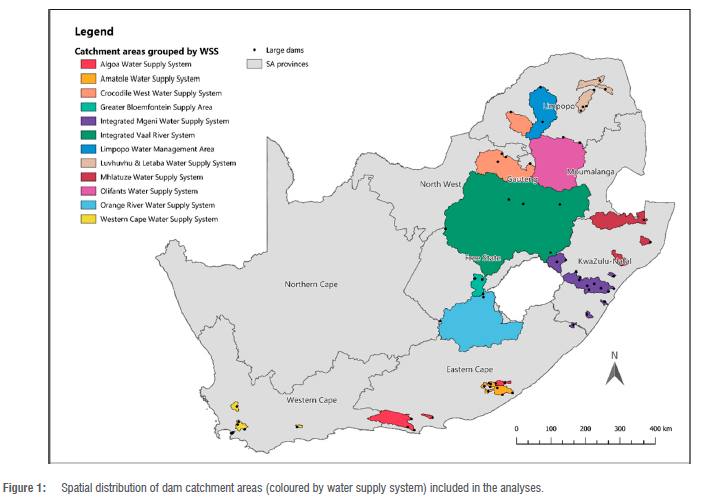
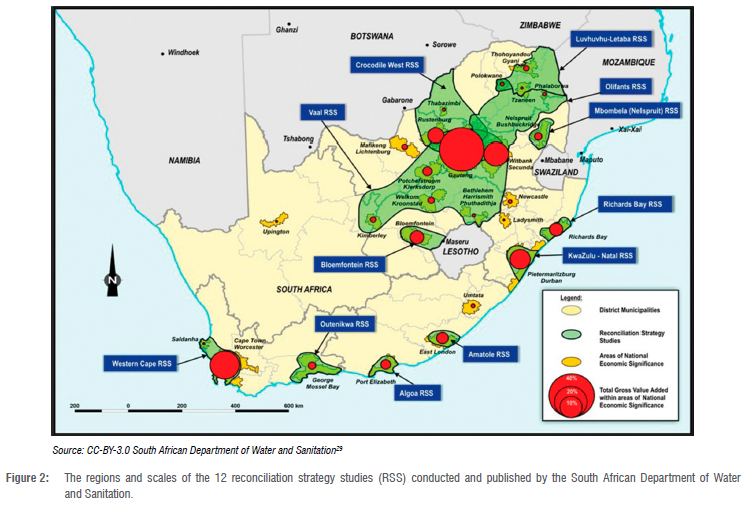
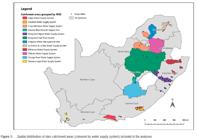
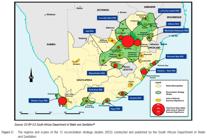
The analysis was carried out for each of South Africa's 11 regional WSSs (Figure 1). WSSs are an appropriate unit of analysis because they are the scale at which the Department of Water and Sanitation undertakes its regional water supply infrastructure planning through 'reconciliation strategy studies' (Figure 2). These studies estimate the water demand trajectory and lay out plans for a series of (usually built) infrastructure investments to meet demands over time as they grow with the population. Within each WSS, our focus was on the catchment areas of existing large water supply reservoirs (large dams) as being the ecological infrastructure of interest.
Delineating dam catchment areas
The analysis was carried out for the catchment areas of the existing large bulk water supply dams in each WSS: 64 large dams (wall height 5-15 m; capacity >3 million m3302Figure 1). Finally, the quaternary catchments within the delineated catchments were identified.31
Extent of IAP coverage in catchment areas
The National Invasive Alien Plant Survey (NIAPS) data set3233(Eucalyptus spp.), pines (Pinus spp.) and wattles {Acacia spp.) as the three most dominant, thirsty invaders in South Africa.5

whereby r is the growth rate, P is the population size, t is the relevant time step, and K is the carrying capacity. K was defined as 'invadable land', which included all land that was not classified as "built-up", "cultivated", "mines and quarries" or "waterbodies" in the South African National Land-Cover data set 2020.3435,36
Cost-effectiveness analysis
Overview
To derive the costs of interventions for catchment restoration (i.e. IAP clearing), information was gathered from literature that addressed the spread of IAPs5,7,36
Unit reference values (URVs) can be used as a direct measure of the benefits derived from water resource interventions and are commonly used to assess the feasibility of projects in the water supply sector.373
Assessment of planned built infrastructure development
Each of the study focus regions is depicted in Figure 2. To determine the planned sequence of infrastructure development per WSS, each of the relevant reconciliation strategy reports was retrieved from online repositories and was analysed for interventions planned to take place between 2022 and 2050. Yield gains and URVs for each water supply option were then extracted directly from the reconciliation strategy reports, or estimated based on similar types of projects in other water supply systems. The URVs of each intervention were reported in 2022 Rands.
Costs of clearing lAPs
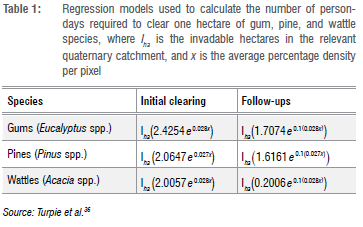
Cost estimates for clearing IAPs in South Africa were based on person-day estimates provided by the Working for Water (WfW) programme. Person-day estimates are derived from data collected over the lifespan of the WfW programme and are based on the costs to clear different groups and age classes of IAPs in riparian and landscape settings using different treatment methods over time.7 Table 1) were used to calculate the person-day estimates required to clear one hectare of gum, pine and wattle. The cost to clear IAPs under the WfW programme was some ZAR500 (in 2022) per condensed hectare (c.ha).36
Based on this, the cost of initial and follow-up clearing events for gums, pines and wattles was calculated for each relevant quaternary catchment. It was assumed that the first two follow-up clearing events would take place in 3-year intervals after the initial clear in 2022 and every 6 years thereafter until 2050. A discount rate of 8% was used to determine the present value of costs over the period. Investment in clearing IAPs is considered inefficient at densities below 5%, so a threshold was applied to the base year (2022) whereby all quaternary catchments with an IAP infestation of less than 5% were excluded from the cost model.
Calculating URVs for IAP clearing
The URV for securing water supply through clearing lAPs is derived by dividing the total present value of costs (PVc) by the present value of water supplied (PVw), as shown in Equation 2. The total PVc to clear IAPs from an area is the sum of initial and follow-up PVc costs. The initial PVc is the product of the number of person-days required to clear IAPs in the first year and the cost to clear one condensed hectare of infested land, while the PVc of one follow-up event is the product of the number of person-days required to clear IAPs in a follow-up event and the cost to clear one condensed hectare of infested land.

The PVw is based on the quantity of water gained if IAPs are removed from catchment areas by 2050. To determine this, estimates of streamflow reduction as a result of IAPs were extracted at the primary catchment level.538t is the quantity of water at year t, and r is the discount rate.

Results
Extent and spread of IAPs
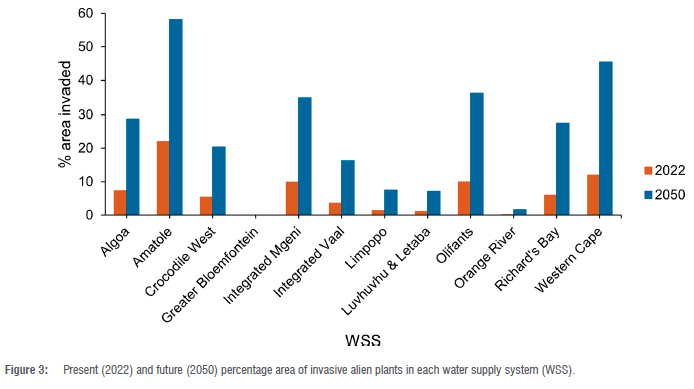
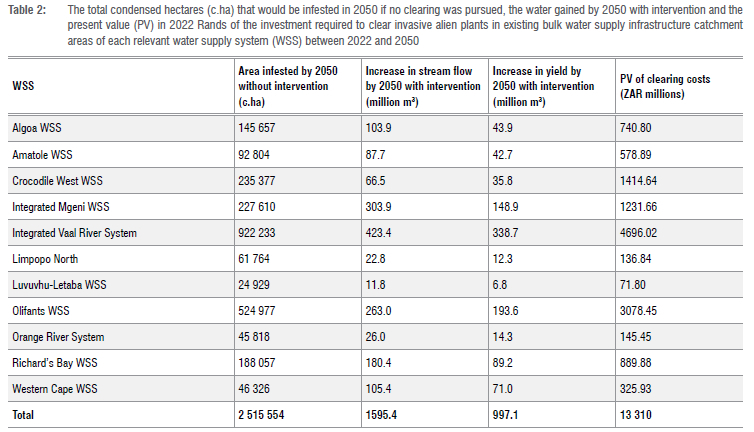
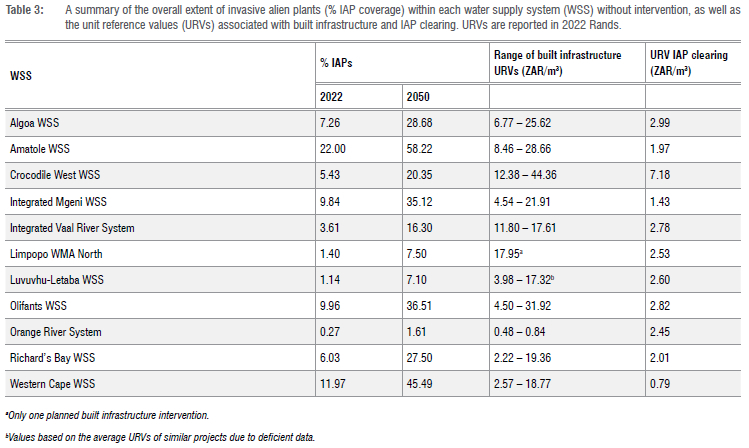
IAP coverage of all catchment areas combined was estimated to be approximately 623 000 c.ha in 2022, or 2.7% of the total area considered. Without intervention, this would quadruple to an estimated 2.5 million c.ha, or 10.9% of the area, by 2050 (Table 2). The Amatole WSS had the highest percentage cover of IAPs in both 2022 (22%) and 2050 (58%; Figure 3). Conversely, the Orange River System was estimated to have the lowest level of infestation in both 2022 (0.3%) and 2050 (1.6%) (Table 2).
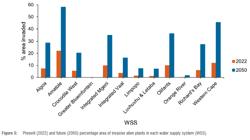
Overall, gum and wattle were more prolific than pine in most WSSs. Wattle was shown to have the most drastic spread by 2050, having the highest average coverage (9.5%) among all three species. The Amatole WSS's high percentage of invaded area was dominated by wattle infestation, covering 29.3% of the WSS total catchment area by 2050.
Cost-effectiveness analysis
The Integrated Vaal River System was estimated to have the greatest number of condensed hectares infested with IAPs by 2050 (approximately 922 000 c.ha; Table 2), resulting in the highest PVc to remove them (ZAR4.7 billion), while the Luvuvhu-Letaba WSS had the lowest number of condensed hectares (approximately 25 000 c.ha), requiring the lowest allocation of investment for IAP removal (ZAR71.8 million).
Across all 11 water supply systems considered, a total of 52 planned water supply projects were specified in the relevant reconciliation strategy studies between 2022 and 2050. Combined, planned built infrastructure interventions would result in yield gains of approximately 4 173 million m333Table 2). This is approximately 24% of the amount of water that could be gained through implementation of built infrastructure interventions (such as dam augmentation and desalination projects, and water transfer schemes) in the same time frame. As a reference, the reliable yield of surface water sources in South Africa as at 2019 was 10 200 million m339
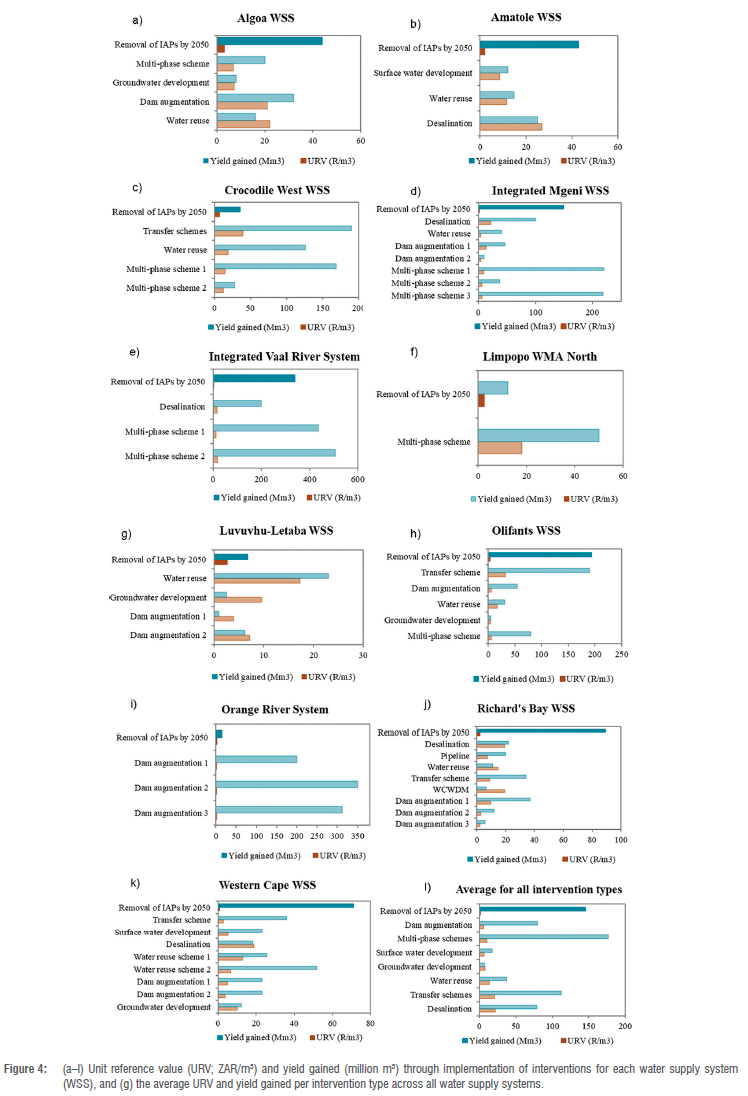
When the URVs and yield gains of IAP clearing are compared with those of planned built infrastructure developments, it becomes clear that IAP clearing is a cost-effective intervention for securing water supply. IAP clearing was the most cost-effective water supply option for all WSSs except for the Orange River System, which showed relatively low water gains for the associated URV (Figure 4). Overall, IAP clearing was the most cost-effective augmentation option.
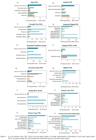
The URVs for built infrastructure ranged from ZAR0.48/m3403413 3Table 3). Of all the 11 water supply systems analysed, only IAP clearing in the Orange River System was less cost-effective than planned built infrastructure options. This finding can be explained by the low levels of estimated invasion in this water supply area, so removal of IAPs would not result in a significant gain in additional water when compared to the built alternatives which had significantly higher yields.
Discussion
There is growing awareness of the important role of ecological infrastructure in achieving water security.27,28,42
This study has shown that, from a water supply perspective alone, securing hydrological ecosystem services through catchment restoration is cost-effective and should be considered as a priority action towards achieving water security in South Africa. Broadly, the yield gained (997 million m3
This study's findings build on a number of smaller-scale studies that have demonstrated restoration measures as being cost-effective in securing hydrological ecosystem services. Clearing IAPs was found to be a cost-effective intervention in a quaternary catchment of the Olifants River with a URV of ZAR1.44/m33433393344
Investing in catchment restoration also becomes increasingly attractive as built augmentation options become progressively more expensive due to (1) the cheaper interventions being implemented first4597,10,15,28,44,4639
To date, the water service providers, which stand to gain significantly from improvements in catchment health through cost savings, have been slow to invest in ecological infrastructure. Indeed, only 1 of the 11 water supply systems has formally acknowledged and actively incorporated catchment restoration as a key intervention in their planning and budgeting for securing water in the long term. IAP clearing is included as a prioritised augmentation option in the Western Cape WSS reconciliation strategy.47333
While some other water reconciliation strategies, namely those of uMgeni and Richard's Bay48,49485036,5033 3651,52
The results from this study provide evidence at scale that investing in ecological infrastructure is a cost-effective and worthwhile long-term option for all of South Africa's water supply systems. However, given that state budgets remain the primary source of restoration funding in the country and are heavily constrained, catchment partnerships and water funds are most likely needed to succeed in leveraging the investment needed to restore these important catchments.
Conclusions
We found that investing in IAP clearing is a viable means of addressing growing water demands in 10 of South Africa's 11 major water supply areas. IAP clearing would lead to a total estimated streamflow gain of 1595 million m333333
Competing interests
We have no competing interests to declare.
Authors' contributions
K.M.E.W.: Data collection, data analysis, data curation, writing -initial draft, project management. J.K.T.: Student supervision, conceptualisation, project leadership, writing - initial draft, methodology. G.K.L.: Student supervision, project leadership, writing - initial draft, methodology, funding acquisition.
Acknowledgements
We thank the Water Research Commission (South Africa) for providing the opportunity to conduct this research and for their funding of the project.
References
-
1. Howard G, Calow R, Macdonald A, Bartram J. Climate change and water and sanitation: Likely impacts and emerging trends for action. Annu Rev Environ Resour. 2016;41:253-276. https://doi.org/10.1146/annurev-environ-110615-085856
» https://doi.org/10.1146/annurev-environ-110615-085856 - 2. South African Department of Water Affairs (DWA). National water resource strategy. 2nd ed. Pretoria: DWA; 2013.
-
3. Prinsloo FW, Scott DF. Streamflow responses to the clearing of alien invasive trees from riparian zones at three sites in the Western Cape Province. S Afr For J. 1999;185(1):1-7. https://doi.org/10.1080/10295925.1999.9631220
» https://doi.org/10.1080/10295925.1999.9631220 - 4. Görgens AHM, Van Wilgen BW. Invasive alien plants and water resources in South Africa: Current understanding, predictive ability and research challenges. S Afr J Sci. 2004;100(1-2):27-33.
-
5. Le Maitre DC, Forsyth GG, Dzikiti S, Gush MB. Estimates of the impacts of invasive alien plants on water flows in South Africa. Water SA. 2016;42(4):659-672. https://doi.org/10.4314/wsa.v42i4.17
» https://doi.org/10.4314/wsa.v42i4.17 -
6. Van Wilgen BW, Raghu S, Sheppard AW, Schaffner U. Quantifying the social and economic benefits of the biological control of invasive alien plants in natural ecosystems. Curr Opin Insect Sci. 2020;38:1-5. https://doi.org/10.1016/j.cois.2019.12.004
» https://doi.org/10.1016/j.cois.2019.12.004 - 7. Turpie JK, Letley G, Schmidt K, Weiss J, O'Farrell P Jewitt D. The potential costs and benefits of addressing land degradation in the Thukela catchment, KwaZulu-Natal, South Africa. Pretoria: Natural Capital Accounting and Valuation of Ecosystem Services (NCAVES); 2021.
- 8. Pringle C, Bredin I, McCosh J, Dini J, Zunckel K, Jewitt G, et al. An investment plan for securing ecological infrastructure to enhance water security in the uMngeni River catchment. Midrand: Green Fund, Development Bank of Southern Africa; 2015.
-
9. Mander M, Jewitt G, Dini J, Glenday J, Blignaut J, Hughes C, et al. Modelling potential hydrological returns from investing in ecological infrastructure: Case studies from the Baviaanskloof-Tsitsikamma and uMngeni catchments, South Africa. Ecosyst Serv. 2017;27:261-271. https://doi.org/10.1016/j.ecoser.2017.03.003
» https://doi.org/10.1016/j.ecoser.2017.03.003 -
10. Hughes CJ, De Winnaar G, Schulze RE, Mander M, Jewitt GPW. Mapping of water-related ecosystem services in the uMngeni catchment using a daily time-step hydrological model for prioritisation of ecological infrastructure investment - part 1: Context and modelling approach. Water SA. 2018;44(4):577-589. https://doi.org/10.4314/wsa.v44i4.07
» https://doi.org/10.4314/wsa.v44i4.07 -
11. Gokool S, Jewitt GPW. Identifying hotspots for investment in ecological infrastructure within the uMngeni catchment, South Africa. Phys Chem Earth. 2019;114, Art. #102807. https://doi.org/10.1016/j.pce.2019.11.003
» https://doi.org/10.1016/j.pce.2019.11.003 - 12. Jewitt G, Sutherland C, Browne M, Stuart-Hill S, Risko S, Martel P et al. Enhancing water security through restoration and maintenance of ecological infrastructure: Lessons from the uMngeni River Catchment. Vol I: Final report. WRC report no. TT 815/20. Pretoria: Water Research Commission; 2020.
- 13. Dasgupta P. The economics of biodiversity: The Dasgupta review. J Polit Ecol. 2021;28.
- 14. Marais C. An economic evaluation of the invasive alien plant control programmes in the mountain catchment areas of the Western Cape Province, South Africa [PhD dissertation]. Stellenbosch: Stellenbosch University; 1998.
-
15. Turpie JK, Marais C, Blignaut JN. The working for water programme: Evolution of a payments for ecosystem services mechanism that addresses both poverty and ecosystem service delivery in South Africa. Ecol Econ. 2008;65(4):788-798. https://doi.org/10.1016/j.ecolecon.2007.12.024
» https://doi.org/10.1016/j.ecolecon.2007.12.024 -
16. United Nations Environmenta Assembly (UNEA). Resolution 73/284: United Nations Decade on Ecosystem Restoration (2021-2030) [cited 2021 May 31]. Nairobi: UNEA; 2019. Available from: https://undocs.org/A/RES/73/284
» https://undocs.org/A/RES/73/284 -
17. International Union for Conservation of Nature. Land degradation neutrality: Implications and opportunities for conservation. Technical Brief. 2015;November:19. Available from: https://portals.iucn.org/library/node/47869
» https://portals.iucn.org/library/node/47869 -
18. Mbopha MS, Marais C, Kleynhans TE, Esler KJ. Unlocking and securing ecological infrastructure investments: The needs and willingness to invest and institutional support mechanisms used. S Afr J Sci. 2021;117(9/10):39-45. https://doi.org/10.17159/sajs.2021/8666
» https://doi.org/10.17159/sajs.2021/8666 -
19. Brauman KA, Daily GC, Duarte TK, Mooney HA. The nature and value of ecosystem services: An overview highlighting hydrologic services. Annu Rev Environ Resour. 2007;32:67-98. https://doi.org/10.1146/annurev.energy.32.031306.102758
» https://doi.org/10.1146/annurev.energy.32.031306.102758 -
20. Postel SL, Thompson BH. Watershed protection: Capturing the benefits of nature's water supply services. Nat Resour Forum. 2005;29:98-108. https://doi.org/10.1111/j.1477-8947.2005.00119.x
» https://doi.org/10.1111/j.1477-8947.2005.00119.x -
21. Bonnesoeur V, Locatelli B, Guariguata MR, Ochoa-Tocachi BF, Vanacker V, Mao Z, et al. Impacts of forests and forestation on hydrological services in the Andes: A systematic review. For Ecol Manage. 2019;433:569-584. https://doi.org/10.1016/j.foreco.2018.11.033
» https://doi.org/10.1016/j.foreco.2018.11.033 -
22. Carvalho-Santos C, Pradinho J, Hein L. Hydrological services and the role of forests: Conceptualization and indicator-based analysis with an illustration at a regional scale. Ecol Complex. 2014;20:69-80. https://doi.org/10.1016/j.ecocom.2014.09.001
» https://doi.org/10.1016/j.ecocom.2014.09.001 -
23. Hanna DEL, Raudsepp-Hearne C, Bennett EM. Effects of land use, cover, and protection on stream and riparian ecosystem services and biodiversity. Conserv Biol. 2019;34(1):244-255. https://doi.org/10.1111/cobi.13348
» https://doi.org/10.1111/cobi.13348 -
24. Holden PB, Rebelo AJ, Wolski P Odoulami RC, Lawal KA, Kimutai J, et al. Nature-based solutions in mountain catchments reduce impact of anthropogenic climate change on drought streamflow. Commun Earth Environ. 2022;3(1):1-12. https://doi.org/10.1038/s43247-022-00379-9
» https://doi.org/10.1038/s43247-022-00379-9 - 25. Maze K, Driver A. Mainstreaming ecological infrastructure in planning and investment. In: Swilling M, Musango J, Wakeford J, editors. Greening the South African Economy: Scoping the issues, challenges and opportunities. Cape Town: UCT Press; 2016. p. 286-302.
-
26. Wertz-Kanounnikoff S, Locatelli B, Wunder S, Brockhaus M. Ecosystem-based adaptation to climate change: What scope for payments for environmental services? Clim Dev. 2011;3(2):143-158. https://doi.org/10.1080/17565529.2011.582277
» https://doi.org/10.1080/17565529.2011.582277 -
27. Vogl AL, Goldstein JH, Daily GC, Vira B, Bremer L, McDonald RI, et al. Mainstreaming investments in watershed services to enhance water security: Barriers and opportunities. Environ Sci Policy. 2017;75:19-27. https://doi.org/10.1016/j.envsci.2017.05.007
» https://doi.org/10.1016/j.envsci.2017.05.007 -
28. Rebelo AJ, Holden PB, Esler K, New MG. Benefits of water-related ecological infrastructure investments to support sustainable land-use: A review of evidence from critically water-stressed catchments in South Africa. R Soc Open Sci. 2021;8, Art. #201402. https://doi.org/10.1098/rsos.201402
» https://doi.org/10.1098/rsos.201402 -
29. South African Department of Water and Sanitation (DWS). Current status of published national and provincial reconciliation strategies: Long-term plan for reconciling water supply and demand for most of the catchments in South Africa [PowerPoint presentation]. c2022 [cited 2022 Apr 23]. Available from: https://pmg.org.za/committee-meeting/34637/
» https://pmg.org.za/committee-meeting/34637/ -
30. South African National Committee on Large Dams (SANCOLD). South African register of large dams [data set]. c2018 [cited 2022 Apr 05]. Available from: https://sancold.org.za/sa-register-of-large-dams/
» https://sancold.org.za/sa-register-of-large-dams/ -
31. South African Department of Water and Sanitation (DWS). Catchments of South Africa - quaternary [data set]. c2011 [cited 2022 Feb 15]. Available from: http://www.sasdi.net/metaview.aspx?uuid=d83ff9c0965b1a2d4a1457b80677ce1f#
» http://www.sasdi.net/metaview.aspx?uuid=d83ff9c0965b1a2d4a1457b80677ce1f# -
32. Kotzé JDF, Beukes BH, Van den Berg EC, Newby TS. National invasive alien plant survey [data set]. c2010 [cited 2022 Jan 29]. Available from: http://bgis.sanbi.org/SpatialDataset/Detail/416
» http://bgis.sanbi.org/SpatialDataset/Detail/416 -
33. Preston IR, Le Maitre DC, Blignaut JN, Louw L, Palmer CG. Impact of invasive alien plants on water provision in selected catchments. Water SA. 2018;44(4):719-729. http://dx.doi.org/10.4314/wsa.v44i4.20
» http://dx.doi.org/10.4314/wsa.v44i4.20 -
34. South African Department of Forests, Fisheries and the Environment (DFFE). South African National Land Cover (SANLC) 2020 [data set]. c2021 [cited 2022 Feb 10]. Available from: https://egis.environment.gov.za/data_egis/data_download/current
» https://egis.environment.gov.za/data_egis/data_download/current - 35. Le Maitre DC, Blignaut JN, Clulow A, Dzikiti S, Everson CS, Görgens AHM, et al. Impacts of plant invasions on terrestrial water flows in South Africa. In: Van Wilgen BW, Measey J, Richardson DM, Wilson JR, Zengeya TA, editors. Biological invasions in South Africa. Berlin: Springer Nature; 2020. p. 431-457.
- 36. Turpie JK, Forsyth K, Seyler H, Howard G, Letley G. Identification of priority areas for clearing invasive alien plants from Greater Cape Town's water supply catchment areas. Technical report no: AEC/1762/1. Cape Town: Anchor Environmental; 2019.
-
37. Van Niekerk PH, Du Plessis JA. Unit reference value: Application in appraising inter-basin water transfer projects. Water SA. 2013;39(4):549-554. https://doi.org/10.4314/wsa.v39i4.14
» https://doi.org/10.4314/wsa.v39i4.14 -
38. Cullis JDS, Görgens AHM, Marais C. A strategic study of the impact of invasive alien plants in the high rainfall catchments and riparian zones of South Africa on total surface water yield. Water SA. 2007;33(1):35-42. https://doi.org/10.4314/wsa.v33i1.47869
» https://doi.org/10.4314/wsa.v33i1.47869 - 39. South African Department of Water and Sanitation (DWS). The national water and sanitation master plan: Ready for the future and ahead of the curve. Pretoria: DWS; 2019.
- 40. South African Department of Water Affairs (DWA). Development of reconciliation strategies for large bulk water supply systems: Orange River. Pretoriaouth Africa: Department of Water Affairs; 2015.
- 41. South African Department of Water and Sanitation (DWS). Crocodile (West) River reconciliation strategy 2015. Pretoria: DWS; 2015.
-
42. Muller M, Biswas A, Martin-Hurtado R, Tortajada C. Built infrastructure is essential. Science. 2015;349(6248):585-586. https://doi.org/10.1126/science.aac7606
» https://doi.org/10.1126/science.aac7606 -
43. Morokong T, Blignaut J, Nkambule NP Mudhavanhu S, Vundla T. Clearing invasive alien plants as a cost-effective strategy for water catchment management: The case of the Olifants River catchment, South Africa. S Afr J Econ Manag Sci. 2016;19(5):774-787. https://doi.org/10.4102/sajems.v19i5.1594
» https://doi.org/10.4102/sajems.v19i5.1594 -
44. Nkambule NP Blignaut JN, Vundla T, Morokong T, Mudavanhu S. The benefits and costs of clearing invasive alien plants in northern Zululand, South Africa. Ecosyst Serv. 2017;27:203-223. http://dx.doi.org/10.1016/j.ecoser.2017.04.011
» http://dx.doi.org/10.1016/j.ecoser.2017.04.011 - 45. Rodriguez DJ, Van Den Berg C, McMahon A. Investing in water infraestructure: Capital, operations and maintenance. World Bank Water Papers. 2012;52.
-
46. Acreman M, Smith A, Charters L, Tickner D, Opperman J, Acreman S, et al. Evidence for the effectiveness of nature-based solutions to water issues in Africa. Environ Res Lett. 2021;16(6), Art. #063007. https://doi.org/10.1088/1748-9326/ac0210
» https://doi.org/10.1088/1748-9326/ac0210 - 47. Tlou T, Fisher-Jeffes L, Singh A. The support for the implementation and maintenance of the water reconciliation strategy for the Western Cape Water Supply System. Pretoria: DWS; 2021.
- 48. South African Department of Water and Sanitation (DWS). Support on the continuation of the reconciliation strategy of the KwaZulu-Natal Coastal metropolitan area: Phase 2. P WMA 04/000/00/3517. Pretoria: DWS; 2017.
- 49. South African Department of Water and Sanitation (DWS). Implementation and maintenance of the water reconciliation strategy for Richard's Bay and surrounding towns: Water Reconciliation Strategy. P WMA 04/ W100/00/9218/7. Pretoria: DWS; 2021.
- 50. The Nature Conservancy. Greater Cape Town Water Fund Business Case. Cape Town: The Nature Conservancy; 2018.
-
51. Turpie JK, Letley G. Cape Town residents' willingness to pay for a secure and 'green' water supply. Water SA. 2023;49(4):327-337. https://doi.org/10.17159/wsa/2023.v49.i4.4002
» https://doi.org/10.17159/wsa/2023.v49.i4.4002 -
52. Du Plessis NS, Turpie J, Letley G. Feasibility of financing nature-based solutions for water security through water tariffs: Evidence from South Africa. Aqua Water Infrastruct Ecosyst Soc. 2024;73(2):152-166. https://doi.org/10.2166/aqua.2024.221
» https://doi.org/10.2166/aqua.2024.221
Revised: 15 Mar. 2024
Accepted: 15 Mar. 2024
Published: 28 May 2024
Funding:South African Water Research Commission