Simon Mokobane's contributions to scientific research at Drimolen and beyond
SIGNIFICANCE: Field technicians and preparators, who often do not hold academic degrees, make significant contributions towards research in the palaeosciences. Typically, these individuals come from local, marginalised communities, and, as a means of employment, began working on projects in labour positions. Over the period of their employment, they have garnered unparalleled skills in excavation, fossil recovery and preparation, curation, and on-site identification of skeletal remains and archaeology. Here, we remember one such individual, Mr Simon Mokobane, whose contributions to the Drimolen fossil hominin project have left a lasting legacy on the academic research in the Cradle of Humankind.
hidden contributions; Drimolen; Cradle of Humankind; human evolution; South Africa
DISCUSSION COMMENTARY
Simon Mokobane's contributions to scientific research at Drimolen and beyond
Stephanie E. BakerI; Matthew V. CaruanaI; Andrew PhaswanaII
IPalaeo-Research Institute, University of Johannesburg, Johannesburg, South Africa
IISchool of Geography, Archaeology and Environmental Studies, University of the Witwatersrand, Johannesburg, South Africa
SIGNIFICANCE:
Field technicians and preparators, who often do not hold academic degrees, make significant contributions towards research in the palaeosciences. Typically, these individuals come from local, marginalised communities, and, as a means of employment, began working on projects in labour positions. Over the period of their employment, they have garnered unparalleled skills in excavation, fossil recovery and preparation, curation, and on-site identification of skeletal remains and archaeology. Here, we remember one such individual, Mr Simon Mokobane, whose contributions to the Drimolen fossil hominin project have left a lasting legacy on the academic research in the Cradle of Humankind.
Keywords: hidden contributions, Drimolen, Cradle of Humankind, human evolution, South Africa
The hidden contribution of excavators and preparators at palaeoanthropological sites in the UNESCO Fossil Hominid Sites of South Africa (locally referred to as the 'Cradle of Humankind'), represents an important issue which all academic researchers working in the landscape should bring to light. Historically, the impact of these 'tracking scientists' (replacing the term 'citizen scientist', as per Liebenberg et al.12
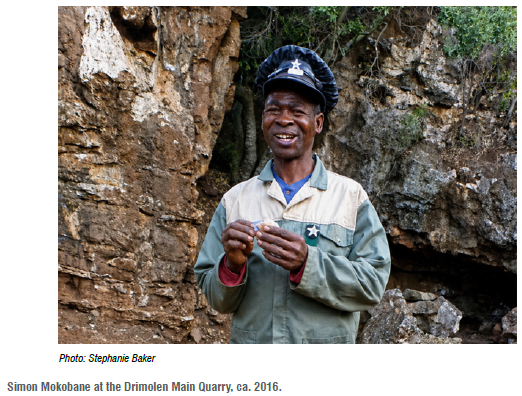
In 1992, Mokobane accompanied Prof. André Keyser for the initial survey of the Drimolen fossil site. Excavations began shortly thereafter, which led to the seminal announcement of DNH 7, a near-complete female Paranthropus robustus skull.3,4 Mokobane's role at this time was to aid in the extraction and preparation of fossils encased in hard, brecciated sediments. During these early years, Mokobane developed a specialised skillset for using an air scribe to release fossils from breccia blocks. This produced an extensive assemblage of faunal materials, including some of the best-preserved early Homo and P. robustus fossils in the Cradle.5,6
Towards the end of the 1990s, Mokobane (then employed by Keyser) was provided workspace at the Sterkfontein Caves for a short time, some 5 km from Drimolen. It was here that he met and trained Mr Andrew Phaswana, passing on his experiential knowledge in excavation techniques, fossil preparation, bone identification and microfaunal sorting. Phaswana is now employed at Sterkfontein as a senior excavator and preparator at the site, where he trains his younger colleagues. Thus, a tradition of technical knowledge and skills transfer that began with Mokobane has continued with the next generations of excavation and preparation staff members.
Mokobane sadly died of cancer in 2018, after having spent nearly three decades living and working in the Cradle as the lead technician at Drimolen. During his time at the site, he played an integral role in training early career scientists who visited the site as part of an international, collaborative field school that attracted students from South Africa and across the globe. Mokobane played a pivotal role in the excavation experience that students were afforded, and his knowledge of the site - and fossil identification, in particular - is a key memory for those who attended. Many students recall repeatedly asking Mokobane whether the objects they found in the sieves were fossils, and almost always receiving the soft-spoken response, "It's a rock".
Moreover, Mokobane made significant contributions towards major discoveries from Drimolen. In 2015, during a field school with University of Johannesburg and La Trobe University (Australia) students, a cluster of bone fragments emerged from the lower western corner of the deposit. Mokobane was responsible for sieving sediments from this area to ensure that any smaller fossil fragments that had been overlooked during excavation were recovered. Reconstruction of this cluster led eventually to the discovery of DNH 134, a juvenile skull cap, which represents the earliest known evidence of Homo erectus sensu lato, globally.5Science in 2020. Mokobane was known for his work ethic, friendliness and humour. We acknowledge his life and career as integral to our understanding of human evolution in South Africa.
Declarations
We have no competing interests to declare. We have no AI or LLM use to declare. All authors read and approved the final manuscript.
References
-
1. Liebenberg L, Lombard M, Shermer M, Xhukwe U, Biesele M, Carruthers P, et al. Tracking science: An alternative for those excluded by citizen science. Citizen Sci Theory Pract. 2021;6(1):6. https://doi.org/10.5334/cstp.284
» https://doi.org/10.5334/cstp.284 -
2. Clarke RJ, Kuman K, Pickering TR, Heaton J, Caruana MV, Beaudet A, et al. Tribute to Abel Molepolle and the central role of the Sterkfontein Caves technicians in international palaeoanthropological research. S Afr J Sci. 2026;122(3/4), Art. #25052. https://doi.org/10.17159/sajs.2026/25052
» https://doi.org/10.17159/sajs.2026/25052 - 3. Keyser AW. The Drimolen skull: The most complete australopithecine cranium and mandible to date. S Afr J Sci. 2000;96(4):189-193.
- 4. Keyser AW, Menter CG, Moggi-Cecchi J, Rayne Pickering P, Berger LR. Drimolen: A new hominid-bearing site in Gauteng, South Africa. S Afr J Sci. 2000;96(4):193-197.
-
5. Herries AI, Martin JM, Leece AB, Adams JW, Boschian G, Joannes-Boyau R, et al. Contemporaneity of Aaustralopithecus, Pparanthropus, and early Homo erectus in South Africa. Science. 2020;368(6486), eaaw7293. https://doi.org/10.1126/science.aaw7293
» https://doi.org/10.1126/science.aaw7293 -
6. Martin JM, Leece AB, Neubauer S, Baker SE, Mongle CS, Boschian G, et al. Drimolen cranium DNH 155 documents microevolution in an early hominin species. Nat Ecol Evol. 2021;5(1):38-45. https://doi.org/10.1038/s41559-020-01319-6
» https://doi.org/10.1038/s41559-020-01319-6