Taxonomic research in South Africa: the state of the discipline
Introduction
There are estimated to be 7–15 million species on Earth, of which only about 1.7 million have been described.1 2 1
Taxonomy is the science of detecting, describing, naming and classifying organisms and is, of course, critically important to disciplines such as conservation, a prerequisite for informed ecological management policy. Currently, there is insufficient taxonomic capacity to keep abreast of the rate of new discoveries of living organisms; this requires an enhanced ability to deal with the outputs of current field work.3 4
Local taxonomists take action
The GTI Africa Regional Workshop was held at the Kirstenbosch National Botanical Garden, Cape Town, from 27 February to 1 March 2001 and was hosted by the then National Botanical Institute of South Africa and the National Herbarium and Botanic Gardens of Malawi, under the auspices of the CBD. This resulted in the Kirstenbosch Declaration, which incorporated the main resolutions reached by the delegates.4 5 4
Local funding initiatives
The establishment of the South African Biosystematics Initiative (SABI), which was instigated and managed by Herbert and his colleagues,6
Where do we come from? — taxonomists together
The establishment of the South African Society for Systematic Biology (SASSB) was preceded by a workshop that took place on 14 January 1998 at the Kirstenbosch Research Centre, and this was attended by 64 systematists from 40 institutions.7 8,9 with preliminary results presented later in the year, at a meeting on 6 and 7 August at the University of Pretoria.10
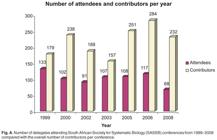
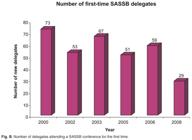
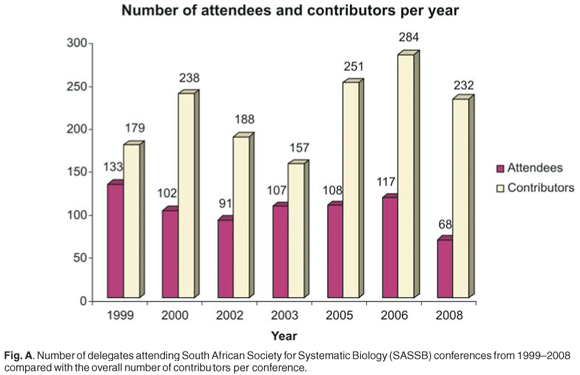
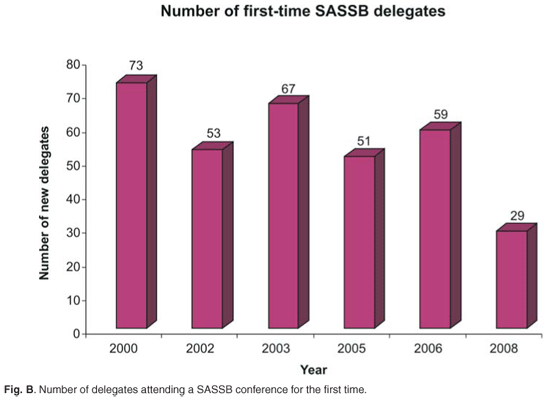
The inaugural conference of the SASSB took place in January 1999 in Stellenbosch and brought together, for the first time, local and foreign systematists from a variety of biological backgrounds.11 Fig. A in supplementary material online at www. sajs.co.za), with the number of first-time attendees ranging from 73 (2000) to 29 (2008) (Fig. B online). In total, 465 individual delegates have attended SASSB conferences over the past 10 years.
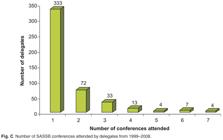
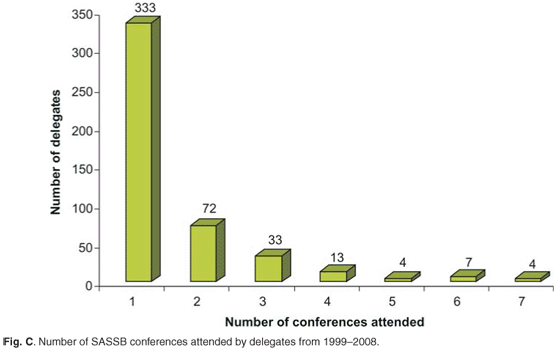
It is alarming to note, however, that more than six out of ten of delegates do not re-attend subsequent conferences (Fig. C online). One may speculate that this is a reflection of irregular student attendance or a consequence of a meeting programme that may be perceived by delegates to be not worthwhile. Only four individuals have attended all seven conferences.
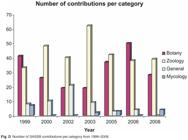
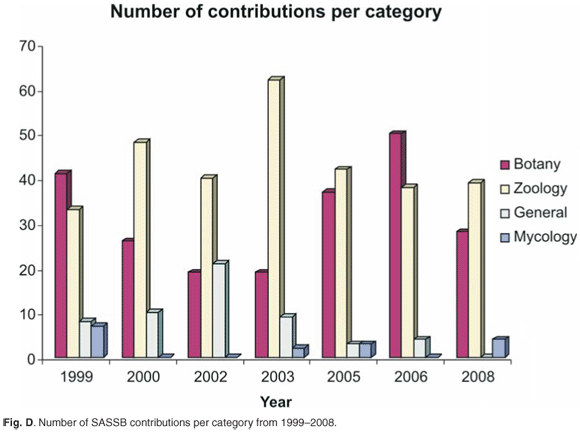
The relative proportions of contributions in each of the four broad categories — zoology, botany, mycology, and general — vary considerably (Fig. D online). Zoological contributions have tended to dominate conferences, although the 2006 meeting in the Kruger National Park saw a large attendance by botanical systematists. Mycology has been poorly represented across the board, and presentations by general systematics have fared only slightly better. The especially high number of zoological presentations at the 2003 conference may have been due to a link with the Entomological Society of Southern Africa conference, which was held immediately before the SASSB conference.
SASSB 2008
The 2008 SASSB conference was held together with that of the South African Association of Botanists (SAAB) 2008, as well as a meeting of the International Association of Plant Taxonomists (IAPT) and immediately followed the Cape Biota meeting. The presentations for the SASSB, SAAB and IAPT meetings were mixed, without discrete boundaries, and as a result we decided to include systematics presentations that were registered under SAAB and the IAPT in the 2008 SASSB analysis, thus resulting in the inclusion of 14 additional plant taxonomic contributions.
The 2008 SASSB conference was held at the Drakensville Mountain Resort in the KwaZulu-Natal Drakensberg from 15–17 January. It was attended by 68 SASSB registered delegates and covered contributions from 232 authors (including the 14 additional botanical contributions). Totals of 57 oral and 14 poster presentations were given, of which 39 were zoological and 28 botanical. Mycology was represented by four oral presentations. Sessions included animal phylogenetics, biogeography, plant phylogenetics, and taxonomy: plant and animal, and biodiversity and conservation.
Of the 39 zoological presentations, only 10 (26%) were on invertebrates, which comprise about 99% of animal diversity, and 29 (74%) were on vertebrates. In addition, only one paper dealt with a taxonomic revision of insects, which comprise about 75% of all animal species. Similar patterns were evident for the 2005 and 2006 conferences, with 19% and 16% invertebrate contributions and 81% and 79% of contributions on vertebrates, respectively.
The biodiversity and conservation sessions included contributions related to threatened taxa such as golden moles (Afrosoricida: Chrysochloridae). The biogeography session included presentations on diverse groups including cannibal snails (Pulmonata: Rhytididae), crayfish (Decapoda: Parastacidae) and the plant family Acanthaceae. Phylogenetic contributions ranged from the diversity of Symbiodinium in corals, the systematics of African spurfowls (Pternistis spp.) to phylogenetic studies of the southern African thicket species Schotia (Fabaceae), and the link between annuality and aridity in the karoo as displayed by the genera Ifloga and Trichogyne (Asteraceae: Gnaphalieae). Other contributions were presented on pollen diversity in Cyperaceae, the demise of the Apiaceae genus Peucedanum in Africa, the systematics of certain southern African cisticolas (Cisticolidae), and ticks of the genus Rhipicephalus.
The overall quality of talks was excellent, and throughout, conference delegates could be seen engrossed in conversations about their work. This, as much as the formal presentations, is the real benefit and purpose of conference attendance: to network, establish collaborations and to exchange ideas. One hopes that friends and colleagues will choose to meet again at the next SASSB conference to be held in July 2009 in KwaZulu-Natal. The conference will be linked with the Zoological Society of Southern Africa (ZSSA) conference, celebrating the 50th anniversary of the society's establishment, as well as Darwin year (150 years since the publication of The Origin of Species, and 200 years since Charles Darwin's birth).
Where are we now?
Systematists in South Africa are increasingly conspicuous at two levels — completing the inventory and generating phylogenies. However, excessive 'tree thinking' has led to a segregated study of phylogeny that may, according to O'Hara,12 13 14
The problems bedevilling the implementation of taxonomy initiatives are little more than a microcosm of how the community at large perceives environmental science: necessary, but one hopes someone else will be prepared to pay for it. A dialogue between science and society is required, so that taxonomy can be firmly incorporated into the mainstream of science policy.
The world around taxonomy and taxonomists continues to change. Broad acceptance of the reality of the biodiversity crisis has opened up new spheres of relevance and opportunity for the discipline. But this is no time to be complacent. Taxonomy and taxonomists have undergone a remarkable few decades of rapid disciplinary evolution, but if we do not continue to evolve and adapt, then like many of the species that we study, we risk extinction.3
Monographic or revisionist study of a not-too-large group remains the best academic subject for a doctoral thesis in taxonomy, providing the student with the intellectual training to investigate the past, and to learn the processes of discrimination, synonymy, and the intricacies of nomenclature.13
It will be difficult to guarantee the future of plant diversity science without international collaboration.3 15 6
Cross-disciplinary collaborations should also be encouraged. As an example, Gotelli16
In summary, we as taxonomists have to re-evaluate our role and be more strategic about the outputs of our research endeavours, and by so doing, re-energize our science,13 17
References
- 1. Mace G.M. (2004). The role of taxonomy in species conservation. Phil. Trans. R. Soc. B 359, 711–719.
- 2. Godfray H.C.J. and Knapp S. (2004). Introduction. Phil. Trans. R. Soc. B 359, 559–569.
- 3. Crane P.R. and Pleasants L.J. (2006). Taxonomy and the future of plant diversity science. In Taxonomy and Plant Conservation, eds E. Leadlay and S. Jury. Cambridge University Press, New York.
- 4. Klopper R.R., Smith G.F. and Chikuni A.C. (2002). The Global Taxonomy Initiative in Africa. Taxon 51, 159–165.
- 5. Klopper R.R., Smith G.F. and Chikuni A.C. (eds) (2001). The Global Taxonomy Initiative: documenting the biodiversity of Africa. Proceedings of a workshop held at the Kirstenbosch National Botanic Garden, Cape Town, 27 February – 1 March 2001. Strelitzia 12. National Botanical Institute, Pretoria.
- 6. Herbert D.G., Smith G.F., Hamer M.L. and Scholtz C.H. (2001). Taxonomy and systematics research in South Africa: vital research facing a crisis in capacity and resources. Unpubl. report to the National Research Foundation and the Department of Arts, Culture, Science and Technology, Pretoria.
- 7. Smith G.F., Willis C.K. and Van Wyk B-E. (1998). Systematic biologists of South Africa, unite! S. Afr. J. Sci. 94, 107–108.
- 8. Mössmer M. and Willis C.K. (2000). Plant taxonomic expertise: an inventory for southern Africa. Southern African Botanical Diversity Network Report No. 10. SABONET, Pretoria.
- 9. Smith G.F., Willis C.K. and Mössmer M. (1999). Southern African herbarium needs assessment. Southern African Botanical Diversity Network Report No. 6. SABONET, Pretoria.
- 10. Smith G.F. and Willis C.K. (1998). Systematic biologists of South Africa: united we stand at last! S. Afr. J. Sci. 94, 519–520.
- 11. Smith G.F. and Willis C.K. (1999). Systematic biologists in South Africa join forces. S. Afr. J. Sci. 95, 156–158.
- 12. O'Hara R.J. (1997). Population thinking and tree thinking in systematics. Zool. Scripta 26, 323–329.
- 13. Korf R.P. (2005). Reinventing taxonomy: a curmudgeon's view of 250 years of fungal taxonomy, the crisis in biodiversity, and the pitfalls of the phylogenetic age. Mycotaxon 93, 407–415.
- 14. Raven P.H. (2004). Taxonomy: where are we now? Phil. Trans. R. Soc. B 359, 729–730.
- 15. Wilson E.O. (2004). Taxonomy as a fundamental discipline. Phil. Trans. R. Soc. B 359, 739.
- 16. Gotelli N.J. (2004). A taxonomic wish-list for community ecology. Phil. Trans. R. Soc. B 359, 585–597.
- 17. Wheeler Q.D. (2004). Taxonomic triage and the poverty of phylogeny. Phil. Trans. R. Soc. B 359, 571–583.
* Author for correspondence. E-mail: