Modern beachrock formation in Durban, KwaZulu-Natal
Abstract
We explored the recent cementation of modern beachrock on the seaward margin of the Durban Bluff, central KwaZulu-Natal. The low latitude and subtropical climatic setting is a unique context compared to the more commonly documented contemporary beachrock formation in the tropics. Geological field mapping was carried out and here we present results based on sedimentary facies of a clastic shoreline and carbonate diagenesis of interstitial cements using transmitted light microscopy. The beachrock was cemented by micrite and aragonite, and iron oxide infilled voids. The presence of human artefacts within the deposit showed evidence for cementation within the last century. The elevation (at Mean Low Water) and correlation to rates of sea level change for the east coast of South Africa showed that the beachrock is less than 72 years in age. In contrast to older local Pleistocene deposits, beachrocks have cemented along this stretch of coast during successive sea level highstands with similar climatic regimes - the last Interglacial, the Holocene High and the present. Here we report the most southerly documentation of modern beachrock in KwaZulu-Natal, which, to our knowledge, represents the youngest deposit reported in southern Africa.
Introduction
Beachrocks are consolidated coastal sedimentary formations, which consist of beach material that is bonded together relatively rapidly by in-situ precipitated carbonate cements (calcite and/or aragonite),1,2 and are commonly found along warm equatorial-tropical coasts.3,4,5,6 Constituent particles include clastic, biogenic and authigenous sands and gravels, as well as human artefacts at some localities.3
Although lithification occurs in the intertidal and/or supratidal zone, either on the beach surface or beneath a thin veneer of unconsolidated sediment,7,8 the significance of beachrock as a reliable sea level indicator has been questioned.910,11
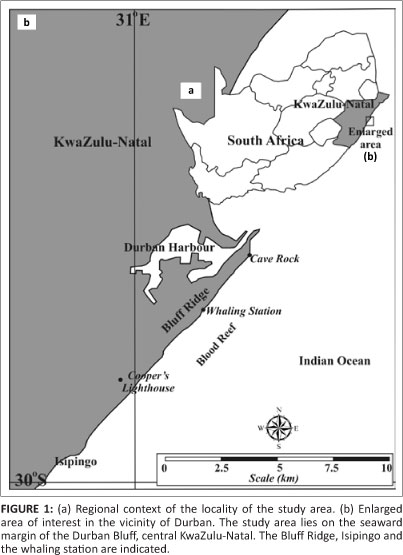
Although carbonate cemented Pleistocene beachrocks are common along the South African coastline,12,13,14,15,16 modern beachrocks are rare.1715Figure 1). The area lies at 29°52'S and experiences a subtropical climate with warm wet humid summers and dry moderate winters.1810
Facies association and description
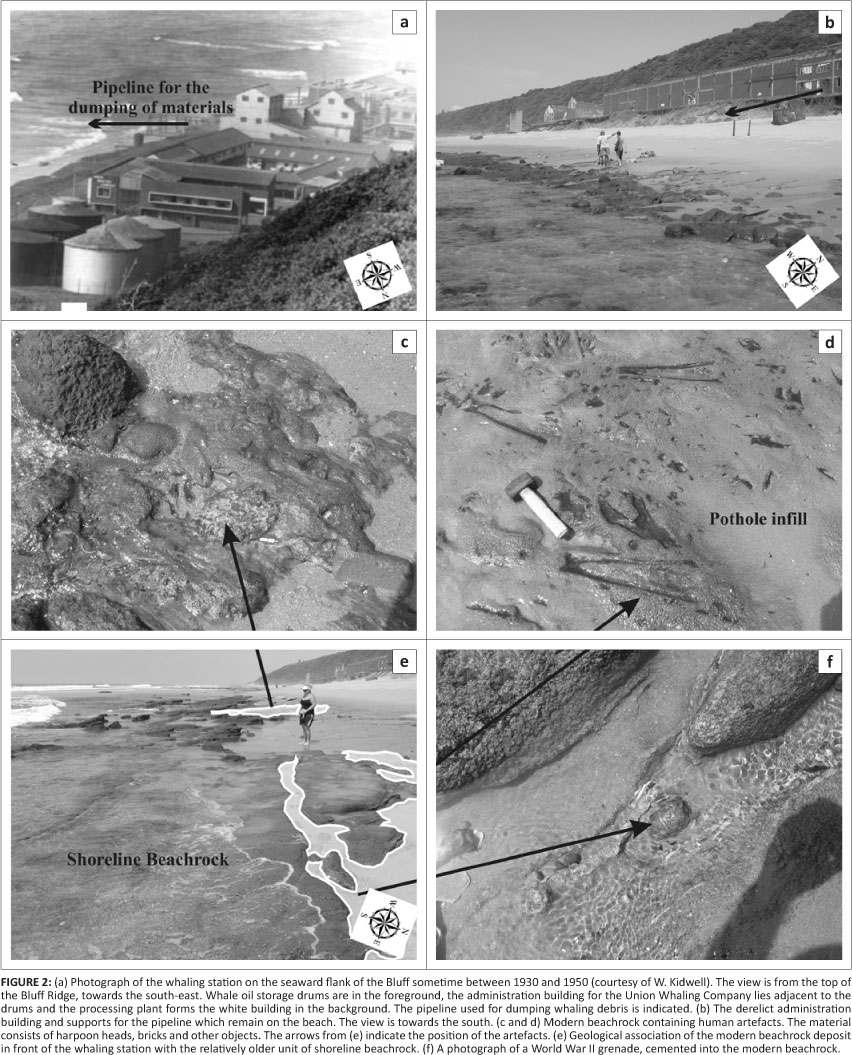
The modern beachrock has developed seaward of a pipeline support structure that formed part of whaling station operations between 1908 and 1975 and extends seaward of an embayment of a 'Type 2' intertidal platform19Figure 2). The exposure has a maximum coast-parallel extent of 40 m that extends seaward for approximately 6 m and is estimated to be no more than 30 cm thick. The site is only exposed at spring low tides and is normally submerged and covered by unconsolidated beach sand. The rocks have developed within the breaker to swash zone at the foreshore-shoreface transition, corresponding to the Mean Low Water level.
The sedimentary facies comprises a poorly sorted, locally pebbly, very coarse to coarse sand. A matrix of quartz, feldspar and bioclastic sediment supports pebbles of older beachrock and aeolianite as well as lithic fragments of lydianite and sandstone, and most importantly an assortment of waste from the whaling station and military dump. This waste comprises harpoon heads, bricks and unexploded hand grenades and is linked to the activities of the whaling station and military disposal (Figure 2). The human artefacts date the deposit to the last century of active whaling between 1908 and 1975.20
Mode of cementation
The beachrock cement forms bladed isopachous rims of micrite and prominent aragonite crystals around sediment grains that radiate into voids (Figures 3b and 3d). Aragonite and micrite are volumetrically the most abundant cement phases and the remaining interstitial porosity of the deposit appears either empty or is infilled by iron oxide (Figure 3a). Carbonate precipitation on grains commenced with micrite followed by a generation of acicular aragonite. The regular distribution and isopachous nature of the two cement generations suggests precipitation in a marine phreatic environment for beachrock formation22122
Two hypotheses are suggested for the recent cementation of this unusual deposit. The first is that modern beachrock is forming along this section of the central KwaZulu-Natal coastline and is only recognisable at this site because of the presence of human artefacts. The second is that carbonate precipitation and cementation has occurred at the interface between oxidising runoff that infiltrates through the forebeach from the waste disposal site and the reducing seawater. The structure of the outcrop, with the erosional embayment on the landward margin, acted as a sediment trap and allowed the dumped artefacts to accumulate with beach sand from the swash zone. Because iron oxide only infills voids instead of binding to the grains, it could have only facilitated the cementation, which implies that the beachrock is a true beachrock. In this case, the iron oxide promoted the release of additional CO2 as described in the Bay of Biscay, Spain.7
The cementation observed, bounded by aragonite and micrite, is as reported for modern beachrocks elsewhere7,23 and is in contrast to older Holocene submerged beachrocks mapped offshore of the Bluff24151,21 These cements are considered to form early in the diagenetic history,1525
Regional significance and applicability to local sea level change
Although the relationship of beachrock to sea level is not suitably resolved, and the potential use of beachrock as a reliable sea level indicator remains controversial,9,26 beachrock can be used to establish former beach configurations.2
It is clear that the modern beachrock described here was deposited and cemented within the last century, was formed in the swash zone and is now at Mean Low Water. The tidal framework can be loosely applied to further constrain the age of the modern beachrock. Contemporary beachrock is thought to form at an elevation of 0.1 m - 0.2 m above Mean Low Water.27,28 The rate of sea level rise of +2.74 mm/ year29in-situ human artefacts observed.
Conclusions
Although the described modern beachrock presents an unusual locality, the sedimentary structures, facies type and carbonate cements are comparable to those recorded in tropical areas and to the Pleistocene of Isipingo Beach. The steep swash zone, coarse grain size and similarity to the modern beach system suggest the deposition occurred on a high-energy, wave-dominated coastline equivalent to the modern intertidal zone environment.
The deposit is of significance because of the timing of diagenesis and the mode of cementation. The cementation is similar to the Pleistocene beachrocks at Isipingo Beach,15
The presence of modern artefacts cemented into the deposit provides evidence for the cementation occurring within the last century, and indicates that the beachrock described here is the youngest catalogued unit in southern Africa, considerably younger than that described from Vilancoulos, Mozambique which is aged at 920-910 BP.13
Although the validity of beachrock as a reliable sea level indicator has been questioned, in this case the data available has allowed a broad correlation to sea level change during the last ~72 years. The migration of the Mean Low Water mark to the position previously occupied by the swash zone may attest to facies stacking associated with a transgressional regime and the use of these clastic shoreline facies as reliable sea level indicators in this area. Our data are in agreement with the east coast rate of sea level rise.29
Competing interests
We declare that we have no financial or personal relationships which may have inappropriately influenced us in writing this paper.
Authors' contributions
This work formed part of H.C.'s MSc which was carried out through the Council for Geoscience Statutory Programme and the University of KwaZulu-Natal. R.U. was the academic
supervisor of this project. H.C. mapped the deposit and subsequently H.C. and R.U. visited the site for sampling. H.C. and R.U. wrote the manuscript.
Acknowledgements
This work was funded by the Council for Geoscience Statutory Programme. We thank Mr Wade Kidwell for sharing his knowledge on whaling in Durban and for permission to reproduce the photograph presented in Figure 2a.
References
- 1. Bathurst RGC. Carbonate sediments and their diagenesis: Developments in sedimentology. 2nd ed. New York: Elsevier; 1975.
-
2. Vousdoukas MI, Velegrakis AF, Plomaritis TA. Beachrock occurrence, characteristics, formation mechanisms and impacts. Earth Sci Rev. 2007;85:23-46. http://dx.doi.org/10.1016/j.earscirev.2007.07.002
» http://dx.doi.org/10.1016/j.earscirev.2007.07.002 -
3. Milliman JD. Marine carbonates: Recent sedimentary carbonates Part 1. New York: Springer-Verlag; 1974. http://dx.doi.org/10.1007/978-3-642-65528-9
» http://dx.doi.org/10.1007/978-3-642-65528-9 -
4. Meyers JH. Marine vadose beachrock cementation by cryptocrystalline magnesian calcite - Maui, Hawaii. J Sediment Petrol. 1987;57:558-570. http://dx.doi.org/10.1306/212F8B93-2B24-11D7-8648000102C1865D
» http://dx.doi.org/10.1306/212F8B93-2B24-11D7-8648000102C1865D -
5. Webb GE, Jell JC, Baker JC. Cryptic intertidal microbialites in beachrock, Heron Island, Great Barrier Reef: Implications for the origin of microcrystalline beachrock cement. Sed Geol. 1999;126:317-334. http://dx.doi.org/10.1016/S0037-0738(99)00047-0
» http://dx.doi.org/10.1016/S0037-0738(99)00047-0 -
6. Vieira MM, De Ros LF. Cementation patterns and genetic implications of Holocene beachrocks from northeastern Brazil. Sed Geol. 2006;192:207-230. http://dx.doi.org/10.1016/j.sedgeo.2006.04.011
» http://dx.doi.org/10.1016/j.sedgeo.2006.04.011 -
7. Arrieta N, Goienaga N, Martinez-Arkarazo I, et al. Beachrock formation in temperate coastlines: Examples in sand-gravel beaches adjacent to the Nerbioi-Ibaizabal Estuary (Bilbao, Bay of Biscay, North of Spain). Spectrochim Acta A. 2011;80(1):55-65. http://dx.doi.org/10.1016/j.saa.2011.01.031
» http://dx.doi.org/10.1016/j.saa.2011.01.031 -
8. Neumeier U. Experimental modelling of beachrock cementation under microbial influence. Sed Geol. 1999;126(1-4):35-46. http://dx.doi.org/10.1016/S0037-0738(99)00030-5
» http://dx.doi.org/10.1016/S0037-0738(99)00030-5 -
9. Kelletat D. Beachrock as sea-level indicator? Remarks from a geomorphological point of view. J Coastal Res. 2006;22(6):1558-1564. http://dx.doi.org/10.2112/04-0328.1
» http://dx.doi.org/10.2112/04-0328.1 - 10. Cooper JAG. Shoreline changes on the Natal coast: Mkomazi River mouth to Tugela River mouth. Natal Town and Regional Planning Commission Report 77. Pietermaritzburg: Natal Town and Regional Planning Commission; 1991.
-
11. Rey D, Dubio B, Bernabeu AM, Vilas F. Formation, exposure and evolution of a high-latitude beachrock in the intertidal zone of the Corrubedo complex (Ria de Arousa, Galicia, NW Spain). Sed Geol. 2004;169(1-2):93-105. http://dx.doi.org/10.1016/j.sedgeo.2004.05.001
» http://dx.doi.org/10.1016/j.sedgeo.2004.05.001 - 12. McCarthy MJ. Stratigraphical and sedimentological evidence from the Durban region of major sea-level movements since the late Tertiary. Trans Geol Soc S Afr. 1967;70:135-165.
-
13. Siesser WG. Relict and recent beachrock from southern Africa. Geol Soc Am Bull. 1974;85:1849-1854. http://dx.doi.org/10.1130/0016-7606(1974)85<1849:RARBFS>2.0.CO;2
» http://dx.doi.org/10.1130/0016-7606(1974)85<1849:RARBFS>2.0.CO;2 - 14. Barwis JH, Tankard AJ. Pleistocene shoreline deposition and sea-level history at Swartklip, South Africa. J Sediment Petrol. 1983;53:1281-1294.
-
15. Cooper JAG, Flores RM. Shoreline deposits and diagenesis resulting from two Late Pleistocene highstands near +5 and +6 metres, Durban, South Africa. Mar Geol. 1991;97:325-343. http://dx.doi.org/10.1016/0025-3227(91)90124-M
» http://dx.doi.org/10.1016/0025-3227(91)90124-M - 16. Roberts DL, Botha GA, Maud RR, Pether J. Coastal Cenozoic deposits. In: Johnson MR, Annhauser CR, Thomas RJ, editors. The geology of South Africa. Johannesburg/Pretoria: Geological Society of South Africa/ Council for Geoscience, 2006; p. 605-628.
- 17. Shinn EA. The mystique of beachrock. Spec Publ Int Assoc Sedimentol. 2009;41:19-28.
-
18. South African Weather Service [homepage on the Internet]. No date [cited 2008 June 18]. Available from: http://www.weathersa.co.za/Climat/Climstats/DurbanStats.jsp
» http://www.weathersa.co.za/Climat/Climstats/DurbanStats.jsp - 19. Miller WR, Mason TR. Erosional features of coastal beachrock and aeolianite outcrops in Natal and Zululand, South Africa. J Coastal Res. 1994;10(2):374-394.
- 20. Pearson T. African keyport - The story of the Port of Durban. Durban: Accucut Books; 1995.
- 21. Flügel E. Microfacies of carbonate rocks: Analysis, interpretation and application. Berlin: Springer-Verlag; 2004.
- 22. Alexandersson T. Intergranular growth of marine aragonite and Mg-calcite: Evidence of precipitation from supersaturated seawater. J Sediment Petrol. 1972;42(2):441-460.
- 23. Ginsburg RN. Beachrock in South Florida. J Sediment Petrol. 1953;32:89-92.
- 24. Cawthra HC. The Cretaceous to Cenozoic evolution of the Durban Bluff and adjacent continental shelf. MSc thesis, Durban, University of KwaZulu-Natal, 2010.
- 25. Greensmith JT. Petrology of sedimentary rocks. London: Allen and Unwin; 1979.
-
26. Vött A, Bareth G, Brückner H, et al. Beachrock-type calcarenitic tsunamites along the shores of the eastern Ionian Sea (western Greece) - Case studies from Akarnania, the Ionian Islands and the western Peloponnese. Z Geomorphol. 2010;54(3):1-50. http://dx.doi.org/10.1127/0372-8854/2010/0054S3-0018
» http://dx.doi.org/10.1127/0372-8854/2010/0054S3-0018 -
27. Ramsay PJ. 9000 Years of sea-level change along the southern African coastline. Quatern Int. 1995;31:71-75. http://dx.doi.org/10.1016/1040-6182(95)00040-P
» http://dx.doi.org/10.1016/1040-6182(95)00040-P -
28. Vousdoukas MI, Velegrakis AF, Karambas TV. Morphology and sedimentology of a microtidal beach with beachrocks: Vatera, Lesbos, NE Mediterranean. Cont Shelf Res. 2009;29:1937-1947. http://dx.doi.org/10.1016/j.csr.2009.04.003
» http://dx.doi.org/10.1016/j.csr.2009.04.003 - 29. Mather AA, Garland GG, Stretch DD. Southern African sea levels: Corrections, influence and trends. Afr J Mar Sci. 2009;31(2):145-156.
 Correspondence to:
Hayley Cawthra
PO Box 572,
Bellville 7530, South Africa
Email:
Accepted: 27 Mar. 2012
Published: 11 July 2012