Public health research using cell phone derived mobility data in sub-Saharan Africa: Ethical issues
Abstract
The movements of humans have a significant impact on population health. While studies of such movements are as old as public health itself, the COVID-19 pandemic has raised the profile of mobility research using digital technologies to track transmission routes and calculate the effects of health policies, such as lockdowns. In sub-Saharan Africa, the high prevalence of cell phone and smartphone use is a source of potentially valuable mobility data for public health purposes. Researchers can access call data records, passively collected in real time from millions of clients by cell phone companies, and associate these records with other data sets to generate insights, make predictions or draw possible policy implications. The use of mobility data from this source could have a range of significant benefits for society, from better control of infectious diseases, improved city planning, more efficient transportation systems and the optimisation of health resources. We discuss key ethical issues raised by public health studies using mobility data from cell phones in sub-Saharan Africa and identify six key ethical challenge areas: autonomy, including consent and individual or group privacy; bias and representativeness; community awareness, engagement and trust; function creep and accountability; stakeholder relationships and power dynamics; and the translation of mobility analyses into health policy. We emphasise the ethical importance of narrowing knowledge gaps between researchers, policymakers and the general public. Given that individuals do not really provide valid consent for the research use of phone data tracking their movements, community understanding and input will be crucial to the maintenance of public trust. SIGNIFICANCE: • Mobility data derived from cell phones are being increasingly used for health research and public health purposes in sub-Saharan Africa, with minimal individual consent and largely without public awareness. • While such data can have significant potential public health benefits, risks and concerns related to their collection and use in sub-Saharan African contexts have not been widely discussed. • Innovative community engagement initiatives, which are appropriate and responsive to sub-Saharan African contexts, need to be developed to address ethical challenge areas and help warrant public trust in mobility research.
ethics; mobility data; public health; community engagement; surveillance
Introduction
The use of big data for public health promotion, clinical care improvement and health system strengthening is increasingly globalised. Until the recent past, the practice of collecting, merging, storing and using large data sets for these purposes was mostly limited to high-income countries. This is no longer the case. Persistent health challenges and the rising integration of digital technologies in the daily lives of people in sub-Saharan Africa (SSA) have engendered increased interest in big data initiatives throughout the region. Traditional health statistics, such as those gathered by government agencies through demographical and health surveys, are unlikely to be as comprehensive as vast volumes of health-related data gathered in real time from a diversity of born digital sources by both public agencies and private companies.
The development and adoption of Internet telephony has been of particular interest to those who have worked for many years to improve health in SSA. In the colonial and post-colonial periods, the use of landlines in Africa was limited to government offices, businesses in major cities and socio-economic elites. Over the past two decades, the rarity of landlines has been eclipsed by the ubiquitous use of cell phones.1The Mobile Economy Sub-Saharan Africa 2022, smartphones are being rapidly adopted: on average accounting for 49% of connections in 2022, smartphones are predicted to account for 61% of connections by 2025. However, this means that nearly 40% of people in SSA use basic cell phones or have no mobile phone access at all.23-5 Tomlinson et al.678
This paper addresses ethical issues that arise with one particularly powerful form of such big data research: the use of cell phone data to track human mobility patterns in efforts to improve public health in SSA. How people move affects population health, most obviously in the case of infectious disease epidemics, such as the West African Ebola outbreak910-12. This research utilises call data records (CDRs) that cell phone companies passively collect in real time from millions of clients. CDRs list the cellular base station or tower and the code of the subscriber identification module (SIM) card involved in each call or text. If these data are available, in conjunction with a map of the relevant towers, the location of each call or text can be identified and, from this, an individual's movement between calls can be derived.1314t) of COVID-19 during the early stages of the pandemic. In addition to CDRs, other types of location data are collected through cell phone apps or the Bluetooth functionality on smartphones. Although this paper focuses on data from CDRs, the ethics discussion is also applicable to other types of cell phone location data.
Cell phone companies can share data from CDRs with third parties (including researchers) in different ways. De Montjoye et al.15
The research use of cell phone derived mobility data is likely to lead to a variety of public health benefits in SSA, even if it is difficult to identify or quantify them at this early stage. Drawing lessons from the COVID-19 pandemic response, Oliver et al.1617
Autonomy
Respect for the autonomy of research participants is a core value in research, usually represented in terms of obtaining their free and informed consent, protecting participants' privacy, and ensuring their ability to withdraw at any time. However, each of these standard methods of respecting the rights and interests of human data sources faces particular challenges in the research use of cell phone derived mobility data in the SSA context.
In their privacy policies and the terms of their service agreements, cell phone companies often disclose that client data may be shared with third parties. Mobility researchers are among these parties, and it could be argued that a client who agreed to the cell phone companies' privacy policies and terms of service therefore consented to the collection, sharing and use of their call records. Although this might be legally adequate, whether this is an ethically valid form of consent has long been debated.181920
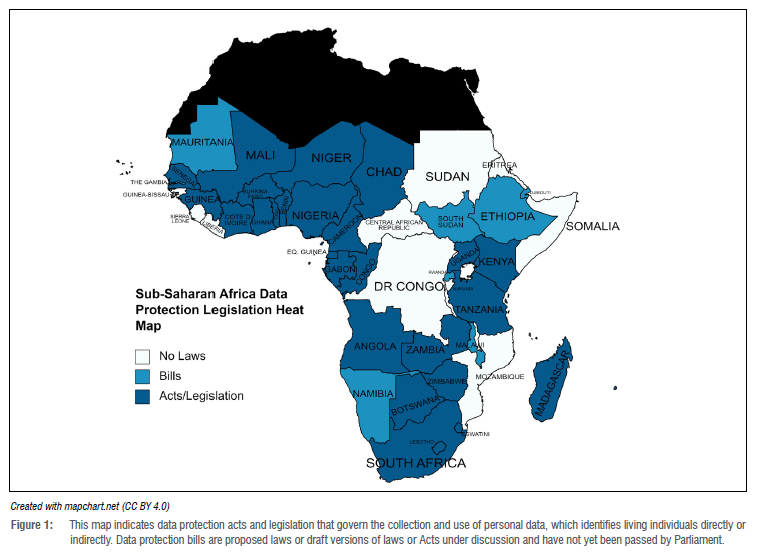
Arguably, the unconsented use of CDRs can be ethically acceptable if the data are fully anonymised, i.e. if the privacy dimension of autonomy is absolutely protected by rendering the reidentification of data sources impossible by all parties. Full anonymity is to be contrasted with deidentification (the removal of a person's identifying characteristics, such as date of birth, from a data set) and pseudoanonymisation (where personal identifiers are replaced by pseudonyms or codes and cannot be attributed to a specific person without the aid of additional information).21 2223 Data Protection Act (Act 2012), there is a long list of exemptions - public order, public safety, public morality, national security or public interest - that enables a government to encroach on the rights of citizens.24252627Figure 1 provides a general overview of the status of data protection legislation in SSA as of April 2023. Enhancing the visibility of groups by governments through mobility data has ethical risks in the SSA context, particularly in relation to politicised ethnic and other divisions.28
Bias and representativeness
The use of reliable scientific methods is a basic ethical requirement of health research.29303131323334
'Mobility justice' refers to how differences in class, gender, race, ethnicity, nationality, sexual identity and physical ability, as well as the built environment, social practices and public policies, influence human movement.353635
The precision of movement data also significantly differed by neighbourhood, which (like representativeness) is likely to influence how resources are allocated during natural disasters.37
Community awareness, engagement and trust
Although COVID-19 has accelerated public health research using cell phone data, studies of public awareness, knowledge or attitudes towards the use of such data for public health purposes are conspicuous by their absence. Jones et al.38393940
In all, explicitly addressing the five principles in the preparation of a project should give confidence to the statistical agency and its partners, that enough care has been exercised in the set up and implementation of the project, and should convey trust to public and government in the use of mobile operator data for policy purposes.40(p.e24-1-e24-21)
The neglect of community engagement in health-related mobility research using cell phone data is problematic for a number of reasons. First, at least some degree of community engagement is increasingly expected (if not demanded) by regulators and ethics committees as a basic requirement of the responsible conduct of research.414243
Function creep and accountability
'Function creep' refers to the phenomenon of a technology being used for something other than its originally intended purpose. Drivers' licences, originally meant to promote traffic safety, gradually took on the role of authorised personal identification. The use of CDRs for public health promotion is itself a form of function creep, although ethical concerns about function creep typically are about when the new function of the technology is less benign than its original purpose.
As some in technology studies have observed, the 'creep' in function creep often takes the form of a gradual expansion from a context of care to a context of control.4445,46 Foreign involvement in the African communication technology sector, particularly that of the Chinese government, has also raised questions about function creep and accountability.474849
As more and more digital phone data are being collected, analysed and shared, potentially harmful manifestations of function creep are likely inevitable. A question then is: who is accountable for minimising the risks raised by function creep in regard to cell phone derived mobility data in SSA? COVID-19 and the rise of data digitisation have stimulated the further development of legal and regulatory frameworks for data protection and privacy, although currently the result is a patchwork, with some African countries having few or no relevant policies, while others have extensive governance frameworks.505152
Stakeholder relationships and power dynamics
Ethical issues regarding research data governance in Africa have been raised for many years, particularly in response to large-scale genomic research initiatives, such as H3Africa.5354
In short, the stakeholder relationships in this relatively new field in LMICs risk being marked by dominance, dependence, a lack of transparency and disempowerment along a number of lines: the power held by cell phone companies with vast amounts of citizens' mobility data; the data dependency of governments and researchers on the companies; the lack of control by individuals and communities over the collection, sharing and use of the data collected from them; and the unwillingness or inability of governments to hold companies accountable in ways commensurate with their growing public influence. This risk is particularly significant in SSA countries, where national governments in resource-limited settings with weak health infrastructures may be highly vulnerable to coming under the sway of powerful transnational corporations. In addition, some African governments have a poor track record in regard to public accountability. The commercially mediated use of big data by political authorities could further widen the rift between government and the governed.
Translation of mobility analyses into health policyPublic health research is conducted on the assumption that its findings can be used to improve health by informing relevant policies and practices. Leaving to one side the issues of data representativeness and accuracy, a central question is what health policymakers should do with cell phone derived mobility analyses. As with other emerging and exciting information technologies, there is a risk of this approach being regarded as inherently superior to other ways of generating evidence or to other considerations that are important to health policy decision-making. This can lead to an overly technology-driven policy approach, such as can be seen in critiques of how big data have been utilised in the development of 'smart cities'. As Kitchin55less inhabitable.
Current debates about evidence-based policy indicate that, while having good evidence is crucially important, health policy is always, to some extent, underdetermined by empirical evidence.565758
In LMICs, including those in SSA, health policymaking is often ad hoc and fragmented in many chronically under-resourced ministries of health.591660
Conclusion
Improving our understanding of human behaviour is vitally important for efforts to improve public health. Insights from cell phone derived mobility data could be beneficial in many contexts, including humanitarian disasters, infectious disease outbreaks and responses to climate change. Considering persistent population health challenges and the sharp growth in cell phone use in SSA, it is understandable that public health researchers, organisations and policymakers are excited about the potential beneficial applications of mobility data. In this paper, we identified key challenges to be taken into account in the collection, sharing, management and use of mobility data in this setting. Moving forward, greater attention will need to be paid to the governance environments in respective SSA countries in regard to this specific type of data, and, in particular, how mobility data are shared between private mobile operators, researchers, national governments and other third parties. It is important to have accurate local knowledge about circumstances where seemingly innocuous information about human movement can become ethically sensitive, such as regions with territorial disputes, jurisdictions that criminalise sexual minorities, or places where religious groups are persecuted. To date, very little social science research has been conducted in SSA about the potential risks of social harm related to mobility data. Social science research on community attitudes about mobility data use is also in its infancy; a recent qualitative study in South Africa suggests that only a minority of those interviewed were concerned about the use of their location data, but also noted that the majority did not really know how that data were being used.6162,63 Data ethics tools have been developed in a number of countries (such as The Data Ethics Canvas of the Open Data Institute, The Box by AI Ethics Lab, and the Data Ethics Decision Aid of Utrecht University) that could be of some use for research ethics committees in SSA. In short, there are some identifiable challenges, but much is unknown, and much is left to be done in regard to the ethical use of cell phone derived mobility data in the SSA context.
Competing interests
We have no competing interests to declare.
Authors' contributions
S.R.: Conceptualisation, literature review and data collection, writing -the initial draft, writing - revisions. C.A.: Conceptualisation, writing - the initial draft, writing - revisions. T.M.: Writing - the initial draft, writing - revisions. W.J.: Writing - the initial draft, writing - revisions. S.L.: Conceptualisation, writing - the initial draft, writing - revisions. E.J.: Conceptualisation, writing - the initial draft, writing - revisions. K.M.: Conceptualisation, literature review and data collection, writing - the initial draft, writing - revisions.
Acknowledgements
Research reported in this publication was supported by the US National Institute of Mental Health of the US National Institutes of Health under award number U01MH127704. The content is solely the responsibility of the authors and does not necessarily represent the official views of the National Institutes of Health. We thank Dr Kenneth Goodman at the University of Miami for his insights and feedback on earlier versions of this article, and Nezerith Cengiz for her research in support of Figure 1.
References
-
1. De Bruijn M, Nyamnjoh F, Brinkman I. Mobile phones: The new talking drums of everyday Africa. Bamenda: Langaa Research and Publishing Common Initiative Group; 2009. https://doi.org/10.2307/j.ctvk3gmgv
» https://doi.org/10.2307/j.ctvk3gmgv -
2. GSMA Intelligence. The Mobile Economy Sub-Saharan Africa 2022 [document on the Internet]. c2022 [cited 2023 May 26]. Available from: https://www.gsma.com/mobileeconomy/wp-content/uploads/2022/10/The-Mobile-Economy-Sub-Saharan-Africa-2022.pdf
» https://www.gsma.com/mobileeconomy/wp-content/uploads/2022/10/The-Mobile-Economy-Sub-Saharan-Africa-2022.pdf -
3. Stephan LS, Almeida ED, Guimaraes RB, Ley AG, Mathias RG, Assis MV et al. Processes and recommendations for creating mHealth apps for low-income countries. JMIR Mhealth Uhealth. 2017;5(4), e41. https://doi.org/10.2196/mhealth.6510
» https://doi.org/10.2196/mhealth.6510 -
4. Beratarrechea A, Lee AG, Willner JM, Jahangir E, Ciapponi A, Rubenstein A. The impact of mobile health interventions on chronic disease outcomes in developing countries: a systematic review. Telemed e-Health. 2014;20(1):75-82. https://doi.org/10.1089/tmj.2012.0328
» https://doi.org/10.1089/tmj.2012.0328 -
5. Sondaal SFV Browne JL, Amoakoh-Coleman M, Borgstein A, Miltenburg AS, Verwijs M, et al. Assessing the effect of mHealth interventions in improving maternal and neonatal care in low- and middle-income countries: A systematic review. PLoS ONE. 2016;11(5), e0154664. https://doi.org/10.1371/journal.pone.0154664
» https://doi.org/10.1371/journal.pone.0154664 -
6. Tomlinson M, Solomon W, Singh Y Doherty T, Chopra M, Ijumba P et al. The use of mobile phones as a data collection tool: A report from a household survey in South Africa. BMC Med Inform Decis Mak. 2009;9, Art. #51. https://doi.org/10.1186/1472-6947-9-51
» https://doi.org/10.1186/1472-6947-9-51 -
7. Hyder AA, Wosu AC, Gibson DG, Labrique AB, Ali J, Pariyo GW. Noncommunicable disease factors and mobile phones: A proposed research agenda. J Med Internet Res. 2017;19(5), e133. https://doi.org/10.2196/jmir.7246
» https://doi.org/10.2196/jmir.7246 -
8. Brinkel J, Kramer A, Krumkamp R, May J, Fobil J. Mobile-phone based mHealth approaches for public health surveillance in sub-Saharan Africa: A systematic review. Int J Environ Res Public Health. 2014;11(11):11559-11582. https://doi.org/10.3390/ijerph111111559
» https://doi.org/10.3390/ijerph111111559 -
9. Wesolowski A, Buckee CO, Bengtsson L, Wetter E, Lu X, Tatem AJ. Commentary: Containing the Ebola outbreak - the potential and challenge of mobile phone data. PLoS Curr. 2014;Sept 29, Edition 1. https://doi.org/10.1371%2Fcurrents.outbreaks.0177e7fcf52217b8b634376e2f3efc5e
» https://doi.org/10.1371%2Fcurrents.outbreaks.0177e7fcf52217b8b634376e2f3efc5e -
10. Tokey AI. Spatial association of mobility and COVID-19 infection rate in the USA: A county-level study using mobile phone location data. J Transp Health. 2021;22, Art. #101135. https://doi.org/10.1016/j.jth.2021.101135
» https://doi.org/10.1016/j.jth.2021.101135 -
11. Willberg E, Jarv O, Vaisanen T, Toivonen T. Escaping from cities during the COVID-19 crisis: Using mobile phone data to trace mobility in Finland. ISPRS Int J Geo-Inf. 2021;10(2):103. https://doi.org/10.3390/ijgi10020103
» https://doi.org/10.3390/ijgi10020103 -
12. Haddawy P Lawpoolsri S, Sa-ngamuang C, Yin MS, Barkowsky T, Wiratsudakul A, et al. Effects of COVID-19 government travel restrictions on mobility in a rural border area of Northern Thailand: A mobile phone tracking study. PLoS ONE. 2021;16(2), e0248542. https://doi.org/10.1371/journal.pone.0245842
» https://doi.org/10.1371/journal.pone.0245842 -
13. Wesolowski A, Buckee CO, Engo-Monsen K, Metcalf CJE. Connecting mobility to infectious diseases: The promise and limits of mobile phone data. J Infect Dis. 2016;214(suppl 4):S414-S420. https://doi.org/10.1093/infdis/jiw273
» https://doi.org/10.1093/infdis/jiw273 -
14. Gibbs H, Liu Y Abbott S, Baffoe-Nyarko I, Laryea DO, Akyereko E, et al. Association between mobility, non-pharmaceutical interventions, and COVID-19 transmission in Ghana: A modelling study using mobile phone data. PLoS Glob Public Health. 2022;2(9), e0000502. https://doi.org/10.1371/journal.pgph.0000502
» https://doi.org/10.1371/journal.pgph.0000502 -
15. De Montjoye YA, Gambs S, Blondel V, Canright G, De Cordes N, Deletaille S, et al. On the privacy-conscientious use of mobile phone data. Sci Data. 2018;5(1):1-6. https://doi.org/10.1038/sdata.2018.286
» https://doi.org/10.1038/sdata.2018.286 -
16. Oliver N, Lepri B, Sterly H, Lambiotte R, Deletaille S, De Nadai M, et al. Mobile phone data for informing public health actions across the COVID-19 pandemic life cycle. Sci Adv. 2020;6(23), Art. #eabc0764. https://doi.org/10.1126/sciadv.abc0764
» https://doi.org/10.1126/sciadv.abc0764 - 17. Fayemi AK, Macaulay-Adeyelure OC. Decolonizing bioethics in Africa. BEOnline. 2016;3(4):68-90.
-
18. McDonald AM, Cranor LF. The cost of reading privacy policies. J Law Policy Inform Soc. 2008;4(3):543-568. http://hdl.handle.net/1811/72839
» http://hdl.handle.net/1811/72839 -
19. Obar JA, Oeldorf-Hirsch A. The biggest lie on the Internet: Ignoring privacy policies and terms of service policies of social networking services. Inf Commun Soc. 2020;23(1):128-147. https://doi.org/10.1080/1369118X.2018.1486870
» https://doi.org/10.1080/1369118X.2018.1486870 -
20. De Gruchy T, Vearey J, Opiti C, Mlotshwa L, Manji K, Hanefeld J. Research on the move: Exploring WhatsApp as a tool for understanding the intersections between migration, mobility, health and gender in South Africa. Global Health. 2021;17, Art. #71. https://doi.org/10.1186/s12992-021-00727-y
» https://doi.org/10.1186/s12992-021-00727-y -
21. Vokinger K, Stekhoven, D, Krauthammer M. Lost in anonymization - a data anonymization reference classification merging legal and technical considerations. J Law Med Ethics. 2020;48(1):228-231. https://doi.org/10.1177/1073110520917025
» https://doi.org/10.1177/1073110520917025 -
22. Sweeney L. Achieving k-anonymity privacy protection using generalization and suppression. Int J Uncertain Fuzz. 2002;10(5):571 -588. https://doi.org/10.1142/S021848850200165X
» https://doi.org/10.1142/S021848850200165X -
23. Gambs S, Killijan M-O, De Prado MN. Show me how you move and I will tell you who you are. Trans Data Priv. 2010;4:103-126. https://doi.org/10.1145/1868470.1868479
» https://doi.org/10.1145/1868470.1868479 -
24. Government of Ghana. Data Protection Act 2012, art. 60-61 [document on the Internet]. c2012 [cited 2023 May 26]. Available from: https://www.dataprotection.org.gh/media/attachments/2021/11/05/data-protection-act-2012-act-843.pdf
» https://www.dataprotection.org.gh/media/attachments/2021/11/05/data-protection-act-2012-act-843.pdf -
25. Green D, Moszczynski M, Asbah S, Morgan C, Klyn B, Foutry G, et al. Using mobile data for epidemic response in low resource settings - a case study of COVID-19 in Malawi. Data Policy. 2021;3, e19. https://doi.org/10.1017/dap.2021.14
» https://doi.org/10.1017/dap.2021.14 -
26. Gueguen C, Snel N, Mutonji E. Turning big data insights into public health responses in the times of pandemics: Lessons learnt from the Democratic Republic of Congo. Data Policy. 2022;4, e8. https://doi.org/10.1017/dap.2021.30
» https://doi.org/10.1017/dap.2021.30 -
27. Arai A, Knippenberg E, Meyer M, Witayangkurn A. The hidden potential of call detail records in The Gambia. Data Policy 2021;3, e9. https://doi.org/10.1017/dap.2021.7
» https://doi.org/10.1017/dap.2021.7 -
28. Taylor L. Safety in numbers? Group privacy and big data analytics in the developing world. In: Taylor L, Floridi L, Van der Sloot B, editors. Group privacy. Philosophical Studies Series vol. 126. Cham: Springer; 2017. p. 13-36. https://doi.org/10.1007/978-3-319-46608-8_2
» https://doi.org/10.1007/978-3-319-46608-8_2 -
29. Emanuel EJ, Wendler D, Killen J, Grady C. What makes clinical research in developing countries ethical? The benchmarks of ethical research. J Infect Dis. 2004;189(5):930-937. https://doi.org/10.1086/381709
» https://doi.org/10.1086/381709 -
30. Erikson SL. Cell phones as an anticipatory technology: Behind the hype of big data for Ebola detection and containment. In: Engel U, Rottenburg R, editors. Adaptation and creativity in Africa: Technologies and significations in the making of order and disorder. Working Papers of the Priority Programme 1448. Leipzig/Halle: German Research Foundation; 2018. p. 2-14. https://lost-research-group.org/wp-content/uploads/2018/01/WP24_Erikson_180115.pdf
» https://lost-research-group.org/wp-content/uploads/2018/01/WP24_Erikson_180115.pdf -
31. Milusheva S, Bjorkegren D, Viotti L. Assessing bias in smartphone mobility estimates in low income countries. COMPASS '21: ACM SIGCAS Conference on Computing and Sustainable Societies; 2021 June 28 - July 02. New York: Association for Computing Machinery; 2021;364-378. https://doi.org/10.1145/3460112.3471968
» https://doi.org/10.1145/3460112.3471968 -
32. Schellhase J. Using Google mobility data to access COVID-19 mitigation strategies in East Africa [webpage on the Internet]. c2020 [cited 2023 May 17]. Available from: https://milkeninstitute.org/article/covid-19-google-mobility-data-africa
» https://milkeninstitute.org/article/covid-19-google-mobility-data-africa -
33. Wesolowski A, Eagle N, Noor AM, Snow RW, Buckee CO. The impact of biases in mobile phone ownership on estimates of human mobility. J R Soc Interface. 2013;10, Art. #20120986. https://doi.org/10.1098/rsif.2012.0986
» https://doi.org/10.1098/rsif.2012.0986 -
34. Rodriguez-Carrion A, Garcia-Rubio C, Campo C. Detecting and reducing biases in cellular-based mobility data sets. Entropy. 2018;10, Art. #736. https://doi.org/10.3390/e20100736
» https://doi.org/10.3390/e20100736 -
35. Sheller M. Theorizing mobility justice. In: Cook N, Butz D, editors. Mobilities, mobility justice and social justice. London: Routledge; 2018. p. 22-36. https://doi.org/10.4324/9780815377047-2
» https://doi.org/10.4324/9780815377047-2 -
36. Nyamai DN, Schramm S. Accessibility, mobility, and spatial justice in Nairobi, Kenya. J Urban Aff. 2022;45(1):367-389. https://doi.org/10.1080/07352166.2022.2071284
» https://doi.org/10.1080/07352166.2022.2071284 -
37. Deng H, Wang Q. Examining mobility data justice during 2017 Hurricane Harvey. arXiv:2103.2021, Art. #13879. https://doi.org/10.48550/arXiv.2103.13879
» https://doi.org/10.48550/arXiv.2103.13879 -
38. Jones KH, Daniels H, Heys S, Ford DV. Challenges and potential opportunities of mobile phone call detail records in health research. JMIR Mhealth Uhealth. 2018;6(7), e161. https://doi.org/10.2196/mhealth.9974
» https://doi.org/10.2196/mhealth.9974 -
39. Sekandi JN, Murray K, Berryman C, Davis-Olwell P Hurst C, Kakaire R, et al. Ethical, legal and sociocultural issues in the use of mobile technologies and call detail records for public health in the East Africa region: Scoping review. Interact J Med Res. 2022;11(1), e35062. https://doi.org/10.2196/35062
» https://doi.org/10.2196/35062 -
40. Jansen R, Kovacs K, Esko S, Saluveer E, Sostra K, Bengtsson L, et al. Guiding principles to maintain public trust in the use of mobile operator data for policy purposes. Data Policy. 2021;3, e24. https://doi.org/10.1017/dap.2021.21
» https://doi.org/10.1017/dap.2021.21 -
41. Adhikari B, Pell C, Cheah PY Community engagement and ethical global health research. Glob Bioeth. 2020;31(1):1-12. https://doi.org/10.1080/11287462.2019.1703504
» https://doi.org/10.1080/11287462.2019.1703504 -
42. Garett R, Young SD. Ethical views on sharing digital data for public health surveillance: Analysis of survey data among patients. Front Big Data. 2022;5, Art. #871236. https://doi.org/10.3389/fdata.2022.871236
» https://doi.org/10.3389/fdata.2022.871236 -
43. Taylor L, Schroeder R. Is bigger better? The emergence of big data as a tool for international development policy. GeoJournal. 2015;80:503-518. https://doi.org/10.1007/s10708-014-9603-5
» https://doi.org/10.1007/s10708-014-9603-5 -
44. Lyon D. Surveillance society. Presented at: Festival del Diritto, Piacenza, Italia, 28 September 2008 [document on the Internet]. c2008 [[cited 2023 May 17]]. Available from: http://www.festivaldeldiritto.it/2008/pdf/interventi/david_lyon.pdf
» http://www.festivaldeldiritto.it/2008/pdf/interventi/david_lyon.pdf -
45. Luca M, Barlacchi G, Oliver N, Lepri B. Levering mobile phone data for migration flows. arXiv:2105. 2021, Art. #14956. https://doi.org/10.48550/arXiv.2105.14956
» https://doi.org/10.48550/arXiv.2105.14956 -
46. Vinck P Pham PN, Salah AA. "Do no harm" in the age of big data: Data, ethics and the refugees. In: Salah AA, Pentland A, Lepri B, Letouze E, editors. Guide to mobile data analytics in refugee scenarios. Cham: Springer; 2019. p. 87-99. https://doi.org/10.1007/978-3-030-12554-7_5
» https://doi.org/10.1007/978-3-030-12554-7_5 -
47. Yusuf M. China's research into Africa's digital sector worries experts [webpage on the Internet]. c2021 [cited 2023 May 17]. Available from: https://www.voanews.com/a/china-reach-into-africa-digital-sector-worries-experts/6281543.html
» https://www.voanews.com/a/china-reach-into-africa-digital-sector-worries-experts/6281543.html -
48. Parkinson J, Bariyo N, Chin J. Huawei technicians helped African governments spy on political opponents. Wall Street Journal. 2019 August 15. Available from: https://www.wsj.com/articles/huawei-technicians-helped-african-governments-spy-on-political-opponents-11565793017
» https://www.wsj.com/articles/huawei-technicians-helped-african-governments-spy-on-political-opponents-11565793017 -
49. Woodhams S. China, Africa and the private surveillance industry. Georget J Int Aff. 2020;21:158-165. https://doi.org/10.1353/gia.2020.0002
» https://doi.org/10.1353/gia.2020.0002 -
50. Daigle B. Data protection laws in Africa: A pan-African survey and noted trends. J Int Commer Econ. 2021;Feb. Available from: https://www.usitc.gov/publications/332/journals/jice_africa_data_protection_laws.pdf
» https://www.usitc.gov/publications/332/journals/jice_africa_data_protection_laws.pdf -
51. Oduro-Marfo S, Falconer TA. Digital identity in Ghana. Case study conducted as part of a ten-country exploration of socio-digital ID systems in parts of Africa [document on the Internet]. c2021 [cited 2023 May 26]. Available from: https://researchictafrica.net/wp/wp-content/uploads/2021/11/Ghana_31.10.21.pdf
» https://researchictafrica.net/wp/wp-content/uploads/2021/11/Ghana_31.10.21.pdf -
52. Macdonald A. Ghana imposes fee for biometric SIM registration with selfservice app [webpage on the Internet]. c2022 [cited 2023 May 26]. Available from: https://www.biometricupdate.com/202208/ghana-imposes-fee-for-biometric-sim-registration-with-self-service-app
» https://www.biometricupdate.com/202208/ghana-imposes-fee-for-biometric-sim-registration-with-self-service-app -
53. Tindana P Yakubu A, Staunton C, Matimba A, Littler K, Madden E, et al. Engaging research ethics committees to develop an ethics and governance framework for best practices in genomic research and biobanking in Africa: The H3Africa model. BMC Med Ethics. 2019;20(1), Art. #69. https://doi.org/10.1186/s12910-019-0398-2
» https://doi.org/10.1186/s12910-019-0398-2 -
54. Taylor L. Public actors without public values: Legitimacy, domination and the regulation of the technology sector. Philos Technol. 2021;34:897-922. https://doi.org/10.1007/s13347-020-00441-4
» https://doi.org/10.1007/s13347-020-00441-4 -
55. Kitchin R. The ethics of smart cities and urban science. Phil Trans R Soc A. 2016;374, Art. #20160115. https://doi.org/10.1098/rsta.2016.0115
» https://doi.org/10.1098/rsta.2016.0115 -
56. Parkhurst J. The politics of evidence: From evidence-based policy to the good governance of evidence. Abingdon: Routledge; 2017. https://doi.org/10.4324/9781315675008
» https://doi.org/10.4324/9781315675008 -
57. Lee M, Zhao J, Sun Q, Pan Y Zhou W, Xiong C, et al. Human mobility trends during the early stage of the COVID-19 pandemic in the United States. PLoS ONE. 2020;15(11), e0241468. https://doi.org/10.1371/journal.pone.0241468
» https://doi.org/10.1371/journal.pone.0241468 -
58. Perrotta D, Frias-Martinez E, Pastore y Piontti A, Zhang Q, Luengo-Oroz M, Paolotti D, et al. Comparing sources of mobility for modelling the epidemic spread of Zika virus in Colombia. PLoS Negl Trop Dis. 2022;16(7), e0010565 https://doi.org/10.1371/journal.pntd.0010565
» https://doi.org/10.1371/journal.pntd.0010565 -
59. Lane J, Andrews G, Orange E, Brezak A, Tanna G, Lebese L, et al. Strengthening health policy development and management systems in low- and middle-income countries: South Africa's approach. Health Policy OPEN. 2020;1, Art. #1000010. https://doi.org/10.1016/j.hpopen.2020.100010
» https://doi.org/10.1016/j.hpopen.2020.100010 -
60. Buckee C, Balsari S, Schroeder A. Making data for good better. PLoS Digit Health. 2020;1(1), e0000010. https://doi.org/10.1371/journal.pdig.0000010
» https://doi.org/10.1371/journal.pdig.0000010 -
61. Usadolo SE, Mbinda BB, Maome IJ. 'We just want to be heard!' Dataveillance and location data - do South Africans care? Afr J Inter-Multidiscip Sud. 2022;4(1):64-75. https://doi.org/10.51415/ajims.v4i1.981
» https://doi.org/10.51415/ajims.v4i1.981 -
62. Ienca M, Ferretti A, Hurst S, Puhan M, Lovis C, Vayena E. Considerations for ethics review of big data health research: A scoping review. PLoS ONE. 2018;13(10), e0204937. https://doi.org/10.1371/journal.pone.0204937
» https://doi.org/10.1371/journal.pone.0204937 -
63. Ferretti A, Ienca M, Velarde MR, Hurst S, Vayena E. The challenges of big data for research ethics committees: A qualitative Swiss study. J Empir Res Hum Res Ethics. 2022;17(1 -2):129-143. https://doi.org/10.1177/15562646211053538
» https://doi.org/10.1177/15562646211053538

Revised: 09 May 2023
Accepted: 12 May 2023
Published: 30 May 2023
Funding: US National Institutes of Health (U01MH127704)