Long-term effects of a low dosage of grape seed proanthocyanidin extract on blood pressure in spontaneously hypertensive rats
Abstract
Most studies on the antihypertensive effects of bioflavonoids have reported short-term effects (within 7 weeks) at high concentrations (40-100 mg kg-1 day-1). The present study by contrast has investigated long-term effects of low concentrations of bioflavonoids on arterial blood pressure and left ventricular performance in spontaneously hypertensive rats (SHR). Spontaneously hypertensive rats were divided into a treated (n = 16) and a control (n = 16) group. The treated group received daily a grape seed proanthocyanidin extract (GSPE) at a concentration of 4 mg kg-1 day-1 over six months. Arterial blood pressure (ABP) was measured once monthly on six randomly selected rats from both groups using an indirect tail-cuff method. After three months, the remaining rats underwent catheterizations to measure left ventricular performance and aortic pressure. The possible role of nitric oxide (NO) in the effects of GSPE was investigated by blocking NO synthase with N-nitro-L-arginine methyl ester (L-NAME). Animals in the treated group had significantly lower arterial end-diastolic pressures (AEDP) after three months of treatment compared with control animals, and this trend continued until six months. In the treated group, left ventricular systolic pressures (LVSP) were reduced by 16.6% (P = 0.005), their dP/dtmax (left ventricular pressures) were reduced by 19.7% (P = 0.050), and cardiac work was reduced by 22.0% (P = 0.045) at the end of three months. Treatment with L-NAME suggested a contribution of NO to the effects of GSPE on blood pressure. A low concentration of GSPE administered over six months lowered AEDP significantly, and the L-NAME response suggested that NO is involved. The decreased AEDP had a lowering effect on left ventricular dynamics of hypertensive rats.
Introduction
In the case of the Dietary Approaches to Stop Hypertension (DASH) diet, it was found that the inclusion of increased bioflavonoids in the diet substantially reduced ABP in humans.1 Most animal studies on the antihypertensive effects of bioflavonoids reflect short-term effects (1–7 weeks) at high concentrations (40–100 mg kg–1 day–1).2–7 Little information is available on long-lasting antihypertensive effects at bioflavonoid concentrations of 4–10 mg kg–1 day–1 in animals, a concentration which would correlate better with the bioflavonoid intake in humans following a diet rich in fruit and vegetables. Various human studies have provided evidence that bioflavonoids have a protective effect in lowering BP.8–10 The DASH diet, rich in fruits, vegetables and low-fat dairy foods, reduced arterial peak systolic pressure (APSP) by 5.5 mm Hg or more, and arterial end diastolic pressure (AEDP) by at least 3.0 mm Hg.11
In an observational study based on a parametric model, it was suggested that a long-term drop in AEDP of between 5 and 6 mm Hg was associated with an approximated 35–40% reduction in the number of cerebral strokes and a 20–25% reduction in the number of CHD.12,13 Another study suggested that a reduction in AEDP as small as 2 mm Hg could result in a 15% decline in the risk of strokes and a 6% decline in the risk of coronary heart disease (CHD).14
A cross-cultural correlation study9–1 in west Finland to 68.2 mg day–1 in Ushibuka, Japan, whereas the average bioflavonoid intake in the Zutphen study,8–1. When the previous results are taken into account, the 68.2 mg day–1(rounded off as 70 mg day–1) (or ~1 mg kg–1 day–1 for a 70-kg human) value can be considered as the highest natural bioflavonoid intake in humans. Since adult rats have a metabolic rate about four times faster than humans,15–1day–1 for these animals.
The aim of this study was to assess long-term blood pressure-lowering effects of bioflavonoids in a hypertensive rat model consuming GSPE at a concentration which reflects a human diet rich in fruits and vegetables. In addition, the effects of GSPE on left ventricular variables were determined, and the question asked whether NO played a role in the BP-lowering effects of GSPE.
Materials and methods
See Appendix.
Results
Effects of GSPE on arterial blood pressure over a six-month period
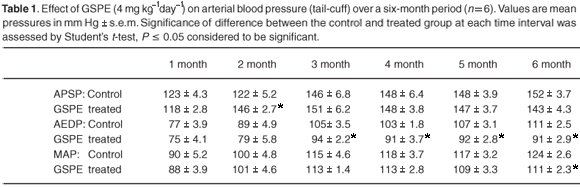
Between three and six months, during which the AEDP of the control group had increased to a level above 100 mm Hg, a significant lowering and stabilizing effect of the AEDP was seen in the GSPE-treated group (Table 1).
Effects of GSPE on left ventricle parameters and aortic blood pressure at three months
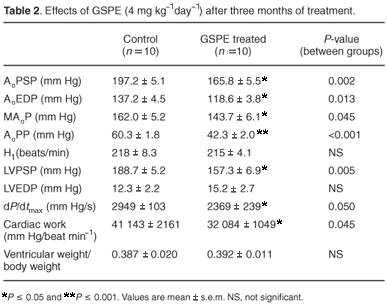
Rats receiving the GSPE had significantly lower cardiac parameters (except LVEDP, HR and VBR, which did not change significantly) when compared with the control group (Table 2). Their LVPSP was less by 16.6%, their dP/dtmax by 19.7% and CW by 22.0%. The AoPSP, AoEDP, MAoP, and AoPP values recorded during this procedure were also significantly lower in the treated group than in the control group (Table 2).
Effects of L-NAME on GSPE-treated rats after three months
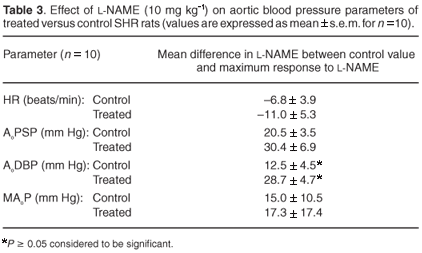
The results show a drop in AoDBP of 12.5 ± 4.5 mm Hg for the control group and 28.7 ± 4.7 mm Hg for the treated group (P = 0.019) with the L-NAME intervention. L-NAME had a much greater effect on the AoEDP of treated animals (130% higher) than on the non-treated control animals, while all the other parameters (AoPSP, MAoP, and HR) were not significantly affected by the L-NAME procedure (Table 3).
Discussion and conclusion
The study indicated that a low dosage of GSPE (4 mg kg–1 day–1) given to SHR daily over a six-month period led to lower AEDP values than those of control rats (Table 1); this lowering effect became significant after three months compared with the control group. The higher indirect APSP for the treated group compared with that of control group at the end of month 3 cannot be explained; because arterial systolic blood pressure is predominantly a function of the heart's pressure development and not of arterial action, and as the direct effect of GSPE is mainly on arterial dynamics, systolic pressure is not the parameter of interest, however. The aortic blood pressures (Table 2), especially the AoPSP, did not correspond with the blood pressures measured at the end of the third month with the tail-cuff method; different states of consciousness could have contributed to this. (It is well documented that blood pressures taken with the tail-cuff method are lower than intra-arterial measured aortic pressures.17,18) The decreased contractility as reflected by the decrease in dP/dtmax, as well as the decrease in LVPSP in the treated group, suggest the beneficial effect of a reduced afterload caused by GSPE (Table 2). The decreased contractility in this study should not be confused with decreased contractility during pathological fibrosis, since the results did not show any significant difference in the ventricular weight/body weight ratio (VBR) (Table 2), indicating the absence of myocardial hypertrophy during the first six months in the lifespan of the SHR. As the AEDP values were lowered in the treated group (Table 1), their left ventricles in turn generated less pressure to eject blood into the aortas as seen from the reduced LVPSP, reduced dP/dtmax and reduced CW (Table 2).
We surmised that the decrease in contractility in the treated group might be attributable to a NO-induced reduction in afterload. Administration of L-NAME, a NO synthase inhibitor, resulted in a larger increase in AoEDBP in the treated group (Table 3). This suggests that higher concentrations of NO might have been present in the GSPE-treated group when compared with the control group, and points to a mechanism through which GSPE can produce blood pressure-lowering effects, because it is known that NO is a powerful vasodilator.
In conclusion, this study indicates that a low dosage of GSPE (4 mg kg–1 day–1) administered over a six-month period significantly reduces the AEDP in SHR after three months (Table 1). The study further suggests that the reduction in afterload leads to a significantly beneficial reduction in left ventricular contractility as well as cardiac work in hypertensive rats (Table 2). The results support the concept that this in vivo antihypertensive effect of the extract might in part at least be due to the vasodilator actions of NO. Lastly, this study supports studies on humans which have indicated that a high consumption of fruit and vegetables which contain large amounts of bioflavonoids might provide protection against hypertension and other related cardiovascular diseases.7,11
We thank Harold Majane, Hosea Lephalala, Danila Correia and Annette de Frietas for technical assistance. This research was supported by a grant from Value Added Life (Pty) S.A. and we declare that there is no conflict of interest between any parties.
References
- 1. Most M. (2004). Estimated phytochemical content of the Dietary Approaches to Stop Hypertension (DASH) diet is higher than the control study diet. J. Am. Diet Assoc. 104(11),1725–1727.
- 2. Bernatova I., Pechanova O., Babal P., Kysela S., Stvrtina S. and Andriantsitohaina R. (2002). Wine polyphenols improve cardiovascular remodeling and vascular function in NO-deficient hypertension. Am. J. Physiol. 282, H942–H948.
- 3. Duarte J., Perez-Palencia R., Vargas F., Ocete M.A., Perez-Vizcaino F., Zarzuelo A. and Tamargo J. (2001). Antihypertensive effects of the flavonoid quercetin in spontaneously hypertensive rats. Br. J. Pharmacol. 133, 117–124.
- 4. Duarte J., Jimenez R., O'Valle F., Galisteo M., Perez-Palencia R., Vargas F., Perez-Vizcaino F., Zarzuelo A. and Tamargo J. (2002). Protective effects of the flavonoid quercetin in chronic nitric oxide deficient rats. J. Hypertens. 20, 1843–1854.
- 5. Pataki T., Bak I., Kovacs P., Bagchi D., Das D.K. and Tosaki A. (2002). Grape seed proanthocyanidins improved cardiac recovery during reperfusion after ischemia in isolated rat hearts. Am. J. Clin. Nutr. 75, 894–899.
- 6. Sato M., Bagchi D., Tosaki A. and Das D.K. (2001). Grape seed proanthocyanidin reduces cardiomyocyte apoptosis by inhibiting ischemia/reperfusion-induced activation of JNK-1 and C-JUN. Free Radic. Biol. Med. 31, 729–737.
- 7. Soares D.M., Costa Viana F.S., Souza M.A., Kovary K., Guedes D.C., Oliveira E.P., Rubenich L.M., Carvalho L.C., Oliveira R.M. et al. (2002). Antihypertensive, vasodilator and antioxidant effects of a vinifera grape skin extract. J. Pharm. Pharmacol. 54, 1515–1520.
- 8. Hertog M.G., Feskens E.J., Hollman P.C., Katan M.B. and Kromhout D. (1993). Dietary antioxidant flavonoids and risk of coronary heart disease: the Zutphen Elderly Study. Lancet 342, 1007–1011.
- 9. Hertog M.G., Kromhout D., Aravanis C., Blackburn H., Buzina R., Fidanza F., Giampaoli S., Jansen A., Menotti A. and Nedeljkovic S. (1995). Flavonoid intake and long-term risk of coronary heart disease and cancer in the seven countries study. Arch. Intern. Med. 155, 381–386.
- 10. Rimm E.B., Katan M.B., Ascherio A., Stampfer M.J. and Willett W.C. (1996). Relation between intake of flavonoids and risk for coronary heart disease in male health professionals. Ann. Intern. Med. 125, 384–389.
- 11. Apple L.J., Moore T.J., Obarzanek E., Vollmer W.M., Svetky L.P., Sacks F.M., Bray G.A., Vogt T.M., Cutler J.A., Windhauser M.M., Lin P. and Karanja N. (1997). A clinical trial of the effects of dietary patterns on blood pressure. N. Engl. J. Med. 336(16), 1117–1124.
- 12. Collins R., Peto R., MacMahon S., Hebert P., Fiebach N.H., Eberlein K.A., Godwin J., Qizilbash N., Taylor J.O. and Hennekens C.H. (1990). Blood pressure, stroke, and coronary heart disease. Part 2. Short-term reductions in blood pressure: overview of randomised drug trials in their epidemiological context. Lancet 335, 827–838.
- 13. Hebert P.R., Moser M., Mayer J., Glynn R.J. and Hennekens C.H. (1993). Recent evidence on drug therapy of mild to moderate hypertension and decreased risk of coronary heart disease. Arch. Intern. Med. 153, 578–581.
- 14. Cook N.R., Cohen J., Hebert P.R., Taylor J.O. and Hennekens C.H. (1995). Implications of small reductions in diastolic blood pressure for primary prevention. Arch. Intern. Med. 155, 701–709.
- 15. Preuss H.G., Montamarry S., Echard B., Scheckenbach R. and Bagchi D. (2001). Long-term effects of chromium, grape seed extract, and zinc on various metabolic parameters of rats. Mol. Cell. Biochem. 223, 95–102.
- 16. Bunag R.D. (1973). Validation in awake rats of a tail-cuff method for measuring systolic pressure. J. Appl. Physiol. 34, 279–282.
- 17. Bunag R.D. (1983). Facts and fallacies about measuring blood pressure in rats. Clin. Exp. Hypertens. A 5(10), 1659–1681.
- 18. Kurtz T.W., Griffen K.A., Bidani A.K., Davisson R.L. and Hall J.E. (2005). Recommendations for blood pressure measurements in humans and experimental animals. Part 2. J. Hypertens. 45, 299–321.
- 19. Hay L., Schutte P.J., du Plooy W.J., Kgwefane K. and Kahler C.P. (1995). The effects of left ventricular loading on three indices of isovolumic relaxation rate in primates. Med. Sci. Res. 23, 285–286.