The deep-time treasure chest of the Makhonjwa Mountains
NEWS & VIEWS
The deep-time treasure chest of the Makhonjwa Mountains
Maarten J de Wit
Africa Earth Observatory Network (AEON). Department of Geological Sciences, University of Cape Town, South Africa
The Makhonjwa Mountains of Mpumalanga and Swaziland comprise some of the most sought after geo-real-estate in the world: priceless - for geoscientists - because the rocks of this c.120 km × 60 km corner of southern Africa, also known as the Barberton greenstone belt, date back to between 3.2 and 3.6 billion years (Ga). These are not the oldest rocks on Earth (those occur in Greenland and Canada), but they are the oldest, most well-preserved ensemble of rocks and, as such, best represent Earth in early Archean times, when it was still c.1 billion years young. In fact, these rocks are so well-preserved that, unless one radiometrically dates them, it is nearly impossible to distinguish them from many modern rocks.
This exceptional preservation has ensured that the Makhonjwa rocks yield the oldest undisputed signs of life on Earth and, when compared to our present biosphere, also provide detailed clues about the hostile nature of the palaeoenvironments under which this life struggled to persist. One severe challenge entailed coping with more potent solar radiation, to which life is particularly sensitive, in a time when Earth's magnetic field was too weak to shield the planet efficiently from the relentless solar wind of lethal charged particles. Two recent discoveries1,2 have stirred scientific debate about this early life and key aspects of the palaeoecology during the Archean Eon, enabling us to better understand how organisms persisted on our young Earth. The first suggests that we revise much further back in time, to when the Eukaryota - to which we belong - last shared a common ancestor with Bacteria. Insights from the second discovery help us reconstruct the survival conditions in this 'cradle of life'.
Ever since the first purported signs of microfossils were discovered here,3
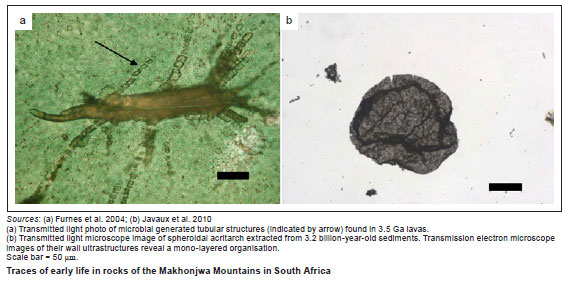
Over the last decade, three Barberton 'surprises' have emerged in the form of early Archean endogenous biogenic fossils, with all three having living equivalents in our modern world. Firstly, trace fossils of single-cell chemosynthesisers were discovered in igneous rocks from glassy margins of lavas formed at the bottom of Archean oceans.4Figure 1a). Similar signs of chemophilic bacteria that metabolise on, and devour, such igneous rock far removed from sunlight are abundant in the modern deep oceans.45
Most recently, however, an astonishing new fossil discovery has been made in sedimentary rocks dated at about 3.2 Ga.1Figure 1b). Further analyses by Javaux et al.1
Arcitarchs are of unknown biological affinities and herein lays the most tantalising part of the discovery: What exactly are these fossils? To which branch of the three known domains of life - Archaea, Bacteria, or Eukaryota - do they belong? Javaux and her collaborators166
It has been calculated that the Earth was subjected to X-ray and UV radiation from the young, rapidly rotating Sun, which was more intense than current levels of solar radiation by several orders of magnitude.7
Presently, the Earth deflects this 'solar wind' by means of a magnetic shield formed around it by a magnetic field generated within its iron core - our geodynamo. Facing the Sun, Earth sports a kind of magnetic 'space-umbrella' that deflects charged particles around it. But, during severe 'windy' conditions, particles can sneak deep beneath the umbrella, giving rise, for example, to the auroras near the poles (the Northern and Southern Lights). Without its magnetic field, life on Earth would cease to exist. So a legitimate and fundamental question, therefore, is when did Earth first acquire its magnetic field; when did our geodynamo first 'kick-in'? This goes to the heart of understanding the origin and evolution of Earth's iron core. And 'reading' this in the rock record - through deciphering palaeomagnetic signatures - is, arguably, even more challenging than finding signs of early life.
It has been known from numerous palaeomagnetic studies in Barberton that a magnetic field existed around the Earth by at least 3.48 Ga. That is the easy part. Determining the strength of this field, however, is much more challenging. Earlier research in the Makhonjwa Mountains has suggested that, by 3.2 Ga, the intensity of the Earth's magnetic field was around 50% of that of the modern Earth. But testing these models is difficult, in part because even slight weathering, along with recent lightning strikes, can easily reset the fossilised magnetic signatures in these rocks.
A current study2227,8,9 There is also too little known, surprisingly perhaps, about the precise past chemical composition of our exosphere to predict how life may have been shielded farther from this potent young Sun.
Do the rocks of the Makhojwa Mountains retain enough pristine 'forensic' evidence with which to push these scientific boundaries further? New studies10,11,12 are attempting to reconstruct the precise physical and chemical conditions of the ecosystems 3.5 billion years ago. These projects revolve around drilling deep into the rocks to ensure that samples are not contaminated by present-day surface processes.
The Makhonjwa Mountain treasure chest continues to yield unique observations with which to model how our planet transformed from a near molten ball, to a tectonic-plate-driven recycling plant. There is always a ripple of excitement at scientific meetings whenever the lid of the Makhonjwa Mountain chest is pried open farther, even if ever so slightly. Perhaps, then, it is time to declare these mountains a world-heritage site?
REFERENCES
- 1. Javaux EJ, Marshall CP, Bekker A. Organic-walled microfossils in the 3.2-billion-year-old shallow-marine siliciclastic deposits. Nature. 2010;463:934-938.
- 2. Tarduno JA, Cottrell RD, Watkeys MK, et al. Geodynamo, solar wind, and magnetopause 3.4-3.45 billion years ago. Science. 2010;327:1238-1240.
- 3. Barghoorn ES, Schopf JW. Microorganisms three billion years old from the Precambrian of South Africa. Science. 1966;152:758-760.
- 4. Furnes H, Banerjee N, Muehlenbachs K, Staudigel H, De Wit MJ. Early life recorded in Archean pillow lavas. Science. 2004;304:578-581.
- 5. Westal F, De Wit MJ, Dann J, Van der Gaast S, De Ronde CEJ, Gerneke D. Early Archean fossil bacteria and biofilms in hydrothermally influenced sediments, Barberton greenstone belt, South Africa. Precambrian Res. 2001;106:93-116.
- 6. Buick R. Ancient arcitarchs. Nature. 2010;436:885-886.
-
7. Cnossen I, Sanz-Forcada J, Favata F, Witasse O, Zegers T, Arnold NF. Habitat of early life: Solar X-ray and UV radiation at Earth's surface 4-3.5 billion years ago. J Geophys Res. 2007;112:E02008, doi:10.1029/2006JE002784.
» https://doi.org/10.1029/2006JE002784 - 8. Aubert J, Labrosse S, Poitou C. Modelling the palaeo-evolution of the geodynamo. Geophys J Int. 2009;179:1414-1428.
- 9. Biggin AJ, Strik GHMA, Langereis CG. Evidence for a very long-term-trend in geomagnetic secular variation. Nat Geosci. 2008;1:395-398
- 10. Grosch EG, McLoughlin N, De Wit MJ, Furnes H. Drilling for the Archean roots of life and tectonic earth in the Barberton Mountains. Sci Drill. 2009;8:24-28.
- 11. Pillipott P, Van Kranendonk M, Van Zuilen M, et al. Early traces of life investigations in drilling Archean hydrothermal and sedimentary rocks of the Pilbara Craton, Western Australia and Barberton greenstone belt, South Africa. Comptes Rendus Palevol. 2009;8:649-663.
-
12. Intercontinental Drilling Program. Barberton drilling project: Peering into the cradle of life [homepage on the Internet]. c.2010 [cited 2010 Feb 23]. Available from: http://www.icdp-online.org/front_content.php?idcat=1294
» http://www.icdp-online.org/front_content.php?idcat=1294

 Postal address:
AEON, University of Cape Town
Rondebosch 7701, South Africa
email: