Enhancing climate governance through indigenous knowledge: Case in sustainability science
Abstract
The current tempo of climate change strategies puts the notion of sustainability in question. In this philosophy, mitigation and adaptation strategies ought to be appropriate to the sectors and communities that are targeted. There is a growing realisation that the effectiveness of both strategies hinges on climate governance, which also informs their sustainability. The application of the climate governance concept by the technocratic divide (policymakers and climate practitioners) to communities facing climate change impacts, however, is still a poorly developed field, despite extensive treatment by academia. By drawing heavily from conceptual and analytical review of scholarship on the utility of indigenous knowledge (IK) in climate science, these authors argue that IK can be deployed in the practice of climate governance. It reveals that the merits of such a deployment lie in the understanding that the tenets of IK and climate governance overlap and are complementary. This is exhibited by examining the conceptual, empirical and sustainability strands of the climate governance-IK nexus. In the milieu of climate change problems, it is argued that the basic elements of climate governance, where actions are informed by the principles of decentralisation and autonomy; accountability and transparency; responsiveness and flexibility; and participation and inclusion, can be pragmatic particularly to communities who have been religiously observing changes in their environment. Therefore, it becomes necessary to invigorate the participation of communities, with their IK, in designing climate change interventions, which in this view can be a means to attain the objectives of climate governance.
climate change; local participation; disaster management; EBA; mitigation; CBA
Introduction
The Intergovernmental Panel on Climate Change (IPCC), a brainchild of the United Nations Environmental Programme (UNEP) and the World Metrological Organisation (WMO) established to give the most comprehensive overview and fact base of climate science, recognises climate governance and indigenous knowledge (IK) in the ongoing climate change discourse. Both concepts, however, are treated in fragmentation. Despite this segmentation, there is a growing appetite by both climate governance community and indigenous knowledge researchers to examine the usefulness of the concepts in climate interventions. In climate regimes, it can be argued that climate governance has dominated climate discussions more than IK.1-3 This dominance continues to grow against a backdrop where the intergovernmental policy arena faces substantial impasse on what constitutes climate governance. The intricacy of the stalemate arises from a tradition characterised by a disparate magnitude of contribution existing between the global North, largely blamed for greenhouse gas (GHG) emissions, and the global South, paradoxically experiencing extreme climatic events. Indigenous climate knowledge, following at a distance behind climate governance, continues to occupy space in climate literature, albeit with limited realisation of the relationship between these concepts. It is therefore essential to advance discourse by examining the relationship between climate governance and IK. In this paper, we argue that IK has potential to transform the technocratic-community engagement front in the current discussions where climate science and policy regimes are increasingly being interrogated for their sustainability.
Conscious of the conceptual and definitional flaws, and the intricacies characterising climate discourse, we proceed by treating climate governance as a concept embracing inclusivity in designing mitigation and adaptation strategies by all climate stakeholders, including indigenous communities affected by climate change. Adaptation governance, a concept that has dominated climate discussions to date, centres, for example, on participation, equality and justice in decision-making about interventions to contain climatic events. Meadowcroft11,2
In a related treatment, IK is a knowledge form defined by Orlove et al.45-7 The disaster management community is also drawing heavily from the experiences of indigenous people with the view of making impacting risk and disaster management interventions.8-12
Evidence of IK's usefulness in climate science ranges from enhancing understanding of climate impacts,13-15 particularly at local scale where scientifically advanced models tend to give a coarse-grained focus,1613,17-19 whose success could be credited on meaningful community participation in identifying appropriate climate projects.15,20-22 A demonstration of the climate governance-IK linkages is given in this paper. This is exclusively done through reviewing literature on climate governance and indigenous climate knowledge across the world.
The overriding theme in this analysis is the interrogation of the notion of sustainability science. The genesis of this philosophy is traced from the United Nations Educational, Scientific and Cultural Organisation (UNESCO) Declaration on Science and the Science Agenda Framework held in Budapest, Hungary in 1999.232425
- The envisaged benefits of local participation in programmes like that on Reducing Emissions from Deforestation and Forest Degradation (REDD+), a mechanism whose thrust is to enable communities in developing countries to benefit from climate funds if they actively partner in forest projects that enhance carbon sinks
- Land Use, Land-Use Changes and Forestry (LULUCF), intended for atmospheric carbon stabilisation through regulated activities in local land-use planning and management
- Community-based adaptation (CBA), a bottom-up framework for making effective adaptation through the central role of local people
- Ecosystem-based adaptation (EBA), an approach that serves both objectives of climate proofing and emission reduction through harnessing ecosystem services coupled with wise management of the same.
The benefits of a climate governance-indigenous knowledge nexus are discussed here from conceptual significance, empirical evidence to sustainable development. But first, it is crucial to trace the major developments on governance around climate change so as to contex-tualise the discussion.
Nature of climate governance and problems of articulation
There is phenomenal growth in literature that examines the concept of climate governance. However, this has not resolved the current impasse in the application of the concept in the global policy arena that has been in existence for the past two decades. Biermann and Boas2627-32 Van Asselt,313328293034
At a higher level, governance of climate change is predominantly seen in the 1992 United Nations Framework Convention on Climate Change (UNFCCC) and the 1997 Kyoto Protocol. The UNFCCC is designed to stabilise GHG concentrations to levels that would not interfere with the earth's climate system, while in addition to sharing the objectives of the Convention, the Kyoto Protocol commits industrialised countries to stabilise their GHG emissions. Ashton and Wang27312635
At the regional level, for example, the European Union (EU) and Southern African Development Community (SADC), climate governance can be effected through appropriate regional environmental policies and protocols. Oberthür3628
Nationally, climate governance is tackled in the form of climate policies and institutions. In most countries, however, the policy domain is marked by a patchwork of public and private institutions that differ in their mandates and interests, with potential to cause conflicts that are likely to stymie governance issues.261
In order to address some of these problems, United Nations Development Programme/ United Nations Capital Development Fund/ United Nations Environment Programme (UNDP/UNCDF/UNEP)2
1. National climate change and sub-national governance policies should involve clear links between national policies and decentralisation/ sub-national policies, especially in developing countries where such linkages are best described as weak or non-existent
2. Improving local understanding of climate change issues; that is, knowledge of what climate change means to local governments in concrete and tangible terms, such as information on nature and risks they face
3. Financing arrangements for climate change; including corruption proofing, where there is room for information transparency and oversight on resource use by community stakeholders
4. Operationalising local democracy for vulnerable groups such as involving indigenous peoples in climate change decision-making processes and adaptation strategies, which would include the use of indigenous knowledge and innovations
5. Addressing the capacity question, where capacity assessment of institutions, organisations and individuals is interrogated
Because of these problems of articulation at differentiated spatial and sectoral levels, the emerging situation is that climate governance remains a rhetorical commitment, particularly when viewed from the perspectives of poor and vulnerable communities relying on climate-sensitive liveli-hoods. Despite increasing global certainty about anthropogenic forcing of climate change and the challenges it poses on humanity noted by the IPCC's53630
Climate governance-IK linkage: A conceptual necessity
Governance refers to the ways in which scale level decision-making takes place. It is called 'good governance' when it reflects scrutinisation and oversight by citizens, openness and transparency and participation.2,32 The IPCC7323330,37, Okereke and Bulkeley3839393332
Apparently, most scholarly work is silent regarding examining the role of indigenous knowledge in climate governance. For example, scholars like Orlove4131840,41, and Mawere et al.42 1-3,28,33 and policy regimes,30,36 a re-examination of climate governance would point towards climate governance-indigenous knowledge connectedness. This linkage is argued here as a conceptual necessity for premising climate governance.
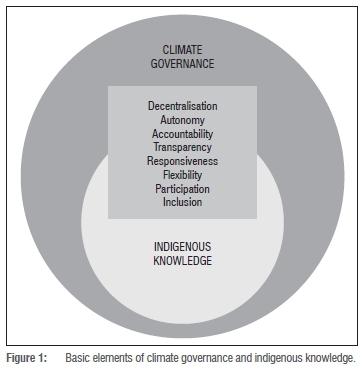
IK as a concept, defines knowledge that is location specific, acquired in situ, through progressive study of the community's interaction with the environment, and orally transferred both within and between generations.4,40-52 Mawere40,41 sees IK as useful in establishing a moral virtuous society whose usage helps African communities to realise a sense of responsibility in environmental resource exploitation, thus ensuring food security in the event of environmental shocks like drought. To Shizha43Figure 1, IK elements are a function of climate governance. Here the major elements characterising climate governance are also found in the utilisation of IK. For instance, the knowledge form is decentralised at grassroots level structures in an autonomous arrangement where there is no exclusion in accessing the knowledge. Whenever a response to climatic events such as floods and drought is called for, users of IK are flexible to actively choose available coping and adaptive options for climate proofing. Although not clearly referring to the concept of climate governance in their arguments, Gwimbi104244,45 write about the significance of IK in mitigating the negative effects of climate change such as floods, violent storms, dry spells and drought.
Climate governance-IK linkage: An empirical reality
The climate change community cites mitigation and adaptation as central themes governing climate interventions. Mitigation, in climate science deployment, is a dual-faceted concept: firstly, as a human intervention to reduce sources or enhance sinks of GHGs; and secondly, as the moderation of potential adverse impacts of climate risks and disasters through actions that reduce hazard, exposure and vulnerability.6
REDD+ is a carbon compensation programme that covers the role of conservation, sustainable management of forests and enhancement of forest carbon stocks in developing countries.5354
The fifth assessment report (AR5) of the IPCC reports that GHG emissions from agriculture comprised about 12% of manufactured pollutants in 2010.75556
In a similar case, Turner and Clifton57
In climate literature, adaptation is treated as a response interventions to some climate stimuli so as to minimise harm or enhance the benefits brought about by climatic conditions or events.5,58-60 Strategies to contain climatic events are usually practical at local or project level involving interactions with the people. In this way, the participation of indigenous people using their knowledge, skills and experiences drawn from many years of coping and adapting to changing and variable environments deserve emphasis.
One of the predominantly preferred strategies by the climate change scholars and practitioners is community-based adaptation (CBA). CBA is viewed as a community-centric approach whereby the locals are positioned as the main stakeholders in the implementation of coping and adaptive interventions.61-63 The intention is to build adaptive capacity and enhance community resilience against the disturbances potentiated by destabilisation in the climate system. In application, it can be seen that this strategy embraces a bottom-up approach where indigenous people are given respect and space to select from a toolbox of their own adaptation options. Kirkland6361
In a study to understand the value of IK in climate adaptation in the African Sahel, Nyong et al.13
- is rich in cultural context
- is an appropriate and sophisticated knowledge form
- increases community buy-in
- promotes equity, efficiency and environmental integrity
- leads to increased communication and understanding
Experiences by Practical Action, working with indigenous rural communities in Bangladesh, Kenya, Peru and Zimbabwe show that for adaptation governance to be realisable it ought to be '.understood as a process, through which communities gain access to skills, resources and information so that they can continuously shape their lives and livelihoods as the environment changes around them.'61
Another key strategy capable of operationalising the climate governance-IK linkage to advance both the goals of mitigation and adaptation governance, is that of ecosystem-based adaptation (EBA). Defined by Munang et al.,6464-67 Worth noting is that the main activities of EBA, listed by the UNFCCC67Box 1).

It should be noted here that focussing on IK does not guarantee the project will be equitable, just and successful, as expected in climate governance. Saran3462,68 defined by Woolcock and Narayan69
Climate governance-IK linkage: A drive towards sustainability
In the preceding sections, we have argued that the realisation of social, economic and environmental sustainability can be enhanced by mitigation and adaptation options that are appropriately crafted through issues of participation, consultation, inclusivity, efficiency, accountability and decentralisation. The IPCCC's6297070
- Prioritise the adaptation needs of, and ensure that resources reach, the most vulnerable, including marginalised groups, women and children, indigenous peoples, local communities and those disproportionately impacted, as well as vulnerable ecosystems, through enhancing adaptive capacity and reducing vulnerability.
- Recognise that responses will have to be based on local assessment of risks, needs and circumstances and be relevant to local people and communities.
- Maximise national, sub national and community level ownership over adaptation planning and implementation processes, and disbursement of adaptation finance, in order to enable and encourage participatory local level planning and implementation.
- Plan and implement adaptation actions in a transparent and well-documented way that is open to public scrutiny and discourse. Ensure the representation of key stakeholders, especially representatives of vulnerable communities, marginalised groups, women, and indigenous peoples at every stage of the process as appropriate -including in the governance and disbursement of adaptation finance, planning, implementation, monitoring and reporting.
- Adopt a process-driven learning-by-doing approach on adaptation planning and implementation, respecting the Precautionary Principle while recognising the urgency to adapt in the absence of complete information and the need to develop and implement flexible plans and programmes that can be updated on the basis of new information and learning.
As the global community drifts towards the post 2015 sustainable development goals (SDGs) marking a paradigmatic shift from the millennium development goals (MDGs), there is need to retrospectively centralise discourse on the sustainability of climate interventions as climate change will remain a cornerstone of the SDGs. The issue of translating climate governance rhetoric into practice should be the central theme of such a transformation. It should be learnt here that local community knowledge, skills and experiences are key in shaping sustainable climate interventions.
Conclusion
In the milieu of climate governance rhetoric characterising the climate regime terrain, the potential role that IK can play in transforming theory into practice deserves attention. The view advanced in this debate is that of taking governance issues to the people who are facing climate impacts. It is hoped that the first point of entry for meaningful climate mitigation and adaptation is the local level where knowledge and experiences of those witnessing the climate phenomena can be harnessed. The effectiveness of REDD+ and LULUCF projects, which are being considered as driving climate stabilisation agendas in many parts of the world, should not be devoid of elements of local governance reflecting local input through IK. Similarly, if adaptation is to build community resilience and adaptive capacity, adaptation governance informed by IK and experiences of locals cannot be ignored. Prioritising local climate governance would translate into local sustainable development which could lead to potential ramifications in higher levels and towards global sustainability. Therefore, it serves to mention that climate governance dialogue should be supported starting at grassroots where indigenous people, with their banks of IK, should characterise the policy discourse for sustainability.
Authors' contributions
N.C. was the lead author who structured the paper concept. AdW reviewed the draft paper and made various suggestions to improve its readability for the target audience.
References
-
1. Meadowcroft J. Climate change governance: A paper contributing to the 2010 World Bank World Development Report. Policy Research Working Paper 4941 [document on the Internet]. c2009 [cited 2014 July 25]. Available from: http://econ.worldbank.org
» http://econ.worldbank.org - 2. United Nations Development/ United Nations Capital Development Fund/ United Nations Environment (UNDP/UNCDF/UNEP). Local governance and climate change. A discussion note, December 2010. Bangkok: UNDP/UNCDF/UNEP; 2010.
- 3. Omuko L. Climate change governance at subnational level: Key lessons for Kenya's county governments. Strathclyde Centre for Environmental Law and Governance (SCELG): Working paper 2/2015. Glasgow: SCELG; 2015.
-
4. Orlove B, Roncoli C, Kabugo M, Majugu A. Indigenous climate knowledge in southern Uganda: The multiple components of a dynamic regional system. Climate Change. 2010;100:243-265. http://dx.doi.org/10.1007/s10584-009-9586-2
» http://dx.doi.org/10.1007/s10584-009-9586-2 - 5. Parry ML, Canziani OF, Palutikof JP Van Der Linden PJ, Hanson CE, editors. Contribution of working group II to the fourth assessment report of the intergovernmental panel on climate change. Cambridge: Cambridge University Press; 2007. p. 976.
-
6. Field CB, Barros V Stocker TF, Qin D, Dokken DJ, Ebi KL, et al, editors. Managing the risks of extreme events and disasters to advance climate change adaptation. A special report of working groups I and II of the Intergovernmental Panel on Climate Change. Cambridge: Cambridge University Press; 2012. p. 582. http://dx.doi.org/10.1017/CBO9781139177245
» http://dx.doi.org/10.1017/CBO9781139177245 -
7. Aggarwal A, Chhetri N, Cull T, Gustavo Feres J, Haggar J, Hutchinson G, et al, editors. Rural areas. Contribution of working group II to the Fifth Assessment Report of the Intergovernmental Panel on Climate Change. Cambridge: Cambridge University Press; 2014. http://dx.doi.org/10.1017/CBO9781107415416.024
» http://dx.doi.org/10.1017/CBO9781107415416.024 - 8. United Nations Environment Programme (UNEP). Indigenous knowledge in disaster management in Africa. Nairobi: UNEP; 2008.
- 9. United Nations International Strategy for Disaster Reduction (UNISDR). Indigenous knowledge for disaster risk reduction - good practices and lessons learned from experiences in the Asia-Pacific Region. Bangkok: UNISDR; 2008.
-
10. Gwimbi P. Linking rural community livelihoods to resilience building in flood risk reduction in Zimbabwe. Jamba. 2009;2(1):071-079. http://dx.doi.org/10.4102/jamba.v2i1.16
» http://dx.doi.org/10.4102/jamba.v2i1.16 -
11. Carcellar N, Christopher J, Co R, Hipolito ZO. Addressing disaster risk reduction through community-rooted interventions in the Philippines: Experience of the Homeless People's Federation of the Philippines. Environ Urban. 2011;23(2):365-381. http://dx.doi.org/10.1177/0956247811415581
» http://dx.doi.org/10.1177/0956247811415581 -
12. Satterthwaite D. Why is community action needed for disaster risk reduction and climate change adaptation? Environ Urban. 2011;23(2):339-349. http://dx.doi.org/10.1177/0956247811420009
» http://dx.doi.org/10.1177/0956247811420009 -
13. Nyong A, Adesina F, Elasha BO. The value of indigenous knowledge in climate change mitigation and adaptation strategies in the African Sahel. Mitig Adapt Strat Glob Change. 2007;12:787-797. http://dx.doi.org/10.1007/s11027-007-9099-0
» http://dx.doi.org/10.1007/s11027-007-9099-0 -
14. Gearheard S, Pocernich M, Stewart R, Sanguya J, Huntington HP! Linking Inuit knowledge and meteorological station observations to understand changing wind patterns at Clyde River, Nunavut. Climate Change. 2010;100(2):267-294. http://dx.doi.org/10.1007/s10584-009-9587-1
» http://dx.doi.org/10.1007/s10584-009-9587-1 -
15. King DNT, Skipper A, Tawhai WB. Maori environmental knowledge of local weather and climate change in Aotearoa - New Zealand. Climate Change. 2008;90:385-109. http://dx.doi.org/10.1007/s10584-007-9372-y
» http://dx.doi.org/10.1007/s10584-007-9372-y - 16. Nakashima DJ, Galloway MK, Thulstrup HD, Ramos CA, Rubis JT. Weathering uncertainty: Traditional knowledge for climate change assessment and adaptation. Paris: United Nations Educational, Scientific and Cultural Organisation (UNESCO); 2012.
- 17. Salick J, Byg A. Indigenous peoples and climate change. Oxford: Tyndall Centre for Climate Change Research; 2007.
-
18. Berkes F. Indigenous ways of knowing and the study of environmental change. J Roy Soc New Zealand. 2009;39(4):151-156. http://dx.doi.org/10.1080/03014220909510568
» http://dx.doi.org/10.1080/03014220909510568 -
19. Green D, Raygorodetsky G. Indigenous knowledge of a changing climate. Climate Change. 2010;100:239-242. http://dx.doi.org/10.1007/s10584-010-9804-y
» http://dx.doi.org/10.1007/s10584-010-9804-y -
20. World Bank. Indigenous knowledge: Local pathways to global development. Knowledge and Learning Group Africa Region [article on the Internet]. c2004 [cited 2014 July 20]. Available from: http://worldbank.org/afr/ik/default.htm
» http://worldbank.org/afr/ik/default.htm -
21. Welp M, De La Vega-Leinert A, Stoll-Kleemann S, Jaeger CC. Science-based stakeholder dialogues: Theories and tools. Glob Env Change. 2006;16:170-181. http://dx.doi.org/10.1016/j.gloenvcha.2005.12.002
» http://dx.doi.org/10.1016/j.gloenvcha.2005.12.002 -
22. International Union for Conservation of Nature (IUCN). Indigenous and traditional peoples and climate change. Issues Paper [document on the Internet]. c2008 [cited 2014 July 20]. Available from: http://cmsdata.iucn.org/downloads/indigenous_peoples_climate_change.pdf
» http://cmsdata.iucn.org/downloads/indigenous_peoples_climate_change.pdf -
23. United Nations Educational, Scientific and Cultural Organisation (UNESCO). Declaration on Science and the use of Scientific Knowledge and the Science Agenda - Framework of Action [document on the Internet]. c1999 [cited 2014 July 22]. Available from: http://unesco.at/wissenschaft/basisdokumente/about_wissenschaft.pdf
» http://unesco.at/wissenschaft/basisdokumente/about_wissenschaft.pdf -
24. United Nations (UN). UN Conference on Environment and Development [document on the Internet]. c1992 [cited 2014 July 20]. Available from:http://un.org/geninfo/bp/enviro.html
» http://un.org/geninfo/bp/enviro.html -
25. United Nations (UN). Report of the World Commission on Environment and Development: Our Common Future [document on Internet]. c1987 [cited 2014 July 22]. Available from: http://un-documents.net/our-common-future.pdf
» http://un-documents.net/our-common-future.pdf -
26. Biermann F, Boas I. Preparing for a warmer world: Towards a global governance system to protect climate refugees. Glob Environ Polit. 2010;10(1):60-88. http://dx.doi.org/10.1162/glep.2010.10.1.60
» http://dx.doi.org/10.1162/glep.2010.10.1.60 - 27. Ashton J, Wang X. Equity and climate in principle and practice. In: Bodansky D, Diringer E, Tudela F, Ashton J, Pershing J, Aldy JE, et al, editors. Beyond Kyoto: Advancing the international effort against climate change. Arlington: Pew Centre on Global Climate Change; 2003.
- 28. Andonova L, Betsill MM, Bulkeley H. Transnational climate change governance. Amsterdam Conference on the Human Dimensions of Global Environmental Change; 2007 May 24-26; Amsterdam, the Netherlands.
- 29. Backstrand K, Loubrand E. Climate governance beyond 2012: Competing discourses of green governmentality, ecological, modernisation and civic environmentalism. In: Pettenger ME, editor. The social construction of climate change: Power, knowledge, norms, discourses. Hampshire: Ashgate Publishing Ltd; 2007.
- 30. Pattberg P Stripple J. Remapping global climate governance: Fragmentation beyond the public/private divide. Global governance working paper No. 32. Amsterdam: The Global Governance Project; 2007.
-
31. Van Asselt H. Dealing with the fragmentation of global climate governance. Legal and political approaches in interplay management. Global Governance Working Paper No. 30. Amsterdam: The Global Governance Project; 2007. http://dx.doi.org/10.2139/ssrn.1335082
» http://dx.doi.org/10.2139/ssrn.1335082 - 32. Chirisa I, Chanza N. How will climate change transform African local governance? - assessing the role of civic engagement. J Public Admin Pol Res. 2009;1(2):035-046.
-
33. Bulkeley H, Moser SC. Responding to climate change: Governance and social action beyond Kyoto. Glob Environ Polit. 2011;7(2):1-10. http://dx.doi.org/10.1162/glep.2007.7.2.1
» http://dx.doi.org/10.1162/glep.2007.7.2.1 - 34. Saran S. Global governance and climate change. Glob Gov. 2009;15:457-460.
- 35. Martin S. Climate change, migration and governance. Glob Gov. 2010;16:397-414.
-
36. Oberthür S. Global climate governance after Cancun: Options for EU leadership. Int Spectator. 2011;46(1):5-13. http://dx.doi.org/10.1080/03932729.2011.567900
» http://dx.doi.org/10.1080/03932729.2011.567900 -
37. Pattberg P, Stripple J. Beyond the public and private divide: Remapping transnational climate governance in the 21st century. Int Environ Agreem-P 2008;8:367-388. http://dx.doi.org/10.1007/s10784-008-9085-3
» http://dx.doi.org/10.1007/s10784-008-9085-3 - 38. Okereke C, Bulkeley H. Conceptualizing climate change governance beyond the international regime. Tyndall Centre Working Paper, East Anglia: Tyndall Centre, University of East Anglia. Norwich: University of East Anglia; 2007.
- 39. Macey A. Climate change: Governance challenges for Copenhagen. Glob Gov. 2009;15:443-449.
- 40. Mawere M. Indigenous knowledge systems' (IKSs) potential for establishing a moral, virtuous society: Lessons from selected IKs in Zimbabwe and Mozambique. J Sust Dev Afr. 2010;12(7):209-221.
- 41. Mawere M. Culture, indigenous knowledge and development in Africa: Reviving interconnections for sustainable development. Bamenda: Langaa RPCIG Publishers; 2014.
- 42. Mawere M, Madziwa BF, Mabeza CM. Climate change and adaptation in third world Africa: A quest for increased food security in semi-arid Zimbabwe. Int J Human Soc Stud. 2013;1(2):14-22.
- 43. Shizha E. Reclaiming our indigenous voices: The problem with postcolonial sub-Saharan African school curriculum. J Indig Soc Dev. 2013;2(1):1-18.
- 44. Chanza N. Indigenous knowledge and climate change: Insights from Muzarabani, Zimbabwe [PhD Thesis]. Port Elizabeth: Nelson Mandela Metropolitan University; 2014.
- 45. Chanza N. Indigenous-based adaptation: An imperative for sustainable climate change strategies for Africa. In: Mawere M, Awuah-Nyamekye S, editors. Harnessing cultural capital for sustainability: A pan Africanist perspective. Bamenda: Langaa Publishing House; 2015. p.85-134.
- 46. Berkes F, Colding J, Folke C. Rediscovery of traditional ecological knowledge as adaptive management. Ecol Appl. 200;10(5):1251-1262.
- 47. Ajibade LT, Shokemi OO. Indigenous approaches to weather forecasting in Asa LGA, Kwara State, Nigeria. Indilinga: Afr J Indig Knowl Syst. 2003;2:37-44.
-
48. Brook RK, McLachlan SM. Trends and prospects for local knowledge in ecological and conservation research and monitoring. Biodivers Conserv. 2008;17:3501-3512. http://dx.doi.org/10.1007/s10531-008-9445-x
» http://dx.doi.org/10.1007/s10531-008-9445-x - 49. Mapara J. Indigenous knowledge systems in Zimbabwe: Juxtaposing postcolonial theory. J Pan Afr Stud. 2009;3(1):139-155.
-
50. Laborde S, Imberger J, Toussaint S. Contributions of local knowledge to the physical limnology of Lake Como, Italy. P Natl Acad Sci USA. 2012;109(17):6441-6445. http://dx.doi.org/10.1073/pnas.1113740109
» http://dx.doi.org/10.1073/pnas.1113740109 -
51. Lefale PF. Ua 'afa le Aso Stormy weather today: Traditional ecological knowledge of weather and climate. The Samoa experience. Climate Change. 2010;100(2):317-335. http://dx.doi.org/10.1007/s10584-009-9722-z
» http://dx.doi.org/10.1007/s10584-009-9722-z -
52. Speranza CI, Kiteme B, Ambenje P, Wiesmann U, Mikal S. Indigenous knowledge related to climate variability and change: Insights from droughts in semi-arid areas of former Makueni District, Kenya. Climate Change. 2010;100:295-315. http://dx.doi.org/10.1007/s10584-009-9713-0
» http://dx.doi.org/10.1007/s10584-009-9713-0 -
53. Makhado RA, Saidi AT, Mantlana BK, Mwayafu MD. Challenges of reducing emissions from deforestation and forest degradation (REDD+) on the African continent. S Afr J Sci. 2011;107(9/10), Art. #615, 3 pages. http://dx.doi.org/10.4102/sajs.v107i9/10.615
» http://dx.doi.org/10.4102/sajs.v107i9/10.615 - 54. Richards M, Swan SR. Participatory subnational planning for REDD+ and other land use programmes: Methodology and step-by-step guidance. Ho Chi Minh: SNV Netherlands Development Organisation, REDD+ Programme; 2014.
-
55. United Nations Framework Convention on Climate Change (UNFCCC). Report of the conference of the parties serving as the meeting of the parties to the Kyoto Protocol on its first session; 2005 Nov 28 - Dec 10; Montreal, Canada [report of the Internet]. c2006 [cited 2014 May 07]. Available from: http://unfccc.int/resource/docs/2005/cmp1/eng/08a03.pdf
» http://unfccc.int/resource/docs/2005/cmp1/eng/08a03.pdf - 56. Mohamed-Katerere JC. Customary environmental management systems. In: Mohamed-Katerere JC, Chenje M, editors. Environmental law and policy in Zimbabwe. Harare: Southern African Research and Documentation Centre; 2002.
-
57. Turner NJ, Clifton H. ''It's so different today'': Climate change and indigenous lifeways in British Columbia, Canada. Glob Environ Chang. 2009;19:180- 190. http://dx.doi.org/10.1016/j.gloenvcha.2009.01.005
» http://dx.doi.org/10.1016/j.gloenvcha.2009.01.005 - 58. Berkes F, Jolly D. Adapting to climate change: Social-ecological resilience in a Canadian western Arctic community. Conserv Ecol. 2001;5(2):18.
-
59. Adger WN, Huq S, Brown K, Conway D, Hulme M. Adaptation to climate change in the developing world. Prog Dev Studies. 2003;3:179-195. http://dx.doi.org/10.1191/1464993403ps060oa
» http://dx.doi.org/10.1191/1464993403ps060oa -
60. Lavell A, Oppenheimer M, Diop C, Hess J, Lempert R, Li J, et al. Climate change: New dimensions in disaster risk, exposure, vulnerability, and resilience. In: Field CB, Barros V Stocker TF, Qin D, Dokken DJ, Ebi KL, et al., editors. Managing the risks of extreme events and disasters to advance climate change adaptation. A special report of working groups I and II of the Intergovernmental Panel on Climate Change (IPCC). Cambridge: Cambridge University Press; 2012. p. 25-64. http://dx.doi.org/10.1017/CBO9781139177245.004
» http://dx.doi.org/10.1017/CBO9781139177245.004 - 61. Ensor J. Governance for community-based adaptation. A practical action discussion paper. Rugby: Practical Action Publishing; 2009.
- 62. Sekine H, Fukuhara K, Uraguchi A, Tan CK, Nagai M, Okada Y.The effectiveness of community-based adaptation (CBA) to climate change-from the viewpoint of social capital and indigenous knowledge. Global Environment Information Centre (GEIC) working paper series 2009-001. Tokyo: GEIC; 2009.
-
63. Kirkland E. Indigenous knowledge and climate change adaptation in the Peruvian Andes [article on the Internet]. c2012 [cited 2014 July 28]. Available from: http://navsarjan.org/ids-document/indigenous-knowledge-and-climate-change-adaptation-in-the-peruvian-andes/
» http://navsarjan.org/ids-document/indigenous-knowledge-and-climate-change-adaptation-in-the-peruvian-andes/ -
64. Munang R, Thiaw I, Alverson K, Mumba M, Liu J, Ravington M. Climate change and ecosystem-based adaptation: A new pragmatic approach to buffering climate change impacts. Curr Opin Environ Sustain. 2013;5(1):67-71. http://dx.doi.org/10.1016/j.COSUSt.2012.12.001
» http://dx.doi.org/10.1016/j.COSUSt.2012.12.001 - 65. Colls A, Ash N, Ikkala N. Ecosystem-based adaptation: A natural response to climate change. Gland: International Union for Conservation of Nature (IUCN); 2009.
- 66. Boyd J. Ecosystem services and climate adaptation. Issue Brief 10-16. Washington, DC: Resources for the Future; 2010.
-
67. United Nations Framework Convention on Climate Change (UNFCCC). Ecosystem-based adaptation [document on the Internet]. c2012 [cited 2014 Aug 01]. Available from: http://unfccc.int/files/adaptation/application/pdf/nwp_cal_2012.pdf
» http://unfccc.int/files/adaptation/application/pdf/nwp_cal_2012.pdf - 68. Chanza N. Building social capital for sustainable rural development in Zimbabwe: Lessons from Korea's Saemaul Undong. Planning and Policy Report Vol. 2. Gyeonggi-do, Korea: Global Development Partnership Center; 2011; p. 84-101.
-
69. Woolcock M, Narayan D. Social capital: Implications for development theory, research and policy. World Bank Res Obs. 2000;15(2):225-249. http://dx.doi.org/10.1093/wbro/15.2.225
» http://dx.doi.org/10.1093/wbro/15.2.225 - 70. Climate Action Network International (CAN). An adaptation action framework of the Copenhagen agreement. Submission to the UNFCCC secretariat; 2009 Apr 24. Beirut: CAN, 2009.
Nelson Chanza
Department of Geosciences, Nelson Mandela Metropolitan University
PO Box 77000, Port Elizabeth 6031. South Africa
Revised: 06 May 2015
Accepted: 10 Oct. 2015