
 Authorship and inclusion - we need more debate and discussion
We all know the stories. The one about the departmental chair who insists on having their name on every paper published from their department. The one about the supervisor who gave no feedback on the dissertation but insists on being senior co-author on all papers from the dissertation. The one about the even worse supervisor who publishes from a student's work without informing the student, without citing the student as co-author, without even mentioning the dissertation from which the supervisor is, to all intents and purposes, plagiarising. The one about the researcher at another university who has the password to a data set they did not create but who will not give researchers access to the data set unless they are listed as a co-author on a study in which they have played no role whatsoever. The one about the authorship cartel in which a group of authors agree to list one another on every article they publish, thereby upping substantially the number of publications each author can claim to have written. And so on and so on... Fill in the blank here with your example of an even more egregious unethical authorship practice.
All these examples share two key features. First, they are products, in part, of the global phenomenon of audit culture, and the particular South African version of this (for a trenchant satire on this, please see the poem by Sioux McKenna we published recently). Second, they involve, in various ways, the unfair exercise of power and access. Although journals are not uncommonly party to authorship disputes, journal editors cannot know who has actually contributed to an article and in what ways, and in general cannot be the adjudicators of authorship on any particular article -this is the work of the authorship team. Journals may, of course, enquire about authorship (our own journal has an Author Declaration form which must be completed by all (co)authors) and ask questions, but we usually cannot police whether authors are being honest with their declarations.
Although much of the focus on websites, blogs and, in our experience, in everyday corridor talk about academia, is on powerful people claiming and abusing authorship rights, there is another side to the authorship question which is emerging and also needs our attention. Our journal, like many others globally and locally, is concerned about questions of exclusion from scholarship and knowledge on the basis of a number of factors including race, gender, disability, and country of origin and residence. There is no question that epistemic exclusion and injustice is a reality - one has simply to examine rates of numeracy and literacy for different groups. At the same time, we are concerned (and have a number of special issues in the works looking at this issue from different perspectives) about how knowledge may be skewed by the foregrounding of professional knowledges to the exclusion of what we can learn from people who have lived experience of social, environmental, and health conditions, to name just three 'expert by experience' groups. The British Medical Journal (BMJ), for example, has an explicit Patient and Public Partnership strategy and requires authors of all submissions to report on if and how they have relied on the expertise of patients in conducting their work. The BMJ group notes the value that patient input can play in health research, and explicitly requests authors to co-produce research outputs together with patients for the Education section of articles in the BMJ, and provides guidelines11
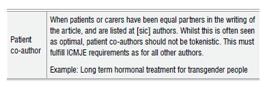
In the article which BMJ suggests as an example, the patient co-author is identified in the author materials as 'Alex Bakker transgender man with 20 years of experience taking hormonal treatment' with no academic affiliation. In a recent example from our own journal, non-academic authors of a Research Article entitled 'The end of the beginning: Establishing isiZulu names for all bird species recorded in South Africa' included those from conservation organisations as well as self-employed bird guides.
The ICMJE (International Committee of Medical Journal Editors) criteria for authorship are very stringent, and it is noteworthy that the BMJ explicitly says, as quoted above, that 'patient co-authors should not be tokenistic'. There are a range of conventions and criteria for authorship of journal articles; in their discussion on authorship criteria, the Committee on Publication Ethics (COPE) note that: "Two minimum requirements define authorship across all definitions - making a substantial contribution to the work and being accountable for the work and its published form."
There have been a number of debates about the inclusion or exclusion of technical contributors, such as statisticians or highly skilled laboratory technicians on academic papers.234
One thing which has been less considered in these debates, as far as we are aware, is the question of authorship, and as COPE suggests above, "being accountable for the work and its published form". What does "being accountable" mean in the context, for example, of an author who may not be fluent in the language in which the article is written (and the problem of the global dominance of English is obvious here)? What if an author who made a substantial contribution is not functionally literate, for reasons of exclusion from education, neurological reasons, or any other? How much room is there, given the basic COPE requirements, to acknowledge the authorship role of people excluded, for a range of reasons, from fluent use of the written word? At what point, by contrast, does a wish to honour all knowledge contributions ethically and inclusively, devolve into the 'tokenism' against which the BMJ warns? How do we factor in the affordances and potential pitfalls of the use of artificial intelligence and large language models into our probably now outdated ideas about 'independence' in scientific writing and thinking?
As we think collectively about opening science and striving for greater and fairer recognition of forms of expertise which have previously been ignored or devalued, we are forced back into fundamental questions about scholarship and authorship. There is much debate about this in the sciences, and we would welcome much more discussion about this in our journal. We all have a responsibility for thinking about these issues.
References
-
1. The BMJ. Co-production guidance for Education articles [document on the Internet]. c2021 [cited 2024 Jun 26]. Available from: https://www.bmj.com/sites/default/files/attachments/resources/2021/06/educationcoproguidance_2021_0.pdf
» https://www.bmj.com/sites/default/files/attachments/resources/2021/06/educationcoproguidance_2021_0.pdf -
2. Smith E. "Technical" contributors and authorship distribution in health science. Sci Eng Ethics. 2023;29(4), Art. #22. https://doi.org/10.1007/s11948-023-00445-1
» https://doi.org/10.1007/s11948-023-00445-1 -
3. Smith E, Hunt M, Master Z. Authorship ethics in global health research partnerships between researchers from low or middle income countries and high income countries. BMC Med Ethics. 2014;15, Art. #42. https://doi.org/10.1186/1472-6939-15-42
» https://doi.org/10.1186/1472-6939-15-42 -
4. Morton B, Vercueil A, Masekela R, Heinz E, Reimer L, Saleh S, et al. Consensus statement on measures to promote equitable authorship in the publication of research from international partnerships. Anaesthesia. 2022;77(3):264-276. https://doi.org/10.1111/anae.15597
» https://doi.org/10.1111/anae.15597
