The evolving landscape of plant breeders' rights regarding wheat varieties in South Africa
Abstract
Addressing the multiple challenges facing global agriculture requires integrated innovation in areas such as seeds, biotechnology, crop protection, grain storage and transport. Innovations related to plant improvement and the development of new or improved plant varieties will only happen at an optimal level if plant breeders' rights (PBR) are properly protected. The objective was to analyse the evolving landscape of wheat plant breeders' rights to address the dearth of empirical evidence of the patterns and trends of wheat varietal improvements in South Africa. We compiled a detailed and novel count and attribute database of wheat varietal innovations in South Africa from 1979 to 2013 using various sources. This data set was then analysed to ascertain the main trends in, and ownership of PBRs for wheat varietal improvements in South Africa over this period. A total of 134 PBR wheat varietal innovations were lodged from 1979 to 2013, an average of 6 applications per year. The administrative delays in granting PBR applications were substantially reduced by 77 days during the post-deregulation period (after 1996), indicating increased efficiency. The main PBR applicants were Sensako (39%), the Agricultural Research Council Small Grains Institute (ARC-SGI) (25%) and Pannar (15%). The ARC-SGI contributed to some of the PBRs owned by private companies through shared genetic resources before Plant Variety Protection (PVP) was implemented. Future innovations and dissemination of wheat innovations can be stimulated by plant variety protection, together with broader variety sector legislation that encourages both public and private sector investment.
Plant variety; protection; breeding; varietal improvements; trends
Introduction and background
Integrated agricultural innovations in areas such as seeds, biotechnology, crop protection, agronomic management practices, harvesting and processing are critical to help address the global challenges facing agriculture, such as climate change and decreasing availability of water and farmland, increasing food demand resulting from increasing population size, and demand for food crops for other uses such as biofuels.1,2 For example, varietal innovations that are high-yielding and drought-resistant are required if farmers are aiming to produce more with less inputs. However, investments in varietal improvements are expensive (in terms of skills, labour, material, resources etc.), take time to develop (10-15 years in the case of many plant species), and the resulting seed products face the risk of being reproduced and 'copied' by competitors, necessitating the need for some form of enforceable commercial protection for plant breeders.1-3
For a long time, developing countries have relied on public investments (national and international) for plant varietal improvements.3,4 Most of the public research investments were implemented through collaborations between national agricultural research institutes and the International Agricultural Research Centres of the Consultative Group on International Agricultural Research such as The International Maize and Wheat Improvement Center (CIMMYT) in Mexico, and the International Rice Research Institute (IRRI) in Manila.456
Pardey et al.7,8 argue that plant varietal rights are subject to controversy and ongoing public policy scrutiny and debate. In order to inform these policy debates, there is a need to understand the evolution of varietal rights and the extent of the varietal rights which are granted. In addition, it is also important to understand the changes which are experienced over time regarding the rights on offer; changing ownership of the rights (including comparison between public and private, as well as domestic and foreign breeders); impacts of plant variety protection on varietal development etc.
In this research, the evolving landscape of plant breeders' rights was analysed regarding wheat varietal improvement in South Africa. The earlier efforts by Stander9
- Which trends can be observed in the wheat varietal improvements subsector in South Africa?
- How have plant breeders' rights for wheat varietal improvements evolved?
- Who are the main plant breeders' rights holders in the wheat sector?
- What are the effects of these developments for diversity and competition in the South African wheat breeding industry?
- Which measures can be taken by the South African Government to restrict or reverse possible negative impacts of these trends in light of relevant policy objectives?
International experiences in plant variety protection
The protection of intellectual property rights of plant breeders was recognised from the 19th century onwards. The International Union for the Protection of New Varieties of Plants (UPOV), established in 1961, seeks to harmonise plant variety protection (PVP) laws and standards of protection across member countries.101sui generis form of protection of new plant varieties for essential features (usually phenotypical).23
Countries are required by the Agreement on Trade-Related Aspects of Intellectual Property Rights (TRIPS) of the World Trade Organisation to provide plant varietal protection 'either by patents or by an effective sui generis system or a combination thereof (TRIPS Article 27(3)(b))'12
The standard argument for implementing PVP is that they would stimulate and drive investments in plant breeding research and development of the domestic seed sector.1111-14 For example, Tripp et al.11 13
Plant variety protection in South Africa
South Africa became a member of UPOV in 1978. According to Moephuli et al.17Plant Breeders' Rights Act (Act 15 of 1976). This was later amended in 1996 to conform to the constitution, as well as to align and comply with the UPOV 1991. Plant variety protection in South Africa is also guided by the Plant Improvement Act 1976 (Act 53 of 1976). Granted PBRs are listed in a variety listing and are usually granted for 20 years for all crops and 25 years for trees and vines. However, the national authority may expropriate rights for national interest, such as food security needs. The granted PBRs automatically expire at the end of the prescribed period.17
The PBR provides the owner of the variety the opportunity to obtain financial reward from the investments put into breeding and development of the new variety in order to recover the costs incurred. Plant breeders' rights have evolved since the nineteen thirties, when crop improvements became an applied form of genetics practised by specialised institutions and seed companies.18
The holder of a set of plant breeder's rights is required to maintain the reproductive material during the period of the rights. It is, however, not clear what happens to the said material after the period of the rights has expired. There is a test for the distinctness of the candidate variety: it should be compared with other varieties of the same kind of plant, of which their existence on that date is a matter of common knowledge. The holder is not entitled to exclusively make available plant material after the holder's rights have expired. This is a problem for other interested parties, as such material will then not be available for comparison purposes with other material that enters the market. DAFF does not have facilities to maintain all the plant material of varieties which have been granted plant breeders' rights, so they are sent to the gene bank at the Agricultural Research Council Small Grains Institute (ARC-SGI).
In South Africa, 60% of holders of PBRs on most crops are foreigners that are largely based in Europe and North America, and this asymmetry is not unique to South Africa as a developing country.18Plant Breeder's Right Act (Act No 15 of 1976) allows farmers to use (re-sow) protected material on his or her own holding. This expression of farmer rights is known as farmer privileges.18
Research methods and data
Plant breeders' rights (PBR) in South Africa were analysed to assess the sources of intellectual property rights in wheat varietal improvements in South Africa. The paper used secondary information collected from various sources on wheat varietal improvement policies, and changes in wheat plant breeders' rights. Other studies that have analysed changes in plant variety protection, focusing on trends and changes in plant variety protection policies, include Diez1553 7,8 In these studies, trends were analysed to understand the evolution of plant varietal protection. This paper applies the same approach in order to understand the changes that have shaped the South African wheat varietal improvement landscape to date, and to allow a comparison with other countries at a later stage.
A detailed and novel count, and attribute database of wheat varietal innovations in South Africa from 1979 to 2013 was compiled. Consultations were made with key informants from the Department of Agriculture Forestry and Fisheries, ARC and the South African National Library during development of the database. The database provides information to assess changing amounts and forms of wheat plant breeders' rights, and changes in the types and pool of the applicants receiving the rights. The database gathered data on applications, granting, and rejections and surrendering of the PBRs. Additional information captured in the database includes plant variety name, alias name, applicant name, applicant type, application date of PBR, grant date of PBR, withdrawal date of PBR, and date end of sole right of PBR, showing end of sole right month and date of termination of PBR.
Data were manually compiled on wheat variety rights from information on wheat plant breeders' rights applications and granting obtained from the Plant Variety Journal of the South African Department of Agriculture Forestry and Fisheries. Additional data were gathered from the South African National Library and the ARC. These different sources of data were used to backfill the data series to come up with a complete database. The data series included 134 applicants for wheat variety rights lodged between January 1979 and December 2013. The empirical analyses were based on descriptive statistics, trend analysis and graphical representation of trends and ownership of wheat varietal improvement PBRs.
Results and discussion
Trends in plant breeders' rights for wheat varietal improvements
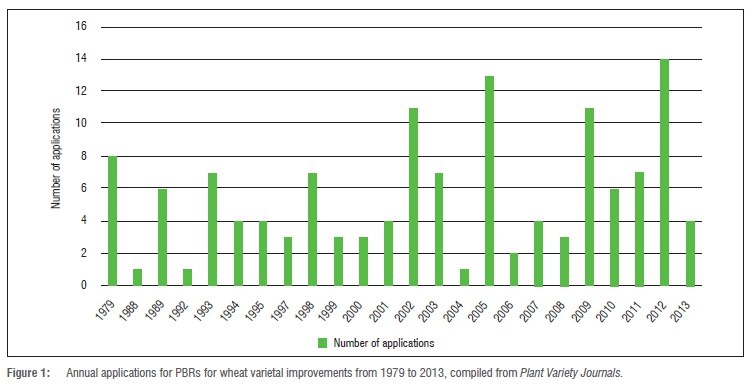
Figure 1 shows the trends in annual applications for PBRs for wheat varietal improvements lodged in South Africa. A total of 134 PBRs were lodged for wheat varietal innovations from 1979 to 2013, an average of 6 applications per year. Data on the number of PBRs lodged for wheat varietal improvements since 1979 show a fluctuation trend with some years having high numbers of applications, and others recording very low applications. For example, 2012 received the highest number of PBRs for wheat varietal improvements, with 14 applications, while 2004 recorded only 1 application. A possible explanation for the uneven trend in applications could be that some breeders chose to apply for their new varieties to be included on the national variety list but did not apply for varietal protection. The variety would then be included on the national variety list so it could be known by millers and bakers, but unless the owner applied for PBRs, anyone could use any material on the variety without paying the owner for IPRs.
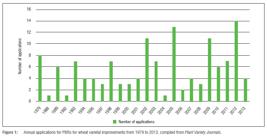
Outbreaks of pests or diseases can trigger more investments in wheat varietal improvements in some years, compared with others. For example, the Ug99 wheat stem rust race group from East Africa was detected in 1999 and since then, 11 pathotypes within the race group have been identified across Africa and a few neighbouring countries. In South Africa, 'four races in the Ug99 lineage have been detected - TTKSF (in 2000), TTKSP (in 2007), PTKST (in 2010) and TTKSF+ (in 2010)'1919
It is also important to understand the effects of the abolishment of the South African Wheat Board in 1996 and the establishment of the ARC-SGI in 1991 on the number of applications for PBRs for wheat varietal improvements. Analysis of the time periods before and after the abolishment of the Wheat Board shows that 77% of the applications were lodged between 1998 and 2013 (after the abolishment of the Wheat Board). The number of PBR applications increased faster after the abolishment of the Wheat Board, at an average of 6 applications per year, compared with 4 applications per year for the time period 1979-1997.
In recent years, the numbers of wheat variety PBRs have substantially increased, compared with the past. From the results, the liberalisation of the wheat sector can be argued to have opened competition in wheat varietal improvements and stimulated increases in applications for PBRs on wheat varietal innovations. Further analysis by time period before and after the establishment of the ARC-SGI shows that only 15 applications for PBRs for wheat varietal innovations were lodged before 1991. The rest of the applications for wheat varietal innovation PBRs (89%) were lodged after the ARC-SGI was established, from 1992 to 2013. The rate of applications was six per year after the establishment of the ARC-SGI, compared with five applications per year before the ARC-SGI was established. The decreasing funding for agricultural research might be contributing to the ARC-SGI seeking revenue from their research outputs.
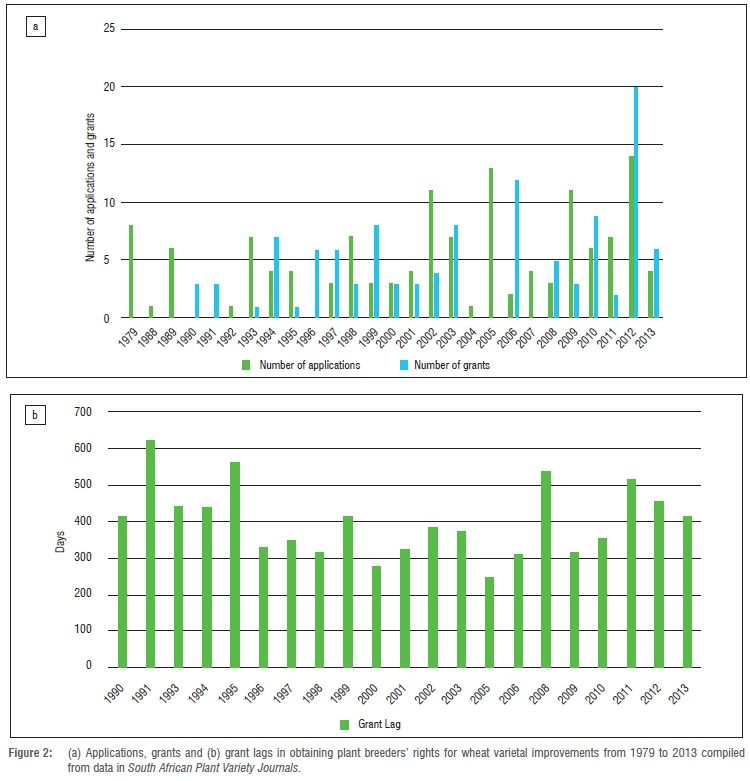
Figure 2 presents an analysis of the wheat varietal improvement PBRs applications, grants and lags. Panel (a) plots PBRs applications and grants in each year, while panel (b) tracks the lag in days between the application and grant dates of each PBR that was eventually granted a certificate. The average time of waiting between application and granting of protection was around 336 days for the overall period of study. Analysis of the grant lags by pre- and post-deregulation time periods indicates that before 1997 (pre-deregulation period) the grant lag was 451 days and this reduced to 374 days in the post-deregulation period. When the application process starts, the sample seeds and application papers are taken and inspected before being sent for trials at ARC. If the variety is found to be distinct, uniform and stable for two seasons, the variety is then granted the PBRs. This means that the processes would take at least 300 days for PBRs to be granted. If the trials are unstable, more trials may be required and the process would take longer until all the irregularities are checked and rectified (De Bruyn E 2015, Oral communication, Aug 24).
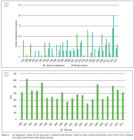
Pardey et al7
The plant variety rights applications can at any time be: granted; abandoned or withdrawn by the applicant; deemed ineligible - such as in cases of incomplete applications; denied by the office; or still pending examination.7
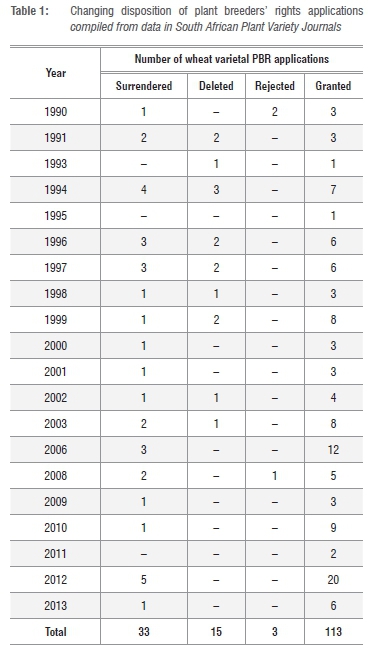
Table 1 shows the changing status of wheat varietal improvement PBRs, over time. For the period under review, 113 wheat variety rights applications were lodged between 1990 and 2013 and were granted, while 33 of the applications were surrendered, and 15 were deleted. The results show that only 3 cases were rejected from 1990 to 2013. Analysis of the granted PBRs for wheat varietal innovations by decade shows an average grant rate of 4 PBRs/year; 5 PBRs/year and 9 PBRs/year for the periods 1990-1999, 2000-2009 and 2010-2013, respectively. Further analysis by pre- and post-deregulation of the wheat sector shows that the grant rate increased from 4 grants/year before abolishment of the Wheat Board to an average of 7 grants/year from 1998 to 2013. In addition, from 2003 to 2013, the number of granted PBRs for wheat varietal improvements was relatively high, compared with other years, and the highest number was recorded in 2012 (20 PBRs were granted). The results indicate that plant breeders are increasingly seeking protection for their innovations.
Applicants for wheat varietal plant breeders' rights
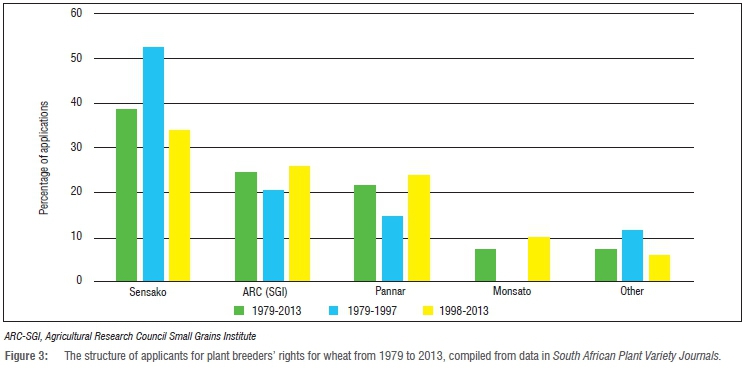
This section analyses the composition of applicants seeking PBRs for wheat varietal improvements from 1979 to 2013 with the focus on identifying the changing public and private roles among the applicants. Figure 3 presents the composition of applicants for PBRs for wheat varietal improvements from 1979 to 2013. Based on analysis of share of PBRs for wheat varietal improvements since the publication of the South African Plant Variety Journal in 1979, the main applicants were Sensako (39%), ARC-SGI (25%) and Pannar (15%). Before 1997, the share of applications from Sensako constituted 53% of all the applications, while that of the ARC-SGI was 21%, and Pannar had 15%. Other applicants, such as CIMMYT, University of Free State, Carnia Seeds, Cargill USA and Gwk Beperk, constituted 12% of the applications. Analysis of the period after the abolishment of the Wheat Board shows that Sensako's share decreased to 34%, while those of the ARC-SGI (26%) and Pannar (24%) increased by 5% and 9%, respectively. The share of applications and grants held by the ARC-SGI is comparable to other countries. In the Netherlands, Louwaars et al.33
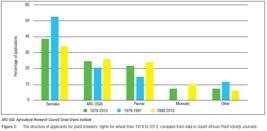
In many developing countries, national agricultural research systems, such as the ARC-SGI and Consultative Group on International Agricultural Research Institutions (CGIARs), dominate agricultural research, including varietal improvements. The development of new varieties is driven by the exchange of plant varieties and genetic resources between the national agricultural research systems and CGIAR institutions, unencumbered by IPRs.516,5 Similarly, the ARC-SGI did not previously apply for PBRs, despite being actively involved with wheat varietal improvements. However, since the abolishment of the Wheat Board in 1997, the ARC-SGI increased their share of PBRs lodged by 5% to 26%, with most of the applications being made in recent years. It might be that the reduced funding for the ARC-SGI contributed to the institution seeking protection for its varieties as a way to generate additional revenue.
Figure 4 presents the changing composition of applicants for wheat PBRs. The majority of the applications for wheat varietal improvements were filed by private companies (Figure 4a), the two main actors being Sensako and Pannar (Figure 4b). Pardey et al.8
It is important to note that public and private sector institutions freely exchanged plant genetic resources and breeding lines before the advent of IPRs.520
Implications of wheat plant variety protection trends for the Agricultural Research Council
PBRs are the predominant intellectual asset of the ARC.17The South African Intellectual Property Rights from Publicly Financed Research and Development Act No. 51 of2008 prescribes that publicly funded research and development must be protected, utilised and commercialised. This is to ensure that: it benefits the people of South Africa; recipients of public funding act in a manner conducive to the public good; it acknowledges and rewards innovation; it enables economic growth through enterprise development; and it allows publishing of scientific results.175,15 Efforts to make public research institutions, such as the ARC-SGI, generate revenue by holding IPRs on plant varieties requires some exclusive licensing, such as is done by US Land Grant Universities.555
The major role played by the ARC-SGI is supported by evidence from around the world indicating that plant-breeding innovations in non-hybrid crops like wheat have largely been sustained by the public sector. For example, Srinivasan512
This implies that although the ARC-SGI is expected to generate revenue to sustain their activities, the concentration of potential revenue generation activities in more commercial crops brings into question public research resource allocations. Public research institutions would still be required to engage in research and plant breeding for mandated crops, such as staples, which might not be very lucrative compared with commercial crops. Such investments would have to be funded by public agricultural expenditures and other sources, making it difficult for NARIs such as the ARC-SGI to focus on revenue generation in their plant breeding activities. Also, the ARC-SGI faces competition from private companies, including in retaining its breeding skills and resources.
Conclusions and recommendations
This paper analysed the evolving landscape of wheat plant breeders' rights to address the dearth of empirical evidence on the patterns and trends of wheat varietal improvements in South Africa. The aim was to provide evidence on the evolution of varietal rights; the extent of varietal rights granted; changes of the rights on offer over time; changing ownership of the rights (including comparison between public and private, as well as domestic and foreign breeders) and; impacts of plant variety protection on wheat varietal development. The study compiled a detailed and novel count and attribute database of wheat varietal innovations in South Africa from 1979 to 2013, using information from the South African Plant Variety Journal, DAFF, South African National Library, and the ARC. The empirical analyses were based on descriptive statistics, trend analysis and graphical representation of trends and ownership of PBRs for wheat varietal improvements.
A total of 134 PBRs for wheat varietal innovations were lodged from 1979 to 2013, giving an average of 6 applications per year. This might have been driven by some breeders choosing not to apply for varietal protection, as well as by natural triggers such as outbreaks of pests and diseases, and different environmental and climatic conditions. The results indicate that plant breeders are increasingly seeking protection for their innovations. The number of PBR applications and grants for wheat variety innovations increased after the abolishment of the Wheat Board (6 applications per year compared with 4 per year before deregulation). The results also indicate that the administrative delays in granting PBR applications have been substantially reduced (by 77 days) post-deregulation, signifying increased efficiency in the processing of PBRs.
Since the publication of the South African Plant Variety Journal in 1979, the main applicants for wheat PVP have been Sensako (39%), ARC-SGI (25%) and Pannar (15%). After deregulation, Sensako's share decreased to 34%, while those of the ARC-SGI and Pannar increased by 5% and 9%, respectively. The results show that the ARC-SGI faces stiff competition from these well-established private companies. Establishing opportunities for collaboration with the private sector would encourage wheat variety innovation development. The advent of PVP/ IPRs considerably restricted the exchange of plant genetic resources and breeding lines between the public and private research institutions. The ARC-SGI contributed to some of the PBRs owned by private companies through shared genetic resources made available before the PVP/IPRs were implemented. Future innovations and dissemination of wheat innovations could be stimulated by plant variety protection, together with the broader variety sector legislation that encourages both public and private sector investment.
Authors' contributions
C.R.N. conceptualised the article content and complied the first draft. F.G.L. and J.K. revised and made conceptual contributions, additions, and refined the article.
Acknowledgements
This work was supported by the Bill and Melinda Gates Foundation grant to the University of Pretoria's Department of Agricultural Economics, Extension and Rural Development. The paper is part of the PhD research by Charity R. Nhemachena on: 'Biological innovations in South African agriculture: A study of wheat varietal change, 1950-2013' which was funded from the Bill and Melinda Gates Foundation grant.
References
- 1. Kock MA, Gould C. 2013. Adapting IP to an evolving agricultural innovation landscape. Sniper No.2013/01028 : WIPO Magazine. 2013;2:25-29.
-
2. Claus P, Thiele-Witting M. 2002 Plant variety protection - a fascinating subject. World Patent Information. 2003;25:243-250. http://dx.doi.org/10.1016/S0172-2190(03)00074-7
» http://dx.doi.org/10.1016/S0172-2190(03)00074-7 - 3. Louwaars N, Dons H, Van Overwalle G, Raven H, Arundel A, Eaton D, et al. Breeding Business: The future of plant breeding in the light of developments in patent rights and plant breeders' rights. CGN Report No. 2009-14. Wageningen: Wageningen University, Centre for Genetic Resources; 2009.
- 4. Evenson RE, Gollin D. Crop variety improvement and its effect on productivity: The impact of international agricultural Research. Wallingford: CABI Publishing; 2003. http://dx.doi.org/10.1079/9780851995496.0000
-
5. Srinivasan CS. 2003. Concentration in ownership of plant variety rights: Some implications for developing countries. Food Policy. 2003;28:519-546. http://dx.doi.org/10.1016/j.foodpol.2003.10.003
» http://dx.doi.org/10.1016/j.foodpol.2003.10.003 - 6. Lesser W. Sector issue II: Seeds and plants. In: Siebeck EW, editor. Strengthening intellectual property rights in developing countries: A survey of literature, World Bank Discussion Paper No.112. Washington, DC: World Bank; 1990. p. 59-68.
- 7. Pardey PG, Koo B, Drew J, Horwich J, Nottenburg C. 2012. The evolving landscape of plant varietal rights in the United States, 1930-2008. Staff paper P12-1. St Paul, MN: University of Minnesota, College of Food, Agricultural and Natural Resource Sciences; 2012.
-
8. Pardey PG, Koo B, Drew J, Horwich J, Nottenburg C. 2013. The evolving landscape of plant varietal rights in the United States, 1930-2008. Nat Biotechnol. 2013;31(1):25-29. http://dx.doi.org/10.1038/nbt.2467
» http://dx.doi.org/10.1038/nbt.2467 - 9. Stander CJ. The economics of cultivar improvement research in the South African wheat industry [MSc dissertation]. Pretoria: University of Pretoria; 2012.
- 10. International Union for the Protection of New Varieties of Plants (UPOV). International Convention for the Protection of New Varieties of Plants of 2 December 1961, as revised at Geneva on 10 November 1972, 23 October 1978 and 19 March 1991, Publication 221, Geneva: OPUV; 1994.
-
11. Tripp R, Louwaars N, Eaton D. 2007. Plant variety protection in developing countries. A report from the field. Food Policy. 2007;32:354-371. http://dx.doi.org/10.1016/j.foodpol.2006.09.003
» http://dx.doi.org/10.1016/j.foodpol.2006.09.003 - 12. Eaton D, Tripp R, Louwaars N. The effects of strengthened IPR regimes on the plant breeding sector in developing countries. International Agricultural Economist Conference; 2006 August 12-18; Gold Coast, Australia.
-
13. Alston JM, Venner RJ. The effects of the US Plant Variety Protection Act on wheat genetic improvement. Res Policy. 2002;31:527-542. http://dx.doi.org/10.1016/S0048-7333(01)00123-8
» http://dx.doi.org/10.1016/S0048-7333(01)00123-8 -
14. Srinivasan CS, Thirtle C. Potential economic impacts of terminator technologies: Policy implications for developing countries. Environ Dev Econ. 2003;8:187-205. http://dx.doi.org/10.1017/S1355770X0300010X
» http://dx.doi.org/10.1017/S1355770X0300010X -
15. Diez MCF. The impact of plant varieties rights on research: The case of Spain. Food Policy. 2002;27:171-183. http://dx.doi.org/10.1016/S0306-9192(02)00010-6
» http://dx.doi.org/10.1016/S0306-9192(02)00010-6 -
16. Wright BD, Pardey PG. Changing intellectual property regimes: Implications for developing country agriculture. Int J Technol Glob. 2006;2(1/2):93-114. http://dx.doi.org/10.1504/IJTG.2006.009129
» http://dx.doi.org/10.1504/IJTG.2006.009129 - 17. Moephuli SR, Moselakgomo MA, Phehane V. The Agricultural Research Council's role in plant variety protection and technology transfer - promoting publicly funded research. UPOV Workshop; 2012 March 05; Zanzibar, Tanzania.
-
18. Department of Agriculture, Forestry and Fisheries (DAFF). Plant Breeders' Rights policy, February 2011 [policy on the Internet]. c2011 [cited 2013 Jul 05]. Available from: http://www.nda.agric.za/docs/Policy/PlantBreederPol_2011.pdf.
» http://www.nda.agric.za/docs/Policy/PlantBreederPol_2011.pdf -
19. RustTracker.org. A global wheat rust monitoring system [article on the Internet]. c2015 [cited 2015 Sep 01]. Available from: http://rusttracker.cimmyt.org.
» http://rusttracker.cimmyt.org - 20. Price SC. 2000.The public-private interface in plant breeding: Can there be a common culture? Diversity. 2000;15:6-7.
Charity Nhemachena
Department of Agricultural Economics, Extension and Rural Development University of Pretoria
Private bag X20, Hatfield, Pretoria, 0028. South Africa

Revised: 13 Aug. 2015
Accepted: 05 Sep. 2015