Nurses' knowledge of and willingness to promote female condom use in Johannesburg Health District
Abstract
The female condom is the only current method for female partners to simultaneously prevent both pregnancy and sexually transmitted infections. Studies of various contraceptive methods suggest that providers' acceptance and endorsement may be a key factor in their clients' uptake and continued use of a method. Our aim in this study was to assess the relationship between nurses' knowledge of and their willingness to promote female condom use in 18 public healthcare facilities within the Johannesburg District. The mean score of correct answers of 398 nurses completing an anonymous, self-administered, six-item questionnaire was 4 out of a maximum of 6. Data analysis included the use of descriptive statistics and a chi-square test. It was found that 79% of participants were knowledgeable but only 59% were willing to promote female condom use. There was no association between knowledge of and willingness to promote female condom use. The following significant associations with knowledge and willingness to promote female condom use were found: family planning experience, being employed by a local government authority, working in a primary care clinic and having had informal training on female condom use. Informal training of nurses within the family planning unit in the clinics has the potential to improve nurses' knowledge and willingness to promote female condom use. SIGNIFICANCE: •This is the first study conducted in South Africa on the knowledge of and willingness of healthcare providers to promote female condom use. •An effective strategy is needed to motivate healthcare workers to promote female condom use with their patients. •Informal training of nurses within the family planning unit has the potential to improve nurses' knowledge of and willingness to promote female condom use.
health professional; prevention; women; cognition; compliance
Introduction
The female condom has been developed as an alternative to the male condom and remains the only female-initiated means of preventing both pregnancy and sexually transmitted infections (STI) including the human immunodeficiency virus (HIV). HIV incidence has slightly decreased in South Africa, but many people still engage in risky sexual behaviour. Findings also indicate higher condom use among young men than among women.123-5 Despite the fact that cases of Ebola and Zika virus have never been reported in South Africa, the fact4
The female condom is considered to be more effective than the male condom because it is less likely to break or burst and it covers a larger portion of the genital area.66-11
A post-marketing survey in Zimbabwe in 1998 highlighted the key role of healthcare providers and lay educators in increasing women's access to the female condom.12131415
Data on 2712 subjects were collected through a cross-sectional survey in Tanzania using mass media as a mode of promoting the female condom. In the above study, as well as in a South Africa based study, communication with a peer educator or healthcare provider was found to have a direct positive impact on female condom uptake.16,17
Research on the acceptability of the female condom carried out in 1999 in Brazil with 2453 women showed high rates of acceptability. It has been noted that women in Costa Rica, Indonesia, Mexico, Senegal, Tanzania, Zimbabwe and the USA feel safe using the female condom.181920-23
Nurses providing family planning services in southern Mozambique saw the provider-client relationship for choosing contraceptive methods as an integral part of their job as opposed to an added burden or contributing to job dissatisfaction.24
A study done in Botswana showed that the perception and attitude of healthcare workers on female condoms played a positive role in advocating against STIs, HIV and unwanted pregnancy in women.2526
Another study on clients' sexual health choice in South Africa showed that the lack of distribution of female condoms in family planning units could prevent their promotion.27
The study conducted in Brazil to ascertain knowledge and promotion of female condom use by healthcare providers found similar results but did not examine any possible association between knowledge of female condom use and willingness of the providers to promote their use.1812
A nationally representative survey was done in Zimbabwe and South Africa. In South Africa, providers of family planning or HIV/STI services were more likely to counsel women on the use of male condoms and less likely to counsel women on female condom use than their counterparts in Zimbabwe. At the time, new types of female condoms were not available and the providers did not see the available type as a good female barrier method.28
The provision of contraceptive services during other primary healthcare consultations is an implementation strategy of the National Contraceptive Policy guidelines29
The authors of a study which reviewed the condom programme implemented by the South African National Department of Health, concluded that although the female condom programme was well established, both cost and education were factors in the uptake of the use of the female condoms.3030
A randomised South African study looking at the higher cost of female condoms introduced new types of female condoms and found similar acceptability among clients of all three types of female condoms.31
Through a joint parallel programme of Universal Access to Female Condoms and Maternal and Child Health, strategies, recommendations and guidelines for the new female condoms were developed to make female condoms more accessible and affordable. The parallel programming also looked at the training of the providers and the marketing of female condoms.3233
New designs and materials were introduced for female condoms in 2014, specifically the variants Cupid and Pleasure More. All three types of female condoms are made of rubber latex. The two newer types are made of natural rubber latex whilst FC2 is composed of synthetic nitrile rubber latex.33
The use of female condoms has doubled since 2008.3433,34
In 2014-2016, a study by the MatCH Research Unit at the University of the Witwatersrand, Johannesburg, assessed the national programme on female condoms and identified strategies to increase acceptability.3434
Several studies on the knowledge, attitudes, practices and behaviours associated with the use of female condoms have been reviewed.35
In South Africa, no published studies exist that have examined the relationship between healthcare providers' knowledge of female condoms and their willingness to promote female condom use.
Methods
We undertook a cross-sectional descriptive study with an analytical component. The study was conducted in 18 public healthcare facilities located in the sub-district 'F' of the Johannesburg Health District in the Gauteng Province of South Africa. These facilities included 16 primary healthcare clinics run by the local municipal government authority, a provincial government community health centre and a provincial district hospital. Female condoms (of type FC2) were freely available in all these healthcare facilities and nurse clinicians in these facilities were active distributors of the female condoms. These facilities provide prevention, promotion, rehabilitative and curative health services. At the time of this study in 2011, the total population of nurses employed by these facilities was 465. A sample size of at least 384 participants was calculated to give 5% precision with a 95% confidence level. We, however, sought to use the entire population of 398 nurses who met the inclusion criteria and consented to participate. Exclusion criteria were the unwillingness to consent or being a nurse in training.
Data were collected using an anonymous, structured, self-administered questionnaire. No questionnaire from any previous research was used in this study. The questionnaire was designed for data collection on the participants' characteristics: knowledge of female condom use and willingness to promote the use of the female condom. The determination of knowledge was, therefore, done using six questions based on the conclusions and findings of various previous studies as discussed in the literature review.6,18,19 'Knowledgeable on female condom use' was determined if a participant correctly answered four or more questions of the six knowledge questions. 'Not knowledgeable' was determined if a participant answered fewer than four of the six knowledge questions correctly. The mean score of correct answers out of the six-item knowledge questionnaire was calculated and used to assess the level of knowledge. The study also categorised participants into two groups based on their willingness to promote female condom use. 'Willing to promote female condom use' was defined as a participant who sees the promotion of female condom use as part of their work and despite being overstretched at work they are willing to promote the use of the female condom. If a participant in the study did not have the two elements of the above statement, they were considered 'not willing to promote female condom use'.
In this study, formal training was defined as prescribed and organised learning in the presence of a designated teacher with the award of a qualification or a learning credit and the external specifications of outcomes.3637
A pilot study was undertaken on 15 nurses at Mofolo Community Health Centre (who were not included in the analysis of the final study) to identify sensitive and ambiguous questions that needed modification, and to determine the time needed to complete the questionnaire. For example, the question 'the female condom works to prevent pregnancy and STI' was answered 'yes' by everyone, and so was changed to 'female condoms do not prevent pregnancy and STI, including HIV'. The internal consistency of the knowledge questions was tested using Cronbach's alpha test (in this pilot study the coefficient was 0.636). The final six-item questionnaire was designed and prepared on the basis of the analysis of the outcomes of the pilot study.
Each facility was visited at different times. These visits were preceded by a phone call to the facility manager to arrange the time of the visit. On the day of the visit, study information leaflets and questionnaires were handed directly to nurse clinicians. It was clearly explained to each nurse clinician that completion of the questionnaire implies consent. Participants were asked to drop completed questionnaires in an identified ballot-type box in their own time.
Data were analysed using STATA version 10.0 (College Station, TX, USA). Descriptive analysis of categorical data is presented as percentages and frequencies. Continuous data are presented as means with standard deviations. The association between knowledge and willingness to promote female condom use was investigated using the multinomial logistic regression. A p-value of less than 0.05 was considered statistically significant.
Ethical clearance
The University of the Witwatersrand Human Research Ethics Committee granted ethical approval for the study (certificate number M101017). Permission was obtained from the Chief Director of the Johannesburg Health District and the Director of the City of Johannesburg Health to conduct the study in their facilities. The questionnaire was anonymous and did not collect identifying information from participants. Participants were told that completion of the questionnaire implies consent.
Results
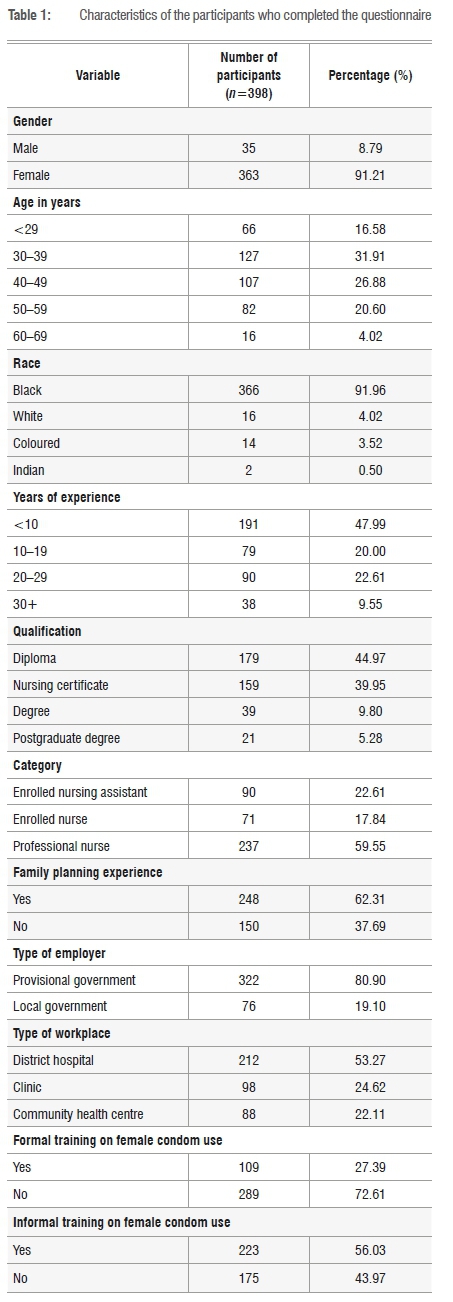
A total of 398 nurses participated in the study; 67 nurses were unwilling to participate or unavailable at the time of the study. The participants' characteristics are presented in Table 1.
The male:female ratio was 1:10; therefore, the sample was mostly female nurses. The mean age of the nurses was 40.7 years (s.d.=10.8). Fewer than half (48%) the nurses had nursing experience of 1-9 years and even fewer (45%) had a diploma certificate in nursing. More than half (60%) of the nurses were professional nurses and 77% practised a specialty of one kind or another. The majority (81%) of nurses was employed by provincial government facilities and a minority (19%) was employed by local government facilities. A majority (62%) of the participants had experience in family planning, and more than half (53%) were working in a district hospital. A minority (27%) had formal training on female condom use and the majority (56%) had informal training.
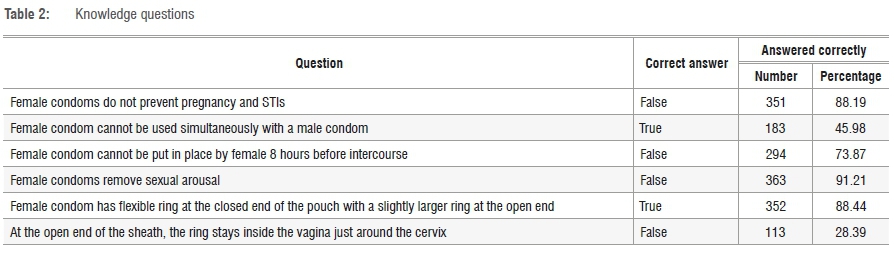
Participants' knowledge of female condoms is shown in Table 2; most participants answered the questions correctly. At least three of the six questions used to assess nurses' knowledge were answered correctly by 90% of the nurses. The question 'female condom cannot be put in place by female 8 hours before intercourse' was correctly answered by 74% of the participants. More than half (54%) of the nurses did not know whether a female condom can be used simultaneously with a male condom and 72% did not know whether the outer ring of the female condom stays inside the vagina just around the cervix. The mean number of correct answers was 4. The majority (79%) of nurses was found to be knowledgeable on female condom use and more than half (59%) were willing to promote female condom use.
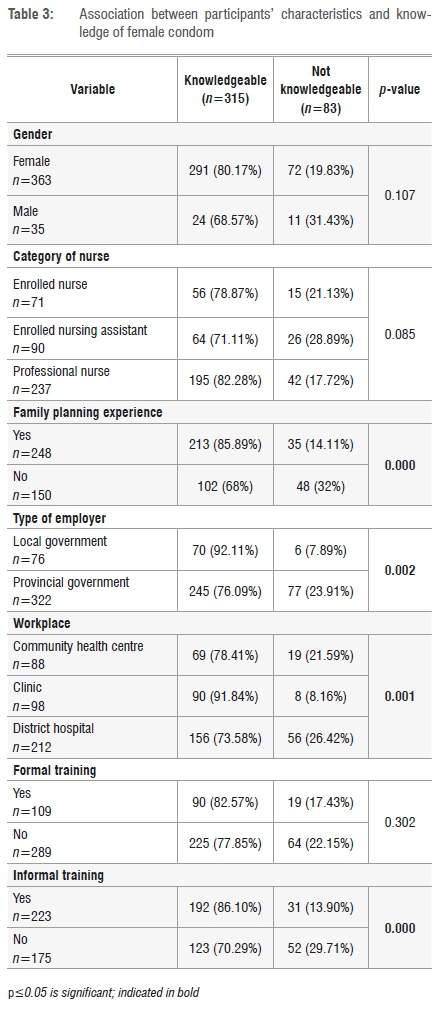
The association between participants' characteristics and knowledge of female condoms is shown in Table 3. Of all the participants' characteristics, having family planning experience, being employed by a local municipal government authority or working in a clinic and having had informal training on female condom use, were associated with being knowledgeable about female condoms.
Nurses who answered two of the knowledge questions - 'Female condoms do not prevent pregnancy and STI' and 'Female condoms remove sexual arousability' - correctly were more willing (61%) to promote female condom use.
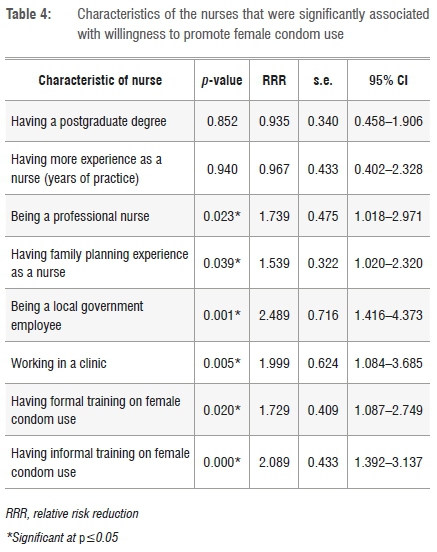
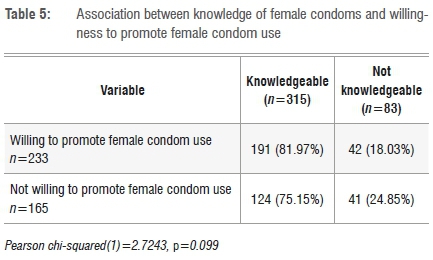
The variables which showed significant association with the willingness of nurses to promote the use of female condoms, following a multinomial logistic regression analysis, are displayed in Table 4. Family planning experience, being employed by a local government authority, working in a clinic, having had formal or informal training or being a professional nurse were all significantly associated with willingness to promote female condom use. Although the majority (82%) of the nurses who were willing to promote female condom use were noted to be knowledgeable, there was no statistically significant association between these variables (Table 5).
Discussion
We found that 79% of participants had good knowledge on female condoms but only 59% of them reported willingness to promote female condom use among their patients. This worrying finding indicates that it is necessary to have effective mechanisms to increase not only knowledge on female condom use, but also motivation in healthcare providers to promote such use.
The low level of willingness has serious implications for reducing the spread of HIV and other STIs such as Ebola, Zika and hepatitis B.3-5 While different studies have reported the role of healthcare providers' knowledge in promoting female condom use,7,22,38 we suggest strategies to improve the motivation for healthcare workers to advocate use of the female condom to their patients. Considering that such studies are non-existent in the South African primary healthcare context, further studies are needed to explore the willingness of the healthcare providers to promote female condom use. While many international funding agencies - such as the WHO, Universal Access to Female Condom and the Swedish International Development Agency - promote female condom use, South Africa is not on the list of the Country Level Focus.3924,28 and HIV/Aids prevention programmes2,4,6,7.
Our findings suggest that knowledge influences willingness to promote female condom use, although this association was not statistically significant. In a project introducing the female condom to the public health sector, Mantell et al.1718
Some demographic characteristics were found to be associated with knowledge of female condoms. Nurses with family planning experience were three times more likely to have knowledge on female condoms than those without family planning experience. Whilst such a finding may be expected, this observation confirms the importance of ensuring that all nurses are trained in providing family planning services within the integrated primary healthcare services.
Participants employed by a local government authority were four times more likely to have knowledge on female condoms than those employed by the provincial government authority. Of the local government nurses, 75% were willing to promote female condom use, compared with 55% of provincial government nurses. Because local government clinics provide mostly prevention services, this finding may be a reflection of the nature of work expected of nurses in the different workplaces. The current salary dispensation favours nurses employed by a local government authority.40
Nurses with informal training were three times more likely to have knowledge of female condoms than those without informal training. This result suggests that female condom providers would achieve better informal training with rotations in family planning units. Similarly, the use of a female condom through demonstration on a model and a step-by-step process of inserting could improve informal training.3517
Additionally, the possession of a university degree or postgraduate degree did not predict knowledge; however, formal training showed a statistically significant association with willingness to promote female condom. Studies previously cited have pointed out the relevance of training on female condom promotion.8,17
Although direct comparison is limited by different methodologies, our findings that higher degree qualification and formal training do not predict knowledge, are consistent with those in the literature.17,18
A majority of the participants knew that female condom use prevents pregnancy and STIs. This finding was expected, as this question relates to prevention of STIs and pregnancy and nurses are usually sent for different workshops/training on prevention of STIs and pregnancy. A significant number of nurses demonstrated adequate knowledge that the female condom 'can be placed up to 8 hours before intercourse', which was also noted in the study done by Oliveira da Silva et al.18186
The questionnaire was not comprehensive and we did not aim to cover all the important issues on female condom use. This study was focused on the association between providers' knowledge of and willingness to promote the use of the female condom. The review of the current literature shows that South Africa still lacks studies on this association as an important addition to sexual health in South Africa.
The study nevertheless had some limitations. This study had a cross-sectional design and at best only describes associations and not causality. Although family planning experience was associated with knowledge of female condom use, the duration of experience that might have an impact on knowledge and willingness was not explored. Because the questionnaire has not been validated, the questions on knowledge and willingness may not have exhaustively assessed what is required to uplift the knowledge and improve the willingness of nurses to promote female condom use. In addition, the computation of a knowledge/willingness score based on correct answers to a set of questions has not been validated. The analysis also did not incorporate differential weightings that may be placed on different questions.
Conclusion
The vast majority of nurses were knowledgeable about female condoms, but this knowledge did not translate into willingness to promote female condom use. The knowledge on simultaneous use of male and female condoms was insufficient. Clinical experience and having had specialty or postgraduate training did not predict the nurses' knowledge on female condoms. Nurses working in clinics were three times more likely to be knowledgeable and two times more likely to promote female condom use. Employment by local government was significantly associated with knowledge of and willingness to promote the use of female condoms. Professional nurses and nurses with a postgraduate qualification were more willing to promote the use of female condoms. Focusing on the informal training of nurses within the family planning unit has the potential to improve their knowledge and willingness to promote female condom use. Our results show that rotating through a family planning unit would not only improve knowledge on female condoms, but also help to change their attitudes towards female condom promotion.
Future research in a randomised controlled trial is suggested to test the relationship between knowledge of and willingness to promote the use of female condoms. Important research on the use of the female condom could be done in different post-natal facilities. Further studies could assess formal training on female condom use as an integral part of nurses' training. Motivation mechanisms need to be developed for the distribution of female condoms by healthcare service providers in the provincial government authority.
Author's contributions
This paper was based on the master's degree of M.S.P. at the University of the Witwatersrand. M.S.P and Z.B.E. conceived and designed the study; M.S.P. collected the data; M.S.P. and Z.B.E. performed and interpreted the statistical analyses; Z.B.E., O.B.O. and T.D-D. prepared the manuscript; the final drafting of Introduction, Results and Discussion was done by T.D-D., E.G.P. and M.S.P.; and T.D-D. and E.G.P. updated the literature review. E.Z. provided supervision. All co-authors contributed to the improvement of the final manuscript.
Acknowledgements
We thank Dr Reji and appreciate her competence and support, especially in the initial phases of the research work. We also acknowledge Mr E. Musenge for assistance with statistical and data analysis.
References
-
1. Matseke G, Peltzer K, Mchunu G, Louw J. Correlates of condom use among male and female aged 18-24 years in South Africa. Gender Behav. 2012;10(2):1-10. Available from: http://www.ajol.info/index.php/gab/article/view/83663
» http://www.ajol.info/index.php/gab/article/view/83663 -
2. South African National AIDS Council. South Africa Global AIDS Response Progress Report (GARPR) [document on the Internet]. c2015 [cited 2017 Nov. 14]. Available from: http://sanac.org.za/wp-content/uploads/2016/06/GARPR_report-high-res-for-print-June-15-2016.pdf
» http://sanac.org.za/wp-content/uploads/2016/06/GARPR_report-high-res-for-print-June-15-2016.pdf -
3. Musso D, Roche C, Robin E, Nhan T, Teissier A, Cao-Lormeau V-M. Potential sexual transmission of Zika virus. Emerg Infect Dis. 2015;21(2):359-361. https://doi.org/10.3201/eid2102.141363
» https://doi.org/10.3201/eid2102.141363 -
4. Oduyebo T, Petersen EE, Rasmussen SA, Mead PS, Meaney-Delman D, Renquist CM, et al. Update: Interim guidelines for health care providers caring for pregnant women and women of reproductive age with possible Zika virus exposure - United States, 2016. MMWR Morb Mortal Wkly Rep. 2016;65(5):122-127. https://doi.org/10.15585/mmwr.mm6505e2
» https://doi.org/10.15585/mmwr.mm6505e2 -
5. Thorsen A, Formently P, Lofthouse C, Broutet N. Systematic review of the literature on viral persistence and sexual transmission from recovered Ebola survivors: Evidence and recommendations. BMJ Open. 2016;6(1), e008859, 7 pages. https://doi.org/10.1136/bmjopen-2015-008859
» https://doi.org/10.1136/bmjopen-2015-008859 -
6. Mantell JE, West BS, Sue K, Hoffman S, Exner TM, Kelvin E, et al. Health care providers: A missing link in understanding acceptability of the female condom. AIDS Educ Prev. 2011;23(1):65-77. https://doi.org/10.1521/aeap.2011.23.1.65
» https://doi.org/10.1521/aeap.2011.23.1.65 -
7. Andrade SS, Zaccara AA, Leite KN, Brito KK, Soares MJ, Costa MM, et al. Knowledge, attitude and practice of condom use by women of an impoverished urban area. Rev Esc Enferm USP. 2015;49(3):364-372. https://doi.org/10.1590/S0080-623420150000300002
» https://doi.org/10.1590/S0080-623420150000300002 -
8. Hoffman S, Mantell J, Exner T, Stein Z. The future of the female condom. Perspect Sex Reprod Health. 2004;36(3):120-126. https://doi.org/10.1363/3612004
» https://doi.org/10.1363/3612004 -
9. Holmes L, Ogungbade GO, Ward DD, Garrison O, Peters RJ, Kalichman SC, et al. Potential markers of female condom use among inner city African-American women. AIDS Care. 2008;20(4):470-477. https://doi.org/10.1080/09540120701867016
» https://doi.org/10.1080/09540120701867016 -
10. Holtgrave DR, Maulsby C, Kharfen M, Jia Y, Wu C, Opoku J, et al. Cost-utility analysis of a female condom promotion program in Washington, DC. AIDS Behav. 2012;16(5):1115-1120. https://doi.org/10.1007/s10461-012-0174-5
» https://doi.org/10.1007/s10461-012-0174-5 -
11. Maksut JL, Eaton LA. Female condoms=missed opportunities: Lessons learned from promotion-centered interventions. Womens Health Issues. 2015;25(4):366-376. https://doi.org/10.1016/j.whi.2015.03.015
» https://doi.org/10.1016/j.whi.2015.03.015 - 12. Kerrigan D, Mobley S, Rutenberg N, Fisher A, Weiss E. The female condom: Dynamics of use in urban Zimbabwe. USAID contract no. HRN-A-00-97-00012-00, document number 153884. Washington DC: Population Council, Horizons Project; 2000.
-
13.Ruminjo JK, Steiner M, Joanis C, Mwathe EG, Thagana N. Preliminary comparison of the polyurethane female condom with the latex male condom in Kenya. East Afr Med J. 1996;73(2):101-106. Available from: http://www.ncbi.nlm.nih.gov/pubmed/8756048
» http://www.ncbi.nlm.nih.gov/pubmed/8756048 -
14.Feldblum PJ, Kuyoh MA, Bwayo JJ, Omari M, Wong EL, Tweedy KG, et al. Female condom introduction and sexually transmitted infection prevalence: Results of a community intervention trial in Kenya. AIDS. 2001;15(8):1037-1044. Available from: https://www.ncbi.nlm.nih.gov/pubmed/11399986
» https://www.ncbi.nlm.nih.gov/pubmed/11399986 -
15. Weeks MR, Zhan W, Li J, Hilario H, Abbott M, Medina Z. Female condom use and adoption among men and women in a general low-income urban U.S. population. AIDS Behav. 2015;19(9):1642-1654. https://doi.org/10.1007/s10461-015-1052-8
» https://doi.org/10.1007/s10461-015-1052-8 -
16. Agha S, Van Rossem R. Impact of mass media campaigns on intentions to use the female condom in Tanzania. Int Fam Plan Perspect. 2002;28(3):151-158. https://doi.org/10.2307/3088258
» https://doi.org/10.2307/3088258 -
17. Mantell JE, Scheepers E, Karim QA. Introducing the female condom through the public health sector: Experience from South Africa. AIDS Care. 2000;12(5):589-601. https://doi.org/10.1080/095401200750003770
» https://doi.org/10.1080/095401200750003770 -
18. Oliveira da Silva N, Ferreira Moura SR, Guedes TG, Cesar de Almeida P. Conhecimento e promoção do uso do preservativo feminino por profissionais de unidades de referência para DST/HIV de Fortaleza-CE: o preservativo feminino precisa sair da vitrine [Knowledge and promotion of the female condom by professionals of reference units for STD/HIV Fortaleza-CE: The female condom needs to get out the window]. Saude Soc. 2008;17(1):107-116. Portuguese. https://doi.org/10.1590/S0104-12902008000100010
» https://doi.org/10.1590/S0104-12902008000100010 -
19. Spizzichino L, Pedone G, Gattari P, Luzi AM, Gallo P, Valli R, et al. The female condom: Knowledge, attitude, and willingness to use. The first Italian study. Ann Ist Super Sanità. 2007;43(4):419-424. Available from: http://www.ncbi.nlm.nih.gov/pubmed/18209275
» http://www.ncbi.nlm.nih.gov/pubmed/18209275 -
20. Mantell JE, Smit JA, Exner TM, Mabude Z, Hoffman S, Beksinska M, et al. Promoting female condom use among female university students in KwaZulu-Natal, South Africa: Results of a randomized behavioral trial. AIDS Behav. 2015;15(7):1129-1140. https://doi.org/10.1007/s10461-014-0860-6
» https://doi.org/10.1007/s10461-014-0860-6 -
21.Masvawure TB, Mantell JE, Mabude Z, Ngoloyi C, Milford C, Beksinska M, et al. "It's a different condom, let's see how it works": Young men's reactions to and experiences of female condom use during an intervention trial in South Afria. J Sex Res. 2014;51(8):841-851. https://doi.org/10.1080/00224499.2013.814043
» https://doi.org/10.1080/00224499.2013.814043 -
22. Speizer IS, Hotchkiss DR, Magani RJ, Hubbard B, Nelson K. Do service providers in Tanzania unnecessarily restrict clients' access to contraceptive methods? Int Fam Plan Perspect. 2000;26(1):13-20. Available from: https://www.guttmacher.org/sites/default/files/article_files/2601300.pdf
» https://www.guttmacher.org/sites/default/files/article_files/2601300.pdf -
23. Weeks MR, Coman E, Hilario H, Li J, Abbott M. Initial and sustained female condom use among low-income urban U.S. women. J Womens Health (Larchmt). 2013;22(1):26-36. https://doi.org/10.1089/jwh.2011.3430
» https://doi.org/10.1089/jwh.2011.3430 -
24. Hayford SR, Agadjanian V. Providers' views concerning family planning service delivery to HIV-positive women in Mozambique. Stud Fam Plan. 2010;41(4):291-300. https://doi.org/10.1111/j.1728-4465.2010.00254.x
» https://doi.org/10.1111/j.1728-4465.2010.00254.x -
25. Mashanda-Tafaune B, Monareng LV. Perception and attitude of healthcare workers towards the use of a female condom in Gaborone, Botswana. Health SA Gesondheid. 2016;21:162-170. https://doi.org/10.1016/j.hsag.2015.12.002
» https://doi.org/10.1016/j.hsag.2015.12.002 -
26. Ng C, Pacqué-Margolis S, Kotellos K, Brantley S, IntraHealth International. Integrating family planning and HIV/Aids services: Health workforce considerations [document on the Internet]. c2012 [cited 2017 Nov. 14]. Available from: https://www.capacityplus.org/technical-brief-5/content/health-worker-attitudes-toward-clients
» https://www.capacityplus.org/technical-brief-5/content/health-worker-attitudes-toward-clients -
27. Ramkissoon A, Searle C, Burns C, Beksinska M. Chapter 3: Sexual and reproductive health and rights [document on the Internet]. c2010 [cited 2015 Jun 03]. Available from: http://sanacws.org.za/resources/sexual-and-reproductive-health-and-rights-in-south-africa
» http://sanacws.org.za/resources/sexual-and-reproductive-health-and-rights-in-south-africa -
28. Holt K, Blanchard K, Chipato T, Nhemachena T, Blum M, Stratton L, et al. A nationally representative survey of healthcare provider counselling and provision of the female condom in South Africa and Zimbabwe. 2013;3(3):1-8. https://doi.org/10.1136/bmjopen-2012-002208
» https://doi.org/10.1136/bmjopen-2012-002208 -
29. Bookshelf: National contraception and fertility planning policy and service delivery guidelines. Reprod Health Matter. 2014;22(43):200-203. https://doi.org/10.1016/S0968-8080(14)43764-9
» https://doi.org/10.1016/S0968-8080(14)43764-9 -
30. Beksinska ME, Smit JA, Mantell JE. Progress and challenges to male and female condom use in South Africa. Sex Health. 2012;9(1):51-98. https://doi.org/10.1071/SH11011
» https://doi.org/10.1071/SH11011 -
31. Joanis C, Beksinska M, Hart C, Tweedy K, Linda J, Smit J. Three new female condoms: Which do South African women prefer? Contraception. 2011;83(3):248-254. https://doi.org/10.1016/j.contraception.2010.08.002
» https://doi.org/10.1016/j.contraception.2010.08.002 -
32. MatCH Research Unit (Maternal Adolescent and Child Health). Developing a strategy for female condom parallel programming: Proceedings of an expert meeting; 2011 Nov 23-24; Durban, South Africa. Durban: Universal Access to Female Condoms Joint Programme; 2011. Available from: http://www.hst.org.za/publications/NonHST%20Publications/Developing%20a%20Strategy %20for%20Female%20Condom_0.pdf
» http://www.hst.org.za/publications/NonHST%20Publications/Developing%20a%20Strategy %20for%20Female%20Condom_0.pdf -
33. Beksinska M, Zulu B, Phungula L, Mabude Z, Nkosi P, Greener R, et al. Evaluation of the National South African Female Condom Programme: Parallel programming of female condoms [document on the Internet]. c2016 [cited 2017 Nov. 14]. Available from: http://www.femalecondoms4all.org/wp-content/uploads/2016/06/Parallel-Programming-of-Female-Condoms-Evaluation-of-the-South-African-Female-Condom-Programme.pdf
» http://www.femalecondoms4all.org/wp-content/uploads/2016/06/Parallel-Programming-of-Female-Condoms-Evaluation-of-the-South-African-Female-Condom-Programme.pdf -
34.MatCH Research Unit, University of the Witwatersrand; HIV Center for Clinical and Behavioral Studies, New York State Psychiatric Institute and Columbia University Medical Center; USAID; and Project SOAR. Evaluation of South Africa's National Female Condom Programme. Washington DC: USAID; 2017. Available from: https://www.usaid.gov/sites/default/files/documents/1864/sa-female-condom-brief-508.pdf
» https://www.usaid.gov/sites/default/files/documents/1864/sa-female-condom-brief-508.pdf -
35. Moore L, Beksinska M, Rumphs A, Festin M, Gollub EL. Knowledge, attitudes, practices and behaviors associated with female condoms in developing countries: A scoping review. Dovepress. 2015;2015(6):125-142. https://doi.org/10.2147/OAJC.S55041
» https://doi.org/10.2147/OAJC.S55041 -
36. Eraut M. Non-formal learning and tacit knowledge in professional work. Br J Educ Psychol. 2000;70(1):113-136. Available from: http://www.ncbi.nlm.nih.gov/pubmed/10765570
» http://www.ncbi.nlm.nih.gov/pubmed/10765570 -
37. Cook J, Smith M. Beyond formal learning: Informal community eLearning. Comput Educ. 2004;43(1-2):35-47. https://doi.org/10.1016/j.compedu.2003.12.003
» https://doi.org/10.1016/j.compedu.2003.12.003 -
38. Mantell JE, Hoffman S, Weiss E, Adeokun L, Delano G, Jagha T, et al. The acceptability of the female condom: Perspectives of family planning providers in New York City, South Africa, and Nigeria. J Urban Health. 2001;78(4):658-668. Available from: http://www.ncbi.nlm.nih.gov/pubmed/11796812
» http://www.ncbi.nlm.nih.gov/pubmed/11796812 -
39. Godhelp K. Advocating female condoms. A reflection on stakeholder commitments & trends in support for female condoms. End-line stakeholder analysis [document on the Internet]. c2015 [cited 2017 Nov. 14]. Available from: http://www.femalecondoms4all.org/Wp-content/uploads/2015/12/151210-Finalreport-end-line-stakeholder-analysis-UAFC-Rutgers.pdf
» http://www.femalecondoms4all.org/Wp-content/uploads/2015/12/151210-Finalreport-end-line-stakeholder-analysis-UAFC-Rutgers.pdf -
40. Bachmann MO, Makan B. Salary inequality and primary care integration in South Africa. Soc Sci Med. 1997;45(5):723-729. https://doi.org/10.1016/S0277-9536(96)00406-6
» https://doi.org/10.1016/S0277-9536(96)00406-6

Revised: 14 Nov. 2017
Accepted: 06 Feb. 2018
Published: 30 July 2018